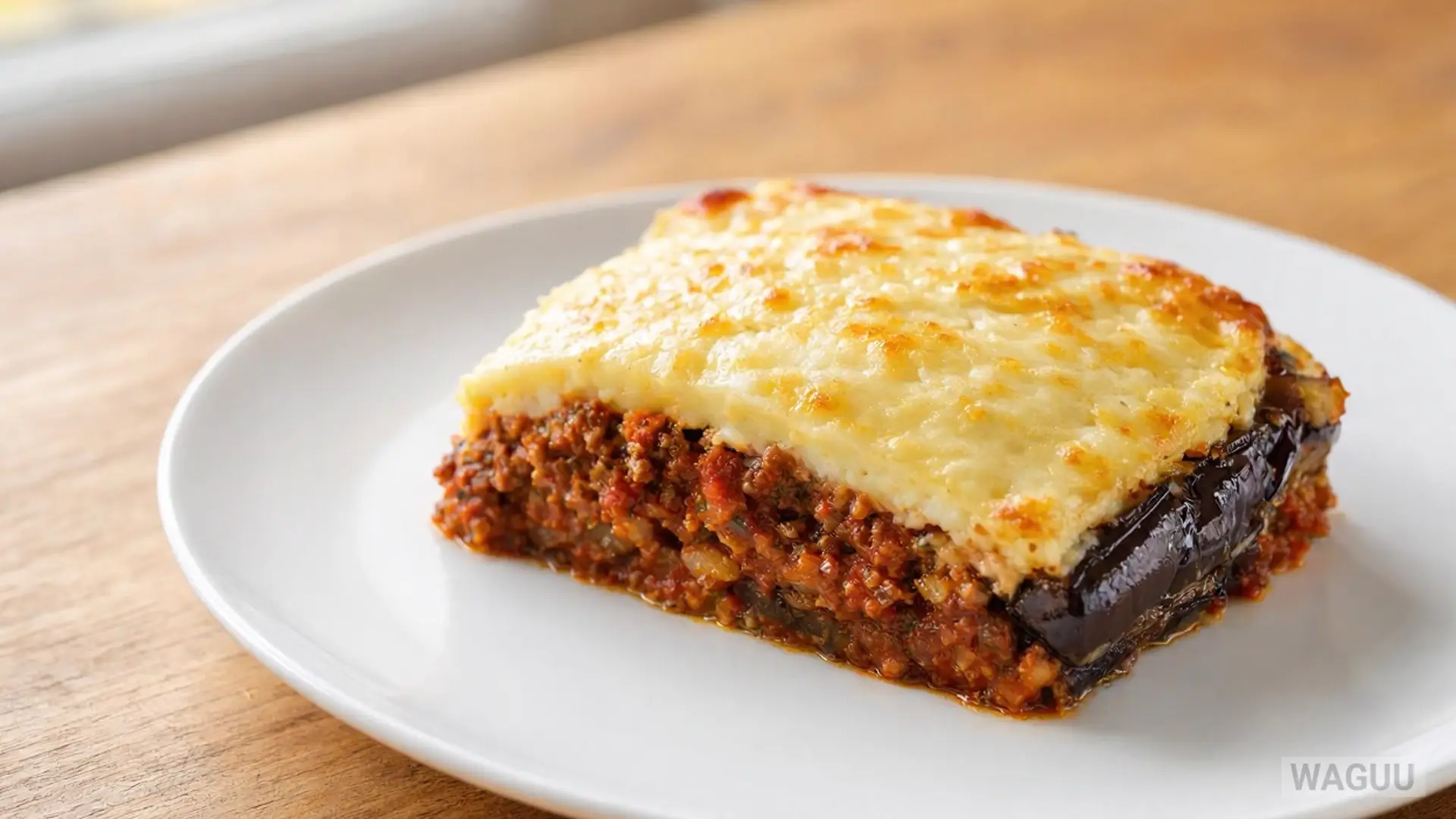
Summary: Traditional Greek Moussaka featuring layered sliced aubergines, rich minced beef and tomato ragù, topped with a velvety homemade béchamel sauce and baked until golden brown; prepared in 120 minutes for 6 portions.
Did you cook this recipe? Share the result with the community.
Category: Main Dishes, Mediterranean Cuisine
Success rate: not rated yet% of users successfully made this recipe
Quick overview
- Dish: Moussaka
- Category: Main Dishes, Mediterranean Cuisine
- Cuisine: Greek
- Main ingredient: Aubergine, 1200 g (firm, glossy purple fruit)
- Guide: 12 most popular Mediterranean dishes: favourite recipes of Mediterranean cuisine
- Total time: 120 minutes (45 min prep + 75 min cooking)
- Difficulty: Intermediate
- Portions: 6 portions (Portion weight: 450 g)
- Key technique: Layering and baking with béchamel
- Preparation types: Slicing, roasting, simmering, baking
- Dietary info & Allergens: Contains gluten, dairy, eggs
- Suitable for: Lunch, festive dinner, weekend gathering
- Nutritional values (per 1 portion): 540 kcal, Protein: 28 g, Fat: 34 g, Carbohydrates: 31 g
- Storage: 3 days in the fridge, 2 months in the freezer
- Pairing: Pale Lager, Xinomavro, Sparkling Water with Lemon
- In short: The ultimate Greek comfort food combining tender aubergines, aromatic minced meat ragù, and a lush layer of golden béchamel.
- Last updated: 2025-05-20
WAGUU says: “Salt your sliced aubergines thoroughly and let them sweat to remove any bitterness before roasting, ensuring a clean and rich flavour profile in your finished Moussaka.”
How to take it further: Serve on a white 26 cm plate warmed to 40 °C, keep the full 26 cm plate in frame; place a glass of water with lime, a linen napkin and fresh herbs in the softly blurred background.
Key facts
| Prep time: | 45 minutes |
| Cooking time: | 75 minutes |
| Temperature: | 200 °C |
| Number of portions: | 6 portions |
In a nutshell
Experience authentic Greek culinary heritage right in your own kitchen with this magnificent Moussaka. Featuring harmonious layers of sweet roasted aubergines, robust minced beef spiced with cinnamon and cloves, and crowned with a thick blanket of creamy, nutmeg-scented béchamel sauce, every slice delivers pure Mediterranean comfort.
Ingredients
Base portions: 6 portions • Portion weight: 450 g
| Ingredient | Amount | Quality |
|---|---|---|
| Aubergines | 1200 g | Firm, glossy, sliced lengthwise |
| Olive oil | 80 ml | Extra virgin |
| Minced beef | 700 g | High quality, 15% fat |
| Onion | 2 pieces | Finely chopped |
| Garlic | 3 cloves | Minced |
| Canned chopped tomatoes | 500 g | Quality Italian tomatoes |
| Tomato paste | 30 g | Concentrated |
| Dry red wine | 100 ml | Full-bodied |
| Ground cinnamon | 3 g | Aromatic ground spice |
| Ground cloves | 1 g | Freshly ground |
| Butter | 80 g | Unsalted |
| Plain flour | 80 g | Wheat flour type 405 |
| Milk | 750 ml | Full fat, lukewarm |
| Nutmeg | 2 g | Freshly grated |
| Eggs | 2 pieces | Free-range egg yolks |
| Grated Kefalotyri cheese | 100 g | Aged Greek cheese (or Parmesan) |
| Table salt | 15 g | Fine sea salt |
| Black pepper | 3 g | Freshly ground |
Why you will love this recipe
- Authentic flavour profile: Combines warm spices like cinnamon and cloves with rich minced meat for genuine Greek taste.
- Perfect textural balance: Soft, melt-in-the-mouth aubergine layers paired with a creamy, golden béchamel crust.
- Make-ahead friendly: Tastes even better when reheated, making it ideal for entertaining guests.
Success guaranteed: Follow the precise roasting and resting times to ensure your Moussaka slices cleanly without falling apart on the plate.
Recipe overview
Prep: 45 min | Cooking: 75 min | Difficulty: Intermediate | Portions: 6 portions | Type: Main Dish | Origin: Greek
Detailed instructions
Overall progress: 0% complete
Phase 1: Preparing and Roasting the Aubergines – 25 min
Appliances: Oven, Baking sheets
1. Cut 1200 g of aubergines lengthwise into 1 cm thick slices. Arrange them on wire racks, sprinkle generously with salt, and let them rest for 30 minutes to draw out excess moisture. Rinse the slices thoroughly under cold water and pat them completely dry with paper towels. Brush both sides of each slice with olive oil and place them in a single layer on baking trays lined with parchment paper. Roast in a preheated oven at 200 °C for 25 minutes until golden brown and tender, turning halfway through.
VKB: Visual control point: Aubergines should be soft and lightly browned at 200 °C.
Before moving to the next step:
Ensure the aubergine slices are thoroughly dried after salting to prevent excess water from thinning out the meat ragù during baking.
Phase 2: Cooking the Minced Meat Ragù – 35 min
Appliances: Stove, Large saucepan
2. Heat 30 ml of olive oil in a large saucepan over medium heat. Add 2 finely chopped onions and 3 minced garlic cloves, sautéing for 5 minutes until soft and translucent. Add 700 g of minced beef and cook, breaking up any lumps with a wooden spoon, until browned evenly. Pour in 100 ml of dry red wine and let it simmer until the alcohol evaporates. Stir in 500 g of canned chopped tomatoes, 30 g of tomato paste, 3 g of ground cinnamon, 1 g of ground cloves, salt, and black pepper. Reduce heat to low and simmer uncovered for 30 minutes until the sauce is thick and rich.
VKB: Visual control point: The meat mixture must be thick and glossy, with no excess watery liquid.
Before moving to the next step:
Let the meat sauce cool slightly before assembling so it does not cook the eggs in the béchamel.
Phase 3: Preparing the Velvety Béchamel Sauce – 20 min
Appliances: Stove, Saucepan, Whisk
3. Melt 80 g of unsalted butter in a medium saucepan over medium heat. Whisk in 80 g of plain flour and cook the roux for 1 minute, stirring constantly. Gradually pour in 750 ml of lukewarm milk while whisking vigorously to prevent any lumps from forming. Cook over medium heat, stirring continuously, until the sauce thickens and coats the back of a spoon. Remove from heat, season with freshly grated nutmeg, salt, and pepper. Allow to cool for 5 minutes, then vigorously whisk in 2 egg yolks and half of the grated Kefalotyri cheese until smooth and creamy.
VKB: Visual control point: Béchamel must be luxuriously thick, glossy, and completely smooth.
Before moving to the next step:
Whisk the egg yolks in rapidly off the heat to prevent them from curdling in the hot sauce.
Phase 4: Layering the Moussaka – 15 min
Appliances: Baking dish (30×20 cm)
4. Lightly oil a 30×20 cm baking dish. Arrange half of the roasted aubergine slices in the bottom, overlapping them slightly to cover the base completely. Spoon all of the prepared minced meat ragù evenly over the aubergines and smooth the surface. Cover the meat with the remaining roasted aubergine slices, creating a neat second layer. Pour the rich béchamel sauce evenly over the top, spreading it smoothly to the edges of the dish. Sprinkle the remaining grated Kefalotyri cheese evenly over the béchamel surface.
VKB: Visual control point: The béchamel layer should completely seal the ingredients beneath it.
Before moving to the next step:
Ensure the béchamel reaches all corners of the baking dish to lock in moisture during baking.
Phase 5: Baking to Perfection – 40 min
Appliances: Oven
5. Place the assembled baking dish into an oven preheated to 180 °C. Bake for 40 minutes until the top is deeply golden brown and bubbling at the edges. Remove the dish from the oven and place it on a wire cooling rack.
VKB: Visual control point: The crust should be a rich amber-brown colour.
Before moving to the next step:
Do not skip the resting period; cutting it immediately will cause the layers to collapse.
Phase 6: Resting and Serving – 20 min
Appliances: None
6. Let the Moussaka rest at room temperature for 20 minutes before slicing. This crucial resting time allows the sauces and juices to settle, ensuring clean, beautiful portions when served. Cut into squares and plate warm.
VKB: Visual control point: Slices hold their shape firmly upon serving.
Required equipment
| Utensil | Ideal size | Alternative | Risk |
|---|---|---|---|
| Baking dish | 30×20 cm | Large ceramic casserole | Overflowing if too small |
| Saucepan | 3-litre capacity | Deep skillet | Splattering during mixing |
| Whisk | 25 cm wire whisk | Silicone spatula | Lumps in béchamel sauce |
Shopping list
Nutritional profile
Values per 1 portion (excluding side dishes). Calculated from average nutritional values of ingredients.
| Nutrient | Per 100 g | Per 1 portion | Per 6 portions |
|---|---|---|---|
| Energy | 120 kcal | 540 kcal | 3240 kcal |
| Fat | 7.5 g | 34 g | 204 g |
| of which saturates | 4.2 g | 19 g | 114 g |
| Carbohydrates | 6.8 g | 31 g | 186 g |
| of which sugars | 3.1 g | 14 g | 84 g |
| Protein | 6.2 g | 28 g | 168 g |
| Salt | 0.75 g | 3.4 g | 20.4 g |
Reference intake of an average adult (8400 kJ / 2000 kcal).
WAGUU Pro Level
- Pro standard: Verified recipe with precise ratios and visual control points.
- Tip 1: Roast aubergine slices instead of deep-frying them to reduce excess greasiness while maintaining rich flavour.
- Tip 2: Incorporate a pinch of cinnamon and cloves into the beef ragù for authentic Greek aromatic depth.
- Tip 3: Whisk egg yolks into the slightly cooled béchamel to achieve a velvety texture without curdling.
- Tip 4: Let the baked moussaka rest for 20 minutes before slicing to ensure neat, picture-perfect portions.
Scientific background
The exceptional structure of moussaka relies on the Maillard reaction during meat browning and roasting of aubergines, which develops complex savoury flavour compounds. Salting aubergines draws out cellular water through osmosis, preventing sogginess and allowing the sponge-like flesh to absorb rich olive oil and tomato juices during baking. The starch gelatinisation in the flour-butter roux provides a stable matrix for the milk proteins and egg yolks, creating an emulsion that sets firmly upon cooling.
Fine Dining – Professional techniques
- Plate composition: Serve a neat rectangular slice in the centre of a warm plate, garnished with micro herbs.
- Textural contrasts: Smooth creamy béchamel top contrasting with tender aubergines and hearty minced meat.
- Temperature contrast: Warm hearty bake served with a crisp, cool Greek salad on the side.
- Aromatic garnishes: Fresh oregano leaves and a drizzle of premium extra virgin olive oil.
Sensory radar
- Appearance: Golden brown, bubbly cheese crust layered neatly over rich red ragù and aubergine slices.
- Aroma: Warm spices of cinnamon and nutmeg combined with roasted aubergine and savoury baked cheese.
- Taste: Deeply savoury, slightly sweet tomato and beef notes balanced by creamy dairy and earthy vegetables.
- Texture: Velvety smooth béchamel melting into tender layers of vegetable and spiced minced meat.
Pairing
- BEER: Crisp Greek Lager or Czech Pale Pilsen
- WINE: Dry Greek red wine such as Xinomavro or Agiorgitiko
- NON-ALCOHOLIC: Sparkling mineral water with a fresh slice of lemon
Various preparation variants
- Vegetarian Moussaka: Replace minced beef with lentils or finely chopped mushrooms for a plant-based alternative.
- Potato Layer Moussaka: Add a bottom layer of parboiled sliced potatoes for a more substantial traditional regional variation.
Allergens and dietary information
Contains: Gluten, dairy, eggs • Gluten: Contains wheat flour • Not suitable for: Vegan, lactose-intolerant, and gluten-free diets
Suitable for
Sunday family lunches, festive Mediterranean dinners, weekend gatherings, and dinner parties.
Substitution catalog
- Kefalotyri cheese: Mature Parmesan or Pecorino Romano
- Minced beef: Minced lamb or a 50/50 beef and lamb blend
FAQ
Can I freeze baked Moussaka?
Yes, you can freeze baked Moussaka for up to 2 months. Let it cool completely, wrap tightly, and reheat thoroughly before serving.
Why is my Moussaka watery when sliced?
Wateriness usually occurs if the aubergines were not salted and dried properly or if the dish was sliced immediately without resting.
Do I need to peel the aubergines?
No, keeping the skin on helps the slices maintain their structural integrity during baking.
Can I prepare Moussaka in advance?
Yes, you can assemble the entire dish a day ahead, store it in the refrigerator, and bake it just before serving.
WAGUU Petr advises: Cooking for 12 or more people?
12–16 people: Prepare two separate 30×20 cm baking dishes to ensure even heat distribution and baking times • 20+ people: Use deep hotel pans and scale ingredient quantities proportionally while maintaining strict temperature control.
Sides and Serving
- Greek Salad (Horiatiki) – Crisp tomatoes, cucumbers, feta, and olives (not included in the recipe)
- Crusty Country Bread – Perfect for soaking up flavorful juices (not included in the recipe)
Serving: Serve warm in generous rectangular portions alongside a crisp refreshing salad.
Storage and reheating
Fridge: 3 days • Freezer: 2 months • Reheating: Reheat covered in an oven at 180 °C for 25 minutes or in individual portions in the microwave.
Author: WAGUU Petr & Team • Published: 26 Aug 2026 • Updated: 31 Oct 2026
More Recipes from This Article
Other recipes you might be interested in
Why WAGUU?
Recipes on WAGUU undergo checks for the accuracy of ingredients, procedures, and nutritional values.
Process photo gallery
Community photos: Cook, take a photo, and share the result.
You can upload photos in the comments below or send them via email.
Did you record a video guide for our recipe? Insert a link to YouTube, YouTube Shorts, TikTok, Instagram Reels, Facebook Reels, Pinterest, Vimeo, or X (Twitter) in the comment – we’d be happy to publish it and help promote you and your content.
Common mistakes
- Skipping the aubergine salting step – Leaves excess moisture in the vegetables, resulting in a watery ragù.
- Cutting the moussaka while piping hot – Causes the layered slices and béchamel sauce to collapse on the plate.
- Adding egg yolks to boiling hot béchamel – Cooks the eggs prematurely, creating lumps in the sauce.
- Overcooking the minced meat ragù – Dries out the meat filling and causes it to lose its rich sauce consistency.