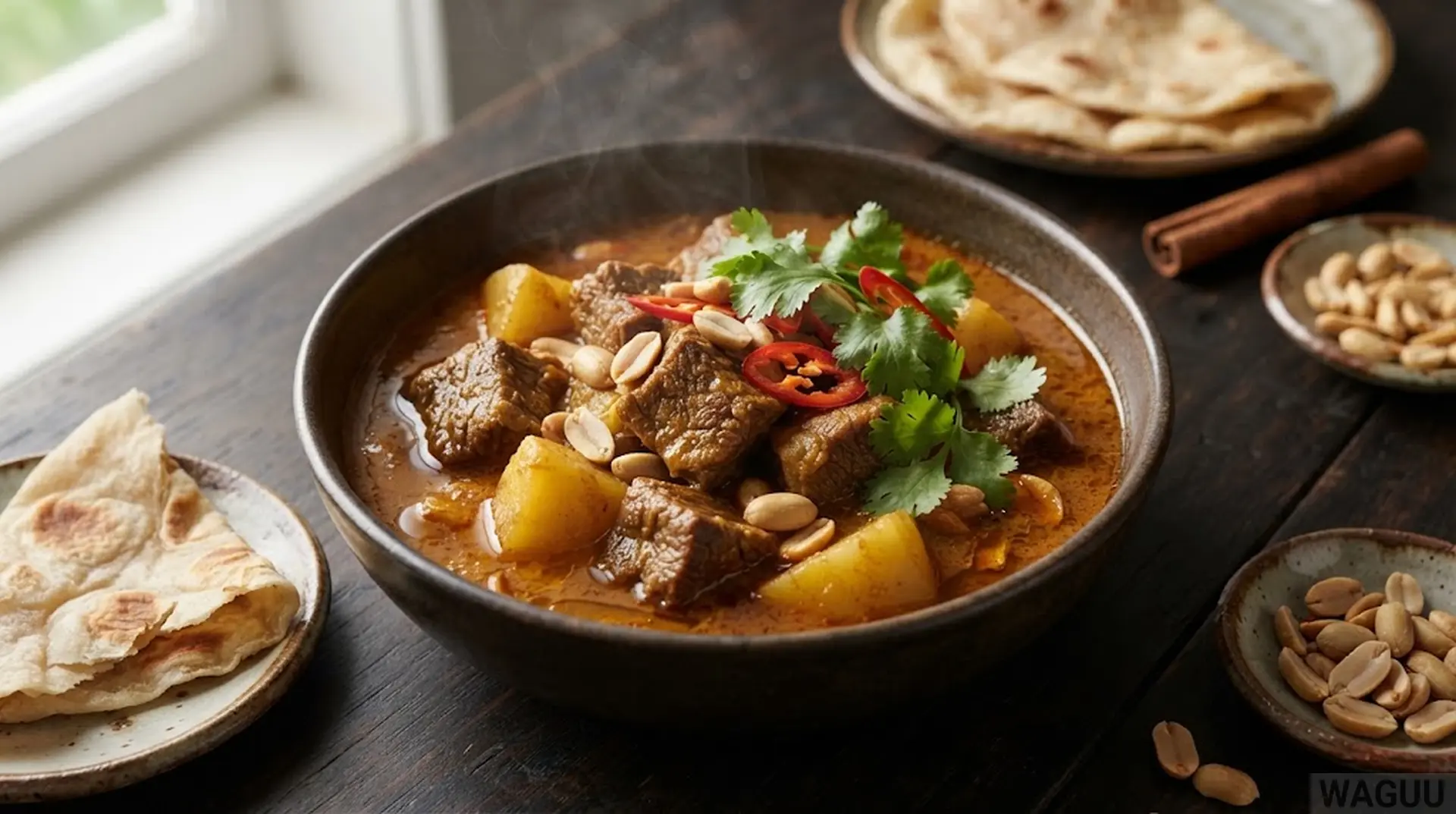
Summary: Beef topside is simmered in coconut milk with massaman paste, cinnamon, cardamom and cloves until tender. Potatoes, peanuts and palm sugar with tamarind are added towards the end. Total time 120 minutes, base 6 servings.
Have you cooked this recipe? Share your result with the community.
Category: Beef · Thai Cuisine
Success rate: not rated yet % of users managed this recipe
Quick overview
- Dish: Massaman Curry – aromatic curry with beef, coconut milk, potatoes and peanuts
- Category: beef, thai-cuisine
- Cuisine: Thai
- Main ingredient: Beef, 900 g (topside, cut into chunks) (quality specification)
- Guide: 12 most famous Thai dishes: traditional recipes from Thai cuisine
- Total time: 120 minutes (30 min preparation + 90 min cooking)
- Difficulty: Medium
- Servings: 6 (Serving weight: 469 g)
- Key technique: Slow simmering of meat in coconut milk with spices until tender
- Preparation types: Stewing, slow cooking
- Dietary info & allergens: peanuts (peanuts, massaman paste), crustaceans and fish (massaman paste)
- Suitable for: Family dinner, dinner with friends, quick midweek lunch or a festive multi-course table.
- Nutritional values (per 1 serving): 767, Protein: 40.3 g, Fat: 50.5 g, Carbohydrates: 38.0 g
- Storage: 3 days in the fridge, 1 month in the freezer
- Pairing: dark lager, dry Shiraz, strong spiced tea
- In short: Beef topside is braised in coconut milk with massaman paste, cinnamon, cardamom and cloves until tender. Total time 120 minutes, serves 6.
WAGUU says: “Massaman can’t be rushed. Two hours on a gentle heat turns topside into meat that falls apart with a spoon.”
Key facts
| Preparation time: | 30 minutes |
| Cooking time: | 90 minutes |
| Temperature: | Simmer at 85–95 °C below boiling point, time 90 minutes |
| Number of servings: | 6 |
In a nutshell
Massaman is the least Thai of Thai curries: the spices come from India and Malaysia, and the meat is simmered for a long time until it falls apart with a spoon. Patience and order matter: the meat is first sealed in the paste, then the milk is added in stages. If you throw everything into the pot at once, you get tough meat in a thin sauce.
Ingredients
Base servings: 6 servings • Serving weight:469 g
| Ingredient | Amount | Quality |
|---|---|---|
| beef for curry | 900g | topside or shoulder, cut into 4 cm chunks |
| coconut milk | 800ml | full-fat, two tins |
| massaman curry paste | 70g | no colourings, with spices |
| potatoes | 600g | firm, waxy, cut into chunks |
| roasted peanuts | 100g | unsalted, whole |
| fish sauce | 15ml | fermented |
| palm sugar | 35g | dark, grated |
| tamarind paste | 30g | seedless |
| ground cinnamon | 1 tsp | Ceylon, fine |
| ground cardamom | 1 tsp | green, freshly ground |
| ground cloves | 0.5 tsp | fine |
| onion | 2 pcs | yellow, cut into wedges |
| garlic | 4 cloves | finely chopped |
| fresh coriander | 1 pcs | bunch, chopped |
| fine sea salt | 1 tsp | only as needed |
Why you’ll love this recipe
- Meat that falls apart with a spoon: Ninety minutes on a gentle heat turns topside into meat that can be divided with a spoon. No pressure cooker can replace that.
- Spices from India and Thailand: Cinnamon, cardamom and cloves meet coconut, tamarind and fish sauce. The flavour is deep and warm.
- Exact ratios for 6 servings: One hundred and fifty grams of meat per serving, eight hundred millilitres of coconut milk and one hundred grams of peanuts. The number of servings can be recalculated.
Guaranteed success: Beef topside contains a lot of collagen, which at around 90 °C turns into gelatine. This takes one to two hours, which is why the meat is simmered long and slow. The acid from tamarind and the sugar from palm sugar are added only at the end, because acid slows down the softening of collagen. Peanuts are added towards the end so they stay whole.
Recipe overview
Preparation: 30 min min | Cooking: 90 min min | Difficulty: Medium | Servings: 6 | Type: Main course | Origin: Thai
Detailed method
Overall progress: 6 % done
Phase 1: Sealing the meat in the paste – 12 min
Equipment: 5 l deep casserole, wooden spoon
1. Skim the thick top layer from the coconut milk and heat it in the casserole over a medium heat until the fat starts to separate. Add the massaman paste and fry it until it becomes fragrant.
2. Pat the meat dry with kitchen paper and add it to the paste. Fry it on all sides until it darkens and is coated with the spices.
Visual check: The meat is coated with paste on all sides and no brown spots form on the bottom. The aroma of the spices is sharp, not burnt.
Before you move to the next step:
Wet meat will start to stew in the paste and the spices won’t stick. Always dry the meat before frying.
Phase 2: Simmering the meat until tender – 60 min
Equipment: casserole dish with lid
1. Pour in the rest of the coconut milk, add the sliced onion and garlic. Bring the curry to 90°C and lower the heat so it just gently bubbles.
2. Simmer the curry with the lid on until the meat is tender. Shake the pan occasionally so the sauce doesn’t catch.
Visual check: A cube of meat can be pulled apart with a spoon and holds its shape. The sauce is smooth, dark orange and glossy.
Before you move to the next step:
A hard boil dries out the meat and makes it tough. Keep the curry below boiling point and lift the lid as little as possible.
Phase 3: Tempering the spices – 5 min
Equipment: small frying pan, teaspoon
1. Dry-fry the ground cinnamon, cardamom and cloves in a pan until fragrant. Then stir them into the curry.
2. Taste the sauce: the spices should be in the background, not overpowering the coconut. Add a pinch more spice if needed.
Visual check: The spices have released their aroma but the sauce hasn’t turned bitter. The colour is dark orange.
Before you move to the next step:
Ground spices burn quickly in a dry pan and turn bitter. Heat them only until fragrant and stir them in straight away.
Phase 4: Potatoes and peanuts – 20 min
Equipment: casserole dish, knife
1. Cut the potatoes into cubes, rinse them and add to the curry. Simmer with the lid on until tender but not falling apart.
2. Add half the peanuts and let them soften in the sauce. Keep the other half for serving.
Visual check: The potatoes hold their shape and offer slight resistance when pierced with a knife. The sauce stays clear, not cloudy.
Before you move to the next step:
Cut the potatoes into larger cubes and add them later. Small pieces break down and thicken the sauce into a mush.
Phase 5: Seasoning with tamarind and sugar – 5 min
Equipment: small bowl, spoon
1. Mix the tamarind paste with the palm sugar and fish sauce in a small bowl. Pour it into the curry and stir.
2. Let the curry sit for another five minutes so the flavours come together. Then take it off the heat.
Visual check: The taste is sweet, sour, salty and spicy all at once. The sauce is thick and glossy.
Before you move to the next step:
Tamarind isn’t added at the start, as the acid would slow down the tenderising of the meat. It belongs in the last third of cooking.
Phase 6: Serving – 5 min
Equipment: deep bowls
1. Pour the curry into warmed bowls and scatter over the remaining roasted peanuts and chopped coriander.
2. Serve jasmine rice or roti alongside for scooping up the sauce.
Visual check: The peanuts stay crunchy on top, the coriander hasn’t wilted and the sauce isn’t splitting.
Equipment needed
| Utensil | Ideal size | Alternative | Risk |
|---|---|---|---|
| deep casserole dish | 5 l capacity, thick base | cast iron pot with lid | a thin base will burn the coconut milk at the bottom |
| wooden spoon | 35 cm long | silicone spatula | a metal spoon will scratch the base and give the sauce a metallic taste |
| small frying pan | 20 cm diameter | dry wok | a heavy pan will burn the spices before they release their aroma |
| kitchen scales | with 1 g resolution | measuring spoons | guessing the spices will overpower the coconut |
Shopping list
Nutritional profile
Values per 1 portion (without side dish). Calculated from average nutritional values of the ingredients.
| Nutrient | Per 100 g | Per 1 portion | For 6 portions |
|---|---|---|---|
| Energy | 686 kJ / 164 kcal | 3209 kJ / 767 kcal | 19255 kJ / 4602 kcal |
| Fat | 10.8 g | 50.5 g | 303.0 g |
| of which saturates | 6.0 g | 28.4 g | 170.1 g |
| Carbohydrate | 8.1 g | 38.0 g | 228.0 g |
| of which sugars | 8.1 g | 38.0 g | 228.0 g |
| Protein | 8.6 g | 40.3 g | 241.8 g |
| Salt | 0.7 g | 3.5 g | 20.9 g |
Reference intake of an average adult (8400 kJ / 2000 kcal).
WAGUU Pro level
- Pro standard: Tested recipe with precise ratios and visual checkpoints.
- Tip 1: Tested recipe with precise ratios and visual checkpoints.
- Tip 2: The meat is coated on all sides with the paste and no brown spots form on the base. The spice aroma is sharp, not burnt. Wet meat steams in the paste and the spices won’t catch. Always pat the meat dry before searing.
- Tip 3: A cube of meat can be pulled apart with a spoon and holds its shape. The sauce is smooth, dark orange and glossy. A hard boil dries out the meat and makes it tough. Keep the curry below boiling point and lift the lid as little as possible.
- Tip 4: Prepare the ingredients in small bowls before you start. Thai cooking happens over a high heat and there’s no time to measure things out mid-cook.
The science behind it
The spices in massaman paste – cinnamon, cardamom, cloves and nutmeg – contain volatile oils that are soluble in fat. That’s why the paste is fried first in the thick part of the coconut milk. Potatoes go in during the second half of simmering so they don’t break down and cloud the sauce.
Fine Dining – Professional techniques
- Plate composition: Serve the curry in a dark deep bowl that makes the orange colour stand out. Put the rice in a small metal ring mould alongside.
- Texture contrasts: Spoon a layer of crushed peanuts and a coriander leaf on top. The crunchy layer holds its own against the thick sauce.
- Temperature contrast: Set the roti triangles aside. They are for scooping up the sauce instead of using a spoon.
- Aromatic extras: Finally, add a squeeze of lime juice to the sauce. The acid cuts through the fat and brightens the flavour.
Sensory radar
- Appearance: The curry is dark orange, thick, with chunks of meat, yellow potatoes and peanuts on top.
- Aroma: Cinnamon and cardamom with coconut sweetness, then tamarind and peanuts after stirring.
- Taste: Sweet and spiced with a gentle tamarind sourness; saltiness holds the sauce together.
- Texture: Meat tender and succulent, potatoes firm, peanuts crunchy, sauce thick and creamy.
Pairings
- dark lager: A dark lager with caramel malt pairs with the spices and peanuts. Serve it at 8°C.
- dry Shiraz: A Shiraz with soft tannins and black pepper notes stands up to the beef. Avoid light white wines.
- strong spiced tea: Strong black tea with cinnamon and star anise. The warm spices mirror massaman and complement it.
Variations
- Chicken massaman:: Replace the beef with chicken thighs and shorten the simmering time to forty minutes. The sauce will be lighter and gentler, and the spices will come forward more.
- Vegetarian massaman:: Omit the meat and use two hundred grams of firm tofu, sweet potatoes and cauliflower. Add the tofu in the last ten minutes so it holds its shape.
Allergens and dietary information
Contains: peanuts (peanuts, massaman paste), crustaceans and fish (massaman paste) • Gluten: no, the recipe is gluten-free • Not suitable for: people with peanut, crustacean and fish allergies
Suitable for
A family dinner, dinner with friends, a quick weekday lunch or a festive multi-course table.
FAQ
What meat is suitable for massaman?
Topside, shoulder or boneless rib. Cuts with collagen soften and hold their shape after long simmering; fillet would become tough.
Why is massaman sweet?
The sweetness comes from palm sugar, peanuts and coconut milk. The sugar is added at the end so it does not catch and darken.
Can I simmer the meat in a pressure cooker?
Yes, the time is reduced to thirty minutes. However, coconut milk easily loses its creaminess in a pressure cooker, so add it after opening.
What can I use instead of potatoes?
Sweet potatoes or taro. Sweet potatoes break down faster, so add them five minutes later and cut them into larger chunks.
How can I make massaman milder for children?
Halve the amount of paste and omit the chilli. Serve peanuts crushed so they are not hard to chew.
Why is the sauce thin?
The coconut milk was diluted and the curry was not cooked long enough. Let it reduce uncovered until the liquid thickens.
WAGUU Petr advises: Cooking for 6 or more?
6–8 people: Heat the wok or pan in batches and keep the finished dish warm in an oven at 80°C. Add the flavourings (fish sauce, lime, sugar) at the end, otherwise the aroma is lost. • 10+ people: Prepare the base (paste, stock or marinade) in double quantity and keep half for the next day. Fill the wok no more than two-thirds full, otherwise the ingredients steam instead of fry.
Sides and serving
Serving: Serve massaman in a deep bowl with jasmine rice or roti bread. Top with roasted peanuts and coriander.
Storage and reheating
Fridge: 3 days • Freezer: 1 month • Reheating: Fridge: 3 days • Freezer: 1 month • Reheating: over a low heat to 85°C with a spoonful of water, add peanuts only to the finished curry
Satay Gai – grilled marinated chicken skewers with peanut sauce and pickled vegetables
Author: WAGUU Petr & Team • Published: 8 Oct 2026 • Updated: 10 Oct 2026
More recipes from the article
Guide: 12 most famous Thai dishes: traditional recipes from Thai cuisine
Pad Thai – stir-fried rice noodles with egg, prawns, tofu, tamarind, peanuts and lime
Tom Yum Goong – spicy and sour soup with prawns, lemongrass, galangal and chilli
Tom Kha Gai – coconut soup with chicken, galangal, lemongrass and lime leaves
Green Curry (Gaeng Keow Wan) – green curry with coconut milk, chicken and Thai basil
Som Tam – spicy green papaya salad with chilli, lime, fish sauce and peanuts
Som Tam – spicy green papaya salad with chilli, lime, fish sauce and peanuts
Pad Kra Pao – stir-fried meat with Thai basil, chilli and garlic, served with rice and a fried egg
Khao Pad – Thai fried rice with egg, vegetables and chicken
Khao Soi – northern Thai noodle soup with coconut curry, chicken and crispy noodles
Satay Gai – grilled marinated chicken skewers with peanut sauce and pickled vegetables
Mango Sticky Rice (Khao Niao Mamuang) – sticky rice with coconut milk and ripe mango
More recipes you might like
Why WAGUU?
WAGUU recipes are checked for accuracy of ingredients, methods and nutritional values.
Photo gallery from the process
Photos from the community: Cook, take a photo and share the result.
You can upload photos in the comments below or send them by email.
Did you film a video of our recipe? Paste a link to YouTube, YouTube Shorts, TikTok, Instagram Reels, Facebook Reels, Pinterest, Vimeo or X (Twitter) in the comments – we will be happy to publish it and help you and your content get noticed.
Most common mistakes
- Searing the meat in the paste – Wet meat will steam in the paste and the spices will not catch. Always dry the meat before searing.
- Simmering the meat until tender – A rapid boil dries and toughens the meat. Keep the curry below boiling point and lift the lid as little as possible.
- Spices according to Indian tradition – Ground spices should not be dry-roasted for too long, they become bitter. Heat them only until fragrant and stir them in immediately.
- Potatoes and peanuts – Cut the potatoes into larger chunks and add them later. Small pieces break down and thicken the sauce to a mush.