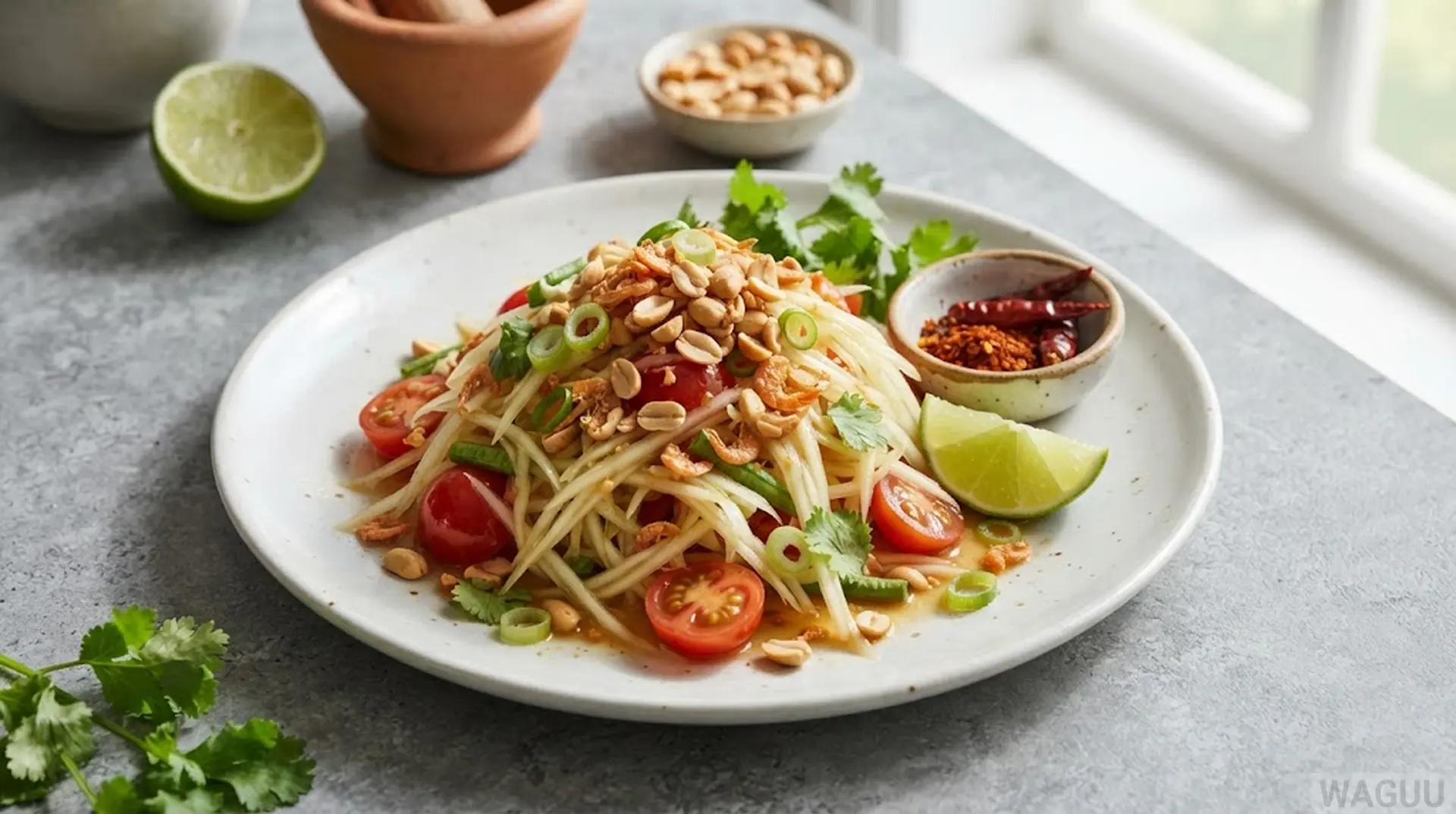
Summary: Shredded green papaya is pounded in a mortar with chilli, garlic, fish sauce, lime juice and palm sugar. Dried shrimp, peanuts and tomatoes are added. Total time 35 minutes, serves 6.
Have you cooked this recipe? Share your result with the community.
Category: Salads · Thai Cuisine
Success rate: not rated yet% of users mastered the recipe
Quick overview
- Dish: Som Tam – spicy green papaya salad with chilli, lime, fish sauce and peanuts
- Category: salads, thai-cuisine
- Cuisine: Thai
- Main ingredient: Green papaya, 900 g (peeled, shredded) (quality specification)
- Guide: 12 most famous Thai dishes: traditional recipes from Thai cuisine
- Total time: 35 minutes (30 min preparation + 5 min cooking)
- Difficulty: Easy
- Servings: 6 (Serving weight: 210 g)
- Key technique: Pounding ingredients in a mortar to release juices and blend flavours
- Preparation type: Fresh salad, pounded in a mortar
- Dietary info & allergens: fish (fish sauce), crustaceans (dried shrimp), peanuts (peanuts)
- Suitable for: Family dinner, dinner with friends, quick weekday lunch or a festive multi-course table.
- Nutritional values (per serving): 193, Protein: 8.5 g, Fat: 7.0 g, Carbohydrates: 24.1 g
- Storage: 3 days in the fridge, 1 month in the freezer
- Pairing: Thai lager, dry Grüner Veltliner, lime and mint lemonade
- In short: Grated green papaya is pounded in a mortar with chilli, garlic, fish sauce, lime juice and palm sugar. Total time 35 minutes, serves 6.
WAGUU says: “Som Tam is pounded, not stirred. The pestle releases papaya juice that binds lime with fish sauce.”
Key facts
| Preparation time: | 30 minutes |
| Cooking time: | 5 minutes |
| Temperature: | Salad is served cold, 8–10 °C |
| Number of servings: | 6 |
In a nutshell
Som Tam is not a salad you stir with a spoon. The ingredients are pounded in a mortar with a pestle so the papaya releases its juice and the flavours combine. The ratio of acid, salt and sugar is crucial, as is not shredding the papaya too finely. If you mix the salad in a bowl, you get dry papaya with dressing at the bottom.
Ingredients
Base servings: 6 servings • Serving weight:210 g
| Ingredient | Amount | Quality |
|---|---|---|
| green papaya | 1 pcs | firm, unripe, not sweet |
| red chilli | 4 pcs | fresh, to taste |
| garlic | 4 pcs | fresh, peeled |
| fish sauce | 45ml | fermented |
| lime juice | 60ml | freshly squeezed |
| palm sugar | 30g | dark, grated |
| dried shrimp | 40g | small, no colourings |
| roasted peanuts | 80g | unsalted, coarsely crushed |
| cherry tomatoes | 200g | firm, halved |
| dried longan | 40g | thin strips |
| fresh coriander | 1 pcs | bunch, chopped |
| spring onion | 3 pcs | diagonally sliced |
| fine sea salt | 0.5 tsp | only if needed |
Why you’ll love this recipe
- Three tastes in one spoon: Lime acidity, fish sauce saltiness and palm sugar sweetness meet in the mortar. The ratio can be adjusted to taste.
- Ready in 35 minutes: The papaya is shredded and chilled, the rest is done in the mortar. The salad requires no cooking or oven.
- Exact ratios for 6 servings: One hundred and fifty grams of papaya per serving, four chillies and a dressing that holds the balance. The number of servings recalculates according to diners.
Guaranteed success: Green papaya is firm and low in sugar, so it holds its shape even after pounding. Pounding breaks down plant tissues and releases juice that combines with fish sauce and lime into one dressing. Palm sugar dissolves in this juice. Peanuts and dried shrimp are added at the end to stay crunchy.
Recipe overview
Preparation: 30 min min | Cooking: 5 min min | Difficulty: Easy | Servings: 6 | Type: Salad | Origin: Thai
Detailed method
Total progress: 6 % done
Phase 1: Preparing green papaya – 15 min
Equipment: peeler or knife, large bowl
1. Peel the papaya, halve it and scoop out the seeds with a spoon. Shred the flesh into thin strips or cut with a knife into thin slices and then into strips.
2. Put the shredded papaya into cold water with ice and let it rest for ten minutes. Then drain well and pat dry.
Visual check: The papaya strips are evenly thick, firm and crunchy. The papaya is not wet but cold and juicy.
Before you move to the next step:
Do not shred the papaya too finely, it releases too much juice and the salad becomes soggy. The strips should be two to three millimetres thick.
Phase 2: Base in the mortar – 5 min
Equipment: mortar, pestle
1. Put the chilli and garlic into the mortar and pound until they break down and become fragrant. Do not use a blender, the taste would be different.
2. Add the dried shrimp and peanuts and lightly pound to release their flavour. Keep the rest of the peanuts for serving.
Visual check:Chilli and garlic form a coarse paste and the aroma is sharp. The peanuts are broken, not ground.
Before you move to the next step:
Pound only briefly and with pressure, not by stomping the pestle. A paste that is too fine loses flavour and the salad darkens.
Phase 3: Lime and fish sauce dressing – 3 min
Equipment:mortar, spoon
1.Add palm sugar and fish sauce to the mortar. Pound until the sugar dissolves and the mixture comes together.
2.Pour in the lime juice and stir briefly so the lime aroma does not disappear.
Visual check:The dressing is smooth, with no grains of sugar. The taste is sour, salty and sweet in equal measure.
Before you move to the next step:
Lime is added to the mortar only after the sugar. If pounded for too long, it turns bitter from the white part of the zest.
Phase 4: Pounding the papaya – 5 min
Equipment:mortar, pestle, large spoon
1.Add a handful of papaya to the mortar and pound it lightly so it becomes coated in the dressing. Gradually add more papaya, alternating pounding and turning with the spoon.
2.When the papaya is coated, add the tomato halves and longan strips and pound everything lightly again.
Visual check:The papaya is glossy and coated in the dressing, holds its shape and does not release water. The tomatoes are firm, not crushed.
Before you move to the next step:
Do not put all the papaya into the mortar at once, it will not coat. Add it handful by handful and always turn it with the spoon.
Phase 5: Taste check – 2 min
Equipment:spoon, small bowl
1.Taste the salad and compare the sourness, saltiness and sweetness. If one is missing, add it drop by drop.
2.Add more chilli or peanuts to taste. Leave the salad to rest for two minutes so the flavours come together.
Visual check:All three tastes are balanced and the heat is felt in the background. The papaya is still crunchy.
Before you move to the next step:
Do not salt in advance. Fish sauce carries a lot of salt, so salt is added only after tasting.
Phase 6: Serving – 3 min
Equipment:chilled plates, bowls
1.Transfer the salad to a chilled plate and scatter over the remaining peanuts, spring onion rings and coriander.
2.Place lettuce leaves or rice crackers alongside for scooping up the salad. Serve immediately.
Visual check:The salad is cold, crunchy and there is no water on the plate. The peanuts remain on the surface.
Required equipment
| Utensils | Ideal size | Alternative | Risk |
|---|---|---|---|
| mortar and pestle | ceramic, 1.5 l capacity | large heavy bowl and wooden pestle | a small mortar will not allow the papaya to coat in the dressing |
| vegetable peeler | 3 mm blade | sharp knife | a fine peeler crushes the papaya and the salad becomes watery |
| large spoon | metal or wooden | silicone spatula | without turning, the papaya will not coat in the dressing |
| chilled plates | 25 cm diameter | bowls from the fridge | a warm plate heats the salad and the papaya softens |
Shopping list
Nutritional profile
Values per 1 portion (without side dish). Calculated from average nutritional values of ingredients.
| Nutrient | Per 100 g | Per 1 portion | Per 6 portions |
|---|---|---|---|
| Energy | 385 kJ / 92 kcal | 808 kJ / 193 kcal | 4845 kJ / 1158 kcal |
| Fat | 3.3 g | 7.0 g | 42.0 g |
| of which saturates | 0.5 g | 1.0 g | 5.9 g |
| Carbohydrate | 11.5 g | 24.1 g | 144.6 g |
| of which sugars | 11.5 g | 24.1 g | 144.6 g |
| Protein | 4.0 g | 8.5 g | 51.0 g |
| Salt | 1.5 g | 3.1 g | 18.5 g |
Reference intake of an average adult (8400 kJ / 2000 kcal).
WAGUU Professional level
- Pro standard: Verified recipe with precise ratios and visual checkpoints.
- Tip 1: Verified recipe with precise ratios and visual checkpoints.
- Tip 2: The papaya strips are the same thickness, firm and crunchy. The papaya is not wet, but cold and juicy. Do not grate the papaya finely, it releases too much juice and the salad becomes watery. The strips should be two to three millimetres thick.
- Tip 3: Chilli and garlic form a coarse paste and the aroma is sharp. The peanuts are broken, not ground. Pound only briefly and with pressure, not by stomping the pestle. A paste that is too fine loses flavour and the salad darkens.
- Tip 4: Prepare the ingredients on the table in small bowls beforehand. Thai cooking is done over a high flame and there is no time to divide ingredients during cooking.
Scientific background
Capsaicin from chilli is fat-soluble, so in Som Tam the heat dissipates more slowly because the salad has little fat – peanuts are the only source. The acid from lime and the salt from fish sauce create a solution in which the sugar dissolves quickly. Pounding the papaya increases the surface area on which the dressing clings.
Fine Dining – Professional techniques
- Plate composition: Spread the salad on a chilled plate into a low mound and place three peanuts on top. It looks light, but the flavour is strong.
- Texture contrasts: Serve it on a lettuce leaf, which the guest eats with the salad. The leaf holds the juice and adds crunch.
- Temperature contrast: Balance the sourness and heat at the table: serve a small bowl of lime juice and chilli flakes alongside the salad.
- Aromatic additions: Finally, sprinkle over toasted sesame seeds. The tiny seeds cling to the papaya and add a nutty layer.
Sensory radar
- Appearance: The salad is light green with red tomatoes, golden peanuts and green onion rings.
- Aroma: Sharp aroma of chilli and garlic, after mixing fresh lime and roasted peanuts.
- Taste: Sour and spicy notes come first, the saltiness of fish sauce holds the middle, and the sweetness of palm sugar arrives at the end.
- Texture: The papaya is crunchy, peanuts and dried shrimp are crumbly, tomatoes are juicy.
Pairing
- Thai lager: A lager with higher carbonation and mild bitterness tempers the chilli heat. Serve it at 5°C.
- Dry Grüner Veltliner: Grüner Veltliner with peppery notes stands up to herbs and chilli. Avoid sweet wines.
- Lime and mint lemonade: Sugar-free lime and mint lemonade. Mint tempers the heat and lime maintains the salad’s acidity.
Variations
- Som Tam with crab (Som Tam Pu):: Add 200 g of cooked crab or crab sticks instead of dried shrimp. The salad is sweeter and more delicate, the seafood flavour comes through more.
- Som Tam with fermented fish (Som Tam Pla Ra):: Replace fish sauce with a tablespoon of fermented fish paste. The flavour is noticeably sharper and smells strongly fermented, which is a common version in Isaan.
Allergens and dietary information
Contains: fish (fish sauce), crustaceans (dried shrimp), peanuts (peanuts) • Gluten: no, the recipe is gluten-free • Not suitable for: people with allergies to fish, crustaceans and peanuts
Suitable for
Family dinner, dinner with friends, quick weekday lunch or a festive multi-course table.
FAQ
Where to find green papaya?
In Asian grocery shops or markets. If unavailable, use white radish, kohlrabi or unripe mango – the texture will be similar.
How to make the salad milder?
Reduce the number of chillies to one and omit chilli flakes. A tablespoon of coconut milk added to the dressing also tempers the heat.
Do I have to use a mortar?
A mortar gives the salad its character because it releases juice from the papaya. Without one, mix the salad in a bowl and let it rest for ten minutes.
Can I use other nuts?
Yes, cashews or pecans. Peanuts are traditional, but the salad’s flavour mainly relies on lime and fish sauce.
How to store the salad?
Som Tam stores poorly. Keep the dressing and papaya separately in the fridge and combine just before serving; it will then last two days.
Why is the salad bitter?
The white part of the lime peel got into the dressing during pounding. Squeeze the lime separately through a sieve and do not add it to the mortar.
WAGUU Petr advises: Cooking for 6 or more people?
6–8 people: Heat a wok or pan in batches and keep the finished dish warm in an oven at 80°C. Add the flavour components (fish sauce, lime, sugar) at the end, otherwise the aroma is lost. • 10+ people: Prepare the base (paste, stock or marinade) in double quantity and keep half for the next day. Fill the wok to no more than two-thirds, otherwise the ingredients steam instead of stir-fry.
Sides and serving
Serving: Serve the salad on a chilled plate, with a handful of peanuts and coriander leaves. Accompany with sticky rice or rice crackers.
Storage and reheating
Fridge: 3 days • Freezer: 1 month • Reheating: Fridge: 3 days • Freezer: 1 month • Reheating: the salad is not reheated, serve it cold within ten minutes of mixing
Satay Gai – grilled marinated chicken skewers with peanut sauce and pickled vegetables
Author: WAGUU Petr & Team • Published: 8 Oct 2026 • Updated: 10 Oct 2026
More recipes from the article
Guide: 12 most famous Thai dishes: traditional recipes from Thai cuisine
Pad Thai – stir-fried rice noodles with egg, prawns, tofu, tamarind, peanuts and lime
Tom Yum Goong – spicy and sour soup with prawns, lemongrass, galangal and chilli
Tom Kha Gai – coconut soup with chicken, galangal, lemongrass and lime leaves
Green Curry (Gaeng Keow Wan) – green curry with coconut milk, chicken and Thai basil
Red Curry (Gaeng Daeng) – red curry from red paste and coconut milk with beef
Red Curry (Gaeng Daeng) – red curry from red paste and coconut milk with beef
Pad Kra Pao – stir-fried meat with Thai basil, chilli and garlic, with rice and a fried egg
Khao Pad – Thai fried rice with egg, vegetables and chicken
Khao Soi – northern Thai noodle soup with coconut curry, chicken and crispy noodles
Satay Gai – marinated grilled chicken skewers with peanut sauce and pickled vegetables
Mango Sticky Rice (Khao Niao Mamuang) – sticky rice with coconut milk and ripe mango
More recipes you might like
Why WAGUU?
Recipes on WAGUU are checked for accuracy of ingredients, procedures and nutritional values.
Photo gallery from the process
Photos from the community: Cook, take a photo and share the result.
You can upload photos in the comments below or send them by email.
Did you film a video of the process for our recipe? Paste the link to YouTube, YouTube Shorts, TikTok, Instagram Reels, Facebook Reels, Pinterest, Vimeo or X (Twitter) in the comments – we will gladly publish it and help promote you and your content.
Most common mistakes
- Preparing green papaya – Do not grate the papaya finely, it releases too much juice and the salad becomes soggy. The strips should be two to three millimetres thick.
- Base in the mortar – Pound only briefly and with pressure, not by stomping the pestle. Too fine a paste loses flavour and the salad darkens.
- Lime and fish sauce dressing – Lime is added to the mortar only after the sugar. If pounded for long, it becomes bitter from the white part of the peel.
- Pounding the papaya – Do not put all the papaya into the mortar at once, it will not coat evenly. Add it by handfuls and always turn it with a spoon.