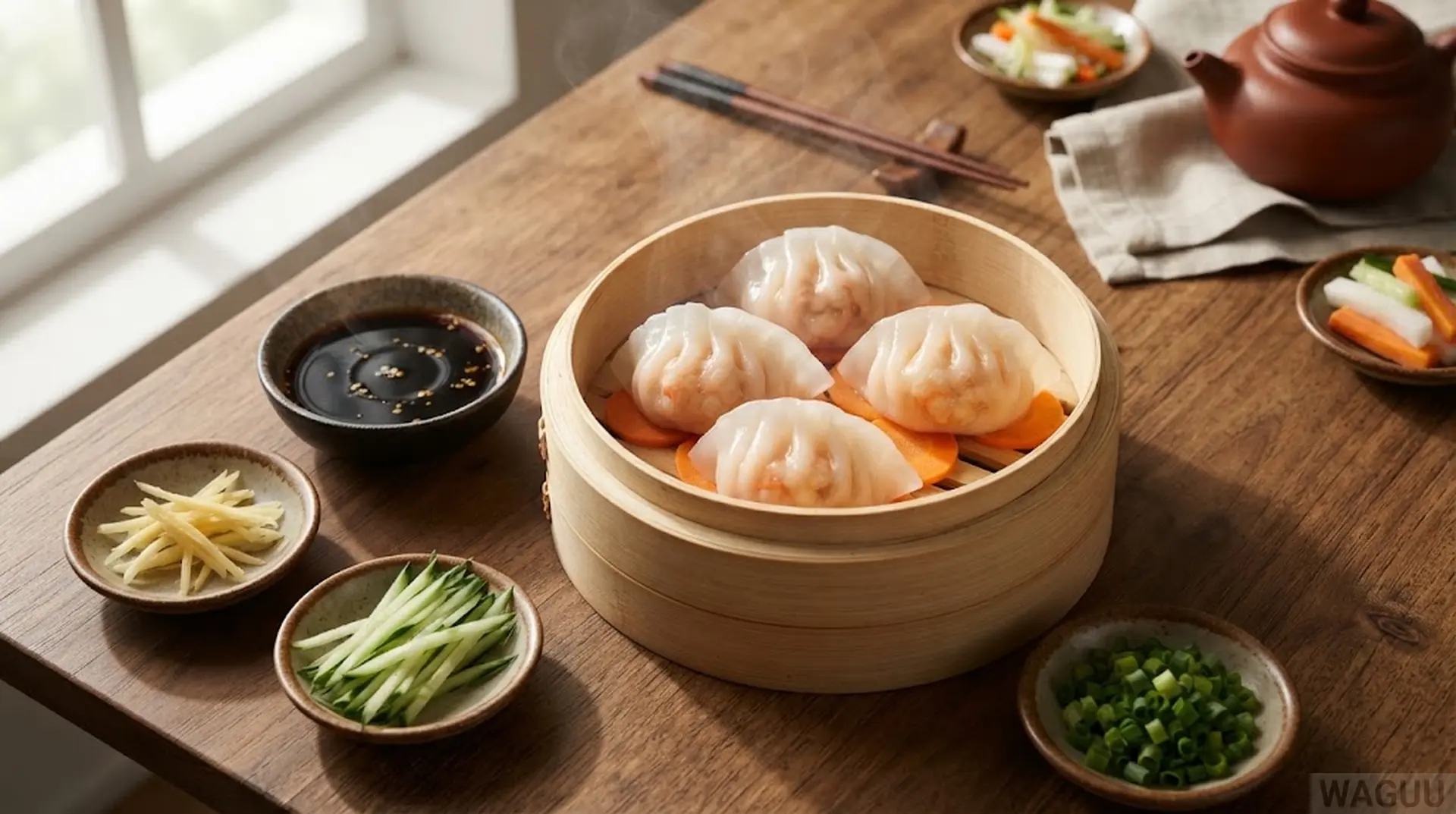
Summary: Cantonese steamed dumplings filled with minced pork and prawns, wrapped in square wonton wrappers and cooked in a bamboo steamer. The filling holds together thanks to cornflour and chopped bamboo shoots, which soak up the extra juices. The dumplings steam in two batches of twelve so the steamer is never overloaded and the wrappers do not go soggy. Served with a bowl of soy sauce and sesame oil. Total time 65 minutes, base 6 servings, 24 pieces.
Cooked this recipe? Share the result with the community.
Category: Starters · Chinese Cuisine
Success rate: not rated yet % of users managed this recipe
Quick overview
- Dish: Dim sum – small Cantonese dishes, especially steamed dumplings and parcels
- Category: Starters, Chinese Cuisine
- Cuisine: Chinese
- Main ingredient: Minced pork belly, 500 g (83 g per portion) plus peeled prawns, 300 g
- Guide: 12 most famous Chinese dishes: traditional recipes from Chinese cuisine
- Total time: 65 minutes (40 minutes preparation + 25 minutes cooking)
- Difficulty: Medium
- Servings: 6 (Portion weight: 249 g, four pieces per portion)
- Key technique: Steaming in a bamboo basket and sealing the wrappers without trapping air
- Method types: Steaming, stir-frying the filling
- Dietary info & allergens: gluten, soy, crustaceans, sesame
- Great for: A starter before a Chinese dinner, feeding guests, a weekend cooking session with the family, party food
- Nutrition (per portion): 476 kcal, Protein: 27.9 g, Fat: 25.6 g, Carbohydrates: 33.4 g
- Storage: 2 days in the fridge, 1 month in the freezer
- Pairing: Jasmine tea, rice beer, dry white wine
- In short: A chilled filling, wrappers sealed without air and a steamer filled in one layer – three steps that decide whether the dumplings hold their shape or fall apart.
WAGUU says: “Dim sum is not boiled in a pan of water, it is steamed. The wrapper only meets moist heat, so it stays tender and never becomes waterlogged.”
Key facts
| Preparation time: | 40 minutes (including 20 minutes chilling the filling) |
| Cooking time: | 25 minutes |
| Temperature: | Steam over boiling water, filling heated to 75 °C |
| Servings: | 6 (24 pieces, portion weight 249 g) |
At a glance
Dim sum depends on two things that are easy to get wrong: the temperature of the filling and the tightness of the wrapper. The filling must be cold, because a cold mixture holds its shape and does not leak moisture into the wrapper as you pleat it. The wrapper is sealed with the air pressed out – trapped air expands in the steam and splits the dumpling open. Bamboo shoots in the filling act like a sponge and soak up the juices released by the pork and prawns, so the wrapper stays dry. The steamer is filled in a single layer so steam circulates around each dumpling and the wrappers never touch.
Ingredients
Base servings: 6 • Portion weight: 249 g
| Ingredient | Quantity | Quality |
|---|---|---|
| minced pork belly | 500 g | freshly minced, around 25 % fat |
| peeled prawns | 300 g | raw, deveined, chopped finely |
| bamboo shoots | 150 g | in water, well drained, chopped finely |
| spring onions | 80 g | fresh, white and green parts chopped |
| ginger | 20 g | fresh, grated finely |
| garlic | 15 g | fresh, crushed |
| soy sauce | 40 ml | light, in the filling and for serving |
| sesame oil | 20 ml | toasted, in the filling and the dipping sauce |
| Shaoxing rice wine | 30 ml | dry, lifts the smell of the meat and prawns |
| cornflour | 30 g | in the filling, so it holds together |
| caster sugar | 8 g | to balance the saltiness of the soy sauce |
| fine sea salt | 3 g | for the filling |
| wonton wrappers | 240 g | 24 squares, 9 cm across, thin |
| carrot | 60 g | sliced thinly into rounds to line the steamer |
Why you will love this recipe
- Twenty-four dumplings from one batch: The filling makes exactly 24 pieces, four per portion. Any extras freeze well for later.
- A flavour no frozen version can match: Pork, prawns and bamboo shoots keep the juices inside the wrapper instead of losing them to the steam.
- Exact quantities for 6 servings: 500 g of pork, 300 g of prawns and 30 g of cornflour for the whole batch, with every amount shown in the shopping list.
- Improvers can manage it: Six phases, five checkpoints and one steamer. What separates a good result from an average one is a chilled filling and a wrapper sealed without air.
Why it works: The filling holds its shape thanks to two components. Cornflour swells as it heats and binds the pork and prawns into a single mass; bamboo shoots are largely insoluble fibre, which behaves like a sponge and soaks up the juices that are released. Without them the juices would seep through the wrapper and it would fall apart in the steam. Steaming is gentler than boiling: the surface of the wrapper stays at 100 °C but never meets liquid water, so flavour compounds and starch are not leached out. Steam also transfers heat faster than hot air, because it condenses on the cooler surface and releases latent heat. Air trapped inside a dumpling expands by roughly a third when heated; seal the wrapper around a bubble and the pressure will split it open.
Recipe overview
Prep: 40 min | Cook: 25 min | Difficulty: Medium | Servings: 6 | Type: Starter | Origin: Chinese
Detailed method
Overall progress: 0 % complete
Phase 1: Filling – 20 min
Equipment: frying pan, kitchen scales, bowl
1. Heat a tablespoon of sesame oil in a pan and stir-fry the crushed garlic and ginger for thirty seconds. Add the minced pork and fry for four minutes, until it loses its pink colour. Pour in the Shaoxing wine and let it evaporate. Tip the pork into a bowl and let it cool. Meanwhile chop the prawns, bamboo shoots and spring onions finely and mix them into the cooled pork with the soy sauce, caster sugar, fine sea salt, the rest of the sesame oil and the cornflour.
Checkpoint: The filling is uniform, sticky and holds on a spoon; it does not run off when the bowl is tilted. It feels cold to the touch, not warm.
Before you move on:
Fill only with a completely cold filling. A warm filling releases steam, which dampens the wrapper from the inside and the dumplings fall apart in the steamer.
Phase 2: Shaping – 20 min
Equipment: board, small bowl of water
2. Lay the wrappers on the board and cover them with a damp cloth so they do not dry out. Put a spoonful of filling in the centre of each square. Wet the edges with a finger dipped in water, fold the opposite corners together and press them so that no air is trapped between the filling and the wrapper. Trim the surplus corners and stand the finished dumplings on a tray. Cut the carrot into thin rounds and line the base of the steamer with them.
Checkpoint: The dumplings hold their shape, the wrapper is dry to the touch and no filling shows through. They do not move when the tray is shaken gently.
Before you move on:
Do not leave the wrappers in the air. Within ten minutes they dry out and crack, and the edges will not seal. Keep them under a damp cloth and take them one at a time.
Phase 3: Setting up the steamer – 5 min
Equipment: pan, bamboo steamer
3. Pour three centimetres of water into a pan and bring it to the boil. Set the bamboo steamer on top, line it with the carrot rounds and arrange twelve dumplings in it, leaving space between them. Cover the steamer so that steam does not escape at the sides.
Checkpoint: A steady column of steam rises from the steamer and the water in the pan bubbles gently. The dumplings sit in a single layer with gaps between them.
Before you move on:
Never stack the dumplings in two layers, even if they fit. Steam is weaker in the upper layer and those wrappers stay raw while the lower ones break up.
Phase 4: Steaming the first batch – 8 min
Equipment: pan, bamboo steamer, meat thermometer
4. Cover the steamer and steam the dumplings for eight minutes. Do not lift the lid during that time; escaping steam lengthens the cooking and leaves the edges of the wrappers sticky. After eight minutes, test one dumpling: the wrapper should be translucent and the filling should read 75 °C on the thermometer.
Checkpoint: The wrapper is translucent, glossy and springy rather than sticky. The thermometer in the filling reads 75 °C and clear juice runs out when it is cut open.
Before you move on:
Do not lift the lid during steaming, not even to check. The steam that escapes cools the surface of the wrapper and leaves it slippery. Check after the eighth minute.
Phase 5: Steaming the second batch – 8 min
Equipment: pan, bamboo steamer, large plate
5. Move the cooked dumplings to a warmed plate and cover them with a clean cloth so they do not dry out. Arrange the second half of the dumplings in the steamer and steam them for eight minutes in the same way. Check the water in the pan and top it up with boiling water only, never cold – cold water interrupts the steaming and the wrappers set unevenly.
Checkpoint: The second batch is as translucent as the first. All the dumplings on the plate hold their shape and no wet patches appear on the cloth beneath them.
Before you move on:
Top up the pan with boiling water only. Cold water drops the temperature and the steam briefly disappears, which leaves the wrapper surface dull and uneven.
Phase 6: Serving – 4 min
Equipment: small bowl, serving plate
6. Stir the remaining soy sauce with the rest of the sesame oil for serving and pour it into a small bowl. Arrange the dumplings on a warmed plate, add pickled vegetables on the side if you have them, and serve at once. The dumplings are eaten by hand or with chopsticks and dipped at the table.
Checkpoint: The dumplings are hot with a glossy surface and none of them have stuck together. The dipping sauce is smooth and carries a thin film of sesame oil on top.
Equipment needed
| Item | Ideal size | Alternative | Risk |
|---|---|---|---|
| bamboo steamer | 24 cm, two tiers | a metal steamer insert or a sieve over a pan | an uncovered metal sieve lets steam escape and the wrappers stay sticky |
| pan for the steamer | 24 cm across, 12 cm deep | a wok with a lid | a small pan cannot produce enough steam for a full batch |
| meat thermometer | probe type, reads to 250 °C | cut one dumpling open and check the juices | without measuring, the filling is judged only by the look of the wrapper |
| kitchen scales | 1 g resolution | a measuring spoon for 30 g of cornflour | the wrong amount of cornflour decides whether the filling holds |
| damp cloth | cotton, 40 × 40 cm | cling film | wrappers left in the air dry out within ten minutes and cannot be sealed |
Shopping list
Nutrition profile
Values per portion (as served, without a side). Calculated from average nutritional values of the ingredients. Portion weight 249 g. The water used to raise steam is not counted in the weight.
| Nutrient | Per 100 g | Per portion | For 6 servings |
|---|---|---|---|
| Energy | 191 kcal | 476 kcal | 2856 kcal |
| Fat | 10.3 g | 25.6 g | 153.8 g |
| of which saturates | 5.4 g | 5.4 g | 5.4 g |
| Carbohydrates | 13.4 g | 33.4 g | 200.7 g |
| of which sugars | 3.2 g | 3.2 g | 3.2 g |
| Protein | 11.2 g | 27.9 g | 167.2 g |
| Salt | 1.6 g | 1.6 g | 1.6 g |
| of which sodium | 0.37 g | 0.92 g | 5.55 g |
Reference intake of an average adult (8400 kJ / 2000 kcal). Salt comes from the soy sauce, the wrappers and the prawns; the filling is only lightly salted.
WAGUU Pro level
- Pro standard: A tested recipe with exact quantities and visual checkpoints.
- Tip 1: Make the filling an hour ahead and keep it in the fridge. A cold mixture is easier to wrap and does not dampen the wrappers.
- Tip 2: Take the wrappers out of the packet one at a time and keep the rest under a damp cloth, or they will harden within ten minutes.
- Tip 3: Line the steamer with carrot rounds rather than baking paper. The carrot stops the dumplings sticking and lends them a faint sweetness.
- Tip 4: Let the dumplings stand for a minute after steaming. The wrapper firms up and will not tear when lifted with chopsticks.
The science behind it
Steaming transfers heat differently from baking or frying. Steam at 100 °C condenses on the cooler surface of the wrapper and releases latent heat, so the food heats faster than in hot oven air. The surface never meets liquid water, so flavour compounds and the starch that holds the wrapper together are not leached away. The starch in the filling swells above 60 °C and, at around 90 °C, forms a network that binds pork, prawns and bamboo shoots into a single mass. Bamboo shoots are largely insoluble fibre, which behaves like a sponge and absorbs the free juices that the meat releases as it heats. Air trapped inside a dumpling expands by roughly a third in volume when heated, and the pressure splits the wrapper, which is why the air is pressed out during sealing. Prawn proteins set at 65 °C; cooked longer they squeeze out water and turn rubbery, which is why eight minutes of steam is enough.
Fine dining – professional techniques
- Plating: Serve four dumplings in a bamboo steamer set on a wooden board with the dipping bowl alongside. The steamer keeps both heat and aroma at the table.
- Texture contrast: Add thin batons of fresh cucumber and pickled ginger. Crunch and acidity lift the soft wrapper.
- Temperature contrast: Serve the dipping sauce at room temperature rather than chilled. A cold sauce dulls the aroma as soon as the dumpling is dipped.
- Aromatic finish: Grate lime zest over the plate and scatter dry-toasted sesame seeds. The citrus bridges the prawns and the spring onion.
Sensory radar
- Appearance: Translucent wrappers with a faint pink glow from the prawns and light reflecting off them in small patches.
- Aroma: Ginger and sesame over the sweet smell of pork and a gentle marine note from the prawns.
- Taste: Salty soy first, then the sweetness of pork and prawns, finishing with fresh spring onion.
- Texture: Wrapper tender and springy, filling juicy with crunchy pieces of bamboo shoot.
Pairing
- Jasmine tea: A floral aroma cleanses the palate and complements the ginger. Serve hot in small cups.
- Rice beer: Light sweetness and low bitterness suit the delicate filling.
- Dry white wine: A Riesling with higher acidity cuts the fat in the pork belly.
- Homemade yuzu lemonade: Citrus acidity refreshes after a rich mouthful.
Variations
- Prawn version: Replace the pork with 800 g of prawns and add a spoon of sesame paste. The filling steams for a shorter time – seven minutes – so the prawns stay juicy.
- Fried version: After steaming, dry the dumplings and fry them in oil for two minutes until the base is golden. The base becomes crisp but the fat content rises.
- Gluten-free version: Use rice paper wrappers soaked in water and steam the dumplings for five minutes. The texture is softer and more fragile.
Allergens and dietary information
Contains: gluten (wonton wrappers); soy (soy sauce); crustaceans (peeled prawns); sesame (sesame oil) • Gluten: yes, in the wrappers • Not suitable for: anyone with coeliac disease or an allergy to crustaceans, soy or sesame
Great for
A starter before a Chinese dinner, feeding guests, a weekend cooking session with the family, party food, a batch made for the freezer.
Substitution guide
- Wonton wrappers: spring roll pastry cut into squares, or a thin yeast dough. Wheat wrappers hold their shape better.
- Peeled prawns: frozen prawns, defrosted and well drained. The flavour is slightly milder, the texture similar.
- Bamboo shoots: water chestnuts or chopped carrot. They do not absorb juices as well, so add 5 g more cornflour.
- Minced pork belly: minced chicken thigh. The filling is leaner and drier, so add a spoon of sesame oil.
- Shaoxing rice wine: dry white wine with a drop of soy sauce. It lifts the smell just as effectively.
- Carrot under the dumplings: cabbage leaves or baking paper. Cabbage adds a faint aroma, paper adds nothing.
FAQ
Why steam rather than boil the dumplings?
In boiling water the wrapper soaks up liquid and part of the filling leaches out. Steam transfers heat just as fast while keeping the surface dry and glossy.
How do I know when they are done?
The wrapper turns translucent and springs back when pressed lightly. The thermometer in the filling reads 75 °C and the juices that run out are clear, not pink.
Can the dumplings be frozen?
Yes. Freeze them uncooked in a single layer on a tray, then transfer them to a bag. Steam them straight from frozen for two minutes longer.
Why does the filling need to be cold?
A warm filling releases steam and dampens the wrapper from the inside. A cold filling holds its shape, wraps faster and the dumplings survive the steamer.
What can I use instead of a bamboo steamer?
A metal steamer insert or a sieve set over a pan of boiling water. Always use a lid, so that as little steam as possible escapes.
Are the dumplings gluten free?
Not with wheat wrappers. Use rice paper or a gluten-free dough and tamari instead of soy sauce. The filling itself contains no gluten.
WAGUU Petr advises: cooking for 6 or more?
6–8 people: Double the filling and wrap two hours ahead. Keep the dumplings in the fridge under a damp cloth and steam them in two batches. • 10+ people: Use two steamers above one another and steam four batches. Make the filling the day before, wrap on the day and keep the finished dumplings in a steamer over a low heat until they go to the table.
Sides and serving
Storage and reheating
Fridge: 2 days • Freezer: 1 month • Reheating: Reheat cooked dumplings in the steamer for three minutes, not in the microwave, where the wrapper hardens. Frozen uncooked dumplings steam for ten minutes straight from the freezer.
Author: WAGUU Petr & Team • Published: 8 Oct 2026 • Updated: 10 Oct 2026
More recipes from this article
Guide: 12 most famous Chinese dishes: traditional recipes from Chinese cuisine
Peking duck – celebratory roast duck with crisp skin, thin pancakes and a sweet sauce
Kung Pao chicken – spicy Sichuan chicken with peanuts, chilli and a sweet-savoury sauce
Mapo tofu – tofu in a spicy Sichuan sauce with minced meat and Sichuan pepper
Sweet and sour pork – fried pork pieces in the classic sweet and sour sauce
Char siu – Cantonese roast pork with a glossy caramelised crust
Xiaolongbao – delicate Shanghai dumplings filled with pork and hot soup
Chow mein – stir-fried wheat noodles with vegetables, meat or seafood
Yangzhou fried rice – fried rice with egg, prawns, ham and peas
Hot pot – a shared meal cooked in bubbling broth at the table
Dan dan noodles – Sichuan noodles with a spicy sauce and chilli oil
Wonton soup – clear broth with filled wonton dumplings and spring onion
Other recipes you might like
Why WAGUU?
Recipes on WAGUU are checked for accurate quantities, method and nutrition. In this recipe the amounts match across the ingredient table, the cooking phases, the shopping list and the print view – 500 g of pork, 300 g of prawns and 150 g of bamboo shoots make exactly 24 dumplings, four per portion, and 30 g of cornflour is enough to bind the whole batch.
Photo gallery from the process
Community photos: Cook it, photograph it and share the result.
Upload your photos in the comments below or send them by email.
Filmed a video following our recipe? Post a link to YouTube, YouTube Shorts, TikTok, Instagram Reels, Facebook Reels, Pinterest, Vimeo or X (Twitter) in the comments – we will gladly publish it and help get your work seen.
Most common mistakes
- A warm filling – it dampens the wrapper and the dumplings fall apart in the steamer. Let the filling cool completely before wrapping.
- Air trapped inside – it expands in the steam and splits the wrapper. Press the edges so the air escapes.
- An overloaded steamer – the dumplings stick together and the upper layer stays raw. Fill one layer with gaps between the pieces.
- Lifting the lid while steaming – steam escapes and the wrappers stay sticky. Check only after the eighth minute.