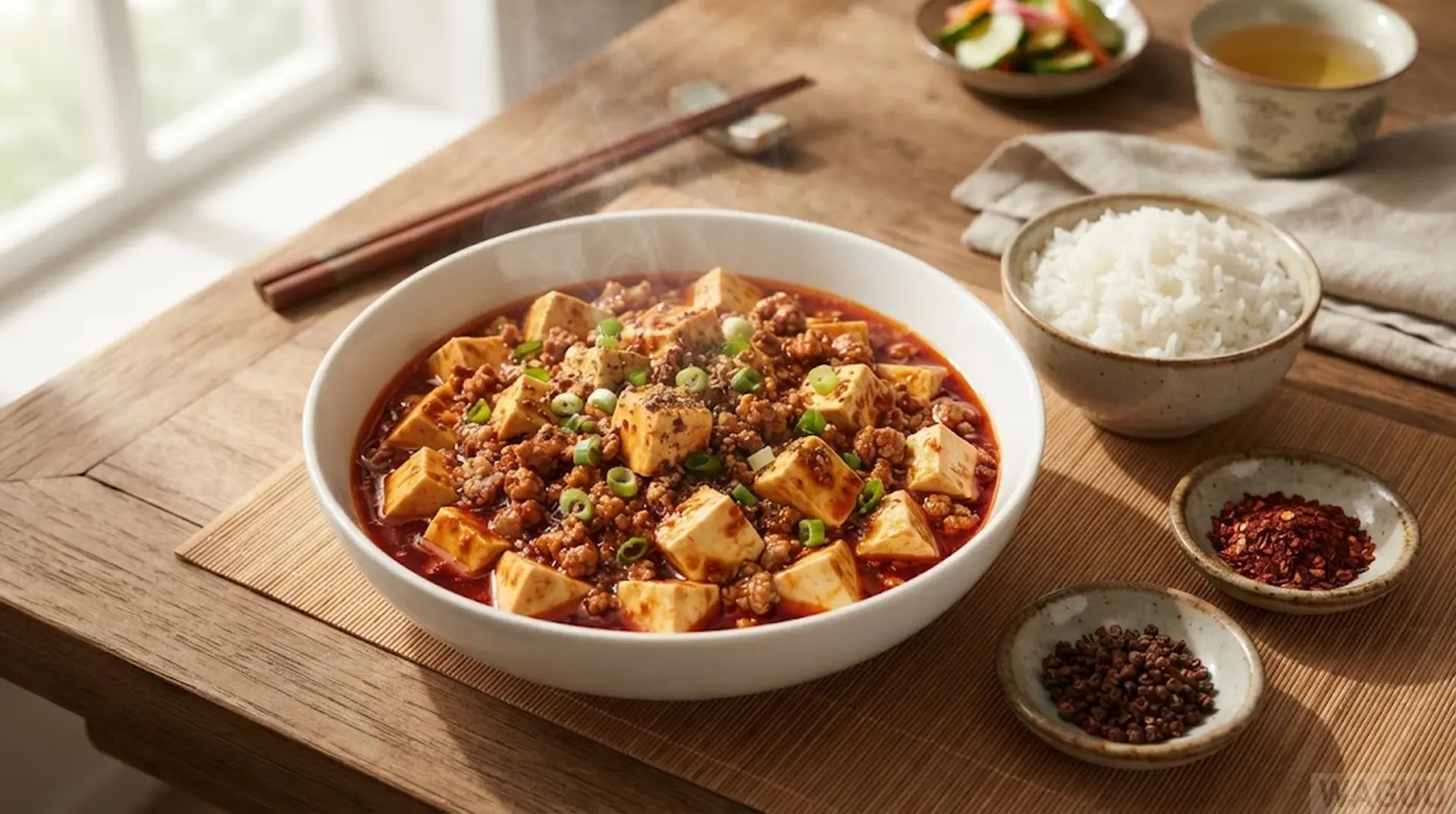
Summary: Sichuan dish of firm tofu simmered in a sauce built on fermented broad bean paste, black beans, chilli flakes and Sichuan pepper, with a small amount of minced pork. The tofu is poached in lightly salted water first so it holds its shape, then added to the sauce and thickened twice with cornflour slurry so the sauce clings rather than runs. Finished with ground Sichuan pepper and spring onion. Total time 40 minutes, base 6 servings.
Cooked this recipe? Share the result with the community.
Category: Pork · Chinese Cuisine
Success rate: not rated yet % of users managed this recipe
Quick overview
- Dish: Mapo tofu – tofu in a spicy Sichuan sauce with minced meat and Sichuan pepper
- Category: Pork, Chinese Cuisine
- Cuisine: Chinese
- Main ingredient: Firm tofu, 800 g (133 g per portion)
- Guide: 12 most famous Chinese dishes: traditional recipes from Chinese cuisine
- Total time: 40 minutes (20 minutes preparation + 20 minutes cooking)
- Difficulty: Medium
- Servings: 6 (Portion weight: 294 g)
- Key technique: Poaching the tofu in salted water and thickening the sauce twice with cornflour
- Method types: Simmering, stir-frying, thickening
- Dietary info & allergens: soy, gluten (check the bean paste)
- Great for: A meat-free Monday with the pork left out, fans of Sichuan food, a rice bowl dinner, batch cooking
- Nutrition (per portion): 493 kcal, Protein: 27.2 g, Fat: 35.6 g, Carbohydrates: 15.9 g
- Storage: 2 days in the fridge, 1 month in the freezer
- Pairing: Jasmine tea, light lager, dry Riesling
- In short: Poached tofu, a paste fried until the oil separates and a sauce thickened twice – three steps that decide whether the dish holds together or turns to soup.
WAGUU says: “Mapo tofu is not stirred. It is pushed. A spoon or the back of a ladle moves the tofu through the sauce without breaking it.”
Key facts
| Preparation time: | 20 minutes |
| Cooking time: | 20 minutes |
| Temperature: | Tofu poached at 90 °C, sauce simmered gently, never at a hard boil |
| Servings: | 6 (portion weight 294 g) |
At a glance
Mapo tofu is built on fermented paste, not on chilli heat alone. Doubanjiang is fried in oil until the oil turns red and separates from the paste; that step releases the aroma and removes the raw, beany taste. Tofu is poached in lightly salted water first, which firms the surface so it survives the sauce. Cornflour goes in twice: the first addition thickens the sauce, the second – added after the sauce relaxes – gives the glossy coating that makes it cling to the tofu. Sichuan pepper is added at the very end, off the heat, so its tingle survives; cooked for minutes it turns bitter and flat.
Ingredients
Base servings: 6 • Portion weight: 294 g
| Ingredient | Quantity | Quality |
|---|---|---|
| firm tofu | 800 g | firm, vacuum packed, plain |
| minced pork belly | 300 g | freshly minced, around 25 % fat |
| doubanjiang (fermented broad bean paste) | 60 g | ground, dark red |
| fermented black beans | 20 g | whole, chopped finely before use |
| Sichuan pepper | 6 g | whole, toasted and ground |
| chilli flakes | 10 g | coarse, seeds removed |
| soy sauce | 30 ml | light, naturally fermented |
| dark soy sauce | 15 ml | sweet, for the colour of the sauce |
| Shaoxing rice wine | 30 ml | dry, to lift the smell of the meat |
| chicken stock | 300 ml | unsalted, homemade or from a cube |
| cornflour | 25 g | for thickening the sauce in two stages |
| peanut oil | 50 ml | for stir-frying, high smoke point |
| sesame oil | 15 ml | toasted, to finish |
| garlic | 25 g | fresh, chopped finely |
| ginger | 20 g | fresh, grated finely |
| spring onions | 60 g | fresh, cut on the diagonal |
Why you will love this recipe
- Tofu that keeps its shape: Poaching in salted water firms the surface, so the cubes survive simmering without turning into crumbs.
- A sauce that clings: Thickening in two stages gives the glossy body that makes mapo tofu feel rich rather than watery.
- Exact quantities for 6 servings: 133 g of tofu per portion, 50 g of pork and 10 g of stock reduction per spoon. Everything matches the shopping list.
- Ready in 40 minutes: Chop, poach, fry, simmer. No long marinade and no waiting.
Why it works: Doubanjiang is a fermented paste made from broad beans and chilli. Frying it in oil drives off water and dissolves the fat-soluble aromas, which is why the oil turns red and the paste stops smelling raw. Tofu is roughly 85 % water; poaching it in salted water at 90 °C warms the interior and firms the protein network at the surface, so it resists breaking when it is stirred. Cornflour gelatinises at around 70 °C and thickens the sauce; on standing, the starch network relaxes and the sauce thins again, which is why the second addition of slurry is needed to bring it back to a glossy body. Sichuan pepper is added last because its aromatic compounds are volatile; heat drives them off within a couple of minutes and leaves a bitter note behind.
Recipe overview
Prep: 20 min | Cook: 20 min | Difficulty: Medium | Servings: 6 | Type: Main course | Origin: Chinese
Detailed method
Overall progress: 0 % complete
Phase 1: Poaching the tofu – 10 min
Equipment: wide pan, slotted spoon
1. Cut the tofu into cubes with a two centimetre edge and lay them in a wide pan in a single layer. Cover with cold water, add half a teaspoon of salt and bring to 90 °C – small bubbles should rise at the edges but the water must not boil. Hold it there for five minutes, then lift the cubes out with a slotted spoon onto a plate.
Checkpoint: The cubes feel firmer at the surface and hold their corners. A cube lifted on the spoon does not sag or break.
Before you move on:
Keep the water below a boil. A hard boil sets the surface too firmly, makes the inside rubbery and starts to break the corners before the sauce ever touches them.
Phase 2: Preparing the paste and slurry – 5 min
Equipment: board, knife, two small bowls
2. Chop the fermented black beans finely and mix them with the doubanjiang and the chilli flakes in one bowl. In a second bowl, whisk the cornflour with six tablespoons of cold stock until smooth; keep the rest of the stock aside. Chop the garlic, grate the ginger and cut the spring onions on the diagonal.
Checkpoint: The slurry is smooth and pours like thin cream, with no lumps at the bottom of the bowl. The paste mixture is evenly combined.
Before you move on:
Mix the cornflour with cold stock only. Tipped into a simmering sauce as dry powder, it sets into lumps that no amount of stirring will remove.
Phase 3: Frying the paste – 4 min
Equipment: wok or deep pan, spatula
3. Heat the peanut oil in the wok over a medium heat, add the paste mixture and fry it gently for three minutes, stirring constantly. The paste will darken and the oil will turn deep red and begin to separate. Add the garlic and ginger and fry for another minute, then stir in the Shaoxing wine and let it bubble away.
Checkpoint: The oil has separated and is bright red, the paste smells roasted rather than raw, and the garlic has not browned.
Before you move on:
Fry the paste on a medium heat, not the highest setting. Burnt doubanjiang turns bitter immediately and the bitterness cannot be masked by sugar or soy sauce later.
Phase 4: Pork and sauce – 6 min
Equipment: wok, spatula
4. Add the minced pork and break it up with the spatula. Fry for three minutes until it loses its pink colour and separates into small grains. Pour in the light and dark soy sauce and the remaining stock, bring to a gentle simmer and cook for two minutes.
Checkpoint: The pork is in small, separate grains with no clumps, and the sauce is a deep red liquid with an even sheen.
Before you move on:
Break the pork up properly before the liquid goes in. Once the sauce is in the pan, clumps of mince stay clumped and the texture of the dish suffers.
Phase 5: Tofu and double thickening – 8 min
Equipment: wok, spatula, ladle
5. Slide the poached tofu into the sauce and push it gently with the back of the spatula for two minutes so it heats through without breaking. Stir the slurry once more and pour in half of it, pushing the tofu through the sauce until it thickens. Simmer for two minutes, then add the rest of the slurry and repeat. The sauce should now coat the tofu evenly.
Checkpoint: The sauce is glossy and thick enough to hold a line drawn through it with a spoon. The tofu cubes are whole and evenly coated.
Before you move on:
Never stir the tofu with a spoon in circles. Push it from the edge into the middle and shake the pan instead; circles break the cubes and cloud the sauce with tofu crumbs.
Phase 6: Finishing – 2 min
Equipment: wok, serving bowl
6. Take the wok off the heat, drizzle in the sesame oil and push the spring onions through the sauce. Tip the dish into a warm bowl, then sprinkle the ground Sichuan pepper over the top and serve at once with steamed rice, which is not part of the recipe.
Checkpoint: The surface of the sauce carries a thin sheen of sesame oil, the spring onions are still bright green and the Sichuan pepper smells fresh and citrus-sharp.
Equipment needed
| Item | Ideal size | Alternative | Risk |
|---|---|---|---|
| wok or deep pan | 28 cm, heavy base | a wide sauté pan | a thin pan scorches the paste before the oil separates |
| wide pan for poaching | 24 cm, with a lid | a deep frying pan | a narrow pan stacks the tofu and the corners break |
| slotted spoon | flat, wide | a fish slice | tongs crush the cubes as you lift them |
| spatula with a flexible edge | silicone, 30 cm | the back of a wooden spoon | a rigid metal spatula cuts through the tofu |
| small whisk | for the slurry | a fork | unmixed slurry leaves lumps in the finished sauce |
Shopping list
Nutrition profile
Values per portion (as served, without rice). Calculated from average nutritional values of the ingredients. Portion weight 294 g. Tofu retains part of the poaching water, which is counted in the weight but contributes no energy.
| Nutrient | Per 100 g | Per portion | For 6 servings |
|---|---|---|---|
| Energy | 167 kcal | 493 kcal | 2957 kcal |
| Fat | 12.1 g | 35.6 g | 213.8 g |
| of which saturates | 5.8 g | 5.8 g | 5.8 g |
| Carbohydrates | 5.4 g | 15.9 g | 95.3 g |
| of which sugars | 3.6 g | 3.6 g | 3.6 g |
| Protein | 9.2 g | 27.2 g | 163.1 g |
| Salt | 2.7 g | 2.7 g | 2.7 g |
| of which sodium | 0.44 g | 1.28 g | 7.68 g |
Reference intake of an average adult (8400 kJ / 2000 kcal). Salt comes from the fermented paste, the black beans, the two soy sauces and the stock; the dish is not salted further.
WAGUU Pro level
- Pro standard: A tested recipe with exact quantities and visual checkpoints.
- Tip 1: Weigh the tofu down for fifteen minutes before cutting. Less water inside means the cubes hold their shape better in the sauce.
- Tip 2: Chop the doubanjiang on the board if it is coarse. A smooth paste disperses through the oil and gives an even colour.
- Tip 3: Add the second slurry only after the first has relaxed. That is what gives the sauce its glossy, clinging body instead of a thin, watery finish.
- Tip 4: Keep the Sichuan pepper in a sealed jar away from light. Ground pepper loses its tingle within a few weeks.
The science behind it
Mapo tofu works because of two starches and one volatile aroma. Tofu protein is held in a weak network with a great deal of water; gentle heat at 90 °C firms the surface network without squeezing water out, which is why poaching in salted water makes the cubes robust. Cornflour gelatinises at around 70 °C: the granules swell, absorb water and form a gel that thickens the sauce. That gel is thixotropic and relaxes when it stands or is stirred, so the sauce thins again; the second slurry rebuilds the network and gives the characteristic glossy coat. Doubanjiang is fermented, which means its proteins have already been broken into amino acids and its starches into sugars; that is why it tastes savoury and slightly sweet even before anything is added. Frying it in oil drives off water and releases fat-soluble aromas. Sanshool, the compound behind the tingle of Sichuan pepper, is volatile: two minutes in a hot pan drives it off and leaves bitterness, so the pepper is ground and sprinkled over the dish after the heat is off.
Fine dining – professional techniques
- Plating: Serve in a warm shallow bowl, the tofu pulled to the centre and the sauce spooned around it. A scatter of spring onion and a pinch of Sichuan pepper on top.
- Texture contrast: Add a spoon of crisp fried garlic or shallots just before serving. It gives a brittle note against the soft tofu.
- Temperature contrast: Pair with cold pickled cucumber. The chill and acidity reset the palate after each spoon of chilli.
- Aromatic finish: Grate a little orange zest over the bowl. The citrus oils lift the fermented notes of the paste.
Sensory radar
- Appearance: Deep red, glossy sauce with whole white tofu cubes, specks of pork and a scatter of green spring onion.
- Aroma: Fermented bean paste and chilli over fried garlic, with a fresh citrus note from the Sichuan pepper.
- Taste: Savoury and salty first, then warm chilli heat and a lasting tingle on the lips.
- Texture: Tofu soft but firm at the edges, sauce thick and smooth, small grains of pork throughout.
Pairing
- Jasmine tea: Floral and light, it softens the heat between mouthfuls.
- Light lager: Bitterness and carbonation cut the oil in the sauce. Serve at 6–8 °C.
- Dry Riesling: Its acidity handles the fermented paste and refreshes the palate.
- Homemade limeade: A good option for anyone avoiding alcohol, and for children with a milder version of the dish.
Variations
- Vegetarian mapo tofu: Replace the pork with 200 g of finely chopped shiitake mushrooms and add five grams more cornflour. The dish becomes lighter and fully meat free.
- Milder version: Halve the chilli flakes and use a mild doubanjiang. The Sichuan pepper stays, because its tingle is not the same as heat.
- With aubergine: Add 300 g of diced aubergine fried separately and folded in at the end. The dish becomes more substantial and absorbs the sauce well.
Allergens and dietary information
Contains: soy (tofu, soy sauce, doubanjiang); gluten (check the doubanjiang and the stock) • Gluten: check the fermented paste, which sometimes contains wheat flour • Not suitable for: anyone with a soy allergy or coeliac disease unless gluten-free paste and tamari are used
Great for
A quick weeknight dinner, fans of Sichuan food, a rice bowl for lunch the next day, batch cooking, a shared table with several dishes.
Substitution guide
- Doubanjiang: gochujang with a spoon of soy sauce. Sweeter and less fermented, so reduce the sugar-free balance accordingly.
- Fermented black beans: a spoon of miso paste. The background flavour is similar, the texture less coarse.
- Minced pork belly: minced chicken thigh or finely chopped shiitake mushrooms for a meat-free version.
- Chicken stock: vegetable stock with a spoon of soy sauce. The dish loses some depth.
- Peanut oil: rapeseed oil. Neutral and able to take the heat.
- Cornflour: potato starch. It thickens at a lower temperature, so add it in smaller amounts.
FAQ
Which tofu should I buy?
Firm or extra-firm vacuum-packed tofu. Silken tofu tastes good but falls apart in the sauce; if you only have silken, poach it for two minutes and handle it with a slotted spoon.
Why thicken the sauce twice?
The first addition sets the sauce; while it simmers the starch network relaxes and it thins again. The second brings back the glossy body so the sauce clings to the tofu instead of running off.
How hot is this dish?
Warm rather than fierce. Ten grams of chilli flakes across six portions gives a gentle, steady heat; the tingling sensation comes from the Sichuan pepper, not from the chilli.
Can I leave out the pork?
Yes. Replace it with finely chopped shiitake mushrooms and add five grams more cornflour, because mushrooms release water as they cook.
Why did my sauce turn grey?
Usually because the paste was not fried long enough, or the tofu was stirred in circles and crumbled. Fry the paste until the oil separates and push the tofu rather than stirring it.
Can mapo tofu be made gluten free?
Yes, with gluten-free doubanjiang, tamari instead of soy sauce and a gluten-free stock. Tofu, pork, garlic, ginger and spices contain no gluten.
WAGUU Petr advises: cooking for 6 or more?
6–8 people: Poach 1000 g of tofu and keep the sauce quantities as they are; the sauce carries more portions than the tofu does. • 10+ people: Poach the tofu in two batches and keep the first warm in a covered dish. Make the sauce base in one large pan, then split it between two woks and add the tofu just before serving so the cubes stay whole.
Sides and serving
Storage and reheating
Fridge: 2 days • Freezer: 1 month, though the tofu texture softens • Reheating: Warm gently in a pan with a spoon of stock for five minutes, pushing the tofu rather than stirring. The microwave heats unevenly and breaks the cubes.
Author: WAGUU Petr & Team • Published: 8 Oct 2026 • Updated: 10 Oct 2026
More recipes from this article
Guide: 12 most famous Chinese dishes: traditional recipes from Chinese cuisine
Peking duck – celebratory roast duck with crisp skin, thin pancakes and a sweet sauce
Kung Pao chicken – spicy Sichuan chicken with peanuts, chilli and a sweet-savoury sauce
Sweet and sour pork – fried pork pieces in the classic sweet and sour sauce
Char siu – Cantonese roast pork with a glossy caramelised crust
Dim sum – small Cantonese dishes, especially steamed dumplings and parcels
Xiaolongbao – delicate Shanghai dumplings filled with pork and hot soup
Chow mein – stir-fried wheat noodles with vegetables, meat or seafood
Yangzhou fried rice – fried rice with egg, prawns, ham and peas
Hot pot – a shared meal cooked in bubbling broth at the table
Dan dan noodles – Sichuan noodles with a spicy sauce and chilli oil
Wonton soup – clear broth with filled wonton dumplings and spring onion
Other recipes you might like
Why WAGUU?
Recipes on WAGUU are checked for accurate quantities, method and nutrition. In this recipe the amounts match across the ingredient table, the cooking phases, the shopping list and the print view – 800 g of tofu serves six at 133 g each, 25 g of cornflour is used in two stages, and 300 ml of stock gives 50 ml per portion.
Photo gallery from the process
Community photos: Cook it, photograph it and share the result.
Upload your photos in the comments below or send them by email.
Filmed a video following our recipe? Post a link to YouTube, YouTube Shorts, TikTok, Instagram Reels, Facebook Reels, Pinterest, Vimeo or X (Twitter) in the comments – we will gladly publish it and help get your work seen.
Most common mistakes
- Paste not fried long enough – the sauce tastes raw and the oil never turns red. Fry it on a medium heat for three minutes, until the oil separates.
- Stirring the tofu in circles – the cubes break and the sauce turns cloudy. Push the tofu from the edge to the middle and shake the pan.
- Dry cornflour into a hot sauce – lumps form that cannot be stirred out. Always mix the slurry with cold stock first.
- Sichuan pepper added too early – the tingle disappears and a bitter note remains. Sprinkle it over the dish after the pan leaves the heat.