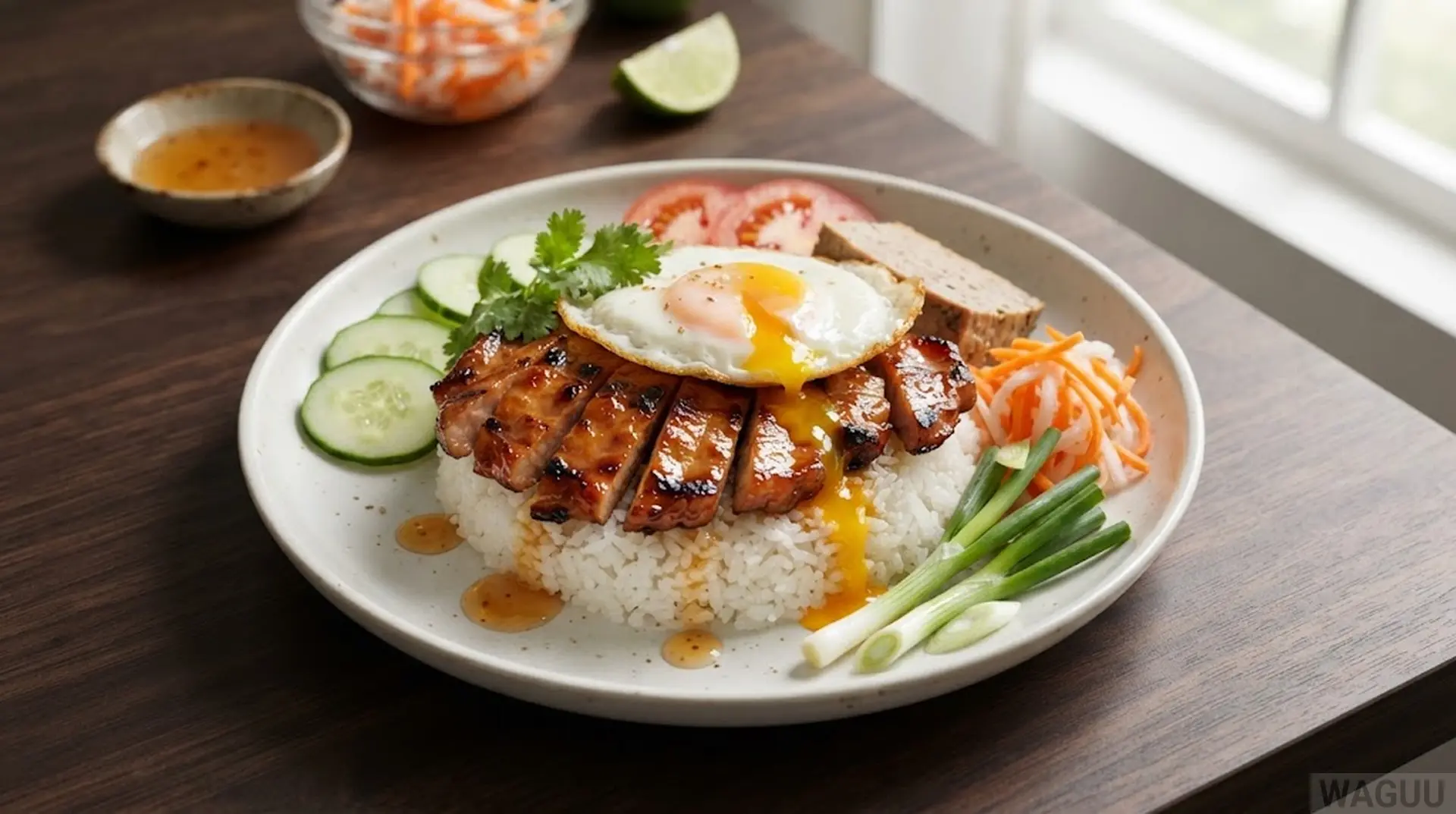
Summary: Broken rice with grilled pork shoulder in lemongrass marinade, fried egg, pickled vegetables, cucumber and a fish sauce dressing. Total time 70 minutes, serves 6.
Have you cooked this recipe? Share your result with the community.
Category: Risotto and Grains · Vietnamese Cuisine
Success rate: not rated yet % of users managed this recipe
Quick overview
- Dish: Cơm Tấm – broken rice with grilled pork, egg and pickled vegetables
- Category: risotto-and-grains, vietnamese-cuisine
- Cuisine: Vietnamese
- Main ingredient: Pork shoulder, 800 g (boneless, sliced 5 mm thick)
- Guide: 12 most famous Vietnamese dishes: traditional recipes from Vietnamese cuisine
- Total time: 70 minutes (25 min preparation + 45 min cooking)
- Difficulty: Medium
- Servings: 6 (Serving weight: 594 g)
- Key technique: Grilling thin slices on a dry griddle and frying rice with crackling paste
- Preparation types: Classic cooking, grilling and roasting, pan-frying
- Dietary info & allergens: fish (fish sauce), egg (egg), gluten (pork
- Suitable for: Family lunch, Vietnamese-style breakfast, packed lunch or dinner after a busy day.
- Nutrition (per serving): 694 kcal, Protein: 36.1 g, Fat: 20.7 g, Carbohydrates: 91.1 g
- Storage: 3 days in the fridge, 1 month in the freezer
- Pairing: Vietnamese lager, dry Riesling, iced tea with lime
- In short: Broken rice, grilled pork slices in lemongrass marinade, fried egg, pickled vegetables and fish sauce dressing. Total time 70 minutes, 6 servings.
WAGUU says: “Cơm tấm isn’t just rice with meat. The dressing poured directly over the rice and the egg spread into the yolk across the portion are what make it.”
Key facts
| Preparation time: | 25 minutes |
| Cooking time: | 45 minutes |
| Temperature: | Griddle 220 °C, rice covered on the lowest flame |
| Servings: | 6 |
At a glance
Cơm tấm is a dish built on the plate: rice, meat, egg, vegetables and dressing. The rice, cooked in an exact water ratio, and the meat marinade with lemongrass and sugar are what matter. If you stir the rice while it cooks or leave it standing in the pot too long, you’ll get porridge instead of separate grains. The grilled slices shouldn’t overlap, or the meat will steam in its own juices.
Ingredients
Base servings: 6 servings • Serving weight: 594 g
| Ingredient | Amount | Quality |
|---|---|---|
| broken rice | 600 g | broken jasmine, free of dust |
| pork shoulder | 800 g | boneless, with a thin layer of fat, sliced 5 mm thick |
| egg | 3 pcs | fresh, room temperature |
| pork pâté | 60 g | smooth, made from pork liver |
| fish sauce | 80 ml | fermented from anchovies, sugar-free |
| soy sauce | 30 ml | dark, naturally fermented |
| cane sugar | 45 g | light, coarse |
| honey | 20 g | blossom, runny |
| lemongrass | 2 pcs | fresh stalks, only the lower white part |
| garlic | 5 cloves | fresh clove, finely chopped |
| shallot | 3 pcs | red, finely chopped |
| spring onion | 4 pcs | fresh, white and green parts |
| carrot | 2 pcs | firm, cut into thin matchsticks |
| daikon radish | 200 g | white, firm, cut into thin matchsticks |
| rice vinegar | 60 ml | mild, 4 percent acidity |
| cucumber | 1 pcs | salad, thinly sliced |
| tomato | 2 pcs | ripe, cut into thin wedges |
| fresh coriander | 30 g | stem and leaf, no root |
| spring onion | 3 pcs | fresh, sliced diagonally |
| sunflower oil | 40 ml | neutral flavour, for frying |
Why you’ll love this recipe
- Rice without watching: Broken rice cooks in an exact water ratio under a lid and finishes by itself. Don’t stir it while it cooks.
- The egg brings the plate together: The spread yolk mixes with the rice and creates a creamy layer that holds the dressing’s flavour.
- Exact ratios for 6 servings: Rice, meat, egg and vegetables are calculated for six plates. The number of servings recalculates according to your diners.
Success guaranteed: Cơm tấm hinges on two steps: the rice, which rests covered for ten minutes after cooking, and the marinade, in which the meat stays for at least an hour. The sugar and honey caramelise during grilling and form a glossy crust. The dressing is poured only on the plate, because it contains sugar and would caramelise and turn bitter if heated.
Recipe overview
Prep: 25 min | Cook: 45 min | Difficulty: Medium | Serves: 6 | Type: Main | Origin: Vietnamese
Detailed method
Total progress: 0 % done
Phase 1: Marinade and pickled vegetables – 20 min
Equipment: two bowls, grater, jar
1. In a bowl, mix fish sauce, soy sauce, honey, half the sugar, chopped lemongrass, garlic and shallot. Stir the marinade until the honey dissolves.
2. Slice the pork shoulder across the grain into 5 mm thick pieces and add them to the marinade. Mix with your hands and refrigerate.
3. Grate the carrot and daikon into thin matchsticks, sprinkle with the remaining sugar, squeeze out excess liquid and cover with rice vinegar. Store in the fridge.
VKB: The meat slices are coated all over with marinade and smell of lemongrass. The vegetables are crisp and release no water when squeezed in your fist.
Before you move on:
Marinate the meat for at least an hour, ideally overnight. A short marinade stays on the surface and the slices will be bland inside.
Phase 2: Cooking broken rice – 25 min
Equipment: heavy-based saucepan with tight-fitting lid, wooden spoon, sieve
1. Rinse the rice in cold water until the water is no longer milky. Drain and tip into the saucepan.
2. Add water in a 1:1.5 ratio of rice to water, bring to the boil, reduce the heat to low and cover with the lid. Do not stir the rice during cooking.
3. Remove the pan from the heat and let the rice rest, covered. Then fluff it with a fork so the grains stay separate.
VKB: The water is absorbed and there are no wet patches on the base of the pan. The grains are loose, separate and soft when tasted, but not mushy.
Before you move on:
Do not stir the rice during cooking and do not lift the lid. Steam escapes, the rice undercooks and sticks to the bottom.
Phase 3: Grilling the meat – 12 min
Equipment: griddle pan or outdoor grill, tongs, tray
1. Heat a griddle pan over high heat and brush with a thin layer of oil. Lay the meat slices in a single layer so they do not overlap.
2. Grill the slices on both sides until deep amber. Turn them only once so the juices stay in, and transfer the cooked slices to a tray.
VKB: The surface of the slices is glossy and caramelised, and the meat is pale inside with no pink juices. When pressed with tongs, a slice feels springy.
Before you move on:
Do not overcrowd the pan. If the slices overlap, the meat steams and the honey marinade burns.
Phase 4: Fried egg and sauce – 10 min
Equipment: non-stick frying pan, spatula, small bowl
1. Heat the remaining oil in the pan and crack in the eggs. Let them set into a thin layer, then break them up with the spatula into small pieces.
2. In a small bowl, mix fish sauce, the remaining sugar and two tablespoons of warm water. Stir until the sugar dissolves, then add chopped garlic and chilli to taste.
VKB: The yolk is runny, the white is set and the edges of the egg are lightly golden. The sauce is clear and tastes salty with a sweet finish.
Before you move on:
Fry the eggs over medium heat. Over high heat the white burns and the yolk hardens before it warms through.
Phase 5: Assembling the plates – 6 min
Equipment: shallow plates, spoon, chopping board
1. On each plate, spread a layer of broken rice, top with slices of grilled meat and place the fried egg alongside. Add a slice of pâté.
2. Arrange cucumber slices, tomato wedges and squeezed pickled vegetables around the edge of the plate. Scatter over spring onion and coriander.
VKB: The rice is loose and separate, the meat warm and glossy, the vegetables cold and crisp. The layers are clearly visible on the plate.
Before you move on:
Squeeze the pickled vegetables before adding them to the plate. Vinegar water would make the rice soggy and the grains would clump.
Phase 6: Sauce and serving – 4 min
Equipment: spoon, serving tray
1. Spoon a tablespoon of the fish sauce and sugar dressing over the rice. The sauce should soak into the meat, not over the vegetables.
2. Serve the remaining sauce in a small bowl so everyone can add more to taste. Cut the egg with a knife so the yolk runs into the rice.
VKB: The sauce is absorbed into the rice and no puddle remains on the plate. The yolk is runny and coats the rice grains when mixed.
Required equipment
| Utensil | Ideal size | Alternative | Risk |
|---|---|---|---|
| saucepan with tight-fitting lid | 4 l capacity, heavy base | rice cooker with measuring cup | a thin base will catch the rice and the bottom layer will taste bitter |
| griddle pan | 28 cm diameter, heavy base | outdoor grill or cast-iron pan | a thin pan will burn the honey marinade |
| non-stick frying pan | 24 cm diameter | cast-iron pan with a thin layer of oil | on a sticky pan the egg white tears and the egg breaks up |
| rice cooker or fork | long handle | two forks for fluffing | a wooden spoon will crush the rice and the grains will stick together |
Shopping list
Nutritional profile
Values per 1 serving (without side dish). Calculated from average nutritional values of ingredients.
| Nutrient | Per 100 g | Per 1 serving | For 6 servings |
|---|---|---|---|
| Energy | 489 kJ / 117 kcal | 2904 kJ / 694 kcal | 17422 kJ / 4164 kcal |
| Fat | 3.5 g | 20.7 g | 124.2 g |
| of which saturates | 7.4 g | 7.4 g | 7.4 g |
| Carbohydrate | 15.3 g | 91.1 g | 546.6 g |
| of which sugars | 8.9 g | 8.9 g | 8.9 g |
| Protein | 6.1 g | 36.1 g | 216.6 g |
| Salt | 2.9 g | 2.9 g | 2.9 g |
Reference intake of an average adult (8400 kJ / 2000 kcal).
WAGUU Pro level
- Pro standard: Tested recipe with precise ratios and visual checkpoints.
- Tip 1: Rinse the rice until the water runs clear. This removes surface starch and keeps the grains separate.
- Tip 2: After cooking, let the rice rest for ten minutes with the lid on. The steam distributes evenly and the grains finish drying.
- Tip 3: Use the honey marinade on thin slices. On a thick piece, the sugar burns before the meat heats through.
- Tip 4: Make the fish sauce dressing just before serving. After standing, it loses its fresh taste and the garlic turns bitter.
The science behind it
Broken rice consists of smaller fragments of grains that absorb water faster during cooking. That is why it needs less water than whole grains and easily becomes mushy. Rinsing removes free starch from the surface of the grains, which would otherwise create a sticky layer. Sugar and honey in the marinade break down on the hot surface of the meat and form a brown crust. That is why the slices are grilled briefly over high heat. Egg yolk contains emulsifiers that, when mixed with rice, bind the sauce with the fat and create a creamy texture.
Fine Dining – Professional techniques
- Plate composition: Shape the rice into a low ring, fan the meat slices over one half and place the egg on the other. Group the vegetables into small piles around the edge.
- Texture contrasts: Add a few crispy fried shallots and a cucumber slice cut into thin batons to the pickled vegetables. The crunchy layer contrasts with the soft rice.
- Temperature contrast: Serve the rice and meat hot, the vegetables straight from the fridge. Warm rice with cold cucumber is the foundation of cơm tấm.
- Aromatic additions: Place a small bowl of chilli sauce and a spoonful of pickled vegetables at the edge of the plate. The guest adjusts their portion themselves, which is the usual way of serving in Saigon.
Sensory radar
- Appearance: White fluffy rice, dark amber meat slices, fried egg with runny yolk, orange carrot, white radish, green cucumber and red tomato wedges.
- Aroma: First grilled meat with lemongrass, then vinegar from the pickled vegetables and finally fresh coriander.
- Taste: Salty from fish sauce, sweet from honey and sugar, sour from vinegar and pickled vegetables. All tastes meet in one bite.
- Texture: Rice fluffy, meat tender with a glossy crust, yolk creamy, vegetables crunchy.
Pairings
- Vietnamese lager: A light pale beer with higher carbonation cleanses the palate from the grilled meat. Serve it chilled to 6–8 °C.
- dry Riesling: The acidity in Riesling pairs with the pickled vegetables. Sweeter wines overpower the saltiness of the fish sauce.
- iced tea with lime: Strong iced tea with lime and a ice cube. The tannins in the tea refresh the mouth between bites.
Variations
- Cơm tấm with pork rib: Instead of pork shoulder, use thin pork rib slices and grill them for three minutes longer. The meat is juicier and has a more pronounced flavour.
- Cơm tấm with chicken: Use boneless chicken thighs and marinate them the same way. Grill them for two minutes longer and cut into strips.
Allergens and dietary information
Contains: fish (fish sauce), egg (egg), gluten (pork pâté), milk (pork pâté), soy (soy sauce) • Gluten: yes, from pâté and soy sauce • Not suitable for: people with allergies to fish, egg, gluten, milk and soy
Suitable for
Family lunch, Vietnamese-style breakfast, packed lunch or dinner after a long day.
Substitution guide
- broken rice: jasmine rice or basmati rice, cooking time will be longer
- pork shoulder: pork tenderloin or boneless chicken thigh, grilling time will be shorter
- pork
- daikon radish: white radish or kohlrabi, the flavour will be milder
- fish sauce: soy sauce with a teaspoon of salt, the flavour will be less pronounced
FAQ
What can I use instead of broken rice?
Jasmine rice, which has a similar texture. The cooking time will be a few minutes longer. Basmati works too, but the grains stay firmer and absorb less sauce.
Why is my rice sticky?
It was not rinsed enough, or you stirred it during cooking. Rinse it until the water is clear, and once it comes to the boil, do not touch the pan.
Can I grill the meat the day before?
You can grill it ahead and reheat it briefly in a pan the next day. The flavour remains, but the crust will not be as crispy. It is best grilled just before serving.
Is cơm tấm breakfast or lunch?
In Vietnam it is most often eaten for breakfast and lunch. It is served hot, so it is not suitable for a party where cold snacks are served.
How can I season the sauce if I don’t have fish sauce?
Use dark soy sauce with a tablespoon of lime juice and a teaspoon of sugar. The taste will be less fishy, but the sweet-salty balance remains.
How much rice per portion?
About one hundred grams of dry rice per portion, which after cooking corresponds to roughly two and a half times the volume. Add meat, egg and vegetables.
WAGUU Petr advises: Cooking for 6 or more people?
6–8 people: Cook the rice in one large batch and keep it warm in the oven on low heat. Grill the meat in batches and keep it under a lid. • 10+ people: Cook the rice in two pans so the grains do not get crushed. Marinate double the amount of meat and grill on two pans at once. Make the pickled vegetables a day ahead and store them in jars. Fry the eggs one at a time and stack them on a warm tray.
Sides and serving
Serving: Cơm tấm is served on a shallow plate where the layers are visible separately. The sauce is spooned directly over the rice and meat, the rest is served in a small bowl. A bowl of soup or strong tea goes with the plate.
Storage and reheating
Fridge: 3 days • Freezer: 1 month • Reheating: Reheat the rice in a steamer or in the microwave with a splash of water. Reheat the meat briefly in a pan so it does not lose its juices. Serve the sauce fresh.
Author: WAGUU Petr & Team • Published: 9 Oct 2026 • Updated: 10 Oct 2026
More recipes from the article
Guide: 12 most famous Vietnamese dishes: traditional recipes from Vietnamese cuisine
Phở Bò – beef noodle soup with star anise, cinnamon and charred ginger
Phở Gà – chicken noodle soup with a delicate broth, star anise and fresh herbs
Bánh Mì – crispy Vietnamese baguette with meat, pâté and pickled vegetables
Bún Chả – grilled pork slices and patties with rice noodles and sweet and sour sauce
Gỏi Cuốn – fresh summer rolls in rice paper with prawns and herbs
Bún Bò Huế – spicy noodle soup from Hue with lemongrass and chilli
Cao Lầu – a speciality from Hoi An with firm rice noodles and crispy chips
Bánh Xèo – crispy rice pancake with turmeric, prawns and bean sprouts
Chả Giò – fried Vietnamese spring rolls with meat, vegetables and noodles
Cá Kho Tộ – caramelised braised fish in a sweet and salty sauce
Chè – Vietnamese sweet desserts with beans, tapioca and coconut milk
More recipes you might like
Why WAGUU?
Recipes on WAGUU are checked for accuracy of ingredients, methods and nutritional values.
Photo gallery of the process
Photos from the community: Cook, take a photo and share the result.
You can upload photos in the comments below or send them by email.
Did you film a video of the process for our recipe? Paste a link to YouTube, YouTube Shorts, TikTok, Instagram Reels, Facebook Reels, Pinterest, Vimeo or X (Twitter) in the comments – we will be happy to publish it and help you and your content get noticed.
Most common mistakes
- Stirring the rice during cooking – the grains get crushed and the rice becomes wet. Once it comes to the boil, do not touch the pan.
- Not rinsing the rice enough – surface starch creates a sticky layer. Rinse until the water is clear.
- Thick meat slices – they do not heat through and the marinade burns. Cut five millimetres across the grain.
- Sauce poured over the vegetables – the pickled vegetables become soggy and lose their crunch. Pour it only over the rice and meat.