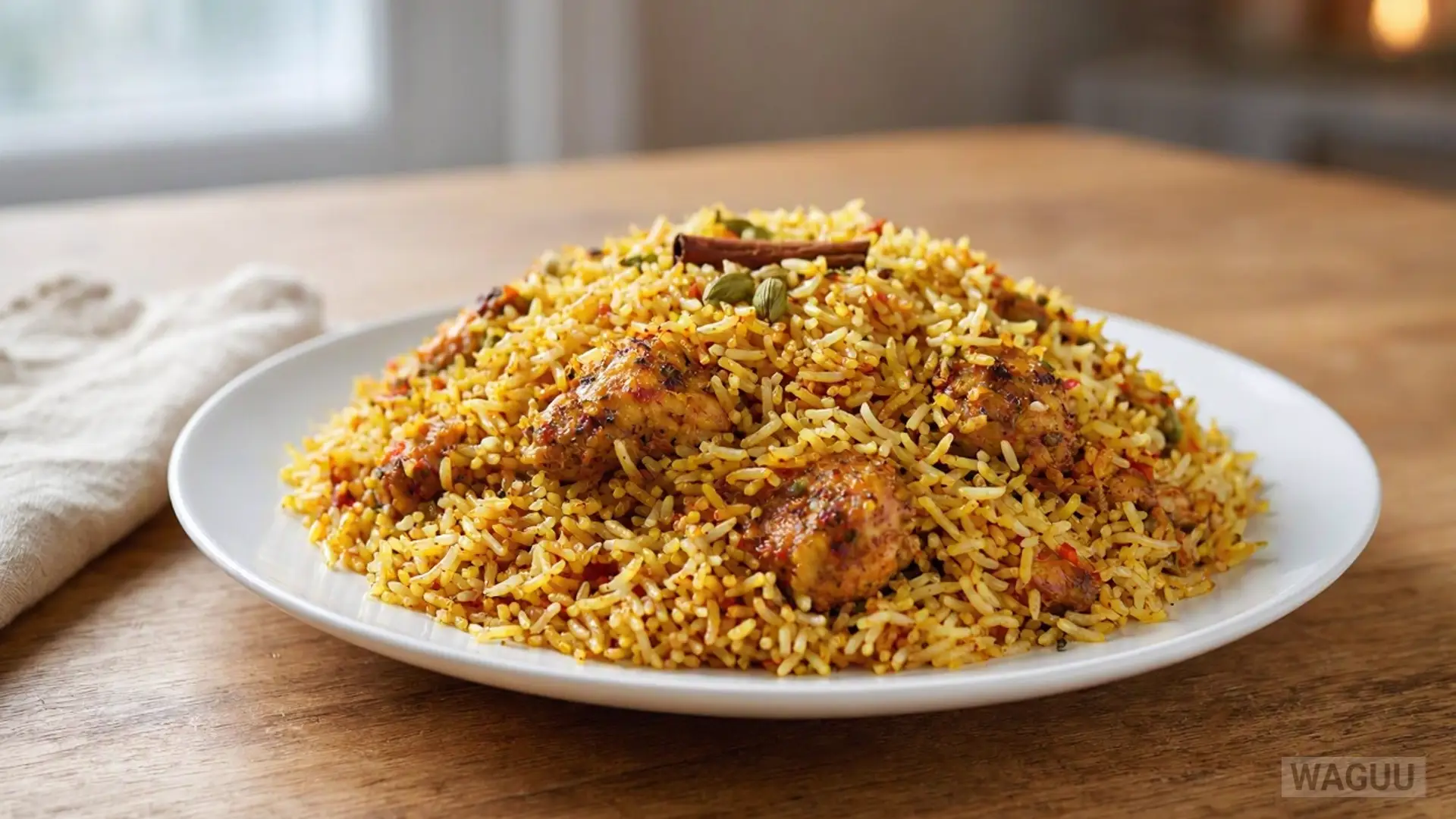
Summary: Biryani – an aromatic, celebratory layered rice dish featuring tender marinated chicken or lamb, fragrant basmati rice infused with saffron and whole spices, caramelized onions, and fresh herbs, prepared in 120 minutes for 6 portions.
Did you cook this recipe? Share the result with the community.
Category: Main Dishes, Indian Cuisine
Success rate: not rated yet% of users successfully made this recipe
Quick overview
- Dish: Biryani
- Category: Main Dishes, Indian Cuisine
- Cuisine: Indian
- Main ingredient: Basmati rice, 600 g (Extra long grain aged basmati)
- Guide: 12 most popular Indian dishes: favourite recipes of Indian cuisine
- Total time: 120 minutes (45 min prep + 75 min cooking)
- Difficulty: Advanced
- Portions: 6 portions (Portion weight: 450 g)
- Key technique: Dum cooking (Sealing the pot with dough for steam infusion)
- Preparation types: Marinating, boiling, frying, steaming
- Dietary info & Allergens: Contains dairy (ghee, yogurt), gluten-free naturally if certified rice is used
- Suitable for: Festive occasions, Sunday family dinners, celebrations
- Nutritional values (per 1 portion): 680 kcal, Protein: 34 g, Fat: 22 g, Carbohydrates: 85 g
- Storage: 3 days in the fridge, 3 months in the freezer
- Pairing: Indian lager beer, dry Riesling, mango lassi
- In short: The ultimate masterpiece of Indian festive cuisine, combining aromatic spiced meat and fragrant basmati rice in perfect harmony.
- Last updated: 2026-03-30
WAGUU says: “Patience is the secret ingredient of authentic Biryani. Never rush the dum sealing process, as the steam is what marries the delicate saffron notes with the robust spice-marinated meat.”
How to take it further: Serve on a white 26 cm plate warmed to 40 °C, keep the full 26 cm plate in frame; place a glass of lassi, a linen napkin and fresh herbs in the softly blurred background.
Key facts
| Prep time: | 45 minutes |
| Cooking time: | 75 minutes |
| Temperature: | 160 °C (Medium heat for steaming) |
| Number of portions: | 6 portions |
In a nutshell
Biryani is a regal dish that transforms simple ingredients into an extraordinary sensory experience. Layers of partially cooked basmati rice are combined with a deeply spiced, yogurt-marinated chicken or lamb base, then sealed tightly in a heavy-bottomed pot to cook in its own aromatic steam. Infused with saffron, fried onions, mint, and cilantro, every spoonful reveals a new layer of complex spices and tender meat.
Ingredients
Base portions: 6 portions • Portion weight: 450 g
| Ingredient | Amount | Quality |
|---|---|---|
| Basmati rice | 600 g | Aged extra-long grain |
| Chicken thighs | 900 g | Boneless, skinless, cut into pieces |
| Plain yogurt | 250 g | Full-fat Greek yogurt |
| Onions | 400 g | Sliced thin for browning |
| Ghee (clarified butter) | 100 g | Traditional aromatic quality |
| Ginger-garlic paste | 40 g | Freshly ground |
| Fresh mint leaves | 30 g | Freshly chopped |
| Fresh cilantro | 30 g | Freshly chopped |
| Saffron threads | 1 g | High grade, bloomed in warm milk |
| Warm milk | 60 ml | Full-fat |
| Garam masala | 15 g | Authentic spice blend |
| Turmeric powder | 5 g | Pure ground |
| Red chili powder | 8 g | Kashmiri chili for color and mild heat |
| Whole spices (cardamom, cloves, cinnamon, bay leaves) | 15 g | Whole aromatic mix |
| Table salt | 35 g | Fine grain sea salt |
| Water | 3000 ml | For boiling rice |
Why you will love this recipe
- Authentic layered technique: Delivers restaurant-quality flavor and texture through traditional dum cooking.
- Harmonious spice balance: Combines warm whole spices with fragrant saffron and tender marinated meat.
- Crowd-pleasing centerpiece: Makes a stunning visual and aromatic presentation for family gatherings and celebrations.
Success guaranteed: Following the exact rice boiling time (precisely 70% cooked) and sealing the pot securely ensures fluffy, separated grains and perfectly tender meat every single time.
Recipe overview
Prep: 45 min | Cooking: 75 min | Difficulty: Advanced | Portions: 6 portions | Type: Main Dish | Origin: Indian
Detailed instructions
Overall progress: 0% complete
Phase 1: Marinating the Meat – 20 min
Appliances: Mixing bowl, refrigerator
1. Combine 900 g of boneless chicken thighs with 250 g of plain Greek yogurt, 40 g of ginger-garlic paste, 15 g of garam masala, 5 g of turmeric powder, 8 g of Kashmiri chili powder, and 15 g of table salt in a large mixing bowl. Mix thoroughly to ensure every piece of meat is evenly coated with the spiced yogurt marinade. Cover the bowl and let it rest in the refrigerator for at least 30 minutes to allow the flavors to penetrate deeply.
VKB: Visual control point: The marinade should thoroughly coat the chicken with a rich red-orange hue and a fragrant aroma of spices.
Before moving to the next step:
Ensure the chicken has marinated for a minimum of 30 minutes so the yogurt enzymes can tenderize the meat fibers properly.
Phase 2: Preparing Fried Onions – 15 min
Appliances: Heavy-bottomed skillet, spatula
2. Heat 50 g of ghee in a heavy-bottomed skillet over medium heat. Add 400 g of thinly sliced onions and fry them stirring frequently for 12 to 15 minutes until they turn deep golden-brown and crispy (known as birista). Remove half of the fried onions with a slotted spoon and set them aside for layering and garnishing later, leaving the remaining onions and flavored ghee in the pan.
VKB: Visual control point: Onions must be evenly caramelized to a rich amber brown without burning, as burnt onions will impart a bitter taste.
Before moving to the next step:
Drain excess oil on paper towels if needed, and keep the reserved fried onions crisp and dry.
Phase 3: Cooking the Meat Base – 20 min
Appliances: Heavy pot, stove
3. Add the marinated chicken and its yogurt sauce into the skillet with the remaining fried onions and ghee. Cook over medium-high heat for 10 minutes, stirring occasionally, until the chicken pieces change color and the yogurt liquid reduces into a thick, clinging masala gravy. Turn off the heat and set the meat base aside.
VKB: Visual control point: The sauce should be rich, thick, and oil should begin to separate slightly at the edges of the pan.
Before moving to the next step:
Ensure the chicken is partially seared and coated in a thick sauce before proceeding to rice preparation.
Phase 4: Boiling the Rice Par-cook – 15 min
Appliances: Large pot, colander
4. Bring 3000 ml of water to a rolling boil in a large pot. Add 15 g of whole spices (cardamom, cloves, cinnamon, bay leaves) and a generous amount of salt. Rinse 600 g of basmati rice thoroughly and add it to the boiling water. Cook the rice for exactly 6 to 7 minutes until it reaches about 70 percent doneness (firm to the bite). Immediately drain the rice in a colander.
VKB: Sensory marker: Rice grains should snap easily when pressed between fingers with a firm core remaining inside.
Before moving to the next step:
Do not overcook the rice during this boiling stage, otherwise it will become mushy during the final steaming process.
Phase 5: Layering the Biryani – 15 min
Appliances: Heavy Dutch oven, spoon
5. In a heavy Dutch oven, spread the chicken masala base evenly across the bottom. Layer half of the drained par-cooked basmati rice over the chicken. Sprinkle half of the reserved fried onions, 30 g of chopped fresh mint, and 30 g of chopped fresh cilantro over the rice. Add the remaining rice on top, followed by the remaining fried onions, herbs, bloomed saffron in 60 ml of warm milk, and 50 g of melted ghee drizzled over the surface.
VKB: Visual control point: Clear alternating layers of spiced meat, white rice, fragrant herbs, golden fried onions, and yellow saffron milk.
Before moving to the next step:
Ensure the layering is neat and evenly distributed so that heat and steam circulate uniformly during cooking.
Phase 6: Dum Steaming and Resting – 30 min
Appliances: Heavy pot with tight lid, stove
6. Seal the Dutch oven tightly with a heavy-fitting lid or wrap the rim with foil before sealing to trap all steam inside. Cook on medium-high heat for 5 minutes to build internal steam, then reduce the heat to the lowest setting (or place on a heat diffuser) and steam for 35 minutes. Turn off the heat and let the biryani rest undisturbed for 10 minutes before opening. Gently fluff and mix the layers when serving.
VKB: Sensory marker: Steam will escape profusely upon opening, revealing tender rice grains infused with golden saffron and rich aromas.
Required equipment
| Utensil | Ideal size | Alternative | Risk |
|---|---|---|---|
| Heavy Dutch oven | 5-liter capacity | Heavy-bottomed stockpot with tight lid | Food burning if pot bottom is too thin |
| Skillet | 28 cm diameter | Sauté pan | Overcrowding when frying onions |
| Colander | Medium mesh | Fine wire sieve | Loss of rice grains through large holes |
Shopping list
Nutritional profile
Values per 1 portion (excluding side dishes). Calculated from average nutritional values of ingredients.
| Nutrient | Per 100 g | Per 1 portion | Per 6 portions |
|---|---|---|---|
| Energy | 151.1 kcal | 680 kcal | 4080 kcal |
| Fat | 4.9 g | 22 g | 132 g |
| of which saturates | 2.9 g | 13 g | 78 g |
| Carbohydrates | 18.9 g | 85 g | 510 g |
| of which sugars | 1.8 g | 8 g | 48 g |
| Protein | 7.6 g | 34 g | 204 g |
| Salt | 1.3 g | 5.8 g | 34.8 g |
Reference intake of an average adult (8400 kJ / 2000 kcal).
WAGUU Pro Level
- Pro standard: Verified recipe with precise ratios and visual control points.
- Tip 1: Use aged basmati rice for at least a year; aged grains contain less moisture and elongate significantly without breaking during boiling.
- Tip 2: Soak the rice in cold water for 30 minutes before boiling to ensure even starch gelatinization.
- Tip 3: Seal the pot lid with a dough rope (atta) for traditional airtight dum cooking if the lid lacks a rubber gasket.
- Tip 4: Never stir the biryani vertically; always use a flat spatula to lift from the bottom so you do not break the long rice grains.
Scientific background
The magic of Biryani lies in the Maillard reaction during the initial browning of onions and meat, coupled with steam distillation during the dum phase. As moisture evaporates from the yogurt-meat base and travels upward through the par-cooked rice grains, it carries fat-soluble aromatic compounds from spices and saffron across every single grain. This precise thermodynamic exchange ensures that each grain of rice absorbs a distinct flavor profile while maintaining structural integrity.
Fine Dining – Professional techniques
- Plate composition: Mold the biryani in a cylindrical ring mold in the center of a warm plate, topping with crispy golden fried onions and fresh mint leaves.
- Textural contrasts: Combine the tender succulent meat and fluffy rice with crunchy toasted cashews and crisp fried onions.
- Temperature contrast: Serve piping hot alongside chilled, refreshing cucumber raita.
- Aromatic garnishes: Finish with edible silver leaf (varak) and a drizzle of rose water or kewra water just before serving.
Sensory radar
- Appearance: A magnificent spectrum of white, yellow saffron, and amber rice grains interspersed with dark meat and golden onions.
- Aroma: Intensely fragrant bouquet of cardamom, cloves, saffron, ghee, and caramelized onions.
- Taste: Deeply savory, aromatic, moderately spiced with a subtle warmth and lingering sweetness from caramelized onions.
- Texture: Fluffy, distinct, long-grain rice paired with melt-in-the-mouth tender chicken and rich gravy.
Pairing
- BEER: Crisp Indian lager or British IPA to balance the rich spices.
- WINE: Off-dry German Riesling or Gewürztraminer with subtle residual sweetness.
- NON-ALCOHOLIC: Traditional sweet or salted mint lassi or fresh lime soda.
Various preparation variants
- Mutton Biryani: Substitute chicken with bone-in lamb shoulder, increasing the marination and braising time accordingly.
- Vegetable Biryani: Replace meat with mixed seasonal vegetables (potatoes, carrots, peas, cauliflower) and paneer cubes.
Allergens and dietary information
Contains: Dairy (ghee, yogurt) • Gluten: Gluten-free (if certified rice and spices are used) • Not suitable for: Vegan diets
Suitable for
Festive occasions, celebratory dinners, weekend cooking projects, and entertaining guests.
Substitution catalog
- Ghee: Clarified butter can be replaced with high-quality neutral cooking oil plus a small pat of unsalted butter.
FAQ
Why did my rice turn mushy?
The rice was overcooked during the initial boiling phase. Ensure it is drained strictly at 70 percent doneness with a firm center.
Can I use normal long-grain white rice instead of basmati?
No, authentic biryani requires aged basmati rice because its grains elongate without breaking and absorb aromatic steam optimally.
How do I prevent the bottom from burning during dum cooking?
Always use a heavy-bottomed Dutch oven and place a cast-iron tawa or heat diffuser underneath the pot on the lowest flame.
Can I make biryani ahead of time?
Yes, you can assemble the layers a few hours in advance, keep it refrigerated, and complete the final dum steaming right before serving.
WAGUU Petr advises: Cooking for 12 or more people?
12–16 people: Double all ingredient quantities and prepare in two separate heavy-bottomed pots to ensure even heat distribution and steam circulation. • 20+ people: Cook the meat base and rice in industrial catering vessels, maintaining the exact same layer proportions and extending the resting time by 15 minutes.
Sides and Serving
- Cucumber Raita – Cool yogurt salad with cucumber and roasted cumin (not included in the recipe)
- Mirchi ka Salan – Tangy peanut and green chili gravy (not included in the recipe)
Serving: Serve hot garnished with fresh mint, cilantro, and fried onions, accompanied by cold raita and lemon wedges.
Storage and reheating
Fridge: 3 days days • Freezer: 3 months months • Reheating: Reheat gently covered in a heavy pot over low heat with a tablespoon of water sprinkled on top, or in a microwave until steaming hot.
Author: WAGUU Petr & Team • Published: 25 Aug 2026 • Updated: 31 Oct 2026
More Recipes from This Article
Guide: 12 most popular Indian dishes: favourite recipes of Indian cuisine
Other recipes you might be interested in
Why WAGUU?
Recipes on WAGUU undergo checks for the accuracy of ingredients, procedures, and nutritional values.
Process photo gallery
Community photos: Cook, take a photo, and share the result.
You can upload photos in the comments below or send them via email.
Did you record a video guide for our recipe? Insert a link to YouTube, YouTube Shorts, TikTok, Instagram Reels, Facebook Reels, Pinterest, Vimeo, or X (Twitter) in the comment – we’d be happy to publish it and help promote you and your content.
Common mistakes
- Overcooking the rice: Boiling the rice completely instead of par-cooking it to 70 percent leads to a mushy texture during dum steaming.
- Skipping the marination time: Failing to marinate the chicken long enough prevents yogurt enzymes and spices from penetrating the meat.
- Leaking steam during dum: Not sealing the pot lid tightly lets essential steam escape, resulting in unevenly cooked rice and dry meat.
- Stirring too aggressively: Mixing the finished biryani vertically breaks the delicate long-grain rice instead of folding the layers gently.