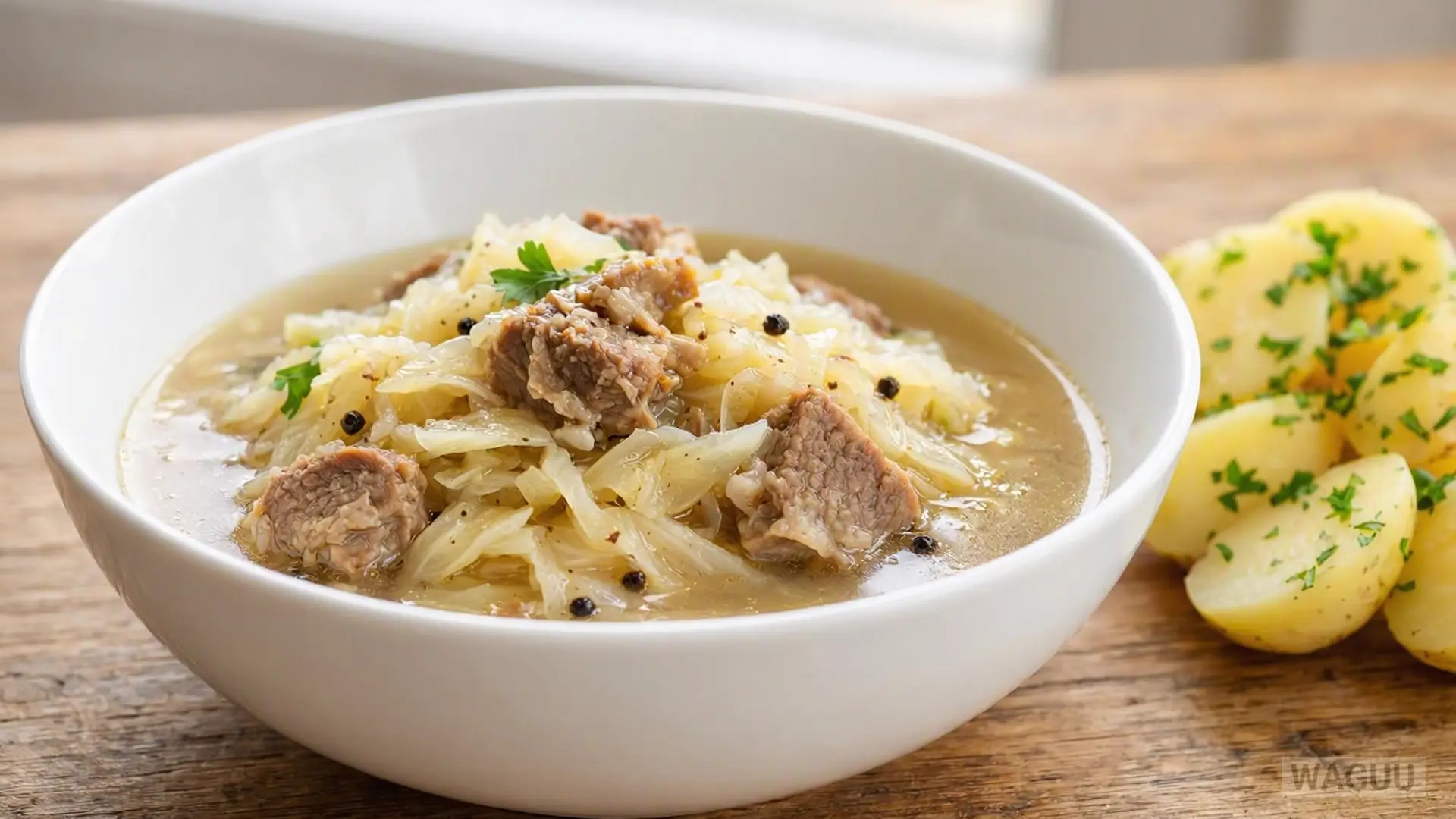
Summary: Fårikål is the national dish of Norway, featuring succulent cuts of lamb layered with fresh white cabbage, whole black peppercorns, a dusting of flour, and water, slow-cooked to tender perfection over 180 minutes and served with boiled potatoes. Preparation time is 30 minutes, total cooking and preparation time is 210 minutes, designed for 6 portions.
Did you cook this recipe? Share the result with the community.
Category: Scandinavian Cuisine, Lamb and Game, Main Dishes
Success rate: not rated yet% of users successfully made this recipe
Quick overview
- Dish: Fårikål
- Category: Scandinavian Cuisine, Lamb and Game, Main Dishes
- Cuisine: Norwegian
- Main ingredient: Lamb shoulder and neck, 1500 g (bone-in pieces)
- Guide: 12 most popular Scandinavian dishes: favourite recipes of Scandinavian cuisine
- Total time: 210 minutes (30 min prep + 180 min cooking)
- Difficulty: Easy
- Portions: 6 portions (Portion weight: 550 g)
- Key technique: Slow-simmering layers
- Preparation types: Braising, boiling
- Dietary info & Allergens: Gluten-free possible (if using cornstarch), lactose-free
- Suitable for: Sunday family dinner, traditional gatherings, autumn feasts
- Nutritional values (per 1 portion): 540 kcal, Protein: 38 g, Fat: 32 g, Carbohydrates: 24 g
- Storage: 3 days in the fridge, 3 months in the freezer
- Pairing: Traditional Norwegian darker lager, Aquavit, lingonberry juice
- In short: The ultimate Norwegian comfort food where tender lamb and sweet cabbage meld into a rich, peppery broth.
- Last updated: October 24, 2023
WAGUU says: “Patience is the secret ingredient in Fårikål; let the heavy pot simmer undisturbed so the collagen breaks down completely.”
Key facts
| Prep time: | 30 minutes |
| Cooking time: | 180 minutes |
| Temperature: | Low simmer (95 °C) |
| Number of portions: | 6 portions |
In a nutshell
Fårikål represents the pinnacle of Norwegian culinary heritage. Celebrated annually on the last Thursday of September, this hearty dish combines economical cuts of bone-in lamb with crisp white cabbage, whole black peppercorns, and flour to create a wonderfully savory sauce. Slow-cooked to melting tenderness, it warms the soul and brings families together around the dining table.
Ingredients
Base portions: 6 portions • Portion weight: 550 g
| Ingredient | Amount | Quality |
|---|---|---|
| Lamb shoulder (bone-in, cut into pieces) | 1500 g | Fresh, marbled with fat |
| White cabbage | 1500 g | Fresh, firm heads |
| Whole black peppercorns | 2 tbsp | Aromatic, freshly opened pack |
| All-purpose flour | 3 tbsp | Standard wheat flour |
| Fine sea salt | 1.5 tbsp | Pure sea salt |
| Water | 500 ml | Clean filtered water |
| Waxy potatoes | 1000 g | Uniform size for boiling |
Why you will love this recipe
- Authentic taste: Delivers the genuine flavor profile of traditional Norwegian home cooking.
- Effortless preparation: Requires minimal active work; the pot does all the heavy lifting on the stove.
- Budget-friendly cuts: Utilizes economical bone-in shoulder cuts that yield incredible depth of flavor.
Success guaranteed: Follow the precise layering method and simmering duration, and you will achieve perfectly tender meat and melt-in-your-mouth cabbage every single time.
Recipe overview
Prep: 30 min | Cooking: 180 min | Difficulty: Easy | Portions: 6 | Type: Main dish | Origin: Norwegian
Detailed instructions
Overall progress: 0% complete
Phase 1: Preparation of Ingredients – 15 min
Appliances: Chef’s knife, cutting board
1. Cut the white cabbage into wedges, removing the tough core, and then slice the wedges into thick chunks. Cut the lamb shoulder into serving-sized pieces, ensuring each piece has a balance of bone, fat, and lean meat. Weigh out the whole black peppercorns, flour, and salt so they are ready for layering.
VKB: Visual key benchmark (VKB): Cabbage wedges are roughly 4 cm thick and meat pieces measure about 5×5 cm.
Before moving to the next step:
Ensure all meat pieces are thoroughly inspected for bone shards from butchering before proceeding to layering.
Phase 2: Layering the Pot – 15 min
Appliances: Heavy-bottomed casserole pot (5-litre capacity)
2. In a large heavy-bottomed casserole pot, arrange a layer of lamb pieces at the bottom with the fatty side facing down. Cover the meat with a layer of cabbage wedges. Sprinkle lightly with a pinch of salt, a dusting of flour, and whole black peppercorns. Repeat the layers until all meat and cabbage are used, finishing with a top layer of cabbage.
VKB: VKB: The pot should be tightly packed, filled to about three-quarters of its total volume.
Before moving to the next step:
Make sure flour is evenly distributed across layers rather than dumped in one spot to prevent lumping.
Phase 3: Adding Liquid and Initial Heat – 15 min
Appliances: Stove burner
3. Pour 500 ml of clean water carefully down the side of the pot so it settles at the base without disturbing the top layer of flour and pepper. Place the pot on the stove over medium-high heat, cover with a tight-fitting lid, and bring the contents to a gentle boil.
VKB: VKB: Steam escapes steadily from beneath the lid and bubbling sounds are clearly audible.
Before moving to the next step:
Verify that the liquid level is visible at the bottom before reducing heat; do not submerge the cabbage completely.
Phase 4: Slow Simmering – 150 min
Appliances: Stove burner set to low
4. Once boiling is achieved, immediately reduce the heat to the lowest possible setting. Maintain a very gentle, quiet simmer with the lid firmly on for 150 minutes. Do not stir the contents during this time, allowing the lamb fat and juices to meld naturally with the softening cabbage.
VKB: VKB: Only minor wisps of steam emerge, and the aroma of tender cooked lamb fills the kitchen.
Before moving to the next step:
Check periodically to ensure the liquid has not completely evaporated; add a splash of water if necessary.
Phase 5: Boiling Potatoes – 20 min
Appliances: Medium saucepan, stove
5. While the Fårikål finishes its final simmering stage, peel the waxy potatoes and place them into a medium saucepan with salted water. Bring to a boil over high heat, then reduce heat to medium and cook until fork-tender, approximately 20 minutes. Drain well.
VKB: VKB: A paring knife slides effortlessly to the center of the largest potato.
Before moving to the next step:
Let drained potatoes sit in the hot dry pan for one minute to steam off excess moisture.
Phase 6: Final Resting and Serving – 10 min
Appliances: Serving bowls, ladle
6. Remove the pot of Fårikål from the heat source and let it rest with the lid on for 10 minutes to allow the flavors to settle. Taste the rich broth and adjust seasoning with additional salt if needed. Ladle generous portions of the tender lamb, melting cabbage, and savory broth into warm shallow bowls alongside the boiled potatoes.
VKB: VKB: Meat falls away effortlessly from the bone and broth is pleasantly translucent with a rich sheen.
Required equipment
| Utensil | Ideal size | Alternative | Risk |
|---|---|---|---|
| Heavy-bottomed pot | 5 litres | Cast iron Dutch oven | Scorching if heat is too high |
| Chef’s knife | 20 cm blade | Santoku knife | Slips on tough cabbage core |
| Saucepan | 3 litres | Standard boiling pot | Boiling over if heat is unmonitored |
Shopping list
Nutritional profile
Values per 1 portion (excluding side dishes). Calculated from average nutritional values of ingredients.
| Nutrient | Per 100 g | Per 1 portion | Per 6 portions |
|---|---|---|---|
| Energy | 98.2 kcal | 540.0 kcal | 3240.0 kcal |
| Fat | 5.8 g | 32.0 g | 192.0 g |
| of which saturates | 2.5 g | 13.8 g | 82.8 g |
| Carbohydrates | 4.4 g | 24.0 g | 144.0 g |
| of which sugars | 2.1 g | 11.5 g | 69.0 g |
| Protein | 6.9 g | 38.0 g | 228.0 g |
| Salt | 0.3 g | 1.6 g | 9.6 g |
Reference intake of an average adult (8400 kJ / 2000 kcal).
WAGUU Pro Level
- Pro standard: Verified recipe with precise ratios and visual control points.
- Tip 1: Use bone-in lamb cuts as the melting bone collagen naturally thickens the broth without needing excessive flour.
- Tip 2: Layer the fattest pieces of lamb near the bottom of the pot to render fat directly through the cabbage.
- Tip 3: Never stir the pot during simmering so the layers and distinct textures remain intact.
- Tip 4: Reheating Fårikål the next day makes it taste even better as the flavors mature overnight.
Scientific background
Long, slow braising at a gentle simmer breaks down the tough collagen in lamb shoulder connective tissue into gelatin, creating a rich mouthfeel. Simultaneously, the sulfur compounds in white cabbage mellow out while cell walls soften, absorbing the rendered lamb fat and peppery aromatic oils from the whole black peppercorns.
Fine Dining – Professional techniques
- Plate composition: Serve in wide rimmed matte ceramic bowls with a neat stack of carved lamb resting against structured cabbage wedges.
- Textural contrasts: Pair the melting tenderness of slow-cooked meat with a sprinkle of freshly cracked toasted pepper on top.
- Temperature contrast: Ensure the boiled potatoes are piping hot when meeting the warm, comforting stew.
- Aromatic garnishes: Garnish minimally with freshly chopped flat-leaf parsley for a vibrant color contrast.
Sensory radar
- Appearance: Rustic, hearty stew with creamy cabbage layers and tender bone-in lamb pieces.
- Aroma: Robust lamb aroma accented by warm, pungent notes of black pepper and sweet cooked cabbage.
- Taste: Deeply savory, mildly sweet from the cabbage, with a pleasant spicy kick from the peppercorns.
- Texture: Exceptionally tender meat that falls off the bone, paired with meltingly soft cabbage leaves.
Pairing
- BEER: Traditional Norwegian dark lager or bock beer.
- WINE: Medium-bodied red wine such as Northern Rhône Syrah or Pinot Noir.
- NON-ALCOHOLIC: Sparkling apple cider or traditional lingonberry cordial.
Various preparation variants
- Oven-baked Fårikål: Assemble in a heavy cast-iron Dutch oven and braise in a preheated oven at 150 °C for 3 hours.
- Herbed variation: Add a sprig of fresh thyme between the layers for an herbaceous aroma.
Allergens and dietary information
Contains: Wheat (flour) • Gluten: Contains gluten (can be substituted with cornstarch) • Not suitable for: Vegans and vegetarians
Suitable for
Sunday family dinner, traditional gatherings, autumn feasts
Substitution catalog
- All-purpose flour: Cornstarch or rice flour for gluten-free thickening.
FAQ
Why should I use bone-in lamb?
Bones release valuable gelatin and minerals during long simmering, giving the broth its characteristic velvety body and rich flavor.
Can I make Fårikål a day in advance?
Yes, Fårikål tastes even better when reheated the next day because the flavors have more time to meld together.
Should I stir the pot while it cooks?
No, stirring breaks up the cabbage wedges and disrupts the layering technique. Let it simmer undisturbed.
What cut of lamb works best?
Traditional cuts include neck chops and shoulder chops because they contain a good ratio of fat, meat, and bone.
WAGUU Petr advises: Cooking for 12 or more people?
12–16 people: Split the recipe into two large heavy-bottomed pots to ensure even heat distribution and prevent overcrowding • 20+ people: Utilize commercial braising pans or multiple stockpots, doubling all ingredients proportionally.
Sides and Serving
- Boiled waxy potatoes – Cooked until tender in salted water (included in recipe)
- Flatbread (Flatbrød) – Traditional Norwegian crispbread (not included in the recipe)
Serving: Serve steaming hot in deep bowls with potatoes on the side or right in the broth.
Storage and reheating
Fridge: 3 days • Freezer: 3 months • Reheating: Reheat gently on the stovetop over medium-low heat until warmed through.
Author: WAGUU Petr & Team • Published: 26 Aug 2026 • Updated: 31 Oct 2026
More Recipes from This Article
Other recipes you might be interested in
Why WAGUU?
Recipes on WAGUU undergo checks for the accuracy of ingredients, procedures, and nutritional values.
Process photo gallery
Community photos: Cook, take a photo, and share the result.
You can upload photos in the comments below or send them via email.
Did you record a video guide for our recipe? Insert a link to YouTube, YouTube Shorts, TikTok, Instagram Reels, Facebook Reels, Pinterest, Vimeo, or X (Twitter) in the comment – we’d be happy to publish it and help promote you and your content.
Common mistakes
- Stirring during cooking – Stirring breaks the cabbage wedges and ruins the distinct layers.
- Using lean meat without bones – Boneless lean cuts result in a dry texture and lack the gelatin needed for a rich broth.
- Adding too much water – Fårikål relies on the moisture released by cabbage; too much water dilutes the flavor.
- Rushing the simmer – Shortening the cooking time leaves the lamb tough and stringy instead of melt-in-the-mouth tender.