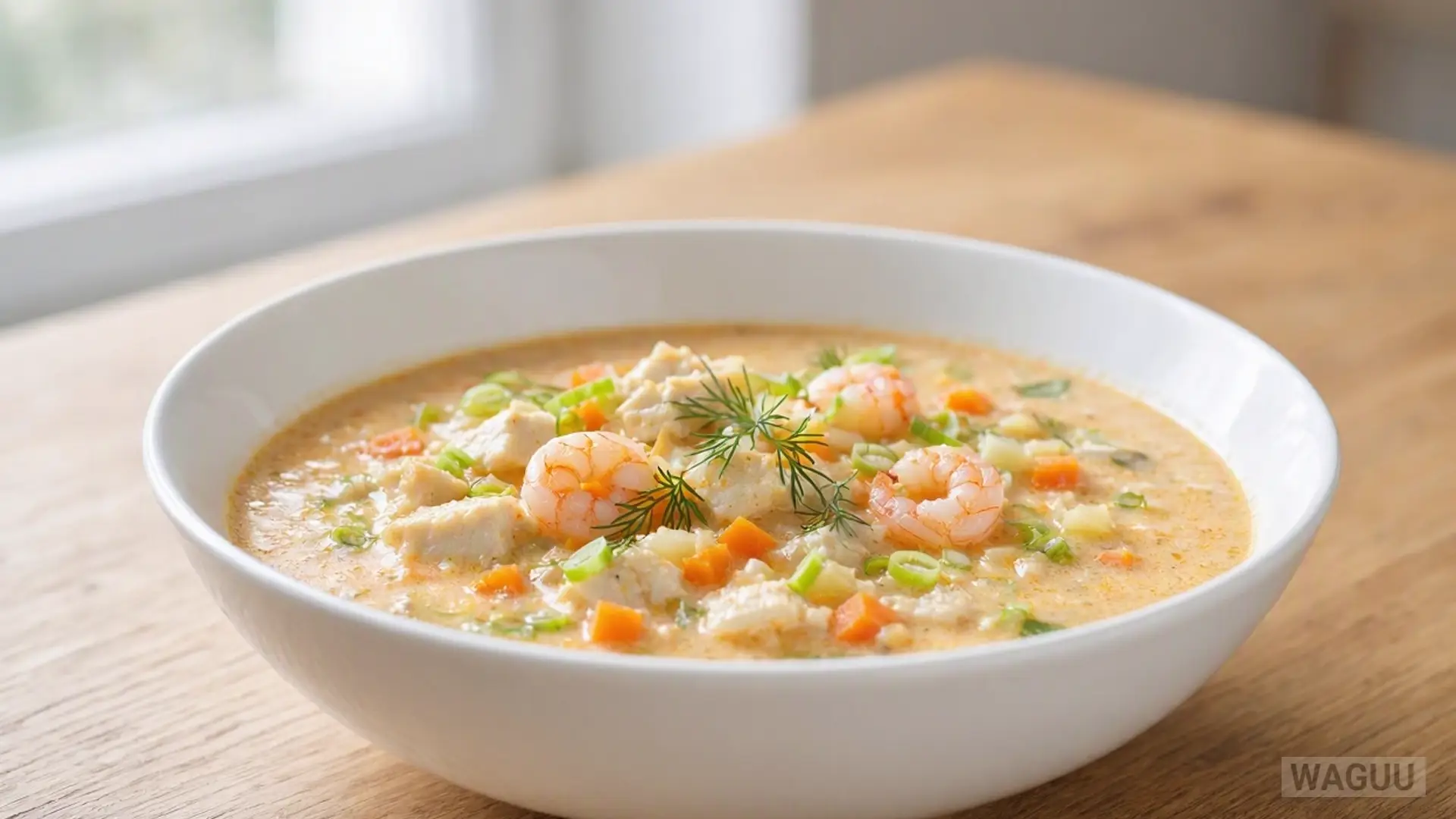
Summary: Fiskesuppe is a traditional Norwegian creamy fish soup loaded with tender pieces of white fish, succulent prawns, aromatic root vegetables, and fresh herbs, varying delightfully by coastal region.
Did you cook this recipe? Share the result with the community.
Category: Soups, Scandinavian Cuisine
Success rate: not rated yet% of users successfully made this recipe
Quick overview
- Dish: Fiskesuppe
- Category: Soups, Scandinavian Cuisine
- Cuisine: Norwegian / Scandinavian
- Main ingredient: White fish fillet, 800 g (fresh cod or salmon)
- Guide: 12 most popular Scandinavian dishes: favourite recipes of Scandinavian cuisine
- Total time: 45 minutes (15 min prep + 30 min cooking)
- Difficulty: Easy
- Portions: 6 portions (Portion weight: 450 g)
- Key technique: Simmering fish stock and gentle poaching of seafood in cream
- Preparation types: Sautéing, simmering, tempering cream
- Dietary info & Allergens: Contains fish, crustaceans, milk/lactose, celery
- Suitable for: Lunch, dinner, festive gatherings, chilly days
- Nutritional values (per 1 portion): 385 kcal, Protein: 28.5 g, Fat: 22.0 g, Carbohydrates: 16.5 g
- Storage: 2 days in the fridge, 1 month in the freezer (without cream)
- Pairing: Pale ale, dry Riesling, sparkling water with lemon
- In short: A velvety, comforting Norwegian fish soup bursting with fresh seafood and vibrant root vegetables.
- Last updated: October 24, 2023
WAGUU says: “Quality fish stock is the secret to an authentic Fiskesuppe; never rush the simmering process of the vegetable and fish trimming base.”
Key facts
| Prep time: | 15 minutes |
| Cooking time: | 30 minutes |
| Temperature: | Gentle simmer at 90 °C |
| Number of portions: | 6 portions |
In a nutshell
Fiskesuppe is the ultimate expression of Norwegian coastal comfort cooking. Rich heavy cream, fragrant butter, delicate fish stock, and a colorful brunoise of root vegetables create a luxurious broth that cradles succulent chunks of fresh cod and sweet prawns. Garnished with freshly chopped dill and chives, this soup warms the soul on the coldest Nordic evenings.
Ingredients
Base portions: 6 portions • Portion weight: 450 g
| Ingredient | Amount | Quality |
|---|---|---|
| Cod fillet (skinless, boneless) | 600 g | Fresh, firm white flesh |
| Salmon fillet (skinless, boneless) | 200 g | Fresh Atlantic salmon |
| Peeled prawns (cooked or raw) | 300 g | North Atlantic prawns |
| Carrots | 2 pcs | Sweet, diced into small cubes |
| Celeriac (root celery) | 150 g | Fresh and firm |
| Leek | 1 pc | Light green and white parts only |
| Unsalted butter | 50 g | High fat content |
| Plain flour | 40 g | All-purpose wheat flour |
| Fish stock | 1000 ml | Homemade or premium quality |
| Heavy cream (35% fat) | 400 ml | Whipping cream |
| Egg yolks | 2 pcs | Fresh eggs for thickening |
| Fresh dill | 20 g | Finely chopped |
| Fresh chives | 20 g | Finely chopped |
| Lemon juice | 30 ml | Freshly squeezed |
| Salt | 12 g | Fine sea salt |
| White pepper | 3 g | Freshly ground |
Why you will love this recipe
- Authentic Nordic Taste: Captured straight from the Norwegian fjords, offering a harmonious blend of sweet seafood and earthy root vegetables.
- Velvety Texture: The combination of heavy cream and an egg-yolk tempering liaison creates an exceptionally smooth, luxurious mouthfeel without any heaviness.
- Quick and Nutritious: Ready in under 45 minutes while packing high-quality lean protein, omega-3 fatty acids, and essential vitamins.
Success guaranteed: Follow the precise temperature cues during the cream and egg tempering stage to avoid curdling, ensuring a silky finish every single time.
Recipe overview
Prep: 15 min | Cooking: 30 min | Difficulty: Easy | Portions: 6 portions | Type: Soup | Origin: Norway
Detailed instructions
Overall progress: 0% complete
Phase 1: Preparing and dicing vegetables – 10 min
Appliances: Chef’s knife, cutting board
1. Peel the carrots and celeriac, then cut them into uniform small dice (brunoise, about 5 mm). Wash the leek thoroughly, halve it lengthwise, and slice it thinly into half-moons. Ensure all vegetable pieces are consistent in size so they cook evenly in the soup.
VKB: Visual knife control (VKB): uniform dice ensure equal texture.
Before moving to the next step:
Ensure root vegetables are cut finely so they tenderise quickly during the short simmering time.
Phase 2: Sautéing the vegetable base – 5 min
Appliances: Large soup pot (4–5 litres), wooden spoon
2. Place the soup pot over medium heat and melt 50 g of unsalted butter. Add the diced carrots, celeriac, and sliced leeks. Sauté gently for 5 minutes, stirring frequently, until the vegetables begin to soften and release their aromatic sweetness without taking on any brown color.
VKB: Vegetables should glisten with butter and smell sweet, temperature kept at medium-low.
Before moving to the next step:
Do not let the butter or vegetables brown, as bitterness will ruin the delicate soup base.
Phase 3: Creating the roux and adding stock – 10 min
Appliances: Soup pot, whisk
3. Sprinkle 40 g of plain flour directly over the sautéed vegetables. Stir continuously with a whisk for 1 minute to cook out the raw flour taste. Gradually pour in 1000 ml of warm fish stock while whisking vigorously to prevent any lumps from forming. Bring the mixture to a gentle simmer and cook for 10 minutes until the root vegetables are tender.
VKB: Liquid must thicken slightly into a smooth, velvety base without flour clumps.
Before moving to the next step:
Whisk constantly when pouring the stock to guarantee a silky, lump-free soup foundation.
Phase 4: Preparing fish and tempering cream – 5 min
Appliances: Small mixing bowl, whisk, knife
4. Cut the 600 g of cod and 200 g of salmon into bite-sized chunks (approximately 3×3 cm). In a small bowl, whisk together 400 ml of heavy cream and 2 egg yolks. Ladle a small amount of the hot soup broth into the cream mixture while whisking constantly (tempering) to prevent the egg yolks from curdling.
VKB: Tempered cream mixture is smooth and warm to the touch.
Before moving to the next step:
Never pour cold cream and raw egg yolks directly into a boiling pot, or the eggs will scramble.
Phase 5: Poaching fish and adding cream – 5 min
Appliances: Soup pot, ladle
5. Reduce the heat under the soup pot to low (sub-simmer, around 85–90 °C). Pour in the tempered cream and egg mixture, stirring gently. Carefully add the cod and salmon pieces. Poach the fish gently for 4–5 minutes without boiling. The fish is done when it opaque and flakes easily.
VKB: Fish pieces remain intact and tender; soup must not boil vigorously.
Before moving to the next step:
Keep the heat low so the delicate fish flesh does not break apart or turn dry.
Phase 6: Finishing with prawns and herbs – 2 min
Appliances: Soup pot, ladle
6. Stir in the 300 g of peeled prawns, 30 ml of fresh lemon juice, 12 g of salt, and 3 g of freshly ground white pepper. Heat through for 1 minute just until the prawns are warm (do not overcook them, or they will become rubbery). Remove from heat, fold in the chopped fresh dill and chives, and serve immediately in warm bowls.
VKB: Prawns are succulent and pink; soup has a vibrant herbaceous aroma.
Required equipment
| Utensil | Ideal size | Alternative | Risk |
|---|---|---|---|
| Soup pot | 4–5 litres | Dutch oven | Too small pot causes overflow when adding cream and stock |
| Wire whisk | Medium (25 cm) | Fork or spiral whisk | Lumps in roux if whisk is not used |
| Chef’s knife | 20 cm blade | Santoku knife | Dull knife mangles delicate fish fillets |
Shopping list
Nutritional profile
Values per 1 portion (excluding side dishes). Calculated from average nutritional values of ingredients.
| Nutrient | Per 100 g | Per 1 portion | Per 6 portions |
|---|---|---|---|
| Energy | 85.6 kcal | 385.0 kcal | 2310.0 kcal |
| Fat | 4.9 g | 22.0 g | 132.0 g |
| of which saturates | 2.8 g | 12.5 g | 75.0 g |
| Carbohydrates | 3.7 g | 16.5 g | 99.0 g |
| of which sugars | 1.2 g | 5.4 g | 32.4 g |
| Protein | 6.3 g | 28.5 g | 171.0 g |
| Salt | 0.4 g | 1.8 g | 10.8 g |
Reference intake of an average adult (8400 kJ / 2000 kcal).
WAGUU Pro Level
- Pro standard: Verified recipe with precise ratios and visual control points.
- Tip 1: Use homemade fish stock prepared from fish heads and bones for unmatched depth of flavor.
- Tip 2: Add a splash of dry white wine to the vegetable base before adding the stock for a subtle acidity.
- Tip 3: Cut all root vegetables to identical sizes so they reach perfect tenderness simultaneously.
- Tip 4: Never let the soup boil after adding the cream and fish to prevent curdling and toughening the seafood.
Scientific background
Fish muscle tissue contains shorter collagen fibers than mammalian meat, making it cook much faster and tenderize at lower temperatures (around 60 °C). Tempering the heavy cream and egg yolks raises their temperature gradually, denaturing egg proteins in a controlled manner that thickens the soup without forming clumps. The high fat content in heavy cream coats the palate, carrying fat-soluble aroma compounds from the dill and fish stock for a longer-lasting flavor experience.
Fine Dining – Professional techniques
- Plate composition: Ladle the steaming soup into pre-warmed deep white porcelain bowls, placing a neat cluster of whole prawns and fresh herbs in the exact center.
- Textural contrasts: Pair the velvety soft cream broth with tender fish flakes and crisp microgreens or toasted rye bread croutons.
- Temperature contrast: Serve the soup piping hot while garnishing with chilled, freshly peeled prawns just before service.
- Aromatic garnishes: Finish with cold-pressed dill oil droplets and edible flower petals for an exquisite restaurant-grade presentation.
Sensory radar
- Appearance: Opaque ivory-cream broth dotted with vibrant orange salmon, white cod, pink prawns, and green herbs.
- Aroma: Rich oceanic scent accented by sweet root vegetables, buttery cream, and fresh dill.
- Taste: Harmonious balance of sweet seafood, saline fish stock, mellow root vegetables, and a bright citrus finish.
- Texture: Silky, smooth, and velvety liquid cradling tender, flaky fish chunks and succulent prawns.
Pairing
- BEER: Crisp Belgian Witbier or Norwegian Pale Ale.
- WINE: Dry German Riesling or crisp French Chablis.
- NON-ALCOHOLIC: Sparkling water with cucumber and fresh lemon slice.
Various preparation variants
- Bergen Style: Features a richer cream and egg yolk liaison (fiskesuppe á la Bergen) with a touch of white wine vinegar.
- Lofoten Coastal Style: Includes smoked fish chunks alongside fresh white fish and potatoes for a heartier meal.
Allergens and dietary information
Contains: Fish, crustaceans, milk/lactose, eggs, celery, gluten • Gluten: Contains wheat flour (can be substituted with cornstarch) • Not suitable for: Vegan, dairy-free, or seafood allergy diets
Suitable for
Lunch, dinner, festive Scandinavian dinners, winter warming meals, family gatherings
Substitution catalog
- Cod fillet: Haddock, pollock, or halibut
- Heavy cream: Cooking cream or crème fraîche
- Fish stock: Vegetable stock or diluted dashi
FAQ
Can I freeze Fiskesuppe?
It is not recommended to freeze soups containing heavy cream and egg yolks, as the dairy tends to separate and grain upon thawing.
What kind of fish is best?
Firm white fish such as cod, saithe, or haddock works best because it holds its shape well during simmering.
Why did my cream curdle?
Curdling happens if the soup is boiled after adding the cream or if the cream was not tempered properly with warm broth.
Can I make this soup in advance?
You can prepare the vegetable and stock base in advance, but add the fish, cream, and seafood just before serving.
WAGUU Petr advises: Cooking for 12 or more people?
12–16 people: Scale all ingredients exactly by double using a large 10-litre stockpot. Poach the fish in two separate batches to avoid overcrowding and breaking the fillets. • 20+ people: Prepare the vegetable and stock base in two separate pots, combine before adding the cream and seafood, and use industrial temperature control.
Sides and Serving
- Fresh crusty sourdough bread – Adds a wonderful rustic crunch (not included in the recipe)
- Boiled buttered potatoes – Traditional Scandinavian accompaniment (not included in the recipe)
Serving: Serve piping hot in deep bowls garnished with extra fresh dill, a wedge of lemon, and a drizzle of melted butter.
Storage and reheating
Fridge: 2 days in an airtight container • Freezer: Not recommended due to dairy content • Reheating: Reheat gently on the stovetop over low heat, stirring constantly. Do not bring to a boil.
Author: WAGUU Petr & Team • Published: 26 Aug 2026 • Updated: 31 Oct 2026
More Recipes from This Article
Other recipes you might be interested in
Why WAGUU?
Recipes on WAGUU undergo checks for the accuracy of ingredients, procedures, and nutritional values.
Process photo gallery
Community photos: Cook, take a photo, and share the result.
You can upload photos in the comments below or send them via email.
Did you record a video guide for our recipe? Insert a link to YouTube, YouTube Shorts, TikTok, Instagram Reels, Facebook Reels, Pinterest, Vimeo, or X (Twitter) in the comment – we’d be happy to publish it and help promote you and your content.
Common mistakes
- Boiling the soup after adding cream – Causes the heavy cream and egg yolks to curdle and ruin the silky texture.
- Overcooking the fish – Boiling fish chunks vigorously breaks them apart and turns them dry and rubbery.
- Skipping the tempering step – Pouring cold dairy into hot broth results in scrambled egg pieces in the soup.
- Uneven vegetable cut – Large, uneven vegetable pieces remain crunchy while small ones turn mushy.