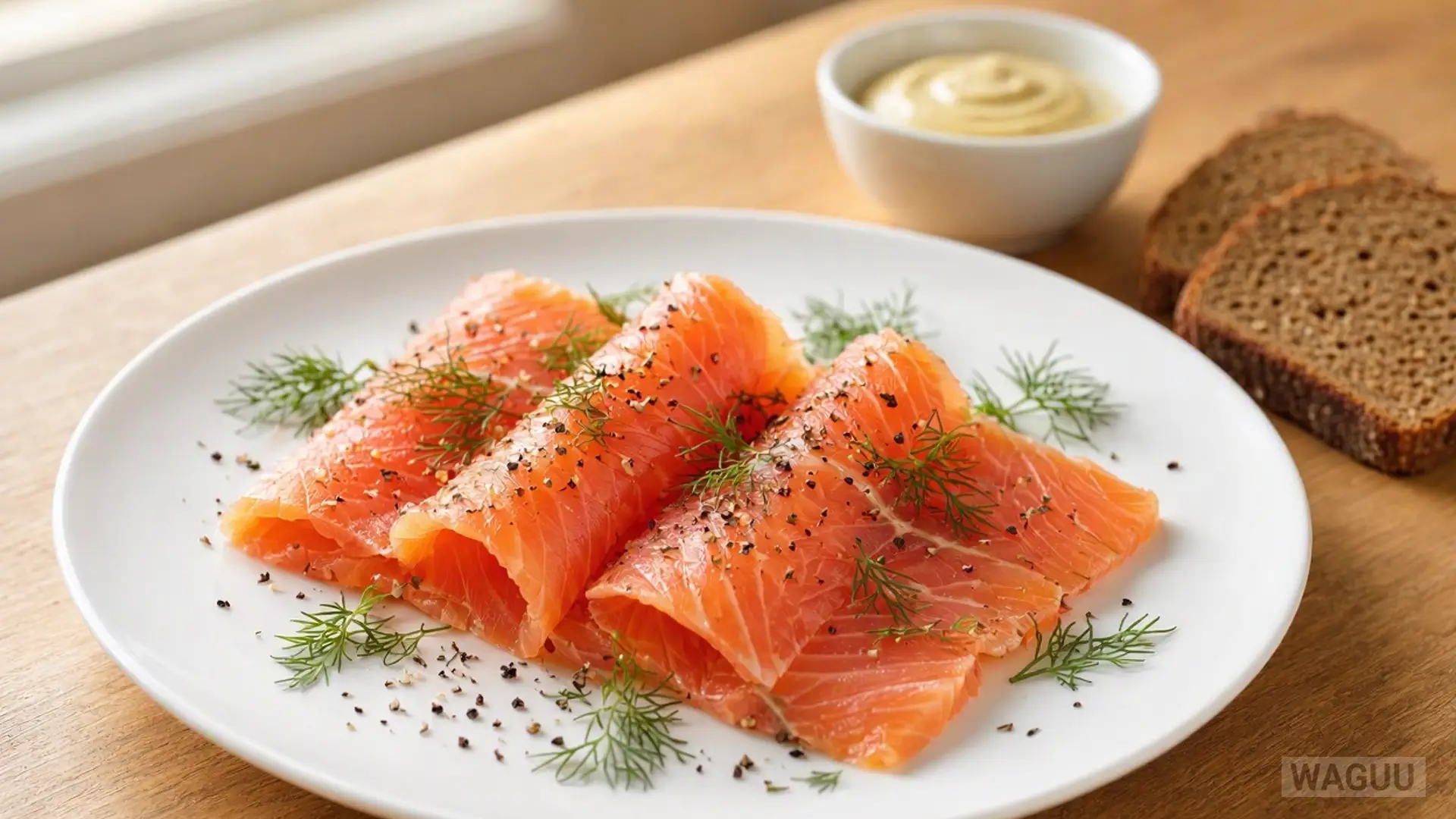
Summary: Gravlax – Scandinavian salmon cured in salt, sugar and dill, sliced thin and served with a mustard sauce and bread. Prepared using dry-curing technique over 48 hours, yielding 6 portions.
Did you cook this recipe? Share the result with the community.
Category: Fish and Seafood, Scandinavian Cuisine
Success rate: not rated yet% of users successfully made this recipe
Quick overview
- Dish: Gravlax
- Category: Fish and Seafood, Scandinavian Cuisine
- Cuisine: Scandinavian
- Main ingredient: Fresh salmon fillet, 1000 g (high-quality sushi grade)
- Guide: 12 most popular Scandinavian dishes: favourite recipes of Scandinavian cuisine
- Total time: 2915 minutes (35 min prep + 2880 min curing)
- Difficulty: Easy
- Portions: 6 portions (Portion weight: 180 g)
- Key technique: Dry salt and sugar curing
- Preparation types: Curing, slicing, sauce whisking
- Dietary info & Allergens: Contains fish, mustard, gluten (bread)
- Suitable for: Festive occasions, starters, special dinners
- Nutritional values (per 1 portion): 320 kcal, Protein: 24.5 g, Fat: 18.2 g, Carbohydrates: 12.4 g
- Storage: 4 days in the fridge, 2 months in the freezer
- Pairing: Pale Lager, Aquavit, Riesling, Sparkling water with lemon
- In short: Exquisite Scandinavian cured salmon with fresh dill and sweet mustard sauce.
- Last updated: 2026-03-30
WAGUU says: “Gravlax represents the pinnacle of Nordic culinary tradition, transforming raw salmon into a silky delicacy through simple yet precise preservation techniques.”
Key facts
| Prep time: | 35 minutes |
| Cooking time: | 48 hours curing |
| Temperature: | 4 °C (refrigerator) |
| Number of portions: | 6 portions |
In a nutshell
Discover the authentic taste of Scandinavia with homemade Gravlax. Fresh salmon is cured with a balanced blend of coarse sea salt, raw cane sugar, crushed white peppercorns, and an abundance of fresh dill. Accompanied by a traditional sweet mustard and dill sauce, this dish is an unforgettable starter.
Ingredients
Base portions: 6 portions • Portion weight: 180 g
| Ingredient | Amount | Quality |
|---|---|---|
| Salmon fillet | 1000 g | Fresh, skin-on, scaled and pin-bones removed |
| Coarse sea salt | 60 g | High-quality sea salt |
| Raw cane sugar | 50 g | Fine granulated |
| Fresh dill | 80 g | Freshly chopped, with stems |
| White peppercorns | 10 g | Coarsely crushed |
| Aquavit | 30 ml | Traditional Scandinavian spirit (optional) |
| Dijon mustard | 40 g | Smooth and sharp |
| Swedish mustard | 40 g | Sweet yellow mustard |
| White wine vinegar | 15 ml | Mild acidity |
| Sunflower oil | 80 ml | Neutral vegetable oil |
| Honey | 20 g | Liquid flower honey |
| Rye bread | 300 g | Traditional dark crispbread or sourdough |
Why you will love this recipe
- Authentic Nordic Taste: Recreates the genuine flavors of traditional Scandinavian coastal cuisine using time-tested methods.
- No Cooking Required: Relies entirely on the natural curing process of salt and sugar to achieve a buttery, tender texture.
- Versatile Presentation: Perfect as a festive starter, buffet centerpiece, or elegant open-faced sandwich topping.
Success guaranteed: Follow the precise curing times and weight ratios for perfectly balanced salinity and silky texture every single time.
Recipe overview
Prep: 35 min | Cooking: 2880 min | Difficulty: Easy | Portions: 6 | Type: Starter / Fish | Origin: Scandinavian
Detailed instructions
Overall progress: 0% complete
Phase 1: Salmon inspection and cleaning – 10 min
Appliances: Refrigerator
1. Inspect the salmon fillet for any remaining pin-bones using culinary tweezers and remove them carefully. Rinse the fillet briefly under cold running water and pat it completely dry with clean paper towels.
VKB: Visual Control Point: The salmon must be completely dry and free of scales and bones before curing.
Before moving to the next step:
Ensure the fish skin is intact and there is no unpleasant odor; use strictly fresh, high-grade salmon.
Phase 2: Preparing the cure mixture – 10 min
Appliances: Mixing bowl
2. In a clean bowl, thoroughly combine 60 g of coarse sea salt, 50 g of raw cane sugar, and 10 g of coarsely crushed white peppercorns. Chop 80 g of fresh dill finely, keeping the aromatic stems included for extra flavor infusion.
VKB: Visual Control Point: Salt and sugar must be evenly distributed to ensure uniform curing across the entire muscle.
Before moving to the next step:
Check that the salt and sugar ratio is accurate; too much salt will make the fish overly firm and dry.
Phase 3: Assembling and wrapping the salmon – 15 min
Appliances: Baking dish, plastic wrap
3. Lay a large sheet of plastic wrap inside a shallow glass or ceramic baking dish. Place half of the chopped dill and cure mixture on the plastic. Lay the salmon fillet skin-side down on top. Scatter the remaining dill, peppercorns, and salt-sugar mixture over the flesh. If desired, drizzle 30 ml of Aquavit evenly over the top. Wrap the plastic tightly around the salmon to seal it completely.
VKB: Visual Control Point: The fillet must be completely coated with the cure and tightly wrapped to prevent liquid leakage.
Before moving to the next step:
Ensure the package is secure so that moisture released during curing is contained within the wrap.
Phase 4: Refrigerated curing process – 2880 min
Appliances: Refrigerator, heavy weight
4. Place a small cutting board or plate directly on top of the wrapped salmon, and weigh it down with 1 to 2 kilograms of canned goods or weights. Place the dish in the refrigerator at 4 °C and let it cure for 48 hours. Turn the salmon package over every 12 hours to redistribute the curing juices evenly.
VKB: Visual Control Point: Liquid will accumulate in the dish as osmosis draws moisture out; the salmon will firm up noticeably.
Before moving to the next step:
Do not skip turning the fish every 12 hours, as uneven curing can result in inconsistent texture.
Phase 5: Preparing the traditional mustard sauce – 15 min
Appliances: Whisk, mixing bowl
5. While the salmon cures, prepare the sauce. In a mixing bowl, whisk together 40 g of Dijon mustard, 40 g of Swedish sweet mustard, 20 g of honey, and 15 ml of white wine vinegar. While whisking continuously in a steady stream, slowly drizzle in 80 ml of sunflower oil until a smooth, emulsified sauce forms. Stir in 20 g of finely chopped fresh dill and season lightly with salt and white pepper.
VKB: Visual Control Point: The sauce should be glossy, thick, and completely emulsified without oil separation.
Before moving to the next step:
Add the oil very gradually at first to prevent the emulsion from breaking.
Phase 6: Unwrapping, slicing, and serving – 15 min
Appliances: Carving knife, cutting board
6. After 48 hours, unwrap the salmon and discard the accumulated liquid. Scrape away the spent dill and spices using the back of a knife and wipe the surface gently with a paper towel. Place the salmon skin-side down on a cutting board. Using a long, flexible slicing knife, cut the salmon at a shallow 45-degree angle into paper-thin slices, leaving the skin behind. Serve immediately with the mustard sauce and slices of rye bread.
VKB: Visual Control Point: Slices should be translucent, even, and cleanly separated from the skin.
Required equipment
| Utensil | Ideal size | Alternative | Risk |
|---|---|---|---|
| Baking dish | 30 x 20 cm | Glass or ceramic tray | Metal reacts with salt |
| Slicing knife | 30 cm flexible blade | Salmon slicer | Dull blade tears the fish |
| Mixing bowl | 1.5 litre capacity | Any ceramic bowl | Spilling during whisking |
Shopping list
Nutritional profile
Values per 1 portion (excluding side dishes). Calculated from average nutritional values of ingredients.
| Nutrient | Per 100 g | Per 1 portion | Per 6 portions |
|---|---|---|---|
| Energy | 177.8 kcal | 320.0 kcal | 1920.0 kcal |
| Fat | 10.1 g | 18.2 g | 109.2 g |
| of which saturates | 1.8 g | 3.2 g | 19.2 g |
| Carbohydrates | 6.9 g | 12.4 g | 74.4 g |
| of which sugars | 5.2 g | 9.4 g | 56.4 g |
| Protein | 13.6 g | 24.5 g | 147.0 g |
| Salt | 3.3 g | 5.9 g | 35.4 g |
Reference intake of an average adult (8400 kJ / 2000 kcal).
WAGUU Pro Level
- Pro standard: Verified recipe with precise ratios and visual control points.
- Tip 1: Always freeze wild-caught salmon for at least 24 hours prior to curing if there is any doubt about parasite safety, though farmed salmon is generally safe.
- Tip 2: Use a long, non-serrated slicing knife dipped in warm water between cuts to achieve perfectly smooth, translucent slices.
- Tip 3: Do not rinse the salmon with water after curing; simply wipe away excess salt and spices with a dry paper towel to maintain ideal seasoning.
- Tip 4: Incorporating fresh dill stems into the cure layer adds deeper herbal complexity compared to using leaves alone.
Scientific background
Gravlax relies on the principle of osmosis. When raw salmon is coated in a dry mixture of sodium chloride (salt) and sucrose (sugar), the high external solute concentration draws moisture out of the fish muscle cells. This dehydration process firms up the protein structure, creating a dense, silky texture while inhibiting bacterial growth. The addition of alcohol (Aquavit) further aids in protein denaturation and imparts subtle botanical notes.
Fine Dining – Professional techniques
- Plate composition: Fan delicate ribbons of salmon across a chilled slate plate, garnishing with sprigs of fresh dill and edible flowers.
- Textural contrasts: Pair the silky, cured fish with crisp rye crackers and pickled mustard seeds for textural variety.
- Temperature contrast: Keep the gravlax strictly refrigerated until the exact moment of plating to maintain optimal firmness.
- Aromatic garnishes: Finish with grated lemon zest and a drop of dill oil for a vibrant visual and olfactory presentation.
Sensory radar
- Appearance: Translucent deep orange-pink flesh garnished with bright green dill.
- Aroma: Fresh oceanic scent combined with sweet dill and subtle pepper notes.
- Taste: Perfectly balanced salty and sweet profile with clean salmon flavor.
- Texture: Silky, tender, and firm with a melt-in-the-mouth consistency.
Pairing
- BEER: Traditional Scandinavian pale ale or pilsner
- WINE: Crisp dry Riesling or Grüner Veltliner
- NON-ALCOHOLIC: Sparkling water with cucumber and fresh dill infusion
Various preparation variants
- Beetroot Gravlax: Add grated raw beetroot to the salt-sugar mixture for a striking ruby-red edge and earthy sweetness.
- Citrus and Gin Gravlax: Substitute Aquavit with gin and incorporate grated orange and lemon zest into the cure.
Allergens and dietary information
Contains: Fish, mustard, gluten (in rye bread) • Gluten: Contains gluten (serve with gluten-free bread for a gluten-free option) • Not suitable for: Fish allergy sufferers
Suitable for
Festive occasions, dinner parties, Easter and Christmas smorgasbord tables, and elegant starters.
Substitution catalog
- Salmon fillet: Sea trout or arctic char
- Aquavit: Vodka or gin
- Sunflower oil: Canola oil or grapeseed oil
FAQ
Do I need to cook the salmon before eating?
No, gravlax is a cured raw fish dish. The combination of salt, sugar, and refrigeration cures the fish safely without heat.
Can I freeze gravlax?
Yes, you can freeze sliced gravlax for up to 2 months, though fresh texture is always superior.
Why do I need to weight down the salmon?
Weighting helps press the cure into the flesh and accelerates the moisture extraction process for a firmer texture.
How long does homemade gravlax last in the fridge?
When wrapped tightly and kept at 4 °C, it stays fresh for up to 4 days.
WAGUU Petr advises: Cooking for 12 or more people?
12–16 people: Prepare two separate 1 kg salmon fillets in individual dishes to ensure even weight distribution and consistent curing. • 20+ people: Scale all ingredients proportionally and use a dedicated catering workstation for slicing just before service.
Sides and Serving
- Boiled new potatoes – Warm or chilled waxy potatoes tossed in butter and dill (not included in the recipe)
- Crisp rye crackers – Traditional Swedish crispbread for crunch (not included in the recipe)
Serving: Serve thin slices on buttered rye bread topped with mustard sauce and extra fresh dill.
Storage and reheating
Fridge: 4 days • Freezer: 2 months • Reheating: Serve chilled; do not reheat.
Author: WAGUU Petr & Team • Published: 26 Aug 2026 • Updated: 31 Oct 2026
More Recipes from This Article
Other recipes you might be interested in
Why WAGUU?
Recipes on WAGUU undergo checks for the accuracy of ingredients, procedures, and nutritional values.
Process photo gallery
Community photos: Cook, take a photo, and share the result.
You can upload photos in the comments below or send them via email.
Did you record a video guide for our recipe? Insert a link to YouTube, YouTube Shorts, TikTok, Instagram Reels, Facebook Reels, Pinterest, Vimeo, or X (Twitter) in the comment – we’d be happy to publish it and help promote you and your content.
Common mistakes
- Using metal containers – Metal reacts with the salt and spoils the delicate flavor of the fish; always use glass or ceramic dishes.
- Skipping the turning step – Failing to turn the salmon every 12 hours results in uneven curing and texture.
- Rinsing the fish with water – Washing the cured salmon introduces excess moisture and dilutes the seasoning; simply wipe it dry.
- Incorrect slicing angle – Cutting perpendicular to the skin instead of at a 45-degree angle prevents getting wide, thin, elegant slices.