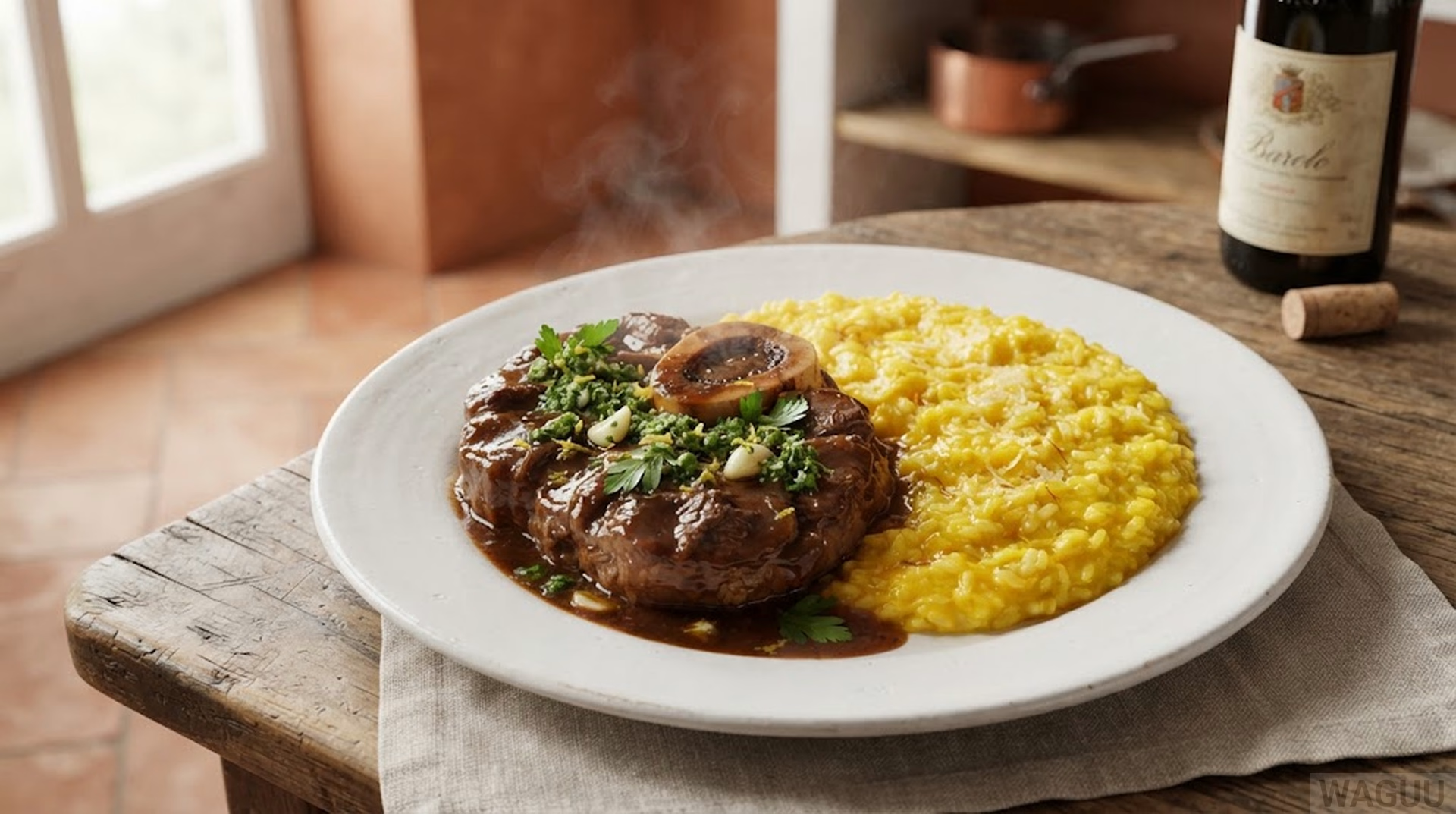
Summary: Slow-braised veal shank, cooked with soffritto, white wine and stock, finished with gremolata. The bone marrow melts into the sauce and gives it body. Serves 6.
Cooked this recipe? Share the result with the community.
Category: Beef, Italian Cuisine
Success rate: not rated yet % of users managed this recipe
Quick Overview
- Dish: Ossobuco alla Milanese
- Category: Beef, Italian Cuisine
- Cuisine: Italian (Milan)
- Main ingredient: Veal shank (bone-in), 6 slices about 300 g each (1800 g total)
- Guide: 12 Most Famous Italian Dishes: Traditional Recipes
- Total time: 150 minutes (30 min preparation + 120 min cooking)
- Difficulty: Hard
- Servings: 6 (portion weight: 450 g)
- Key technique: Slow braising, gremolata
- Preparation types: Braising, reduction
- Dietary info & allergens: Milk, celery
- Suitable for: Festive dinner, Sunday lunch, special occasion
- Nutrition (per portion): 640 kcal, Protein: 52 g, Fat: 38 g, Carbohydrates: 18 g
- Storage: 3 days in the fridge, 2 months in the freezer (without gremolata)
- Pairing: Barolo, Chianti Riserva, sparkling water
- In brief: The marrow is the point. Without it, you have braised veal – good, but not ossobuco.
- Last updated: 23. 9. 2026
WAGUU says: “The marrow is what separates ossobuco from braised veal. Do not skip it, and do not remove it.”
Key Facts
| Preparation: | 30 minutes |
| Cooking: | 120 minutes |
| Temperature: | 160 °C (oven) or gentle simmer on the hob |
| Servings: | 6 |
At a Glance
Deep, glossy braising liquid clinging to tender veal shank, the marrow soft in the middle of the bone, and a bright hit of lemon zest and parsley at the end.
Ingredients
Base servings: 6 servings • Portion weight: 450 g
| Ingredient | Quantity | Quality |
|---|---|---|
| Veal shank slices | 1800 g | 6 slices, about 4 cm thick, bone-in with marrow |
| Plain flour | 60 g | For dusting the veal |
| Butter | 60 g | Unsalted |
| Olive oil | 30 ml | Extra virgin |
| Onion | 120 g | Finely chopped |
| Carrot | 80 g | Finely chopped |
| Celery | 60 g | Finely chopped |
| Dry white wine | 250 ml | Pinot Grigio or similar |
| Veal or beef stock | 600 ml | Hot, homemade if possible |
| Tinned chopped tomatoes | 200 g | Good quality |
| Bay leaf | 2 pcs | Dried |
| Lemon zest (gremolata) | 1 pc | From an unwaxed lemon |
| Garlic (gremolata) | 2 cloves | Finely chopped |
| Fresh parsley (gremolata) | 30 g | Flat-leaf, finely chopped |
| Fine sea salt | 10 g | For seasoning |
| Black pepper | 3 g | Freshly ground |
Why You Will Love This Recipe
- Deep flavour: The marrow melts into the sauce and gives it a rich, glossy body.
- Fork-tender meat: Two hours of braising gives veal that pulls apart with a spoon.
- Gremolata finish: The lemon zest, garlic and parsley lift the dish and cut through the fat.
Why it works: Slow braising at 160 °C breaks down the veal collagen into gelatine, which thickens the sauce and gives it body. The bone marrow melts out of the bone and emulsifies into the sauce, adding richness and a glossy mouthfeel. The gremolata is added at the very end – the lemon zest and parsley are not cooked, so they stay bright and aromatic.
Recipe Overview
Preparation: 30 min | Cooking: 120 min | Difficulty: Hard | Servings: 6 | Type: Main dish | Origin: Italian (Milan)
Detailed Method
Total progress: 0 % done
Phase 1: Prepping the veal – 10 min
Equipment: Kitchen paper, shallow plate, knife
1. Pat the 6 veal shank slices completely dry with kitchen paper. Do not wash them. Tie each slice around the middle with kitchen string if it looks like it might fall apart. Dust both sides with 60 g of plain flour, shaking off the excess.
Visual check: The veal is completely dry before flouring. The flour coating is thin and even, with no wet patches.
Before you continue:
Do not wash the veal. Washing spreads bacteria and prevents the meat from browning. Pat it dry instead.
Phase 2: Browning – 12 min
Equipment: Wide heavy casserole, tongs
2. Heat 30 ml of olive oil and 30 g of butter in a wide heavy casserole over medium-high heat. Brown the veal slices for 3–4 minutes per side until dark golden. Work in batches – do not crowd the pan. Remove and set aside.
Visual check: The veal is deeply browned on both sides. The bottom of the pan has a dark brown crust from the meat.
Phase 3: Soffritto – 10 min
Equipment: Casserole, wooden spoon
3. Reduce the heat to medium-low. Add 30 g of butter and the chopped onion, carrot and celery. Cook for 10 minutes, stirring and scraping the browned bits from the bottom of the pan, until the vegetables are soft and translucent.
Visual check: The vegetables are soft, glossy and pale gold. The bottom of the pan is clean – all the crust has been scraped up.
Phase 4: Wine and stock – 5 min
Equipment: Casserole, wooden spoon
4. Pour in 250 ml of dry white wine and let it bubble for 3–4 minutes until the alcohol smell is gone. Return the veal to the pan. Add 600 ml of hot veal or beef stock, 200 g of tinned chopped tomatoes, 2 bay leaves and season with salt and pepper.
Visual check: The wine has evaporated. The veal sits in the liquid but is not completely submerged – the top of the shank is above the sauce.
Phase 5: Braising – 120 min
Equipment: Oven or hob, lid or foil
5. Cover the casserole and transfer to a preheated oven at 160 °C. Cook for 2 hours, turning the veal slices every 30 minutes. The meat is done when a fork slides in with almost no resistance. If the sauce reduces too much, add a splash of hot stock.
Visual check: The meat is fork-tender, the sauce is thick and glossy, and the marrow has melted into the liquid.
Before you continue:
If the sauce is still thin after 2 hours, remove the lid and reduce on the hob for 10 minutes. It must coat the back of a spoon.
Phase 6: Gremolata and serving – 5 min
Equipment: Small bowl, zester, knife
6. Mix the zest of 1 unwaxed lemon with 2 finely chopped garlic cloves and 30 g of finely chopped flat-leaf parsley. Remove the string from the veal. Serve one slice per plate, spoon the sauce over, and sprinkle a pinch of gremolata on top.
Visual check: The gremolata is bright green and fresh. The sauce coats the meat. The marrow is soft in the middle of the bone.
Required Equipment
| Item | Ideal size | Alternative | Risk |
|---|---|---|---|
| Wide heavy casserole with lid | 30 cm, deep, ovenproof | Cast-iron Dutch oven | Thin pans burn the soffritto and the sauce |
| Kitchen string | For tying shanks | Silicon bands | Without tying, the shank may fall apart |
| Zester | Fine | Fine grater | A coarse grater takes the bitter pith |
Shopping List
Nutrition Profile
Values per 1 portion (without side). Calculated from average nutritional values of the ingredients.
| Nutrient | Per 100 g | Per 1 portion | Per 6 portions |
|---|---|---|---|
| Energy | 142 kcal | 640 kcal | 3840 kcal |
| Fat | 8.4 g | 38 g | 228 g |
| of which saturated | 4.2 g | 19 g | 114 g |
| Carbohydrates | 4 g | 18 g | 108 g |
| of which sugars | 1.3 g | 6 g | 36 g |
| Protein | 11.6 g | 52 g | 312 g |
| Salt | 0.7 g | 3.2 g | 19.2 g |
Reference intake of an average adult (8400 kJ / 2000 kcal).
WAGUU Pro Level
- Pro standard: Tested recipe with exact ratios and visual control points.
- Tip 1: Ask your butcher to cut the shanks about 4 cm thick. Thinner slices dry out during braising.
- Tip 2: Do not remove the marrow. It is the signature of the dish. It melts into the sauce and gives it body.
- Tip 3: Tie the shanks with kitchen string. It keeps them from falling apart during the long braise.
- Tip 4: The gremolata is added at the very end, off the heat. If it is cooked, it loses its aroma.
Scientific Background
Veal shank is rich in collagen – the connective tissue that makes the meat tough in a raw state but silky after long cooking. Collagen breaks down into gelatine at temperatures between 70 and 90 °C, but it needs time and moisture. Two hours at 160 °C in a covered casserole gives exactly that. The bone marrow melts at 40–50 °C and emulsifies into the sauce, adding richness and gloss. The gremolata is a cold garnish added off the heat: the essential oils of lemon zest and parsley are volatile and evaporate when heated, so they are added at the end to keep their aroma.
Fine Dining – Professional Techniques
- Plate composition: One veal shank in the centre of a shallow bowl, sauce spooned over, gremolata on top, risotto alla Milanese on the side.
- Textural contrast: Fork-tender meat, glossy sauce, bright crunch of gremolata, creamy risotto.
- Temperature contrast: Hot meat and sauce, cool gremolata on top.
- Aromatic additions: Lemon zest, parsley, a little garlic – all fresh and added at the end.
Sensory Radar
- Appearance: Deep brown braised shank, golden marrow in the bone, bright green gremolata on top.
- Aroma: Slow-cooked veal, wine, bay leaf, lemon zest and parsley.
- Taste: Rich and savoury, with a bright finish from the gremolata.
- Texture: Fork-tender meat, glossy sauce, marrow soft in the middle.
Pairing
- Beer: A dark Italian birra doppio malto or a Belgian dubbel.
- Wine: Barolo, Chianti Riserva or a young Nebbiolo.
- Non-alcoholic: Sparkling water with a slice of orange.
Variations of Preparation
- With gremolata: The classic Milanese finishing touch – lemon zest, garlic and parsley.
- Ossobuco in bianco: Without tomato – the sauce is based on stock and wine only. Lighter but less deep.
Allergens and Dietary Information
Contains: Milk, celery, gluten (from flour) • Gluten: Contains • Not suitable for: Coeliac disease, lactose intolerance
Suitable For
Festive dinner, Sunday lunch, special occasion, do-ahead cooking.
Substitution Catalogue
- Veal shank: Beef shank (longer cooking – 2.5 hours).
- Plain flour: Rice flour (for gluten-free version).
- Pinot Grigio: Any dry white wine.
FAQ
Can I use beef shank instead of veal?
Yes. Beef shank needs longer braising – about 2.5 hours. The flavour is stronger but still good.
Do I have to eat the marrow?
The marrow melts into the sauce during cooking – it is part of the dish. If you do not want to eat it from the bone, just leave it in the sauce.
Can I make it ahead?
Yes. Make the ossobuco a day ahead – the flavour improves overnight. Add the gremolata just before serving.
What do I serve with it?
Risotto alla Milanese is the traditional partner. Polenta or mashed potatoes also work.
WAGUU Petr advises: Cooking for 6 or more?
6–8 people: One shank per person. Use a larger casserole and increase the liquid by 20 %. • 10+ people: Brown the shanks in batches. Cook in two casseroles to avoid overcrowding.
Storage and Reheating
Fridge: 3 days (without gremolata) • Freezer: 2 months (without gremolata) • Reheating: Reheat gently in a covered pan at 160 °C for 20 minutes. Add fresh gremolata after reheating.
Author: WAGUU Petr & Team • Published: 23 Sep 2026
More Recipes from This Article
More Recipes You Might Like
Why WAGUU?
WAGUU recipes are checked for ingredient accuracy, method consistency and nutritional values.
Photo Gallery from Cooking
Community photos: Cook it, photograph it, share the result.
You can upload photos in the comments below or send them by email.
Filmed a video of this recipe? Paste the link from YouTube, YouTube Shorts, TikTok, Instagram Reels, Facebook Reels, Pinterest, Vimeo or X (Twitter) into a comment – we will publish it and help make you and your content visible.
Most Common Mistakes
- Washing the meat – washing spreads bacteria and prevents browning. Pat it dry instead.
- Not tying the shanks – they may fall apart during the braise.
- Cooking at too high a temperature – 160 °C is correct. Higher heat makes the meat stringy.
- Adding gremolata too early – the lemon zest and parsley lose their aroma when heated.