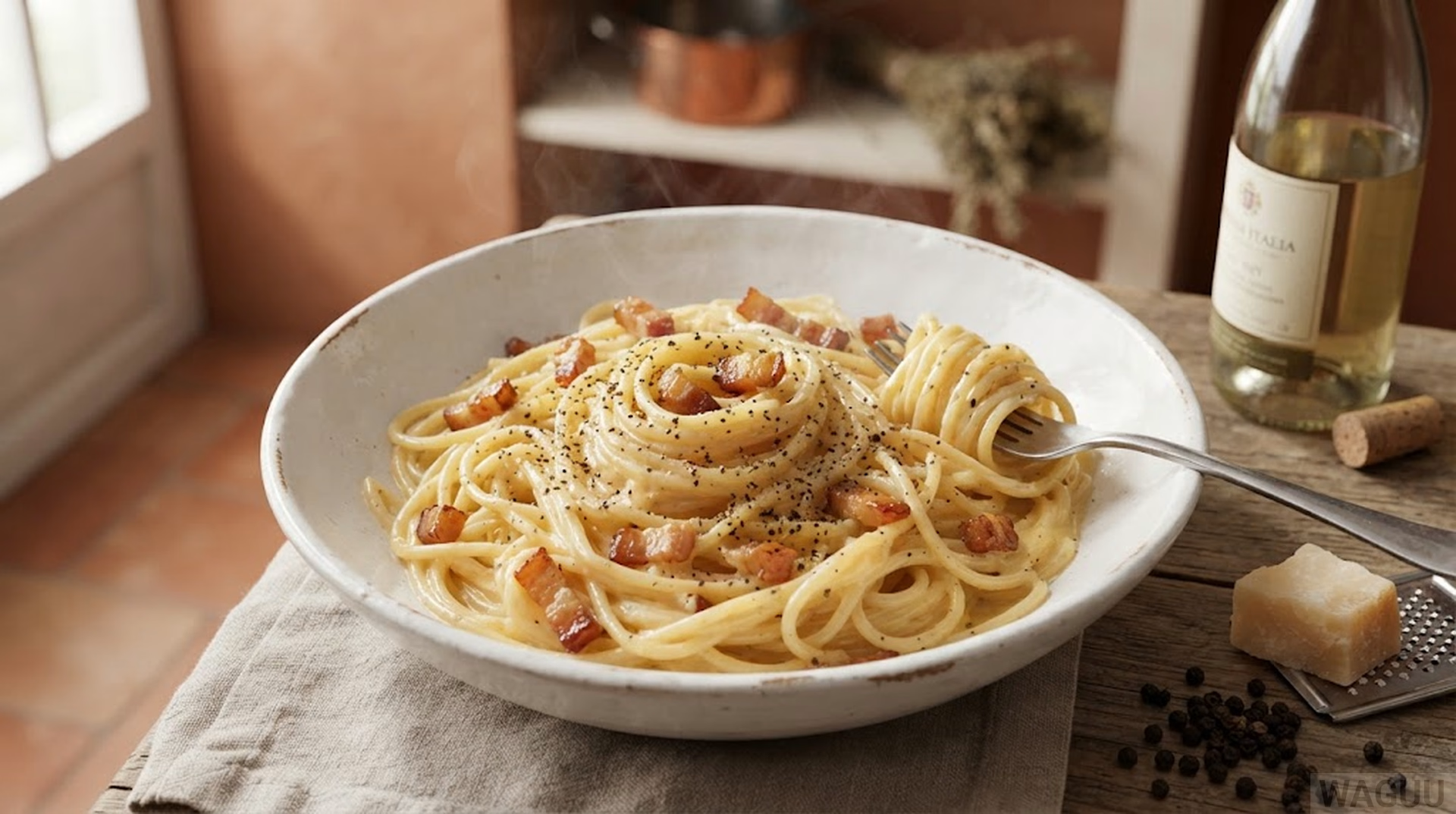
Summary: Roman pasta with a sauce of egg yolk, Pecorino Romano, guanciale fat and starchy pasta water. No cream is used. Ready in 30 minutes. Serves 6.
Cooked this recipe? Share the result with the community.
Category: Pasta, Italian Cuisine
Success rate: not rated yet % of users managed this recipe
Quick Overview
- Dish: Spaghetti alla Carbonara
- Category: Pasta, Italian Cuisine
- Cuisine: Italian (Rome)
- Main ingredient: Spaghetti, 600 g (bronze-cut, durum wheat)
- Guide: 12 Most Famous Italian Dishes: Traditional Recipes
- Total time: 30 minutes (10 min preparation + 20 min cooking)
- Difficulty: Medium
- Servings: 6 (portion weight: 280 g)
- Key technique: Emulsification off the heat
- Preparation types: Boiling, emulsifying
- Dietary info & allergens: Gluten, milk, egg
- Suitable for: Weeknight dinner, quick cooking, small gathering
- Nutrition (per portion): 640 kcal, Protein: 28 g, Fat: 27 g, Carbohydrates: 72 g
- Storage: Not recommended (best fresh), 1 day in the fridge
- Pairing: Frascati, dry white wine, sparkling water
- In brief: Emulsion, not scrambling. Guanciale, not bacon.
- Last updated: 23. 9. 2026
WAGUU says: “Carbonara has no cream. If yours has cream, you are making something else.”
Key Facts
| Preparation: | 10 minutes |
| Cooking: | 20 minutes |
| Temperature: | Gentle heat, no direct flame at the end |
| Servings: | 6 |
At a Glance
A sauce that is nothing more than eggs, cheese, pork fat and starchy water – combined in the right order at the right temperature. That is the whole secret.
Ingredients
Base servings: 6 servings • Portion weight: 280 g
| Ingredient | Quantity | Quality |
|---|---|---|
| Spaghetti | 600 g | Bronze-cut, durum wheat |
| Guanciale | 200 g | Cured pork jowl, cut into 1 cm strips |
| Egg yolks | 6 pcs | Free-range, at room temperature |
| Whole egg | 1 pc | Free-range, at room temperature |
| Pecorino Romano | 120 g | DOP, finely grated |
| Black pepper | 4 g | Freshly ground, coarse |
| Fine sea salt | 20 g | For the pasta water |
Why You Will Love This Recipe
- Five ingredients: Pasta, guanciale, egg, Pecorino, pepper. Nothing else.
- Ready in 30 minutes: No long cooking, no slow reduction.
- Technique, not luck: Once you learn the temperature window, you can repeat it.
Why it works: Egg yolk proteins coagulate between 65 and 70 °C. Below that the sauce stays liquid; above that it scrambles. Combining the sauce off the heat and using starchy pasta water as a buffer keeps the temperature in the correct range and produces a smooth, glossy sauce without any cream.
Recipe Overview
Preparation: 10 min | Cooking: 20 min | Difficulty: Medium | Servings: 6 | Type: Main dish | Origin: Italian (Rome)
Detailed Method
Total progress: 0 % done
Phase 1: Guanciale – 8 min
Equipment: Cold frying pan, knife, wooden spoon
1. Cut 200 g of guanciale into strips about 1 cm wide and 3 cm long. Place them in a cold pan without any oil and set the heat to medium-low. Render slowly for 6–8 minutes until the fat has melted out and the strips are golden but not crispy.
Visual check: The strips are pale gold, the fat is transparent, and the pan has enough fat to cover the base.
Before you continue:
Do not add oil to the pan. Guanciale has enough fat of its own. Oil added at the start burns before the guanciale renders.
Phase 2: Sauce base – 3 min
Equipment: Bowl, whisk, fine grater
2. In a large bowl, whisk 6 egg yolks and 1 whole egg with 120 g of finely grated Pecorino Romano and 4 g of freshly ground black pepper. Whisk until a thick, uniform paste forms.
Visual check: The paste is pale yellow, thick and even. No lumps of cheese.
Phase 3: Pasta – 9 min
Equipment: Large pot, colander, mug
3. Bring 5 litres of water to a rolling boil. Add 20 g of fine sea salt. Add 600 g of spaghetti and cook for 1 minute less than the packet says. Before draining, save 300 ml of the cooking water in a mug.
Visual check: The pasta bends but still has a firm bite at the centre. The water is cloudy and slightly thick.
Before you continue:
Never drain the pasta without saving the water first. Starchy water is the buffer that keeps the sauce from scrambling.
Phase 4: Combining – 3 min
Equipment: Large bowl, tongs or pasta fork
4. Transfer the drained pasta to the bowl with the egg and cheese mixture. Add the guanciale with all its rendered fat. Toss quickly with tongs, adding 100 ml of hot pasta water in two additions, until a glossy sauce coats every strand.
Visual check: The sauce is smooth and creamy, coating the pasta evenly. There are no lumps and no visible egg.
Phase 5: Serving – 2 min
Equipment: Warm plates, extra Pecorino
5. Divide between six warm plates. Finish with a little more grated Pecorino Romano and a twist of black pepper. Serve immediately – carbonara waits for no one.
Visual check: Steam rises from the plate and the sauce still clings to the pasta without separating.
Required Equipment
| Item | Ideal size | Alternative | Risk |
|---|---|---|---|
| Large pot | 5 litres | Two smaller pots | Too little water = sticky pasta |
| Wide frying pan | 28 cm, heavy base | Cast iron skillet | Thin pans burn the guanciale fat |
| Large bowl | 3 litres, heatproof | Warm serving bowl | Cold bowl cools the pasta too fast |
Shopping List
Nutrition Profile
Values per 1 portion (without side). Calculated from average nutritional values of the ingredients.
| Nutrient | Per 100 g | Per 1 portion | Per 6 portions |
|---|---|---|---|
| Energy | 229 kcal | 640 kcal | 3840 kcal |
| Fat | 9.6 g | 27 g | 162 g |
| of which saturated | 4.3 g | 12 g | 72 g |
| Carbohydrates | 25.7 g | 72 g | 432 g |
| of which sugars | 1.1 g | 3 g | 18 g |
| Protein | 10 g | 28 g | 168 g |
| Salt | 1.2 g | 3.3 g | 19.8 g |
Reference intake of an average adult (8400 kJ / 2000 kcal).
WAGUU Pro Level
- Pro standard: Tested recipe with exact ratios and visual control points.
- Tip 1: Use guanciale, not bacon or pancetta. The flavour is completely different.
- Tip 2: The pan must be off the heat when the egg mixture is added. Use the residual heat of the pasta and the fat.
- Tip 3: Serve in warm bowls. Cold plates cool the sauce and it thickens too fast.
- Tip 4: Grind the pepper fresh. Pre-ground pepper loses aroma within days.
Scientific Background
The carbonara sauce is a classic emulsion. Egg yolk contains lecithin, which acts as an emulsifier – it allows fat (from the guanciale) to be suspended in water (from the pasta water) without separating. Starch from the pasta water thickens the mixture and coats the fat droplets, which gives the sauce its glossy, silky texture. The whole thing works only within a narrow temperature window: between 65 and 70 °C the yolk proteins coagulate into a smooth cream. Above 75 °C they contract and squeeze out water, which is what makes scrambled eggs.
Fine Dining – Professional Techniques
- Plate composition: Twist the pasta into a nest in the centre of the plate with a carving fork.
- Textural contrast: Crisp guanciale strips against silky sauce and firm pasta.
- Temperature contrast: Warm plate, hot pasta – the sauce stays fluid through the meal.
- Aromatic additions: A light dusting of freshly ground black pepper over the top just before serving.
Sensory Radar
- Appearance: Pale golden-yellow sauce, glossy, coating the pasta evenly.
- Aroma: Cured pork, sharp Pecorino, black pepper.
- Taste: Salty, savoury, sharp from the cheese, warm heat from the pepper.
- Texture: Silky sauce, firm pasta, slightly crisp guanciale.
Pairing
- Beer: A light Italian birra chiara or a dry pilsner.
- Wine: Frascati Superiore or another dry white from Lazio.
- Non-alcoholic: Still water with a slice of lemon.
Variations of Preparation
- Rigatoni: Same sauce with rigatoni – tubes catch more sauce.
- Without guanciale: Use pancetta (milder, less fat). Do not use bacon.
Allergens and Dietary Information
Contains: Gluten, milk, egg • Gluten: Contains • Not suitable for: Coeliac disease, lactose intolerance, egg allergy
Suitable For
Weeknight dinner, quick cooking, casual entertaining, small gatherings.
Substitution Catalogue
- Guanciale: Pancetta (milder, less fat).
- Pecorino Romano: Parmigiano Reggiano (less salty, less sharp).
- Spaghetti: Rigatoni, bucatini, or any long dried pasta.
FAQ
Why did my carbonara scramble?
The heat was too high, or the pan was still on the hob. Combine the egg mixture with the pasta off the heat.
Can I add cream?
No. Cream changes the dish entirely. The silkiness comes from the emulsion, not from cream.
Can I use bacon?
You can, but the flavour will be different. Guanciale is cured pork jowl – fattier and more savoury than bacon.
Why is my sauce too thick?
You did not add enough pasta water, or the pan was too hot. Add pasta water gradually and keep the mixture moving.
WAGUU Petr advises: Cooking for 6 or more?
6–8 people: Double the sauce but keep pasta water on hand. Work in two batches. • 10+ people: Do not attempt to make carbonara for a large group all at once. Make it in two or three pans and serve as it is finished.
Storage and Reheating
Fridge: Not recommended, but up to 1 day. • Freezer: Not suitable. • Reheating: If reheating leftovers, do so gently in a pan with a splash of water. The sauce will not return to its original silkiness.
Author: WAGUU Petr & Team • Published: 23 Sep 2026
More Recipes from This Article
More Recipes You Might Like
Why WAGUU?
WAGUU recipes are checked for ingredient accuracy, method consistency and nutritional values.
Photo Gallery from Cooking
Community photos: Cook it, photograph it, share the result.
You can upload photos in the comments below or send them by email.
Filmed a video of this recipe? Paste the link from YouTube, YouTube Shorts, TikTok, Instagram Reels, Facebook Reels, Pinterest, Vimeo or X (Twitter) into a comment – we will publish it and help make you and your content visible.
Most Common Mistakes
- Adding cream – it changes the dish. Carbonara relies on emulsion, not cream.
- Scrambling the eggs – the mixture was on the heat. Combine off the heat.
- Using bacon – it is not the same thing. Guanciale has its own flavour and fat.
- Draining without saving water – without starchy water the sauce will not come together.