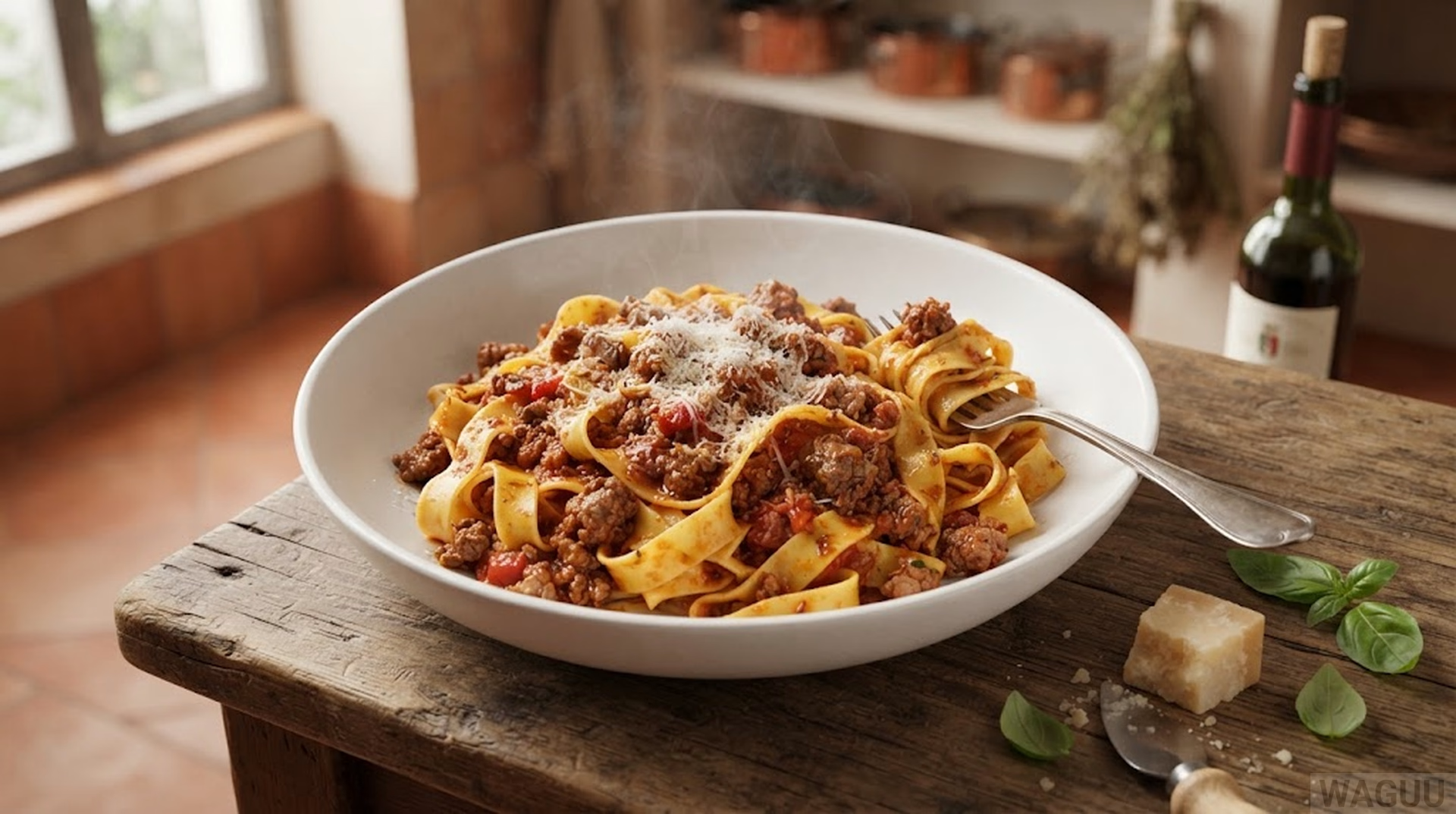
Summary: Fresh egg tagliatelle with a slow-cooked ragù of beef, pork and a small amount of tomato. Finished with Parmigiano Reggiano. The ragù simmers for at least 3 hours. Serves 6.
Cooked this recipe? Share the result with the community.
Category: Pasta, Italian Cuisine
Success rate: not rated yet % of users managed this recipe
Quick Overview
- Dish: Tagliatelle al Ragù
- Category: Pasta, Italian Cuisine
- Cuisine: Italian (Bologna)
- Main ingredient: Fresh egg tagliatelle, 600 g (or dried)
- Guide: 12 Most Famous Italian Dishes: Traditional Recipes
- Total time: 220 minutes (40 min preparation + 180 min cooking)
- Difficulty: Medium
- Servings: 6 (portion weight: 350 g)
- Key technique: Slow braising, reduction
- Preparation types: Braising, boiling
- Dietary info & allergens: Gluten, milk, egg
- Suitable for: Sunday lunch, family gathering, festive dinner
- Nutrition (per portion): 760 kcal, Protein: 38 g, Fat: 32 g, Carbohydrates: 78 g
- Storage: 3 days in the fridge (ragù), 2 months in the freezer (ragù only)
- Pairing: Sangiovese, Chianti Classico, sparkling water
- In brief: The ragù is the dish. The pasta is only the vehicle.
- Last updated: 23. 9. 2026
WAGUU says: “Never serve ragù with spaghetti. The flat tagliatelle holds the sauce; the round spaghetti lets it slide off.”
Key Facts
| Preparation: | 40 minutes |
| Cooking: | 180 minutes (ragù) + 4 minutes (pasta) |
| Temperature: | Gentle simmer, 90–95 °C |
| Servings: | 6 |
At a Glance
Deep red, glossy, slow-cooked ragù clinging to flat golden ribbons of egg pasta. The smell alone tells you the sauce has had time.
Ingredients
Base servings: 6 servings • Portion weight: 350 g
| Ingredient | Quantity | Quality |
|---|---|---|
| Beef mince | 400 g | Coarse ground, 15 % fat |
| Pork mince | 200 g | Coarse ground, 20 % fat |
| Pancetta | 80 g | Cut into small cubes |
| Onion | 120 g | Finely chopped |
| Carrot | 80 g | Finely chopped |
| Celery | 60 g | Finely chopped |
| Dry red wine | 200 ml | Sangiovese or similar |
| Passata | 400 g | Smooth, good quality |
| Beef stock | 300 ml | Hot, homemade if possible |
| Whole milk | 150 ml | Full fat |
| Fresh egg tagliatelle | 600 g | Fresh, or dried (reduce to 500 g) |
| Parmigiano Reggiano | 120 g | Aged 24 months, finely grated |
| Butter | 30 g | Unsalted |
| Fine sea salt | 12 g | For seasoning |
| Black pepper | 3 g | Freshly ground |
Why You Will Love This Recipe
- Authentic ragù: Beef, pork and a small amount of tomato – not a tomato sauce with meat.
- Better the next day: The ragù improves overnight and reheats perfectly.
- Comfort food: Rich, savoury and satisfying – the kind of dish you make on a Sunday.
Why it works: Three hours of slow simmering breaks down the meat collagen into gelatine, which thickens the ragù and gives it body. Milk added at the start softens the acidity of the tomato and adds a subtle sweetness that many cooks miss. The small amount of tomato is deliberate – this is a meat sauce, not a tomato sauce. Tagliatelle is the traditional pasta because its flat surface holds the ragù better than round pasta.
Recipe Overview
Preparation: 40 min | Cooking: 180 min | Difficulty: Medium | Servings: 6 | Type: Main dish | Origin: Italian (Bologna)
Detailed Method
Total progress: 0 % done
Phase 1: Soffritto – 15 min
Equipment: Heavy casserole, wooden spoon, knife
1. Heat a heavy casserole over medium-low heat. Add 80 g of diced pancetta and render for 5 minutes. Add 120 g chopped onion, 80 g chopped carrot and 60 g chopped celery. Cook for 10 minutes, stirring, until soft and sweet, not browned.
Visual check: The vegetables are translucent, glossy and smell sweet. No browning.
Before you continue:
Keep the heat low. Browned vegetables give the ragù a bitter, roasted edge instead of the sweet base it needs.
Phase 2: Meat and wine – 20 min
Equipment: Heavy casserole, wooden spoon
2. Raise the heat to medium. Add 400 g beef mince and 200 g pork mince. Break up the lumps and brown for 8–10 minutes. Pour in 200 ml of dry red wine and let it bubble away completely, about 5 minutes.
Visual check: The meat is evenly browned, no pink left. The wine has evaporated – no alcohol smell.
Phase 3: Ragù simmer – 180 min
Equipment: Casserole with lid, wooden spoon
3. Add 400 g of passata, 300 ml of hot beef stock, 150 ml of whole milk, 12 g of fine sea salt and 3 g of freshly ground black pepper. Bring to a gentle simmer, reduce the heat to low and cover partially. Cook for at least 3 hours, stirring every 20 minutes, until the fat separates and the meat is soft.
Visual check: The sauce is thick, glossy and deep red. The fat pools at the edges. The meat is dark and soft.
Before you continue:
If the ragù is still liquid after 2 hours, remove the lid for the last hour. The sauce must be thick enough to hold its shape on the pasta.
Phase 4: Pasta – 4 min
Equipment: Large pot, colander, mug
4. Bring 5 litres of water to a rolling boil. Add salt. Add 600 g of fresh egg tagliatelle and cook for 3–4 minutes until al dente. Save 200 ml of the cooking water before draining.
Visual check: The pasta bends easily but still has a firm bite at the centre. The water is cloudy.
Phase 5: Combining – 3 min
Equipment: Large pan or bowl, tongs
5. Add the drained pasta to the casserole with the ragù. Add 30 g of butter and a splash of pasta water. Toss over low heat for 1–2 minutes until the sauce clings to every strand.
Visual check: The pasta is coated evenly and the sauce is glossy. No pool of liquid at the bottom of the pan.
Phase 6: Serving – 2 min
Equipment: Warm plates, grater
6. Divide between six warm plates. Finish with grated Parmigiano Reggiano. Serve immediately.
Visual check: Steam rises from the plate, the sauce still clings to the pasta, and the cheese melts slightly on the top.
Required Equipment
| Item | Ideal size | Alternative | Risk |
|---|---|---|---|
| Heavy casserole | 5 litres, thick base | Cast-iron Dutch oven | Thin pans burn the soffritto |
| Large pot | 5 litres | Two smaller pots | Too little water = sticky pasta |
| Wooden spoon | Long handle | Silicone spatula | Metal spoons can scratch the pan |
Shopping List
Nutrition Profile
Values per 1 portion (without side). Calculated from average nutritional values of the ingredients.
| Nutrient | Per 100 g | Per 1 portion | Per 6 portions |
|---|---|---|---|
| Energy | 217 kcal | 760 kcal | 4560 kcal |
| Fat | 9.1 g | 32 g | 192 g |
| of which saturated | 4.3 g | 15 g | 90 g |
| Carbohydrates | 22.3 g | 78 g | 468 g |
| of which sugars | 2.6 g | 9 g | 54 g |
| Protein | 10.9 g | 38 g | 228 g |
| Salt | 0.8 g | 2.8 g | 16.8 g |
Reference intake of an average adult (8400 kJ / 2000 kcal).
WAGUU Pro Level
- Pro standard: Tested recipe with exact ratios and visual control points.
- Tip 1: Make the ragù a day ahead. The flavour improves overnight.
- Tip 2: Use passata, not chopped tomatoes. Chopped tomatoes have firm pieces that do not break down.
- Tip 3: Add the milk at the beginning. It softens the meat and reduces the acidity of the tomato.
- Tip 4: Fresh egg tagliatelle cooks in 3–4 minutes. Do not overcook it.
Scientific Background
The three-hour simmer is chemistry, not tradition. Collagen in the meat breaks down into gelatine at temperatures between 70 and 90 °C, which thickens the sauce and gives it body. The tomato sauce concentrates as water evaporates, which intensifies the sugars and acids. The milk proteins and lactose soften the acidity of the tomato and add a subtle sweetness. The final result is a sauce where the fat has separated from the meat proteins – that is why you see a glossy layer at the edges of the pan.
Fine Dining – Professional Techniques
- Plate composition: Twist the tagliatelle into a nest with a carving fork, sauce pooled around the base.
- Textural contrast: Flat pasta ribbons against the deep, meaty ragù.
- Temperature contrast: Warm plates, hot pasta, cool Parmigiano freshly grated on top.
- Aromatic additions: A few leaves of fresh basil on the plate, not in the pan.
Sensory Radar
- Appearance: Deep red ragù coating golden flat ribbons of egg pasta.
- Aroma: Slow-cooked tomato, red wine, beef and pork, aged cheese.
- Taste: Deeply savoury, slightly sweet from the milk and vegetables, sharp finish from the Parmigiano.
- Texture: Tender but firm pasta, rich and glossy sauce.
Pairing
- Beer: A dark Italian birra doppio malto or a Belgian dubbel.
- Wine: Sangiovese, Chianti Classico or a young Barbera.
- Non-alcoholic: Sparkling water with a slice of orange.
Variations of Preparation
- Pappardelle: Wider ribbons that hold even more sauce.
- Vegetarian ragù: Use lentils or mushrooms instead of meat. The technique is the same.
Allergens and Dietary Information
Contains: Gluten, milk, egg • Gluten: Contains • Not suitable for: Coeliac disease, lactose intolerance
Suitable For
Sunday lunch, family gathering, festive dinner, do-ahead cooking.
Substitution Catalogue
- Fresh egg tagliatelle: Dried tagliatelle (cook 8 minutes), pappardelle, fettuccine.
- Parmigiano Reggiano: Grana Padano (milder, less expensive).
- Passata: Tinned chopped tomatoes, blended smooth.
FAQ
Can I use spaghetti instead?
You can, but it is not traditional. Flat pasta holds the ragù better. Spaghetti lets the sauce slide off.
Why add milk to the ragù?
The milk proteins and lactose soften the acidity of the tomato and add a subtle sweetness. It is part of the authentic recipe.
How long does the ragù keep?
Up to 3 days in the fridge, 2 months in the freezer. It also tastes better the next day.
Can I make the ragù in a slow cooker?
Yes. Brown the meat and soffritto on the hob, then transfer to a slow cooker for 6 hours on low.
WAGUU Petr advises: Cooking for 6 or more?
6–8 people: Double the ragù but keep the tomato low. The ragù must taste of meat, not tomato. • 10+ people: Cook the ragù in two pans and combine at the end. One pan of ragù for 12 is uneven.
Storage and Reheating
Fridge: 3 days (ragù only) • Freezer: 2 months (ragù only) • Reheating: Reheat the ragù gently in a pan with a splash of stock or water. Cook the pasta fresh.
Author: WAGUU Petr & Team • Published: 23 Sep 2026
More Recipes from This Article
More Recipes You Might Like
Why WAGUU?
WAGUU recipes are checked for ingredient accuracy, method consistency and nutritional values.
Photo Gallery from Cooking
Community photos: Cook it, photograph it, share the result.
You can upload photos in the comments below or send them by email.
Filmed a video of this recipe? Paste the link from YouTube, YouTube Shorts, TikTok, Instagram Reels, Facebook Reels, Pinterest, Vimeo or X (Twitter) into a comment – we will publish it and help make you and your content visible.
Most Common Mistakes
- Too much tomato – this is a meat sauce, not a tomato sauce. Keep the passata low.
- Rushing the ragù – three hours is the minimum. Less time equals less flavour.
- Not browning the meat – the Maillard reaction during browning is what gives the ragù its depth.
- Skipping the milk – without it the sauce tastes harsh and acidic.