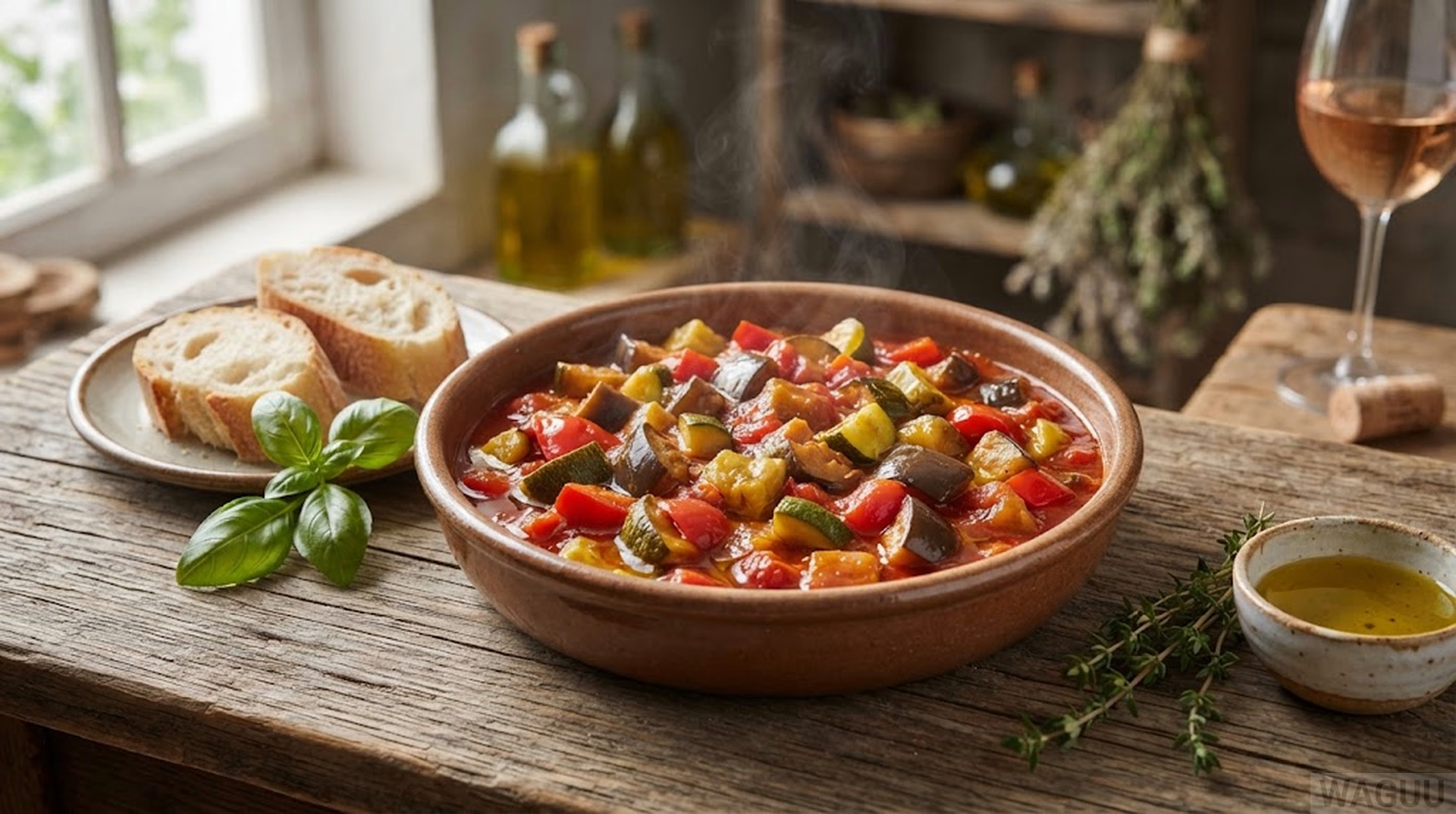
Summary: Provençal vegetable stew with aubergine, courgette, and tomato, each cooked separately. Ready in 90 minutes, serves 6.
Cooked this recipe? Share your result with the community.
Category: Meatless Dishes, French Cuisine
Success rate: not rated yet % of users mastered this recipe
Quick overview
- Dish: Ratatouille
- Category: Meatless Dishes, French Cuisine
- Cuisine: French
- Main ingredient: Aubergine, 400 g (firm, glossy skin)
- Guide: 12 Most Famous French Dishes
- Total time: 90 minutes (30 min prep + 60 min cooking)
- Difficulty: Easy
- Servings: 6 (Portion weight: 300 g)
- Key technique: Separate vegetable cooking
- Preparation types: Sautéing, simmering
- Dietary info & allergens: Vegan, gluten-free, lactose-free
- Suitable for: Lunch, dinner, side dish, meal prep
- Nutritional values (per serving): 180 kcal, Protein: 4 g, Fat: 12 g, Carbs: 14 g
- Storage: 4 days in fridge, 3 months in freezer
- Pairing: Rosé, light red wine, sparkling water
- In short: Each vegetable cooked separately – that is the secret of a true ratatouille.
- Last updated: 24. 9. 2026
WAGUU says: “A ratatouille is not a mush. Each vegetable should still taste of itself.”
Key facts
| Prep time: | 30 minutes |
| Cooking time: | 60 minutes |
| Temperature: | Medium heat (hob) |
| Servings: | 6 |
At a glance
A Provençal vegetable stew where each vegetable is cooked separately, then combined. The result is a dish where every element keeps its own character.
Ingredients
Base servings: 6 • Portion weight: 300 g
| Ingredient | Amount | Quality |
|---|---|---|
| Aubergine | 400 g | Firm, glossy skin |
| Courgette | 400 g | Medium, firm |
| Red peppers | 2 pieces | Medium, deseeded |
| Brown onions | 2 pieces | Medium, sliced |
| Garlic | 4 cloves | Crushed |
| Ripe tomatoes | 600 g | Chopped |
| Tomato purée | 2 tbsp | Double concentrate |
| Olive oil | 6 tbsp | Extra virgin |
| Fresh thyme | 4 sprigs | Or 1 tsp dried |
| Bay leaves | 2 pieces | Dried |
| Fresh basil | 10 leaves | To garnish |
| Fine sea salt | 1 tsp | To taste |
| Black peppercorns | 1 tsp | Freshly ground |
Why you will love this recipe
- Every vegetable tastes of itself: Cooking them separately preserves their texture and character.
- Better the next day: The flavours deepen overnight. Serve it cold as a spread or hot as a side dish.
- Vegan and gluten-free: Naturally free from animal products and gluten.
Why it works: Cooking each vegetable separately prevents them from turning into a mush. The aubergine absorbs oil and becomes silky. The courgette stays firm. The peppers add sweetness. The tomatoes bind everything together.
Recipe overview
Prep: 30 min | Cook: 60 min | Difficulty: Easy | Servings: 6 | Type: Main or side | Origin: French
Detailed method
Total progress: 0 % done
Phase 1: Preparation – 20 min
Equipment: Chopping board, knife
1. Cut the aubergine and courgette into 2 cm cubes. Deseed the peppers and cut into 2 cm pieces. Slice the onions. Crush the garlic. Chop the tomatoes.
VKB: All vegetables are cut into even pieces. This ensures even cooking.
Before you continue:
Do not peel the aubergine or courgette. The skin holds the vegetable together and adds flavour.
Phase 2: Cooking the aubergine – 15 min
Equipment: Large frying pan
2. Heat 3 tablespoons of olive oil in a large frying pan. Add the aubergine cubes and fry until golden and soft, about 10 minutes. Remove and set aside on kitchen paper.
VKB: Aubergine is golden brown and soft. It has absorbed the oil.
Before you continue:
Do not overcrowd the pan. The aubergine should fry, not steam. Cook in batches if needed.
Phase 3: Cooking the courgette and peppers – 15 min
Equipment: Frying pan
3. Add 2 tablespoons of olive oil to the pan. Fry the courgette until golden and slightly soft, about 5 minutes. Remove and set aside. Fry the peppers for 5 minutes until softened. Remove and set aside.
VKB: Courgette is golden and firm. Peppers are soft and sweet.
Before you continue:
Do not overcook the courgette. It should be golden but still hold its shape.
Phase 4: Making the sauce – 15 min
Equipment: Large pot, wooden spoon
4. Heat the remaining tablespoon of olive oil in a large pot. Add the onions and cook for 5 minutes until softened. Add the garlic and cook for 1 minute. Add the tomatoes, tomato purée, thyme, and bay leaves. Simmer for 10 minutes until the sauce thickens.
VKB: The sauce is thick and fragrant. The tomatoes have broken down.
Before you continue:
Do not let the garlic burn. It becomes bitter. Cook it gently.
Phase 5: Combining – 10 min
Equipment: Large pot
5. Add the cooked aubergine, courgette, and peppers to the tomato sauce. Stir gently to combine. Simmer for 10 minutes to allow the flavours to meld. Taste and adjust the seasoning.
VKB: The vegetables are coated in the sauce. Each vegetable is still distinct.
Before you continue:
Stir gently. You do not want to break up the vegetables. A ratatouille should have texture.
Phase 6: Finishing – 5 min
Equipment: Serving bowl
6. Remove from the heat. Stir in the fresh basil leaves. Serve hot, warm, or cold. Ratatouille tastes even better the next day.
VKB: The basil is wilted. The ratatouille is fragrant and rich.
Required equipment
| Equipment | Ideal size | Alternative | Risk |
|---|---|---|---|
| Large frying pan | 28 cm | Sauté pan | Overcrowding steams the vegetables |
| Large pot | 4–5 litres | Casserole dish | Small pot overcrowds the vegetables |
| Chopping board | Large | Any flat surface | Cross-contamination if not cleaned |
Shopping list
Nutritional profile
Values per 1 serving (without side dish). Calculated from average nutritional values of ingredients.
| Nutrient | Per 100 g | Per 1 serving | Per 6 servings |
|---|---|---|---|
| Energy | 60 kcal | 180 kcal | 1080 kcal |
| Fat | 4 g | 12 g | 72 g |
| of which saturates | 0.6 g | 1.8 g | 10.8 g |
| Carbohydrates | 4.7 g | 14 g | 84 g |
| of which sugars | 2.7 g | 8 g | 48 g |
| Protein | 1.3 g | 4 g | 24 g |
| Salt | 0.4 g | 1.2 g | 7.2 g |
Reference intake of an average adult (8400 kJ / 2000 kcal).
WAGUU Pro level
- Pro standard: Verified recipe with precise ratios and visual control points.
- Tip 1: Salt the aubergine 30 minutes before cooking. It draws out moisture and prevents it from absorbing too much oil.
- Tip 2: Cook each vegetable separately. This is the difference between a ratatouille and a vegetable mush.
- Tip 3: Add the basil at the very end. Heat destroys its aroma.
- Tip 4: Ratatouille tastes even better the next day. Make it ahead and reheat gently.
Scientific background
Cooking each vegetable separately prevents them from turning into a mush. The aubergine absorbs oil and becomes silky. The courgette stays firm. The peppers add sweetness. The tomatoes bind everything together. The Maillard reaction during frying adds depth of flavour.
Fine Dining – Professional techniques
- Plate composition: Serve in a shallow bowl. Add a drizzle of olive oil and a few basil leaves.
- Texture contrast: Serve with toasted sourdough rubbed with garlic.
- Temperature contrast: Serve cold as a spread on toast, or hot as a side dish.
- Aromatic additions: Add a little orange zest for a citrus note.
Sensory radar
- Appearance: Deep red sauce with golden aubergine, green courgette, and red peppers.
- Aroma: Tomatoes, garlic, thyme, and basil.
- Taste: Sweet, savoury, with the acidity of the tomatoes balanced by the sweetness of the peppers.
- Texture: Each vegetable is distinct. The sauce is rich.
Pairing
- Wine: Provençal rosé or a light red wine.
- Beer: A light lager or wheat beer.
- Non-alcoholic: Sparkling water with a slice of lemon.
Different variations
- Ratatouille Confite: A slow-cooked version where the vegetables are baked together for hours.
- Ratatouille with eggs: Add beaten eggs at the end for a Provençal omelette.
Allergens and dietary information
Contains: None of the major allergens • Gluten: Gluten-free • Not suitable for: Nightshade allergies
Suitable for
Lunch, dinner, side dish, meal prep, vegan, gluten-free
Substitution catalogue
- Aubergine: Courgette or mushrooms
- Courgette: Aubergine or squash
- Fresh basil: Dried oregano or thyme
FAQ
Can I make this ahead of time?
Yes. It tastes even better the next day. Store in the fridge and reheat gently on the hob.
Can I use tinned tomatoes?
Yes, but fresh tomatoes give a brighter flavour. Use good-quality tinned tomatoes if fresh are not available.
Why is my ratatouille watery?
The vegetables may not have been cooked long enough, or the tomatoes were too watery. Simmer uncovered for a few more minutes.
Can I freeze ratatouille?
Yes. Freeze in portions for up to 3 months. Thaw overnight in the fridge and reheat gently.
WAGUU Petr advises: Cooking for 6 or more?
6–8 people: Double the recipe but use a larger pot. 10+ people: Make two batches. Ratatouille is even better the next day.
Serving suggestion
Storage and reheating
Fridge: 4 days • Freezer: 3 months • Reheating: Gently on the hob. Do not boil.
Author: WAGUU Petr & Team • Published: 25 Sep 2026
More recipes from this article
Guide: 12 Most Famous French Dishes
More recipes you might like
Why WAGUU?
Recipes on WAGUU are checked for accuracy of ingredients, methods, and nutritional values.
Photo gallery from the process
Community photos: Cook, photograph, and share your result.
You can upload photos in the comments below or send them by email.
Did you film a video of our recipe? Paste a link to YouTube, YouTube Shorts, TikTok, Instagram Reels, Facebook Reels, Pinterest, Vimeo or X (Twitter) in the comments – we will publish it and help promote you and your content.
Most common mistakes
- Cooking all vegetables together – Each vegetable has a different cooking time. Cook them separately.
- Not salting the aubergine – Salting draws out moisture and prevents it from absorbing too much oil.
- Overcrowding the pan – The vegetables should fry, not steam. Cook in batches.
- Adding basil too early – Heat destroys its aroma. Add it at the very end.