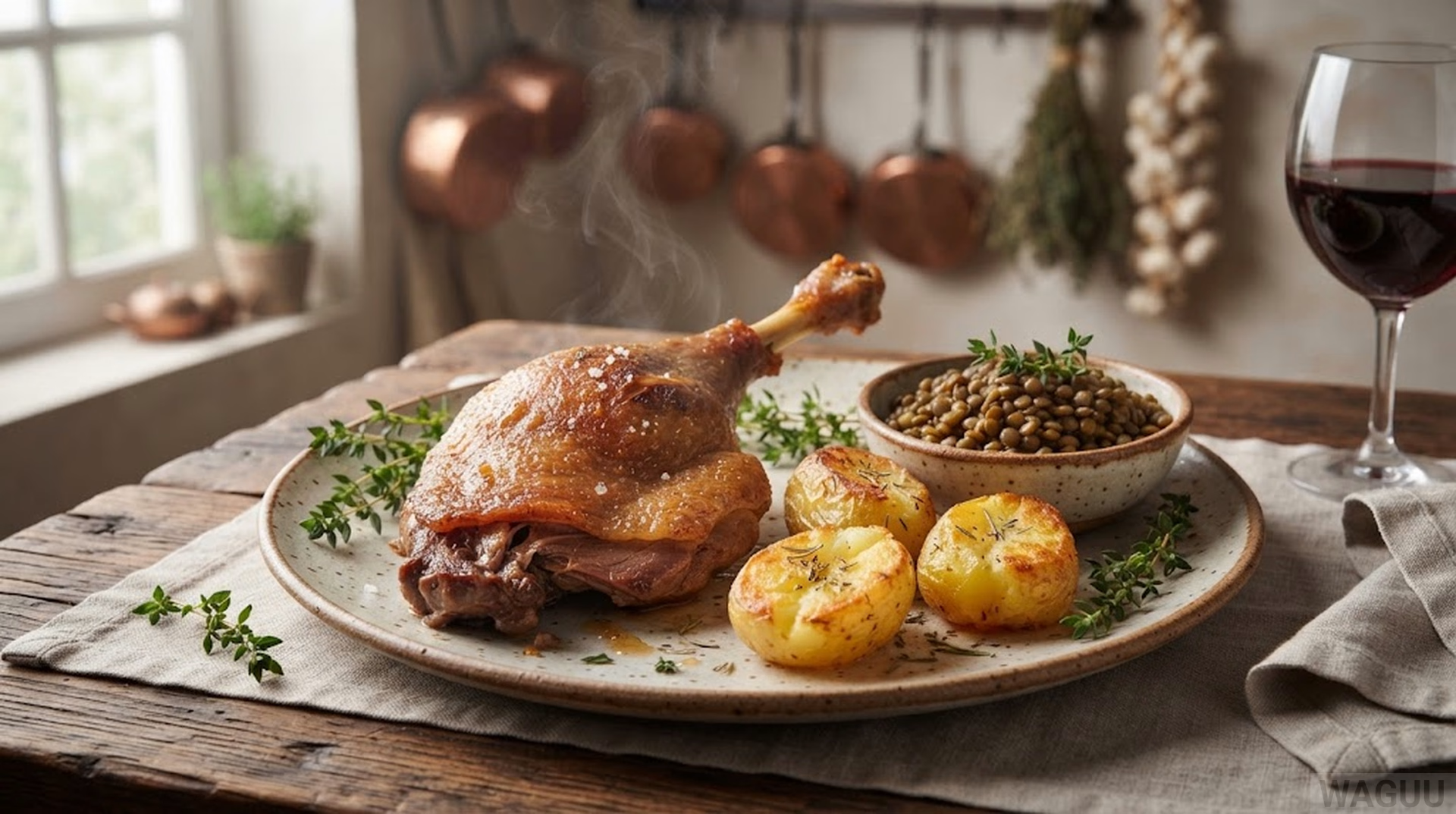
Summary: Duck legs cured in salt, then cooked slowly in duck fat until silky and tender. Ready in 3 hours, serves 6.
Cooked this recipe? Share your result with the community.
Category: Poultry, French Cuisine
Success rate: not rated yet % of users mastered this recipe
Quick overview
- Dish: Confit de Canard
- Category: Poultry, French Cuisine
- Cuisine: French
- Main ingredient: Duck legs, 6 pieces (free-range)
- Guide: 12 Most Famous French Dishes
- Total time: 180 minutes (20 min prep + 160 min cooking, plus 24 hours curing)
- Difficulty: Advanced
- Servings: 6 (Portion weight: 9 oz)
- Key technique: Confit (slow cooking in fat)
- Preparation types: Curing, confit, crisping
- Dietary info & allergens: Contains sulfites, gluten-free, lactose-free
- Suitable for: Dinner, special occasions, meal prep
- Nutritional values (per serving): 580 kcal, Protein: 32 g, Fat: 48 g, Carbs: 1 g
- Storage: 2 weeks in fridge (in fat), 3 months in freezer
- Pairing: Red wine, Cahors, sparkling water
- In short: Duck legs cooked in duck fat until silky and tender – a specialty of south-west France.
- Last updated: 24. 9. 2026
WAGUU says: “The duck should fall off the bone. If it does not, it needs more time.”
Key facts
| Prep time: | 20 minutes (plus 24 hours curing) |
| Cooking time: | 160 minutes |
| Temperature: | 265 °F (oven) |
| Servings: | 6 |
At a glance
Duck legs cured in salt and cooked slowly in duck fat until silky and tender. The skin is crisped in a hot pan before serving. A dish that tastes of patience.
Ingredients
Base servings: 6 • Portion weight: 9 oz
| Ingredient | Amount | Quality |
|---|---|---|
| Duck legs | 6 pieces | Free-range, skin on |
| Coarse sea salt | 3.5 oz | For curing |
| Black peppercorns | 1 tsp | Crushed |
| Fresh thyme | 6 sprigs | Or 2 tsp dried |
| Bay leaves | 3 pieces | Dried |
| Garlic | 4 cloves | Crushed |
| Duck fat | 35 oz | Enough to cover the legs |
| Fine sea salt | 1 tsp | To taste |
Why you will love this recipe
- Melt-in-the-mouth texture: The duck becomes silky and tender after slow cooking in fat.
- Make-ahead: The confit can be stored in the fat for weeks. It is a traditional way of preserving meat.
- Impressive but simple: It looks and tastes like a restaurant dish, but the technique is straightforward.
Why it works: The salt cure draws out moisture and seasons the meat. The slow cook in duck fat at 265 °F breaks down the connective tissue without drying out the meat. The result is duck that is tender, rich, and deeply flavored.
Recipe overview
Prep: 20 min | Cook: 160 min | Difficulty: Advanced | Servings: 6 | Type: Main | Origin: French
Detailed method
Total progress: 0 % done
Phase 1: Curing – 24 hours
Equipment: Glass dish, plastic wrap
1. Mix the coarse salt, crushed peppercorns, thyme, and bay leaves. Rub the mixture over the duck legs. Place in a glass dish, cover with plastic wrap, and refrigerate for 24 hours.
VKB: The duck legs are coated in the salt mixture. They are firm to the touch.
Before you continue:
Do not cure for longer than 24 hours. The duck becomes too salty.
Phase 2: Rinsing and drying – 10 min
Equipment: Paper towels
2. Rinse the duck legs under cold water to remove the salt. Pat them dry with paper towels. They should be dry to the touch.
VKB: The duck legs are dry and free of salt.
Before you continue:
Dry the duck legs thoroughly. Water prevents the fat from sealing the meat.
Phase 3: Confit – 150 min
Equipment: Oven, deep Dutch oven
3. Melt the duck fat in a deep Dutch oven. Add the duck legs, ensuring they are completely covered. Add the garlic. Cook in the oven at 265 °F for 2.5 hours, until the meat is tender and falls off the bone.
VKB: The meat is tender and falls off the bone. The fat is clear.
Before you continue:
Keep the temperature low. If the fat bubbles vigorously, the duck will be tough.
Phase 4: Cooling and storing – 30 min
Equipment: Sterilized jars
4. Remove the duck legs from the fat. Strain the fat and pour it into sterilized jars. Add the duck legs to the jars, ensuring they are covered with fat. Store in the fridge for up to 2 weeks.
VKB: The duck legs are completely covered in fat. The fat is clear and golden.
Before you continue:
Make sure the duck is completely covered in fat. Any exposed meat will spoil.
Phase 5: Crisping – 10 min
Equipment: Skillet
5. Remove the duck legs from the fat. Scrape off any excess fat. Place them skin-side down in a cold skillet. Cook over medium heat for 8–10 minutes until the skin is golden and crisp. Turn and cook for 2 minutes on the other side.
VKB: The skin is golden and crisp. The meat is heated through.
Before you continue:
Start with a cold pan. This renders the fat slowly and makes the skin crisp without burning.
Phase 6: Serving – 5 min
Equipment: Warm plates
6. Serve the duck legs on warm plates. They are traditionally served with potatoes sautéed in duck fat, or with a sharp salad.
VKB: The skin is crisp. The meat is tender. The plates are warm.
Required equipment
| Equipment | Ideal size | Alternative | Risk |
|---|---|---|---|
| Deep Dutch oven | 5–6 quarts | Any heavy pot | Small pot overcrowds the duck |
| Skillet | 12 inches | Sauté pan | Thin pan burns the skin |
| Glass dish | Large | Any non-reactive dish | Metal reacts with salt |
Shopping list
Nutritional profile
Values per 1 serving (without side dish). Calculated from average nutritional values of ingredients.
| Nutrient | Per 100 g | Per 1 serving | Per 6 servings |
|---|---|---|---|
| Energy | 232 kcal | 580 kcal | 3480 kcal |
| Fat | 19.2 g | 48 g | 288 g |
| of which saturated | 7 g | 17.5 g | 105 g |
| Carbohydrates | 0.4 g | 1 g | 6 g |
| of which sugars | 0 g | 0 g | 0 g |
| Protein | 12.8 g | 32 g | 192 g |
| Salt | 0.8 g | 2 g | 12 g |
Reference intake of an average adult (8400 kJ / 2000 kcal).
WAGUU Pro level
- Pro standard: Verified recipe with precise ratios and visual control points.
- Tip 1: Use free-range duck legs. They have more flavor and better texture.
- Tip 2: Do not cure for longer than 24 hours. The duck becomes too salty.
- Tip 3: Keep the fat at a low temperature. If it bubbles vigorously, the duck will be tough.
- Tip 4: Reserve the duck fat. It is excellent for roasting potatoes.
Scientific background
The salt cure draws out moisture and seasons the meat. The slow cook in duck fat at 265 °F breaks down the connective tissue without drying out the meat. The fat seals the meat and prevents it from drying out. The result is duck that is tender, rich, and deeply flavored.
Fine Dining – Professional techniques
- Plate composition: Place a duck leg on a warm plate. Add a spoonful of sautéed potatoes and a sharp salad.
- Texture contrast: Serve with a crisp potato galette or toasted sourdough.
- Temperature contrast: Add a spoonful of cold crème fraîche on top just before serving.
- Aromatic additions: Grate a little orange zest over the dish before serving.
Sensory radar
- Appearance: Golden, crisp skin. The meat is dark and tender.
- Aroma: Duck, garlic, thyme, and the richness of the fat.
- Taste: Deep, savory, with the salt cure adding complexity.
- Texture: The skin is crisp. The meat is silky and falls off the bone.
Pairing
- Wine: Cahors or Madiran – full-bodied red wines from south-west France.
- Beer: A Belgian dubbel or a dark ale.
- Non-alcoholic: Sparkling water with a slice of orange.
Different variations
- Confit de Canard with Honey: Glaze the duck with honey and soy sauce before crisping.
- Confit de Canard with Orange: Add orange zest and juice to the fat for a citrus note.
Allergens and dietary information
Contains: Sulfites • Gluten: Gluten-free • Not suitable for: Vegetarian, vegan
Suitable for
Dinner, special occasions, meal prep
Substitution catalogue
- Duck legs: Goose legs or chicken thighs
- Duck fat: Goose fat or olive oil
- Coarse sea salt: Kosher salt or flaky sea salt
FAQ
Can I make this ahead of time?
Yes. The confit can be stored in the fat for up to 2 weeks in the fridge. Crisp the skin just before serving.
Can I use chicken instead of duck?
Yes. Use chicken thighs and reduce the cooking time. The result is lighter but still rich.
What can I do with the leftover duck fat?
Strain it and store it in the fridge. Use it for roasting potatoes or making confit again.
Why is my duck tough?
The cooking temperature was too high, or the cooking time was too short. Keep the fat at 265 °F and cook until the meat falls off the bone.
WAGUU Petr advises: Cooking for 6 or more?
6–8 people: Use a larger Dutch oven. Do not overcrowd the duck. 10+ people: Make two batches. Confit is even better the next day.
Serving suggestion
Storage and reheating
Fridge: 2 weeks in fat • Freezer: 3 months • Reheating: Crisp the skin in a hot pan before serving.
Author: WAGUU Petr & Team • Published: 25 Sep 2026
More recipes from this article
Guide: 12 Most Famous French Dishes
More recipes you might like
Why WAGUU?
Recipes on WAGUU are checked for accuracy of ingredients, methods, and nutritional values.
Photo gallery from the process
Community photos: Cook, photograph, and share your result.
You can upload photos in the comments below or send them by email.
Did you film a video of our recipe? Paste a link to YouTube, YouTube Shorts, TikTok, Instagram Reels, Facebook Reels, Pinterest, Vimeo or X (Twitter) in the comments – we will publish it and help promote you and your content.
Most common mistakes
- Curing for too long – The duck becomes too salty. Do not cure for longer than 24 hours.
- Cooking at too high a temperature – The duck becomes tough. Keep the fat at 265 °F.
- Not covering the duck in fat – Any exposed meat will spoil. Make sure the duck is completely covered.
- Starting with a hot pan – The skin burns before the fat renders. Start with a cold pan.