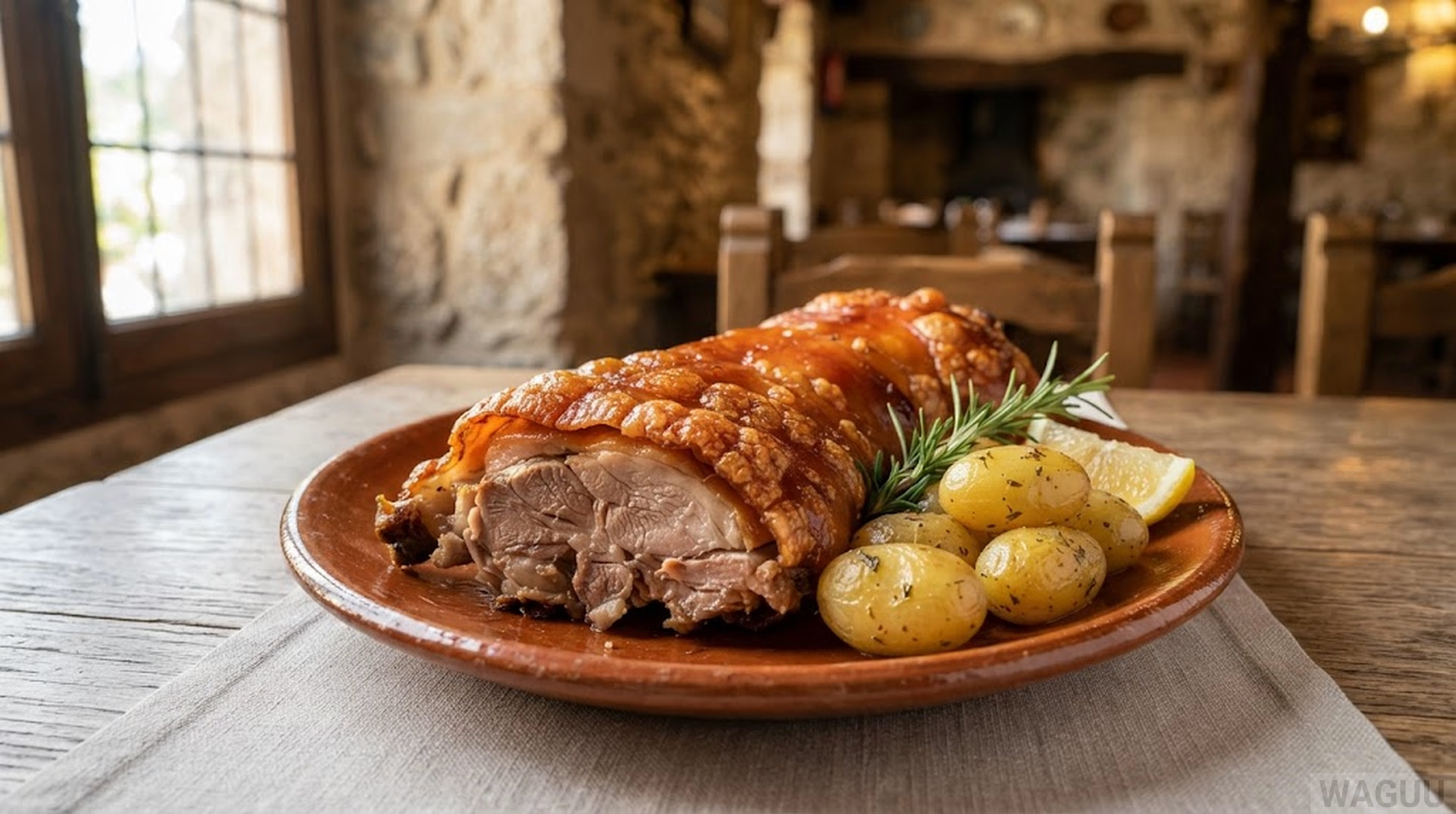
Summary: A whole suckling pig roasted slowly until the skin is crispy and the meat is tender and juicy. A speciality of Castile, traditionally cooked in a clay oven. Ready in 3 hours 30 minutes, serves 6.
Cooked this recipe? Share your result with the community.
Category: Pork, Spanish Cuisine
Success rate: not rated yet % of users mastered this recipe
Quick overview
- Dish: Roast Suckling Pig
- Category: Pork, Spanish Cuisine
- Cuisine: Spanish (Castile)
- Main ingredient: Suckling pig, 3 kg
- Guide: 12 Most Famous Spanish Dishes
- Total time: 210 minutes (30 min prep + 180 min cooking)
- Difficulty: Advanced
- Servings: 6 (portion weight: 400 g)
- Key technique: Slow roasting
- Preparation types: Roasting
- Dietary info & allergens: Gluten-free, lactose-free. Contains pork.
- Suitable for: Festive meal, Christmas, special occasion
- Nutritional values (per serving): 680 kcal, Protein: 42 g, Fat: 48 g, Carbs: 0 g
- Storage: 2 days in fridge, 1 month in freezer
- Pairing: Ribera del Duero red wine, roasted potatoes
- In short: Slow-roasted suckling pig with crispy skin and tender meat.
- Last updated: 25. 9. 2026
WAGUU says: “Cochinillo asado is a celebration dish – the crackling skin and succulent meat are worth the wait.”
Key facts
| Prep time: | 30 minutes |
| Cooking time: | 180 minutes |
| Temperature: | 160°C then 220°C |
| Servings: | 6 |
At a glance
A show-stopping roast suckling pig with shatteringly crispy skin and melt-in-the-mouth meat.
Ingredients
Base servings: 6 • Portion weight: 400 g
| Ingredient | Amount | Quality |
|---|---|---|
| Suckling pig | 3000 g | Whole, cleaned |
| Garlic | 4 cloves | Crushed |
| Olive oil | 60 ml | Extra virgin |
| White wine | 200 ml | Dry |
| Bay leaf | 2 pcs | Dried |
| Fresh thyme | 4 sprigs | Or 1 tsp dried |
| Salt | 2 tsp | Coarse sea salt |
| Black pepper | 1 tsp | Freshly ground |
Why you will love this recipe
- Spectacular centrepiece: A whole roast pig is a showstopper for any festive table.
- Crispy skin: The slow roasting followed by high heat creates perfect crackling.
- Tender meat: The meat is so soft it can be cut with a plate.
Why it works: Slow roasting at a low temperature renders the fat and cooks the meat gently, while the final blast of high heat crisps the skin. The result is juicy meat and shatteringly crispy skin.
Recipe overview
Prep: 30 min | Cook: 180 min | Difficulty: Advanced | Servings: 6 | Type: Main | Origin: Spanish
Detailed method
Total progress: 0 % done
Phase 1: Preparation – 15 min
Equipment: Roasting tin, knife
1. Preheat the oven to 160°C. Rub the pig inside and out with crushed garlic, salt and pepper. Place in a roasting tin with the wine, bay leaves and thyme.
VCP: The pig is evenly seasoned.
Phase 2: Slow roasting – 150 min
Equipment: Oven
2. Cover the tin with foil and roast for 2.5 hours, basting occasionally with the pan juices.
VCP: The meat is tender and the juices are rich.
Before you continue:
Do not let the foil touch the skin – it will prevent it from crisping later.
Phase 3: Crisping – 30 min
Equipment: Oven
3. Remove the foil and increase the oven to 220°C. Roast for another 20–30 minutes, until the skin is golden and crispy.
VCP: The skin is puffed, golden and crackling.
Phase 4: Resting – 15 min
Equipment: None
4. Remove from the oven and let rest for 15 minutes before carving.
VCP: The juices redistribute and the meat is tender.
Phase 5: Carving – 10 min
Equipment: Sharp knife, chopping board
5. Carve the pig into portions. The meat should be so tender it falls off the bone.
VCP: The skin crackles and the meat is juicy.
Phase 6: Serving – 5 min
Equipment: Plates
6. Serve with roasted potatoes and a simple salad.
VCP: The plate is a feast for the eyes.
Required equipment
| Utensil | Ideal size | Alternative | Risk |
|---|---|---|---|
| Roasting tin | Large enough for the pig | Disposable foil tray | Juices may overflow |
| Sharp knife | 20 cm blade | Electric carving knife | Torn skin |
| Baster | For basting | Large spoon | None |
Shopping list
Nutritional profile
Values per 1 serving (without side dish). Calculated from average nutritional values of ingredients.
| Nutrient | Per 100 g | Per 1 serving | Per 6 servings |
|---|---|---|---|
| Energy | 170 kcal | 680 kcal | 4080 kcal |
| Fat | 12 g | 48 g | 288 g |
| of which saturates | 4.5 g | 18 g | 108 g |
| Carbohydrates | 0 g | 0 g | 0 g |
| of which sugars | 0 g | 0 g | 0 g |
| Protein | 10.5 g | 42 g | 252 g |
| Salt | 0.6 g | 2.4 g | 14.4 g |
Reference intake of an average adult (8400 kJ / 2000 kcal).
WAGUU Pro level
- Pro standard: Verified recipe with precise ratios and visual control points.
- Tip 1: Ask your butcher to prepare the pig – it should be cleaned and ready for roasting.
- Tip 2: Rub the skin with a little vinegar before roasting – it helps it crisp.
- Tip 3: Let the pig come to room temperature before roasting for even cooking.
- Tip 4: The traditional test of doneness is to cut the meat with a plate – if it cuts easily, it is ready.
Scientific background
Slow roasting at 160°C gently breaks down the collagen in the meat, converting it to gelatine and making it tender. The final high heat causes the skin to dehydrate and the Maillard reaction to occur, creating a crispy, flavourful crust.
Fine Dining – Professional techniques
- Plate composition: Serve a portion of meat with a piece of crackling, roasted potatoes and a drizzle of pan juices.
- Texture contrasts: The crispy skin contrasts with the soft, juicy meat.
- Temperature contrast: Serve hot, with a glass of Ribera del Duero.
- Aromatic additions: A sprig of fresh thyme or rosemary.
Sensory radar
- Appearance: Golden-brown pig with glistening, crackling skin.
- Aroma: Roast pork, garlic, herbs.
- Taste: Rich, savoury, with a hint of wine and herbs.
- Texture: Crispy skin, tender, juicy meat.
Pairing
- Wine: Ribera del Duero or Rioja red.
- Beer: A dark lager or stout.
- Non-alcoholic: Sparkling water or dry cider.
Different preparation variations
- With apples: Stuff the pig with apples and onions for a fruity note.
- With spices: Rub with smoked paprika and cumin for a different flavour profile.
Allergens and dietary information
Contains: None of the main allergens • Gluten: Gluten-free • Not suitable for: Vegetarians, vegans
Suitable for
Festive meal, Christmas, special occasion, family gathering.
Substitution catalogue
- Suckling pig: Not easily substituted – this is a unique dish.
- White wine: Dry sherry or chicken stock.
FAQ
Where can I buy a suckling pig?
Ask your butcher to order one for you. They are usually available frozen or fresh from speciality suppliers.
How do I know when it’s cooked?
The meat should be tender and easily pull away from the bone. A meat thermometer inserted into the thickest part should read at least 75°C.
Can I roast it in a normal oven?
Yes, a normal oven works well. Use a large roasting tin and follow the temperature and timing in the recipe.
What do I serve with it?
Roasted potatoes, a simple green salad, and crusty bread. A glass of red wine is the classic pairing.
WAGUU Petr advises: Cooking for 6 or more?
6–8 people: A 3 kg pig serves 6–8. 10+ people: Roast two smaller pigs or one larger one – allow 400 g per person.
Serving suggestion
Storage and reheating
Fridge: 2 days • Freezer: 1 month • Reheating: Reheat in a hot oven (200°C) for 10–15 minutes to restore crispness.
Author: WAGUU Petr & Team • Published: 27 Sep 2026
More Recipes from This Article
More recipes you might like
Why WAGUU?
Recipes on WAGUU are checked for accuracy of ingredients, procedures and nutritional values.
Photo gallery from the process
Community photos: Cook, take a photo and share your result.
You can upload photos in the comments below or send them by email.
Did you film a video tutorial for our recipe? Insert a link to YouTube, YouTube Shorts, TikTok, Instagram Reels, Facebook Reels, Pinterest, Vimeo or X (Twitter) in the comment – we will gladly publish it and help promote you and your content.
Most common mistakes
- Not drying the skin: Moisture prevents crisping. Pat the skin dry before roasting.
- Roasting at too high a temperature: The skin will burn before the meat is cooked. Start low and finish high.
- Not resting the meat: Resting allows the juices to redistribute. Don’t skip this step.
- Carving too early: Let the pig rest for at least 15 minutes before carving.