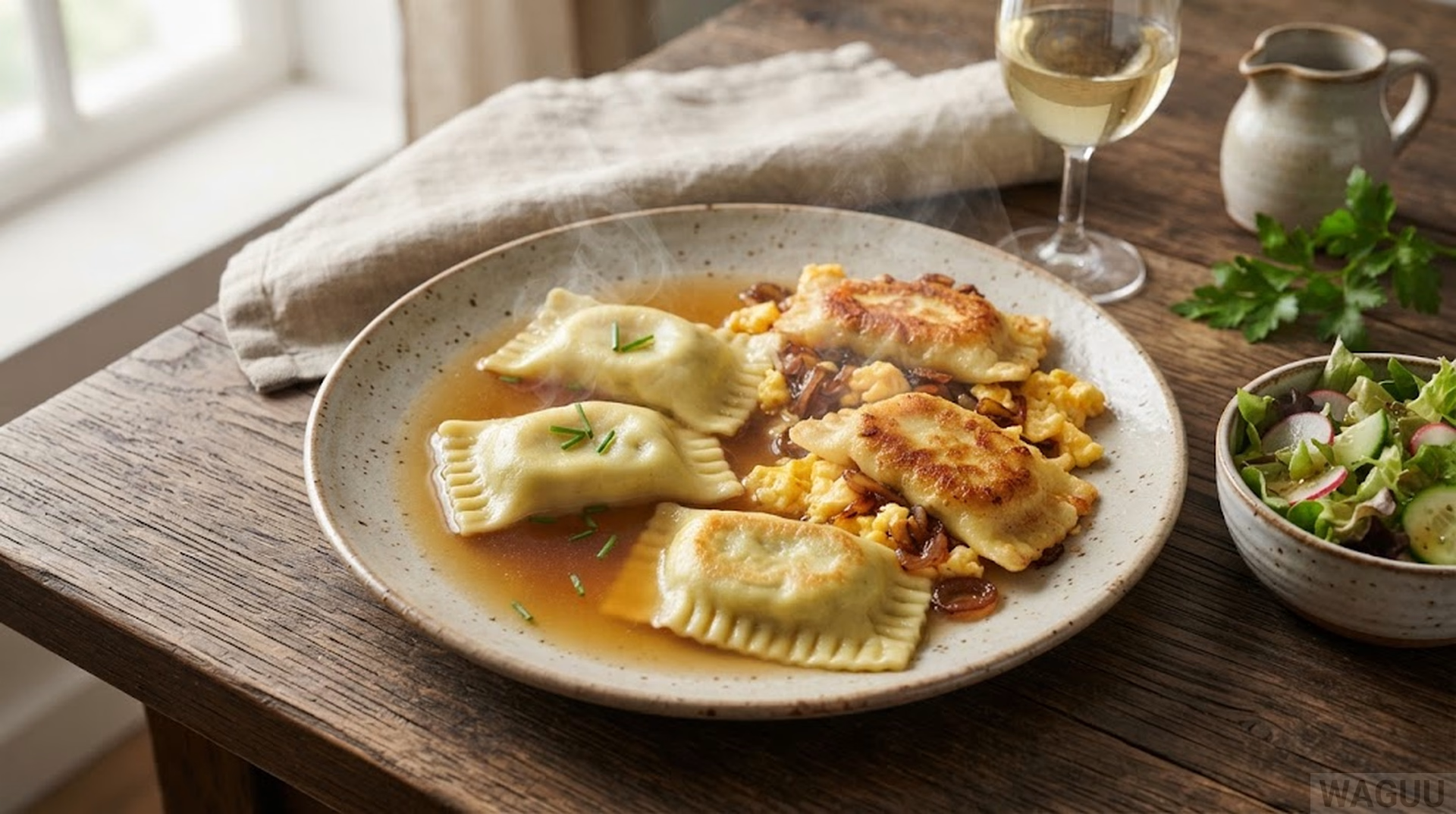
Summary: Large Swabian pasta pockets filled with minced meat, spinach and bread, poached in broth or fried in butter. Serves 6, ready in about 90 minutes.
Cooked this recipe? Share the result with the community.
Category: Pasta, German Cuisine
Success rate: not rated yet % of users managed this recipe
Quick overview
- Dish: Schwäbische Maultaschen – Swabian Stuffed Pasta Pockets
- Category: Pasta, German Cuisine
- Cuisine: German (Swabia)
- Main ingredient: Plain flour, 400 g (plus eggs and filling)
- Guide: 12 Most Famous German Dishes
- Total time: 90 minutes (50 min preparation + 40 min cooking)
- Difficulty: Medium
- Servings: 6 (portion weight: 300 g)
- Key technique: Pasta making and poaching
- Preparation types: Poaching, pan-frying
- Dietary info & allergens: Contains gluten, eggs, milk, celery
- Suitable for: Sunday lunch, family meal, meal prep
- Nutrition (per portion): 580 kcal, Protein: 28 g, Fat: 24 g, Carbohydrates: 62 g
- Storage: 3 days in the fridge, 2 months in the freezer
- Pairing: Light beer, Trollinger, apple juice
- In short: Large Swabian pasta pockets filled with meat, spinach and bread, poached in broth or fried in butter.
- Last updated: 25 September 2026
WAGUU says: “Maultaschen are the German answer to ravioli – larger, heartier, and just as worth the effort.”
Key facts
| Prep time: | 50 min |
| Cook time: | 40 min |
| Temperature: | Gentle simmer (95 °C) |
| Servings: | 6 |
At a glance
A soft egg-pasta dough rolled thin, cut into rectangles, filled with a mixture of minced meat, spinach, soaked bread, onion and parsley, then folded, sealed and poached in broth until tender. Serve in the broth or slice and fry in butter with onions. This is the dish that Swabia is famous for, and it is easier than it looks.
Ingredients
Base servings: 6 • Portion weight: 300 g
| Ingredient | Amount | Quality |
|---|---|---|
| Plain flour | 400 g | for the dough |
| Eggs | 4 pcs | large, free-range |
| Fine sea salt | 8 g | for the dough |
| Water | 60 ml | cold, for the dough |
| Pork mince | 500 g | coarse ground |
| Stale bread rolls | 2 pcs | soaked in milk |
| Whole milk | 150 ml | for soaking |
| Frozen spinach | 300 g | thawed, squeezed dry |
| Brown onion | 2 pcs | finely chopped |
| Fresh parsley | 15 g | chopped |
| Ground nutmeg | 1 g | freshly grated |
| Black pepper | 2 g | freshly ground |
| Beef stock | 2000 ml | for poaching |
| Unsalted butter | 60 g | for frying (optional) |
Why you will love this recipe
- Two dishes in one: Serve them in broth as a soup, or sliced and fried in butter as a main course.
- Freezer-friendly: Make a double batch and freeze half for a quick meal later.
- Rustic and satisfying: The filling is rich and savoury, the dough is soft, and the butter-fried version is deeply comforting.
Why it works: The soaked bread binds the filling and keeps it moist during poaching. The egg-rich pasta dough is elastic enough to hold the filling without tearing, but thin enough to cook through in a few minutes. Poaching at a gentle simmer keeps the pockets intact.
Recipe overview
Prep: 50 min | Cook: 40 min | Difficulty: Medium | Servings: 6 | Type: Main course | Origin: German
Detailed method
Overall progress: 0 % done
Phase 1: Making the dough – 20 min
Equipment: Large bowl, rolling pin, cling film
1. Combine the flour and salt in a large bowl. Make a well in the centre and add the eggs and water. Mix with a fork, then knead with your hands for 8–10 minutes until the dough is smooth and elastic. Wrap in cling film and rest at room temperature for 30 minutes.
VKB: The dough is smooth, slightly tacky and springs back when pressed with a finger.
Before you continue:
If the dough is too dry, add a teaspoon of water at a time. If it is too sticky, add a teaspoon of flour. Do not over-flour – the dough should stay soft.
Phase 2: Making the filling – 15 min
Equipment: Frying pan, large bowl
2. Soak the bread rolls in the milk for 10 minutes, then squeeze out the excess liquid. Sauté the chopped onion in a little butter until soft. In a large bowl, combine the pork mince, soaked bread, spinach, sautéed onion, parsley, nutmeg, salt and pepper. Mix well with your hands until evenly combined.
VKB: The filling holds together when pressed and tastes well seasoned when a small spoonful is fried and tasted.
Before you continue:
Squeeze the spinach really dry. Wet spinach will make the filling loose and the pockets will fall apart during poaching.
Phase 3: Rolling and filling – 20 min
Equipment: Rolling pin, sharp knife, small bowl of water
3. Divide the dough into 4 pieces. Roll each piece into a thin rectangle (about 2 mm thick) on a lightly floured surface. Cut the sheets into rectangles roughly 10 × 15 cm. Place a heaped tablespoon of filling in the centre of each rectangle, brush the edges with water, fold the dough over the filling and press the edges firmly to seal. If you want the classic Maultaschen shape, fold the two short ends inwards before sealing.
VKB: The pockets are sealed on all sides with no air pockets. The dough does not tear when lifted.
Phase 4: Poaching – 15 min
Equipment: Large saucepan, slotted spoon
4. Bring the beef stock to a gentle simmer in a large saucepan. Lower the Maultaschen into the stock in batches (do not overcrowd) and poach for 8–10 minutes, until they float to the surface and the dough is tender. Remove with a slotted spoon and keep warm while you poach the rest.
VKB: The Maultaschen float on the surface and the dough is pale and soft to the touch.
Before you continue:
Do not boil the stock rapidly. A rolling boil will break the pockets. Keep it at a gentle simmer – small bubbles rising slowly.
Phase 5: Serving – 10 min
Equipment: Deep bowls or large frying pan
5. Serve two ways. For the broth version, place three Maultaschen in a deep bowl and ladle over hot beef stock. For the fried version, slice the poached Maultaschen into 1 cm strips and fry in foaming butter with sliced onion until golden brown. Serve with a green salad.
VKB: Fried version is golden brown on both sides; broth version is served piping hot with visible steam.
Required equipment
| Item | Ideal size | Alternative | Risk |
|---|---|---|---|
| Large saucepan | 5 L | Wide deep frying pan | Small pan = overcrowded pockets |
| Rolling pin | 40 cm | Wine bottle (clean) | Uneven thickness means uneven cooking |
| Slotted spoon | Large | Spider strainer | Regular spoon will not drain the stock |
Shopping list
Nutritional profile
Values per 1 portion (without side dish). Calculated from average nutritional values of the ingredients.
| Nutrient | Per 100 g | Per portion | Per 6 portions |
|---|---|---|---|
| Energy | 193 kcal | 580 kcal | 3480 kcal |
| Fat | 8 g | 24 g | 144 g |
| of which saturates | 3.2 g | 9.6 g | 57.6 g |
| Carbohydrates | 20.7 g | 62 g | 372 g |
| of which sugars | 1.7 g | 5 g | 30 g |
| Protein | 9.3 g | 28 g | 168 g |
| Salt | 0.8 g | 2.4 g | 14.4 g |
Reference intake of an average adult (8400 kJ / 2000 kcal).
WAGUU Pro level
- Pro standard: Verified recipe with precise ratios and visual control points.
- Tip 1: Rest the dough for 30 minutes before rolling. This relaxes the gluten and makes the dough easier to roll thin without tearing.
- Tip 2: Use a pasta machine if you have one. Roll the dough to setting 6 or 7 – thin but strong enough to hold the filling.
- Tip 3: For a richer version, add 50 g of finely chopped smoked bacon to the filling.
- Tip 4: Fried Maultaschen are best cut into strips and served with a fried egg on top – that is the classic “Maultaschen mit Ei”.
Scientific background
The egg-rich pasta dough is what makes Maultaschen different from Italian ravioli. The extra eggs give the dough more elasticity, which means it can be rolled thin without breaking and seals easily when pressed. During poaching, the starch in the dough gelatinises and the proteins in the filling set, holding everything together. The bread in the filling soaks up juices during cooking and keeps the interior moist.
Fine dining – professional techniques
- Plate composition: Three poached Maultaschen in a shallow bowl, sliced in half to show the filling, with a clear beef broth poured over at the table.
- Texture contrasts: The soft dough against the firm filling and the clear broth.
- Temperature contrast: Broth and Maultaschen piping hot, a fresh green salad served cold on the side.
- Aromatic additions: Fresh chives or a few chervil leaves on top of the broth.
Sensory radar
- Appearance: Pale, soft pockets floating in a clear amber broth.
- Aroma: Beef stock, spinach and a hint of nutmeg.
- Taste: Savoury, rich, slightly herby.
- Texture: Soft dough, moist filling, clean broth.
Pairing
- Beer: A light lager or a Swabian “Viertele” of Trollinger.
- Wine: A dry Trollinger or Lemberger.
- Non-alcoholic: Cold apple juice or a glass of sparkling water.
Preparation variations
- Fried with onions and egg: Slice the Maultaschen, fry in butter with onion and serve with a fried egg on top.
- Vegetarian filling: Replace the pork with 300 g of ricotta and 100 g of grated Emmental.
Allergens and dietary information
Contains: gluten, eggs, milk, celery • Gluten: contains • Not suitable for: coeliac disease, gluten-free diet, lactose-free diet
Suitable for
Sunday lunch, family meal, meal prep, freezer batch
Substitution catalogue
- Pork mince: Beef mince, veal mince or a mix
- Beef stock: Vegetable stock or chicken stock
- Spinach: Chopped kale or chard (blanched first)
FAQ
Can I use ready-made pasta sheets?
Yes, but the dough will be thinner than homemade Maultaschen dough. Reduce the poaching time to 6 minutes.
Why did my Maultaschen fall apart?
Either the edges were not sealed properly (brush with water and press firmly) or the filling was too wet (squeeze the spinach dry).
Can I freeze Maultaschen?
Yes. Freeze them uncooked on a tray, then transfer to a bag. Cook from frozen – add 2 minutes to the poaching time.
What is the classic serving?
In Swabia, Maultaschen are most often served in a clear beef broth as a soup, or sliced and fried in butter with onions as a main course.
WAGUU Petr advises: Cooking for 6 or more?
6–8 people: Make a double batch of dough and filling, freeze half the Maultaschen for another day. • 10+ people: Poach in batches and keep warm in a low oven (80 °C) covered with foil.
Sides and serving
- Clear beef broth – classic serving (not part of the recipe)
- Green salad with vinaigrette – for the fried version (not part of the recipe)
- Fried egg on top – for the fried version (not part of the recipe)
Serving: Serve three Maultaschen per portion, either in hot beef broth or sliced and fried in butter with onions and an egg on top.
Storage and reheating
Fridge: 3 days • Freezer: 2 months (uncooked or cooked) • Reheating: Reheat in simmering broth for 4–5 minutes, or fry in butter until golden.
Author: WAGUU Petr & Team • Published: 28 Sep 2026
More recipes from this article
Guide: 12 Most Famous German Dishes
Other recipes you might enjoy
Why WAGUU?
WAGUU recipes are checked for accuracy of ingredients, methods and nutritional values.
Photo gallery from the process
Community photos: Cook it, photograph it and share the result.
You can upload photos in the comments below or send them by email.
Filmed a video of this recipe? Post a link to YouTube, YouTube Shorts, TikTok, Instagram Reels, Facebook Reels, Pinterest, Vimeo or X (Twitter) in the comments – we will feature it and help your content reach more people.
Common mistakes
- Wet spinach: Squeeze it really dry or the filling will be loose and the pockets will open during cooking.
- Rolling too thick: A thick dough will not cook through in the poaching time and will taste raw. Roll to about 2 mm.
- Not sealing the edges: Brush the edges with water and press firmly. Press again after folding.
- Boiling instead of simmering: A rolling boil will break the pockets. Keep the stock at a gentle simmer.