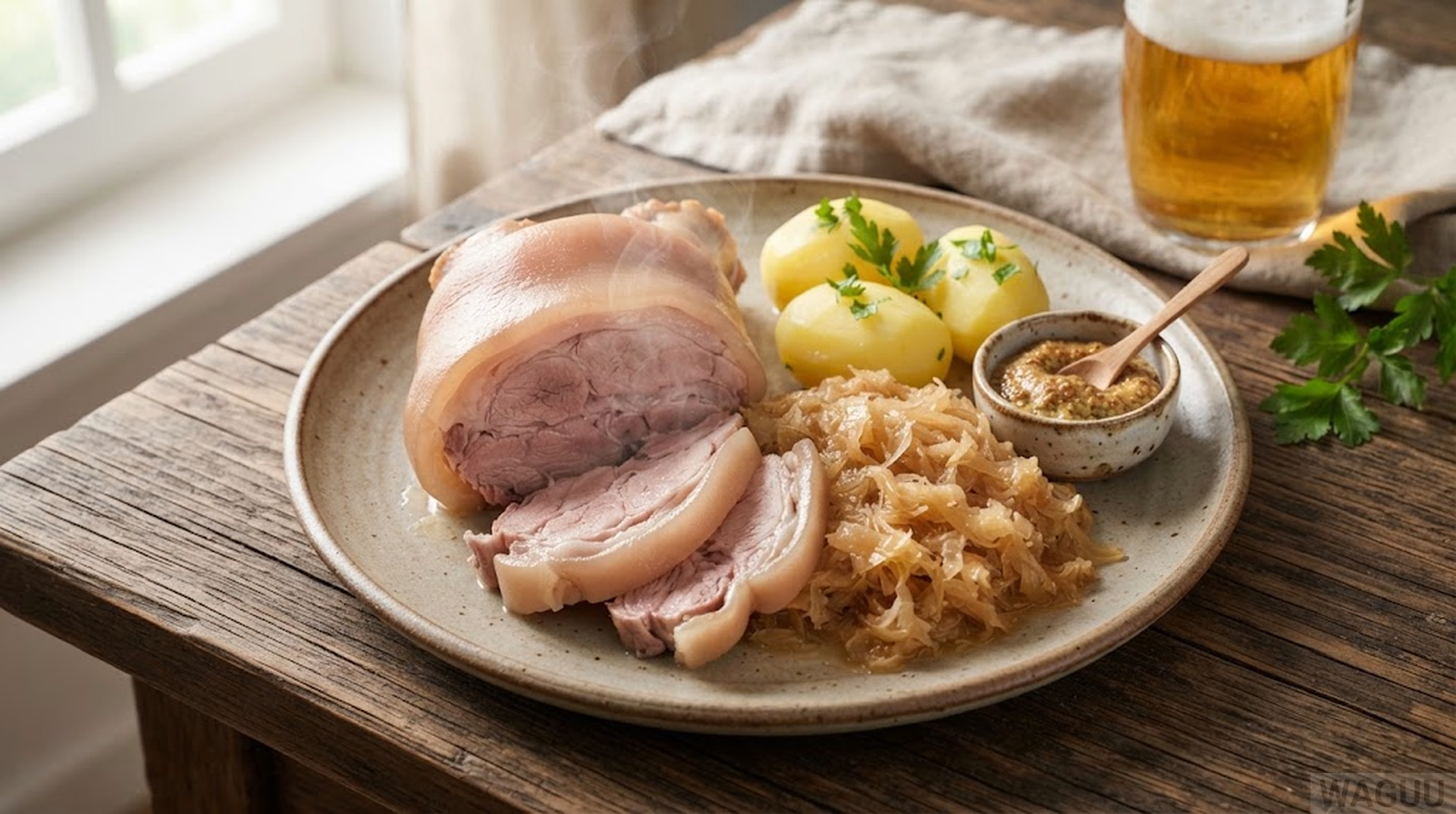
Summary: Pork knuckle slowly simmered with root vegetables and spices until spoon-tender, served with sauerkraut and boiled potatoes. Serves 6, ready in about 3 hours.
Cooked this recipe? Share the result with the community.
Category: Pork, German Cuisine
Success rate: not rated yet % of users managed this recipe
Quick overview
- Dish: Eisbein mit Sauerkraut – Boiled Pork Knuckle with Sauerkraut
- Category: Pork, German Cuisine
- Cuisine: German (Berlin, Northern Germany)
- Main ingredient: Pork knuckle, 2 × 1 kg (cured or fresh, skin on)
- Guide: 12 Most Famous German Dishes
- Total time: 190 minutes (25 min preparation + 165 min cooking)
- Difficulty: Easy
- Servings: 6 (portion weight: 300 g)
- Key technique: Poaching
- Preparation types: Simmering, boiling
- Dietary info & allergens: Contains celery, sulphites, mustard
- Suitable for: Winter meal, family lunch, New Year’s dinner
- Nutrition (per portion): 560 kcal, Protein: 44 g, Fat: 38 g, Carbohydrates: 14 g
- Storage: 4 days in the fridge, 2 months in the freezer
- Pairing: Dark beer, Berliner Weisse, apple juice
- In short: Pork knuckle poached until spoon-tender, served with sauerkraut and boiled potatoes.
- Last updated: 25 September 2026
WAGUU says: “Eisbein is the dish of patience. Three hours of gentle simmering and a pork knuckle becomes something you can cut with a spoon.”
Key facts
| Prep time: | 25 min |
| Cook time: | 2 hours 45 min |
| Temperature: | Gentle simmer (95 °C) |
| Servings: | 6 |
At a glance
Two pork knuckles, simmered for over two and a half hours with onions, carrot, celeriac, bay leaves, peppercorns and juniper, until the meat is so tender it pulls cleanly off the bone. Served with sauerkraut and boiled potatoes, with a mustard sauce or a spoonful of pease pudding on the side. This is the northern counterpart to Schweinshaxe – softer, saltier and slower.
Ingredients
Base servings: 6 • Portion weight: 300 g
| Ingredient | Amount | Quality |
|---|---|---|
| Pork knuckle | 2000 g | 2 pieces, cured or fresh, skin on |
| Brown onions | 2 pcs | halved |
| Carrots | 2 pcs | roughly chopped |
| Celeriac | 150 g | peeled, chopped |
| Bay leaves | 4 pcs | dried |
| Juniper berries | 8 pcs | lightly crushed |
| Black peppercorns | 12 pcs | whole |
| Cloves | 4 pcs | whole |
| Fine sea salt | 10 g | (less if knuckle is cured) |
| Sauerkraut | 800 g | drained |
| Dry white wine | 100 ml | for the sauerkraut |
| Apple | 1 pc | peeled, grated |
| Unsalted butter | 30 g | for the sauerkraut |
| Waxy potatoes | 1200 g | for boiling |
Why you will love this recipe
- Slow and easy: Once the pot is on the stove, you can walk away for two hours.
- Deep flavour: The long simmer draws out the pork’s natural richness and the aromatics infuse the meat.
- Feeds a crowd: One knuckle serves three, so two knuckles easily feed six.
Why it works: Poaching at a gentle simmer keeps the meat moist and slowly breaks down the collagen around the bone. The aromatic vegetables and spices flavour the poaching liquid, which penetrates the meat over the long cooking time. The sauerkraut is cooked separately with apple and wine to soften its sharpness.
Recipe overview
Prep: 25 min | Cook: 165 min | Difficulty: Easy | Servings: 6 | Type: Main course | Origin: German
Detailed method
Overall progress: 0 % done
Phase 1: Preparing the stock – 15 min
Equipment: Large stock pot (7–8 L)
1. Place the pork knuckles in a large pot and cover with cold water (about 4 L). Bring to a boil, then immediately drain and rinse the knuckles under cold water. This removes impurities and gives a cleaner stock. Return the knuckles to the pot, add the onions, carrot, celeriac, bay leaves, juniper, peppercorns and cloves, and cover with 4 L of fresh cold water.
VKB: The water is clear and the vegetables and spices are evenly distributed around the knuckles.
Phase 2: Simmering – 150 min
Equipment: Same pot, lid slightly ajar
2. Bring the pot to a boil, then immediately reduce the heat to a gentle simmer. Add 10 g of salt (less if using cured knuckles – taste the water first). Cover with the lid slightly ajar and simmer for 2.5 hours, skimming any foam that rises during the first 30 minutes. The knuckles are ready when a skewer slides in with almost no resistance.
VKB: The meat pulls cleanly away from the bone when tested with a fork. The skin is soft and translucent.
Before you continue:
If the knuckle is cured (salted), taste the poaching water before adding salt. Cured knuckles can be very salty and need no added salt.
Phase 3: Cooking the sauerkraut – 40 min
Equipment: Large frying pan or saucepan
3. While the knuckles simmer, melt the butter in a large pan over medium heat. Add the drained sauerkraut and cook for 5 minutes, stirring. Pour in the white wine and add the grated apple. Stir well, cover and simmer gently for 30 minutes, stirring occasionally. Season with a little salt and pepper.
VKB: The sauerkraut is soft, slightly golden and no longer sharply sour. The apple has melted into it.
Phase 4: Boiling the potatoes – 25 min
Equipment: Medium saucepan
4. Peel the potatoes and cut into halves or quarters. Place in a saucepan, cover with cold water, add a teaspoon of salt and bring to a boil. Cook for 20 minutes, until a knife slides in easily. Drain and keep warm.
VKB: A knife slides into the potatoes easily with no resistance.
Phase 5: Serving – 10 min
Equipment: Warm plates, sharp knife
5. Remove the knuckles from the stock and drain. Cut the meat off the bone in thick slices (the skin is usually discarded or cut into small pieces and served alongside). Serve with the sauerkraut and boiled potatoes, and if you like, a spoonful of mustard sauce or pease pudding on the side.
VKB: The meat is soft and pale pink, with no pink near the bone. The skin is soft and jellied.
Required equipment
| Item | Ideal size | Alternative | Risk |
|---|---|---|---|
| Large stock pot | 7–8 L with lid | Pressure cooker (reduce time by 90 min) | Small pot = insufficient water, dry knuckles |
| Skimming ladle | Fine mesh | Slotted spoon | Foam and impurities make the stock cloudy |
| Sharp knife | 20 cm blade | Carving knife | Blunt knife tears the meat |
Shopping list
Nutritional profile
Values per 1 portion (without side dish). Calculated from average nutritional values of the ingredients.
| Nutrient | Per 100 g | Per portion | Per 6 portions |
|---|---|---|---|
| Energy | 187 kcal | 560 kcal | 3360 kcal |
| Fat | 12.7 g | 38 g | 228 g |
| of which saturates | 4.7 g | 14 g | 84 g |
| Carbohydrates | 4.7 g | 14 g | 84 g |
| of which sugars | 1.7 g | 5 g | 30 g |
| Protein | 14.7 g | 44 g | 264 g |
| Salt | 1.1 g | 3.3 g | 19.8 g |
Reference intake of an average adult (8400 kJ / 2000 kcal).
WAGUU Pro level
- Pro standard: Verified recipe with precise ratios and visual control points.
- Tip 1: Ask your butcher for a cured Eisbein if you want the full Berlin experience. Fresh knuckles work too but taste less salty.
- Tip 2: Skim the foam during the first 30 minutes of simmering. This is what gives you a clear, clean stock.
- Tip 3: Save the poaching liquid. It makes an excellent base for pea soup or lentil soup the next day.
- Tip 4: Serve with a spoonful of hot mustard on the side – it cuts through the richness of the pork.
Scientific background
Poaching is a moist-heat cooking method that keeps the meat tender and moist. The collagen around the bone converts into gelatine at around 70–80 °C over a long period, which gives the meat its soft, almost jelly-like texture. The aromatic vegetables and spices (onion, carrot, celeriac, bay, juniper) flavour the poaching liquid, which slowly penetrates the meat. The sauerkraut’s sharpness comes from lactic acid, produced by fermentation – the apple and wine soften this acidity and add sweetness.
Fine dining – professional techniques
- Plate composition: Sliced knuckle in the centre, sauerkraut on one side, boiled potatoes on the other, a small dish of mustard on the plate.
- Texture contrasts: Soft meat, slightly crunchy sauerkraut, firm potatoes.
- Temperature contrast: Everything served hot, with a cold beer on the side.
- Aromatic additions: Fresh parsley or a few caraway seeds sprinkled over the sauerkraut.
Sensory radar
- Appearance: Pale pork slices, soft translucent skin, golden sauerkraut, white potatoes.
- Aroma: Savoury pork, bay, juniper and the sharp note of sauerkraut.
- Taste: Salty, rich, slightly sour from the sauerkraut.
- Texture: Soft, spoon-tender meat with soft skin and slightly firm sauerkraut.
Pairing
- Beer: A dark German lager or Berliner Weisse.
- Wine: A dry Riesling or a light red such as Spätburgunder.
- Non-alcoholic: Cold apple juice or a glass of sparkling water.
Preparation variations
- With pease pudding: Serve with a purée of yellow split peas and a mustard sauce (Berlin classic).
- With root vegetables: Add turnip, parsnip and leek to the poaching liquid for a richer broth.
Allergens and dietary information
Contains: celery, sulphites, mustard (if served) • Gluten: check the mustard and the sauerkraut brine • Not suitable for: low-sodium diets, low-fat diets
Suitable for
Winter meal, family lunch, New Year’s dinner, Oktoberfest-themed dinner
Substitution catalogue
- Pork knuckle: Lamb shank (reduce cooking time by 45 minutes)
- Dry white wine: Apple cider or a splash of white wine vinegar mixed with water
- Juniper berries: A sprig of rosemary or a few bay leaves
FAQ
Should I use a cured or fresh knuckle?
Cured knuckles (Eisbein) give the classic Berlin flavour – salty, pink and slightly firmer. Fresh knuckles are lighter and less salty. Both work.
Can I use a pressure cooker?
Yes. Cook at high pressure for 45–60 minutes instead of 2.5 hours. Let the pressure release naturally, then check the meat is fork-tender.
What do I do with the poaching liquid?
Strain it and use it as a base for soup, or reduce it and freeze it in portions. It is rich in gelatine and flavour.
Is the skin supposed to be eaten?
Yes. In a boiled Eisbein, the skin is soft and jellied, and many people eat it. If you prefer, cut it off and discard it, but the traditional version includes it.
WAGUU Petr advises: Cooking for 6 or more?
6–8 people: Two knuckles are enough. Make a double batch of sauerkraut and potatoes. • 10+ people: Cook the knuckles in a larger pot (or two pots) and keep them warm in the strained poaching liquid while you finish the sides.
Sides and serving
- Boiled waxy potatoes with parsley – classic (not part of the recipe)
- Pease pudding – traditional Berlin side (not part of the recipe)
- Mustard sauce – sharp, cuts through the pork (not part of the recipe)
Serving: Cut the meat off the bone in thick slices, arrange on warm plates with the sauerkraut and boiled potatoes, and put mustard on the table.
Storage and reheating
Fridge: 4 days • Freezer: 2 months • Reheating: Reheat in the strained poaching liquid for 10 minutes, or gently in a covered pan with a splash of stock.
Author: WAGUU Petr & Team • Published: 28 Sep 2026
More recipes from this article
Guide: 12 Most Famous German Dishes
Other recipes you might enjoy
Why WAGUU?
WAGUU recipes are checked for accuracy of ingredients, methods and nutritional values.
Photo gallery from the process
Community photos: Cook it, photograph it and share the result.
You can upload photos in the comments below or send them by email.
Filmed a video of this recipe? Post a link to YouTube, YouTube Shorts, TikTok, Instagram Reels, Facebook Reels, Pinterest, Vimeo or X (Twitter) in the comments – we will feature it and help your content reach more people.
Common mistakes
- Not blanching the knuckles: Skipping the first boil and rinse gives a cloudy stock and a less clean flavour. Do not skip this step.
- Boiling instead of simmering: A rolling boil will toughen the meat. Keep the water at a gentle simmer.
- Adding salt without tasting: Cured knuckles are already salty. Taste the poaching water before adding any salt.
- Discarding the poaching liquid: It is full of flavour and gelatine. Strain it, cool it, and use it as a soup base.