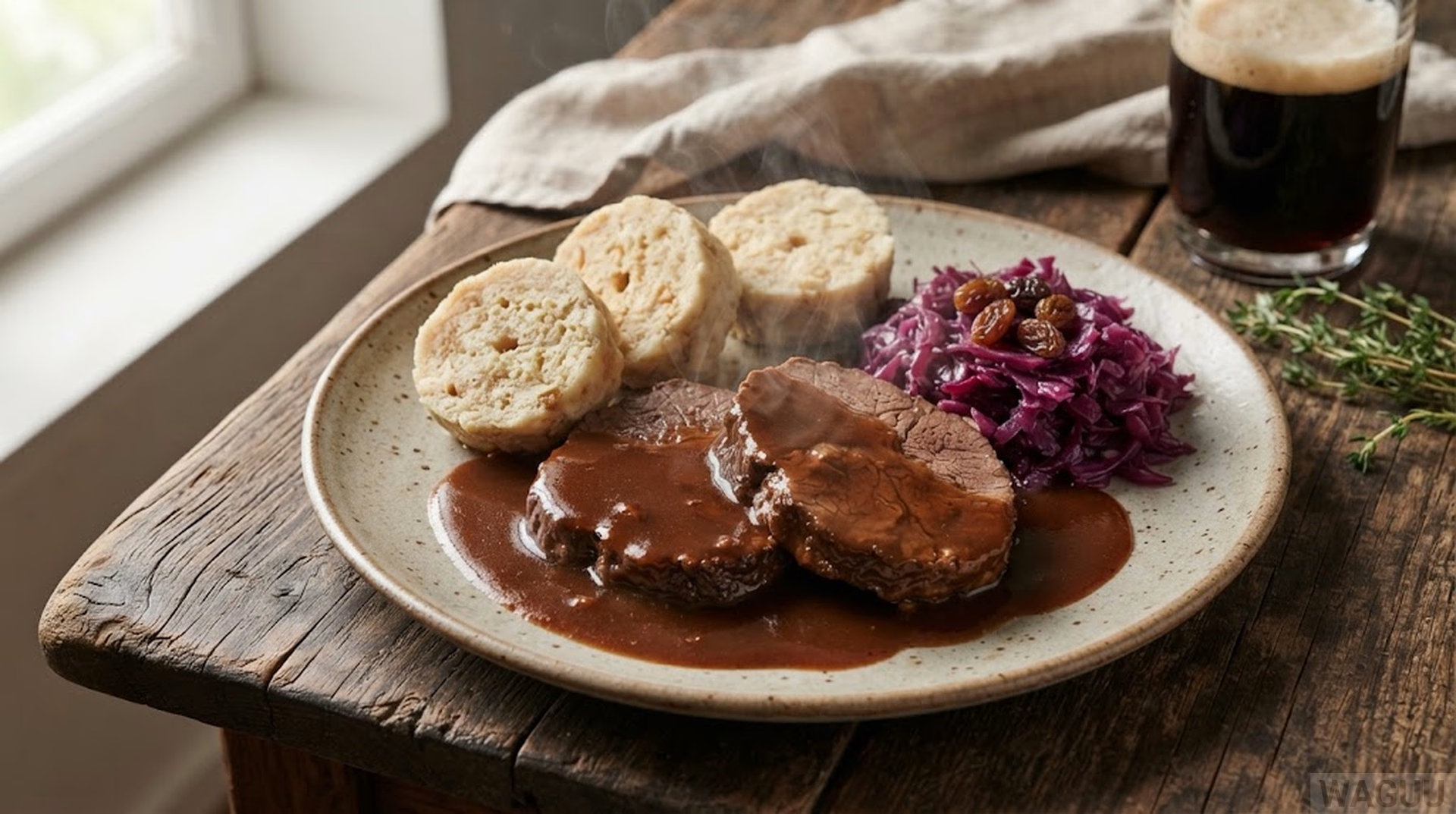
Summary: Beef topside marinated for three days in vinegar, wine and spices, then braised slowly until fork-tender. Serves 6, ready in about 3.5 hours plus marinating time.
Cooked this recipe? Share the result with the community.
Category: Beef, German Cuisine
Success rate: not rated yet % of users managed this recipe
Quick overview
- Dish: Sauerbraten – Marinated Beef Roast in Aromatic Sauce
- Category: Beef, German Cuisine
- Cuisine: German (Rhineland / Swabia)
- Main ingredient: Beef topside, 1.5 kg (thick end, well marbled)
- Guide: 12 Most Famous German Dishes
- Total time: 3 hours 45 minutes (45 min preparation + 3 hours cooking) plus 3 days marinating
- Difficulty: Medium
- Servings: 6 (portion weight: 250 g)
- Key technique: Marinating and braising
- Preparation types: Braising, roasting, pan-frying
- Dietary info & allergens: Contains gluten, celery, sulphites
- Suitable for: Sunday lunch, festive menu, family celebration
- Nutrition (per portion): 520 kcal, Protein: 42 g, Fat: 28 g, Carbohydrates: 18 g
- Storage: 4 days in the fridge, 3 months in the freezer
- Pairing: Dark beer, dry Riesling, apple juice
- In short: A long-marinated beef roast braised in its own marinade, finished with a roux or gingerbread.
- Last updated: 25 September 2026
WAGUU says: “Sauerbraten is a dish built on time. Three days of marinating, three hours of braising, and the result tastes like a week of work.”
Key facts
| Prep time: | 45 min |
| Cook time: | 3 hours |
| Temperature: | 160 °C oven |
| Servings: | 6 |
At a glance
A whole piece of beef topside, soaked for three days in a sharp vinegar-and-wine marinade, then dried, seared and braised slowly with root vegetables until it falls apart under a fork. The sauce is dark, glossy and slightly sour, thickened with a roux or a piece of gingerbread. This is the German Sunday roast at its best.
Ingredients
Base servings: 6 • Portion weight: 250 g
| Ingredient | Amount | Quality |
|---|---|---|
| Beef topside | 1500 g | thick end, well marbled |
| Red wine vinegar | 250 ml | 5 % acidity |
| Dry red wine | 250 ml | Riesling or Pinot Noir |
| Water | 500 ml | cold |
| Brown onion | 2 pcs | medium, roughly sliced |
| Carrot | 2 pcs | medium, roughly sliced |
| Celeriac | 100 g | peeled, cubed |
| Bay leaves | 3 pcs | dried |
| Juniper berries | 8 pcs | lightly crushed |
| Cloves | 4 pcs | whole |
| Black peppercorns | 10 pcs | whole |
| Fine sea salt | 15 g | for searing |
| Beef dripping | 40 g | or clarified butter |
| Plain flour | 40 g | for the roux |
| Cranberry compote | 100 g | to serve |
| Red cabbage | 600 g | for the side |
| Potato dumplings | 12 pcs | ready-made or homemade |
Why you will love this recipe
- Time does the work: The marinade tenderises the meat for three days before you even turn on the oven.
- One-pot cooking: The vegetables, marinade and meat all cook together in a single casserole.
- Deep, complex flavour: The vinegar, wine and spices build a sauce you cannot get from a shortcut.
Why it works: The acid in the marinade breaks down surface proteins and carries the spice flavours into the meat. The long braise at 160 °C converts collagen into gelatine, which gives the sauce its body. The final roux stabilises the sauce so it coats the meat without being heavy.
Recipe overview
Prep: 45 min | Cook: 180 min | Difficulty: Medium | Servings: 6 | Type: Main course | Origin: German
Detailed method
Overall progress: 0 % done
Phase 1: Marinating the beef – 3 days (active: 15 min)
Equipment: Large non-reactive bowl or zip-lock bag, fridge
1. Combine the vinegar, wine, water, sliced onion, carrot, celeriac, bay leaves, juniper berries, cloves and peppercorns in a saucepan. Bring to a boil, then remove from the heat and cool completely. Place the beef in a large bowl or zip-lock bag, pour over the cooled marinade, seal and refrigerate for 3 days, turning the meat once a day.
VKB: The meat has darkened slightly on the surface and the marinade smells sharply of vinegar and spice.
Before you continue:
Do not use a reactive metal bowl (aluminium, copper or cast iron without enamel). The acid in the marinade will react with the metal and give the meat a metallic taste.
Phase 2: Drying and searing – 15 min
Equipment: Heavy casserole with lid, paper towels, tongs
2. Remove the beef from the marinade and pat it completely dry with paper towels. Strain the marinade through a sieve and reserve both the liquid and the vegetables separately. Season the beef generously with salt. Heat the beef dripping in a heavy casserole over medium-high heat and sear the beef on all sides until deep brown, about 3 minutes per side. Remove the beef from the pan and set aside.
VKB: The beef has a dark brown crust on all sides. The bottom of the pan has a brown glaze (fond), not black burnt bits.
Before you continue:
Do not wash the beef. Washing spreads bacteria and prevents the meat from browning properly. Pat it dry with paper towels instead.
Phase 3: Sautéing the vegetables – 8 min
Equipment: Same casserole, wooden spoon
3. Add the strained marinade vegetables to the casserole and cook over medium heat for 6–8 minutes, stirring occasionally, until softened and lightly browned. Pour in the strained marinade and scrape the bottom of the pan to release the browned bits. Return the beef to the casserole, add enough water to come about two-thirds up the side of the meat, and bring to a gentle simmer.
VKB: The vegetables are soft and glistening. The liquid in the casserole simmers gently, not bubbles vigorously.
Before you continue:
Make sure the liquid is simmering, not boiling. A rolling boil will toughen the meat and make the sauce cloudy.
Phase 4: Braising – 150 min
Equipment: Oven at 160 °C, lid
4. Cover the casserole with a lid and transfer to the oven. Braise at 160 °C for 2.5 hours, turning the beef once halfway through. The meat is ready when a fork slides in with almost no resistance.
VKB: A fork slides into the meat with almost no resistance. The sauce has reduced slightly and coats the back of a spoon.
Before you continue:
Do not lift the lid more than once or twice during braising. Every time you open the oven, the temperature drops and the cooking time extends.
Phase 5: Making the sauce – 10 min
Equipment: Small saucepan, whisk, sieve
5. Remove the beef from the casserole, cover loosely with foil and rest for 15 minutes. Strain the cooking liquid through a sieve into a saucepan, pressing the vegetables to extract all the flavour. Melt the butter in a separate pan, whisk in the flour and cook for 2 minutes until light brown. Pour in the strained liquid gradually, whisking constantly, and simmer for 5 minutes until the sauce thickens. Season with salt and a splash of vinegar if needed.
VKB: The sauce is glossy, coats the back of a spoon and tastes balanced – sour, salty, with a touch of sweetness.
Phase 6: Slicing and serving – 10 min
Equipment: Sharp carving knife, warm plates
6. Slice the rested beef across the grain into 1 cm thick slices. Arrange on warm plates, spoon the sauce over and serve with red cabbage, potato dumplings and a spoonful of cranberry compote.
VKB: The slices hold together but give way easily under a fork. The plate is warm and the sauce is glossy.
Required equipment
| Item | Ideal size | Alternative | Risk |
|---|---|---|---|
| Heavy casserole with lid | 5–6 L, oven-safe to 200 °C | Dutch oven or deep roasting tin with foil | Thin pans scorch the sauce on the bottom |
| Large non-reactive bowl or zip-lock bag | 3 L | Glass or ceramic bowl with cling film | Metal bowls react with the acid marinade |
| Sharp carving knife | 20–25 cm blade | Long slicing knife | A blunt knife tears the meat instead of slicing it |
Shopping list
Nutritional profile
Values per 1 portion (without side dish). Calculated from average nutritional values of the ingredients.
| Nutrient | Per 100 g | Per portion | Per 6 portions |
|---|---|---|---|
| Energy | 208 kcal | 520 kcal | 3120 kcal |
| Fat | 11.2 g | 28 g | 168 g |
| of which saturates | 4.4 g | 11 g | 66 g |
| Carbohydrates | 7.2 g | 18 g | 108 g |
| of which sugars | 3.2 g | 8 g | 48 g |
| Protein | 16.8 g | 42 g | 252 g |
| Salt | 0.5 g | 1.25 g | 7.5 g |
Reference intake of an average adult (8400 kJ / 2000 kcal).
WAGUU Pro level
- Pro standard: Verified recipe with precise ratios and visual control points.
- Tip 1: Ask your butcher for a piece from the thick end of the topside. It has more marbling than the thin end and braises better.
- Tip 2: Add a spoonful of beetroot syrup or a piece of dark chocolate to the sauce for a deeper colour without changing the flavour.
- Tip 3: If the sauce tastes too sharp at the end, add a teaspoon of redcurrant jelly or a little sugar. If it tastes flat, add a splash more vinegar.
- Tip 4: Sauerbraten is better the next day. Cool it overnight in the sauce, then slice it cold and reheat gently in the sauce.
Scientific background
The vinegar and wine marinade works on two levels. First, the acid denatures surface proteins, which allows the spice flavours (juniper, cloves, bay) to penetrate the meat. Second, it slows the growth of surface bacteria, which is why the meat can sit in the fridge for three days without spoiling. During braising, the collagen in the meat converts into gelatine at around 70–80 °C, which gives the sauce its body and the meat its tenderness.
Fine dining – professional techniques
- Plate composition: Two slices of beef, overlapped slightly, with the sauce spooned over the meat only and the red cabbage and dumpling placed to the side.
- Texture contrasts: The soft meat against the firm dumpling and the slightly crunchy cabbage.
- Temperature contrast: Serve the meat hot, the cabbage warm and the cranberry compote at room temperature.
- Aromatic additions: A few fresh marjoram leaves or a strip of lemon zest on the plate before serving.
Sensory radar
- Appearance: Deep brown slices of beef with a glossy dark sauce; red cabbage alongside.
- Aroma: Sour, spiced, with a background of wine and root vegetables.
- Taste: Sour, savoury, slightly sweet, with a long finish.
- Texture: Soft, fork-tender beef with a smooth, coating sauce.
Pairing
- Beer: A dark lager or a Bavarian dunkel.
- Wine: A dry German Riesling or a light Pinot Noir.
- Non-alcoholic: Cold apple juice or a glass of sparkling water with lemon.
Preparation variations
- Gingerbread sauce: Replace the flour roux with 40 g of crumbled gingerbread, stirred into the sauce at the end.
- Red wine and cream: Use 400 ml red wine instead of half the water and finish with 100 ml sour cream.
Allergens and dietary information
Contains: gluten, celery, sulphites • Gluten: contains (flour roux) • Not suitable for: coeliac disease, gluten-free diet
Suitable for
Sunday lunch, festive menu, family celebration, Oktoberfest-themed dinner
Substitution catalogue
- Beef topside: Silverside, rump or chuck (chuck needs 30 minutes more braising)
- Beef dripping: Clarified butter, sunflower oil or lard
- Red wine vinegar: White wine vinegar or apple cider vinegar
FAQ
Do I really need to marinate for three days?
Two days gives a noticeable sourness; three days is the classic Rhineland timing; four days is the maximum before the meat starts to taste too acidic.
Can I use a slow cooker?
Yes, but sear the meat first and reduce the sauce on the hob at the end. Slow cookers do not develop the browned flavour from a hot pan.
The sauce is too sour. What do I do?
Add a teaspoon of redcurrant jelly, a pinch of sugar or a small piece of dark chocolate. Stir and taste after each addition.
Can I freeze Sauerbraten?
Yes. Freeze the sliced meat in the sauce for up to 3 months. Thaw overnight in the fridge and reheat gently on the hob.
WAGUU Petr advises: Cooking for 6 or more?
6–8 people: Use a 2 kg piece of beef and extend the braising time by 20 minutes. • 10+ people: Use two smaller pieces rather than one large one; they will cook more evenly and be easier to slice.
Sides and serving
- Boiled potatoes with parsley – simple, absorbs the sauce (not part of the recipe)
- Bread dumplings – classic German side (not part of the recipe)
- Red cabbage braised with apple – traditional (not part of the recipe)
Serving: Slice the beef across the grain, arrange on warm plates and spoon the sauce over. Serve the cabbage and dumplings on the side.
Storage and reheating
Fridge: 4 days • Freezer: 3 months • Reheating: Gently on the hob in the sauce, covered, for 10–15 minutes. Do not microwave, it toughens the meat.
Author: WAGUU Petr & Team • Published: 28 Sep 2026
More recipes from this article
Guide: 12 Most Famous German Dishes
Other recipes you might enjoy
Why WAGUU?
WAGUU recipes are checked for accuracy of ingredients, methods and nutritional values.
Photo gallery from the process
Community photos: Cook it, photograph it and share the result.
You can upload photos in the comments below or send them by email.
Filmed a video of this recipe? Post a link to YouTube, YouTube Shorts, TikTok, Instagram Reels, Facebook Reels, Pinterest, Vimeo or X (Twitter) in the comments – we will feature it and help your content reach more people.
Common mistakes
- Using a reactive bowl: Aluminium or unlined cast iron reacts with the acid marinade and gives the meat a metallic taste. Use glass, ceramic or a zip-lock bag.
- Not drying the meat before searing: Wet meat steams instead of browning. Pat it thoroughly dry with paper towels.
- Boiling instead of simmering: A rolling boil toughens the meat and clouds the sauce. Keep the liquid at a gentle simmer.
- Slicing against the grain: Always slice across the grain. Slicing with the grain makes the meat stringy.