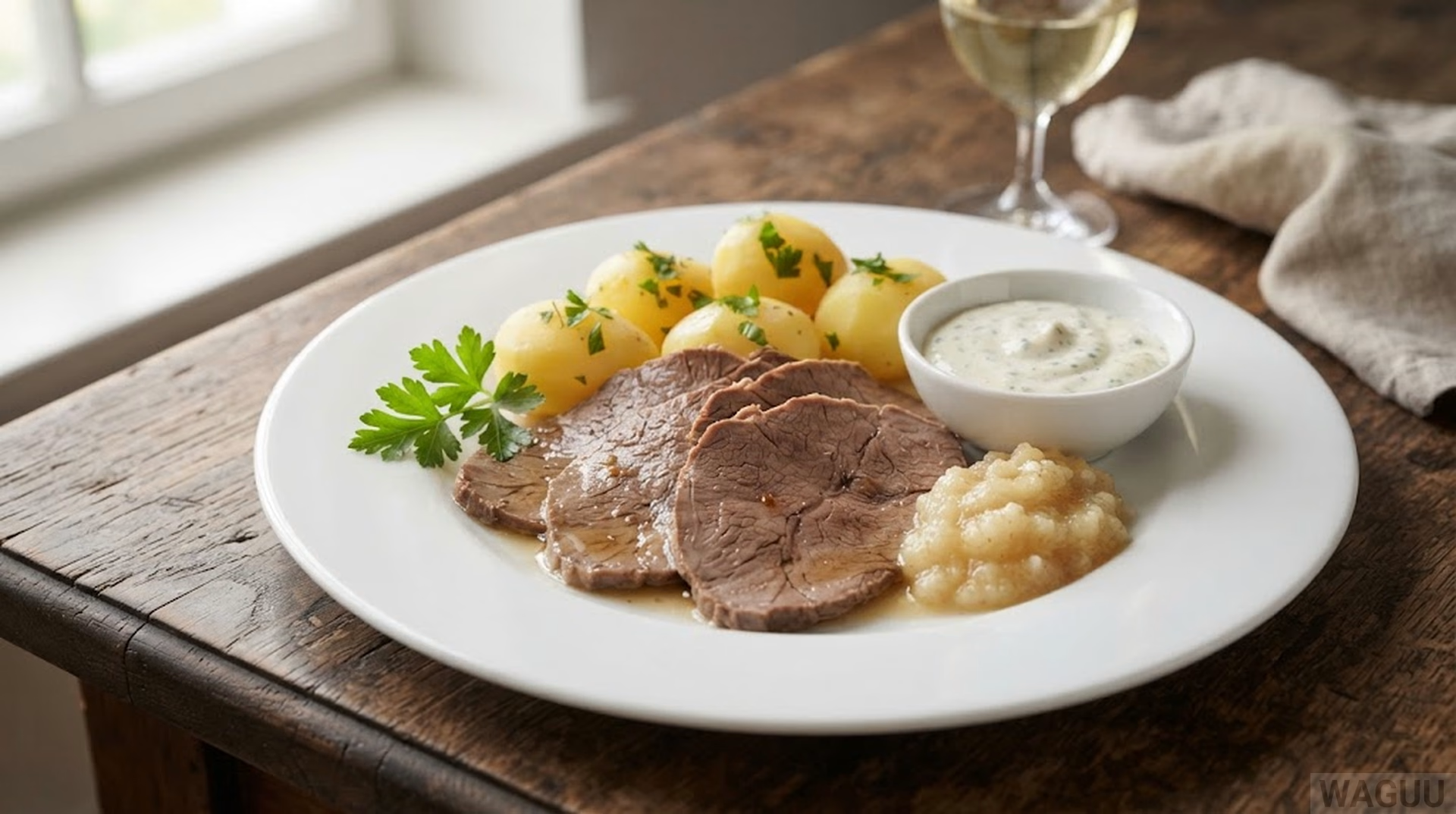
Summary: Beef topside slowly simmered with root vegetables, served with apple horseradish, chive sauce and its own clear broth. Ready in 2.5 hours, serves 6.
Cooked this recipe? Share your result with the community.
Categories: Beef, Austrian Cuisine
Success rate: not rated yet % of users cooked this recipe without problems
Quick Overview
- Dish: Tafelspitz
- Categories: Beef, Austrian Cuisine
- Cuisine: Austrian
- Main ingredient: Beef topside, 1.5 kg (from the thick end)
- Guide: 12 Most Famous Austrian Dishes
- Total time: 160 minutes (20 minutes preparation + 140 minutes cooking)
- Difficulty: Easy
- Servings: 6 (portion weight: 250 g)
- Key technique: Gentle simmering (never boiling)
- Preparation types: Boiling, simmering
- Dietary info & allergens: Contains milk (in the chive sauce), eggs (in the apple horseradish)
- Suitable for: Sunday lunch, festive menu, family dinner, Emperor’s table
- Nutritional values (per portion): 425 kcal, Protein: 42 g, Fat: 22 g, Carbohydrates: 12 g
- Storage: 3 days in the fridge, 2 months in the freezer (meat only)
- Pairing: Blaufränkisch, Zweigelt, Grüner Veltliner, Vienna lager
- In short: Boiled beef done right — the cut, the temperature and the patience make the dish.
- Last update: 28 September 2026
WAGUU says: “Tafelspitz is not about the meat — it is about the broth. If the broth is cloudy, you boiled it. If it is clear, you simmered it. Only one of those is right.”
Key Facts
| Prep time: | 20 minutes |
| Cooking time: | 140 minutes |
| Temperature: | 90–95 °C (bare tremble, never boil) |
| Servings: | 6 |
At a Glance
Tafelspitz is boiled beef at its finest — a clean, clear broth, meat that falls apart with a spoon, and two cold sauces that cut through the richness. Emperor Franz Joseph ate it almost every day, and once you taste it you will understand why.
Ingredients
Base servings: 6 servings • Portion weight: 250 g
| Ingredient | Amount | Quality |
|---|---|---|
| Beef topside | 1500 g | From the thick end, tied with string |
| Beef bones (marrow bones) | 500 g | Cut into 5 cm pieces |
| Carrots | 200 g | Peeled, cut into chunks |
| Celeriac | 150 g | Peeled, cut into chunks |
| Parsley root | 150 g | Peeled, cut into chunks |
| Leeks | 150 g | White part only, sliced |
| Brown onions | 2 pcs | Halved, cut side charred in a dry pan |
| Bay leaves | 3 pcs | Dried |
| Black peppercorns | 10 pcs | Whole |
| Allspice berries | 6 pcs | Whole |
| Fresh thyme | 3 sprigs | Fresh |
| Fine sea salt | 20 g | For the broth |
| Apples | 3 pcs | Tart, such as Granny Smith, for the horseradish |
| Fresh horseradish | 100 g | Freshly grated |
| Lemons | 1 pcs | Juice only |
| Chives | 30 g | Finely chopped |
| Sour cream | 200 g | Full-fat, for the chive sauce |
| White bread | 6 slices | For serving |
Why You Will Love This Recipe
- Two dishes in one: A clear beef broth as a first course, then the sliced beef as a main.
- Almost hands-off: Once it is on the hob, the dish cooks itself for two hours.
- Emperor-approved: Franz Joseph ate Tafelspitz almost daily. If it was good enough for the Habsburgs, it is good enough for a Tuesday.
Why it works: The meat is simmered at 90–95 °C — never boiled. At this temperature, collagen slowly turns into gelatine without the muscle fibres contracting and squeezing out their juices. The result is meat that stays moist and a broth that stays clear.
Recipe Overview
Prep: 20 min | Cook: 140 min | Difficulty: Easy | Servings: 6 | Type: Main | Origin: Austrian
Detailed Method
Total progress: 0 % done
Phase 1: Preparing the Base – 15 min
Equipment: Large stockpot (8 litres), dry frying pan
1. Halve the onions and place them cut-side down in a dry frying pan over high heat. Char them until the cut surface is almost black — this gives the broth its colour. Peel and roughly chop the carrots, celeriac and parsley root. Slice the leek.
VKB: The onion halves have a dark, almost black char on the cut side. The vegetables are cut into rough 3 cm chunks — no need for precision.
Before you continue:
Do not wash the meat. Pat it dry with kitchen paper. Washing spreads bacteria and dilutes the broth.
Phase 2: Starting the Broth – 10 min
Equipment: Large stockpot, slotted spoon
2. Put the beef, bones and charred onions into the stockpot and cover with cold water — about 4 litres. Bring to a bare tremble over medium heat, then reduce the heat to the lowest setting that keeps the surface moving. Skim off the grey foam that rises to the surface.
VKB: The surface of the water trembles but does not bubble. A steady stream of grey foam rises and is skimmed away with the slotted spoon. After 10 minutes, no more foam appears.
Before you continue:
The single biggest mistake with Tafelspitz is boiling it. If the surface bubbles vigorously, the meat will be dry and the broth cloudy. Keep it at a tremble.
Phase 3: Adding Aromatics – 5 min
Equipment: Stockpot
3. Add the carrots, celeriac, parsley root, leek, bay leaves, peppercorns, allspice berries and thyme to the pot. Do not add salt yet.
VKB: The vegetables are in the pot and the water level has risen slightly. The broth smells of bay and peppercorns, not just meat.
Before you continue:
Do not add salt at this stage. Salt draws moisture out of the meat during long cooking. Add it only in the last 20 minutes.
Phase 4: Slow Simmer – 120 min
Equipment: Stockpot, lid slightly ajar
4. Cover the pot with a lid, leaving it slightly ajar so steam can escape. Simmer at 90–95 °C for 120 minutes. Check every 30 minutes that the water level still covers the meat. If it drops, top up with boiling water — never cold.
VKB: After 90 minutes, a skewer slides into the meat with only slight resistance. The broth is clear and golden. The meat has not fallen apart.
Before you continue:
Never top up with cold water. It shocks the meat fibres and makes them contract, which squeezes out the juices. Always use boiling water.
Phase 5: Making the Sauces – 15 min
Equipment: Grater, small bowl, whisk
5. Peel and grate the apples. Grate the horseradish. Mix them together with the lemon juice and a pinch of salt — this is the apple horseradish (Apfelkren). In a separate bowl, whisk the sour cream with the chopped chives and a pinch of salt — this is the chive sauce (Schnittlauchsauce).
VKB: The apple horseradish is pale, fluffy and smells sharp. The chive sauce is pale green and thick enough to coat the back of a spoon.
Before you continue:
Grate the horseradish at the last minute. The moment it is exposed to air, its aroma fades. If your eyes water, you are doing it right.
Phase 6: Serving – 10 min
Equipment: Warm bowls, carving board, sharp knife
6. Lift the meat out of the broth and rest it on a board for 5 minutes. Slice it against the grain into 1 cm thick slices. Strain the broth through a fine sieve into a clean pot, season with salt and serve a small bowl as a first course. Then serve the sliced beef on warm plates with the apple horseradish, chive sauce and white bread on the side.
VKB: The broth is clear and golden. The sliced beef is pale pink inside and holds its shape. It gives way with almost no resistance when pressed with a fork.
Required Equipment
| Item | Ideal size | Alternative | Risk |
|---|---|---|---|
| Large stockpot | 8 litres, heavy bottom | Large casserole with lid | Thin pots scorch the vegetables at the bottom |
| Fine sieve | 20 cm, fine mesh | Muslin cloth in a colander | A coarse sieve leaves sediment in the broth |
| Sharp carving knife | 25 cm blade | Serrated bread knife | A blunt knife tears the meat instead of slicing it |
Shopping List
Nutritional Profile
Values per portion (without side dish). Calculated from average nutritional values of ingredients.
| Nutrient | Per 100 g | Per 1 portion | Per 6 portions |
|---|---|---|---|
| Energy | 169 kcal | 425 kcal | 2550 kcal |
| Fat | 8.8 g | 22 g | 132 g |
| of which saturated | 4.4 g | 11 g | 66 g |
| Carbohydrates | 4.8 g | 12 g | 72 g |
| of which sugars | 2.4 g | 6 g | 36 g |
| Protein | 16.8 g | 42 g | 252 g |
| Salt | 0.9 g | 2.2 g | 13.2 g |
Reference intake of an average adult (8400 kJ / 2000 kcal).
WAGUU Pro Level
- Pro standard: Verified recipe with exact ratios and visual control points.
- Tip 1: Ask your butcher for topside from the thick end. It has the right ratio of meat to fat and stays tender during long simmering.
- Tip 2: Char the onion halves until almost black. This is what gives the broth its amber colour, not just its flavour.
- Tip 3: Strain the broth twice — once through a coarse sieve, once through a fine one. The result is a crystal-clear soup.
- Tip 4: Slice the meat against the grain, not with it. Against the grain shortens the muscle fibres and makes the meat taste more tender.
Scientific Background
Beef muscle is made of long protein fibres held together by collagen. When you boil beef at 100 °C, the fibres contract and squeeze out their juice, leaving the meat dry and stringy. At 90–95 °C, however, the fibres stay relaxed while the collagen slowly dissolves into gelatine. That is what makes Tafelspitz tender instead of tough — and it is also why the broth stays clear. Boiling agitates the proteins and makes them cloud the water; simmering leaves them intact.
Fine Dining – Professional Techniques
- Plate composition: Place two slices of beef in the centre of a warm plate. Spoon a quenelle of apple horseradish on one side and a quenelle of chive sauce on the other. Serve the broth in a separate cup.
- Texture contrasts: The soft meat against the crisp bread, the cool sauces against the warm broth.
- Temperature contrast: Serve the broth hot and the sauces cold. The contrast keeps the palate awake.
- Aromatic additions: A few fresh chive stalks on top of the sliced beef. Do not put them on the broth — they will wilt.
Sensory Radar
- Appearance: Pale pink beef slices on a warm plate, two small bowls of sauce, a clear amber broth.
- Aroma: Clean beef broth, bay leaf, peppercorn, horseradish sharpness.
- Taste: Mild, deep beef flavour, sharp horseradish, cool chive cream.
- Texture: The meat gives way with almost no resistance. The broth is silky.
Pairing
- BEER: Vienna lager, Märzen, or a light Zwickl.
- WINE: Blaufränkisch, Zweigelt, or a dry Grüner Veltliner.
- SOFT DRINK: Sparkling water with lemon, or a light apple spritzer.
Preparation Variations
- With beef tongue: Add a whole beef tongue to the pot for the last 90 minutes. Peel it while warm and slice it alongside the topside.
- With marrow dumplings: Add small dumplings made from bread, marrow and egg to the broth just before serving.
Allergens and Dietary Information
Contains: Milk (sour cream), eggs (optional in marrow dumplings) • Gluten: Yes (in the bread served alongside) • Not suitable for: Vegan, vegetarian, lactose intolerance (without the chive sauce)
Suitable For
Sunday lunch, festive menu, family dinner, Emperor’s table
Substitution Catalogue
- Beef topside: Thick flank or brisket (slightly fattier but equally good)
- Fresh horseradish: Prepared horseradish from a jar (weaker but acceptable)
- Sour cream: Crème fraîche or Greek yoghurt (lighter)
FAQ
What cut of beef is best for Tafelspitz?
Topside from the thick end. It has enough marbling to stay tender during long simmering but is not so fatty that the broth becomes greasy.
Why is my broth cloudy?
You boiled it instead of simmering it. Keep the surface at a bare tremble — never a rolling boil — and skim the foam regularly.
Can I make Tafelspitz ahead of time?
Yes. Cook the meat and broth the day before, cool them separately, and reheat gently. The flavour improves overnight.
What can I serve with it?
Apple horseradish, chive sauce and white bread are traditional. Some Austrian families also serve boiled potatoes or creamed spinach on the side.
WAGUU Petr advises: Cooking for 6 or more?
6–8 people: Use a 10-litre pot and increase the water to 5 litres. Cooking time stays the same. • 10+ people: Cook two smaller pieces of beef rather than one large piece. They cook faster and are easier to slice.
Side Dishes and Serving
Storage and Reheating
Fridge: 3 days (store meat and broth separately) • Freezer: 2 months (meat only — the broth loses clarity) • Reheating: Reheat the meat in the broth at 80 °C for 15 minutes. Do not boil.
Author: WAGUU Petr & Team • Published: 30 Sep 2026
More Recipes from This Article
More Recipes You Might Like
Why WAGUU?
Recipes on WAGUU go through a check of ingredient accuracy, method and nutritional values.
Photo Gallery from the Process
Community photos: Cook it, photograph it, and share the result.
You can upload photos in the comments below or send them by email.
Filmed a video of our recipe? Post a link to YouTube, YouTube Shorts, TikTok, Instagram Reels, Facebook Reels, Pinterest, Vimeo or X (Twitter) in the comments — we will be glad to publish it and help you and your content get noticed.
Most Common Mistakes
- Boiling instead of simmering – The meat turns dry and the broth cloudy. Keep the surface at a bare tremble.
- Adding salt too early – Salt draws moisture out of the meat during long cooking. Add it in the last 20 minutes.
- Topping up with cold water – Cold water shocks the meat fibres and makes them contract. Always use boiling water.
- Slicing with the grain – Slicing with the grain leaves long muscle fibres intact. Slice against the grain for tenderness.