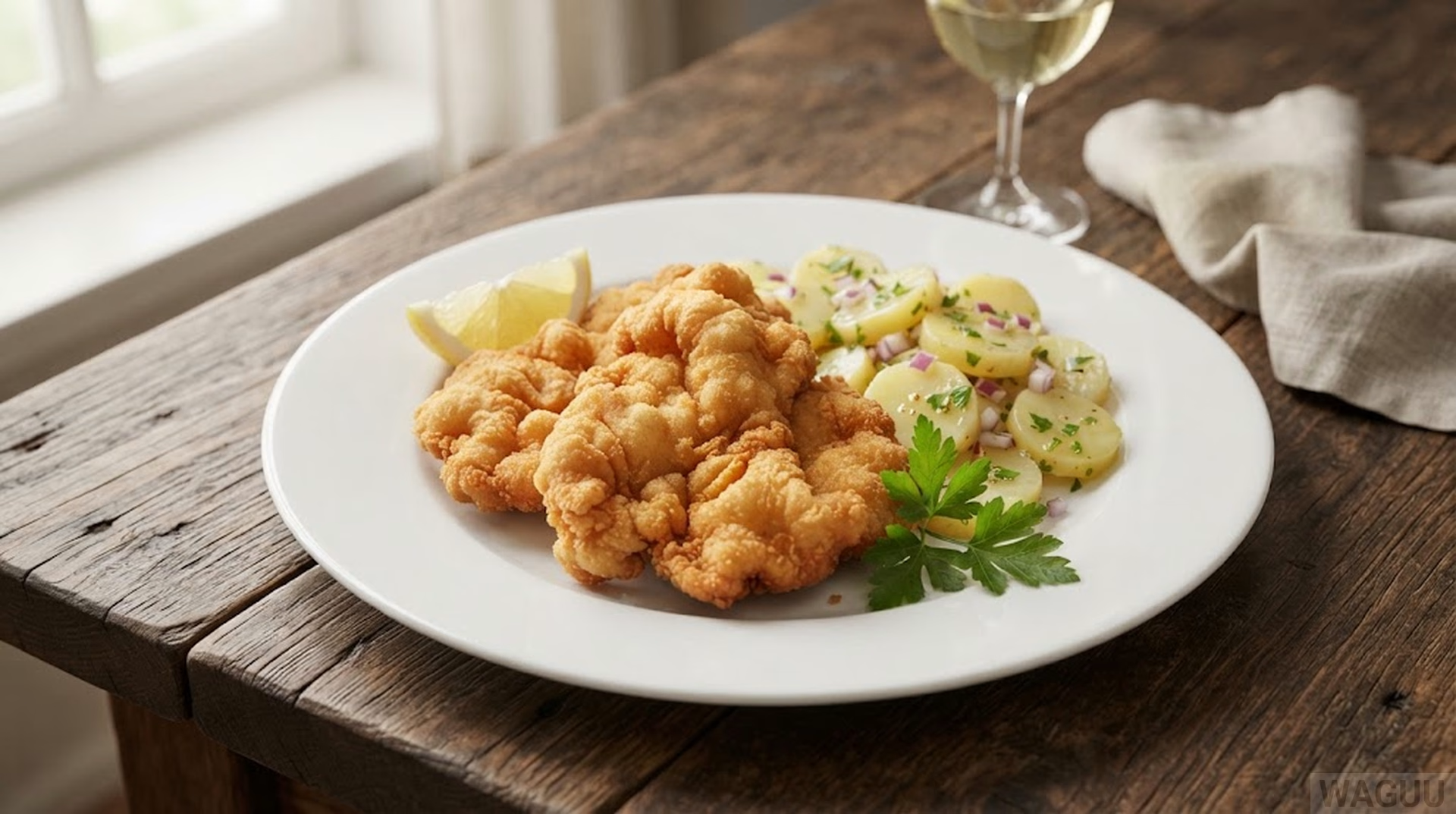
Summary: Chicken pieces in a light, crisp breadcrumb crust, shallow-fried in clarified butter until golden. Ready in 40 minutes, serves 6.
Cooked this recipe? Share your result with the community.
Categories: Poultry, Austrian Cuisine
Success rate: not rated yet % of users cooked this recipe without problems
Quick Overview
- Dish: Backhendl
- Categories: Poultry, Austrian Cuisine
- Cuisine: Austrian
- Main ingredient: Chicken, 1.8 kg (jointed into 8 pieces)
- Guide: 12 Most Famous Austrian Dishes
- Total time: 40 minutes (20 minutes preparation + 20 minutes cooking)
- Difficulty: Medium
- Servings: 6 (portion weight: 220 g)
- Key technique: Shallow-frying in clarified butter
- Preparation types: Shallow-frying
- Dietary info & allergens: Contains gluten, eggs, milk
- Suitable for: Sunday lunch, family dinner, picnic
- Nutritional values (per portion): 525 kcal, Protein: 42 g, Fat: 28 g, Carbohydrates: 20 g
- Storage: 1 day in the fridge, not suitable for freezing
- Pairing: Vienna lager, Grüner Veltliner, apple spritzer
- In short: Viennese fried chicken — the same breading as a schnitzel, but with more flavour and more crunch.
- Last update: 28 September 2026
WAGUU says: “Backhendl is what you make when you want a schnitzel but you want more flavour. Chicken on the bone holds moisture, and the breading puffs up just like on a veal cutlet.”
Key Facts
| Prep time: | 20 minutes |
| Cooking time: | 20 minutes |
| Temperature: | 170–175 °C fat temperature |
| Servings: | 6 |
At a Glance
Backhendl is a Viennese classic — pieces of chicken breaded the same way as a Wiener Schnitzel and shallow-fried until the crust puffs and the meat stays juicy. Traditionally served cold or at room temperature, which makes it the perfect picnic dish.
Ingredients
Base servings: 6 servings • Portion weight: 220 g
| Ingredient | Amount | Quality |
|---|---|---|
| Chicken | 1800 g | Free-range, jointed into 8 pieces |
| Plain flour | 150 g | Fine, sifted |
| Eggs | 4 pcs | Large, free-range |
| Fine dry breadcrumbs | 250 g | Day-old white bread, finely ground |
| Clarified butter | 500 g | Butterschmalz, for frying |
| Fine sea salt | 15 g | For seasoning |
| Black pepper | 3 g | Freshly ground |
| Lemons | 2 pcs | Unwaxed, cut into wedges |
| Fresh parsley | 20 g | For garnish |
Why You Will Love This Recipe
- More flavour than a schnitzel: Chicken on the bone keeps the meat juicy and adds depth to the crust.
- Great cold: Traditional Backhendl is served at room temperature — the crust stays crisp and the meat stays moist.
- Simple breading: The same flour-egg-breadcrumbs as a Wiener Schnitzel, but the chicken is thicker so the crust is less likely to burn.
Why it works: Chicken on the bone has more moisture than a boneless breast. As the breading sets in hot fat, that moisture turns to steam and pushes the crust away from the meat, creating the same puff as on a schnitzel. The bone also insulates the meat so it cooks more slowly and stays juicy.
Recipe Overview
Prep: 20 min | Cook: 20 min | Difficulty: Medium | Servings: 6 | Type: Main | Origin: Austrian
Detailed Method
Total progress: 0 % done
Phase 1: Preparing the Chicken – 10 min
Equipment: Chopping board, kitchen paper
1. If the chicken is whole, joint it into 8 pieces — two legs, two thighs, two wings, two breast halves. Pat every piece dry with kitchen paper. Season lightly with salt and pepper, then leave to come to room temperature for 10 minutes.
VKB: The chicken pieces are dry to the touch and no longer cold from the fridge. The skin is intact and unbroken.
Before you continue:
Do not wash the chicken. Washing spreads bacteria and makes the skin wet, which stops the breading from sticking. Pat it dry instead.
Phase 2: Setting up the Breading Station – 5 min
Equipment: Three deep plates or shallow bowls
2. Put the flour in the first plate, beat the eggs with a fork in the second plate, and spread the breadcrumbs in the third plate. Season the flour lightly with salt and pepper.
VKB: The eggs are completely beaten with no streaks. The breadcrumbs are dry and loose, with no clumps.
Before you continue:
Use one hand for the wet ingredients and one for the dry. This keeps your fingers from becoming breaded and the coating clean.
Phase 3: Coating the Chicken – 10 min
Equipment: Three plates, tongs
3. Press each chicken piece into the flour on both sides and shake off the excess. Dip it into the beaten egg, letting the excess drip back into the plate. Lay it flat on the breadcrumbs and press gently so the crumbs stick. Turn it over and press again. Set the breaded pieces aside on a tray. Repeat with the remaining pieces.
VKB: The breadcrumbs stick in a single even layer. There are no bare patches and no thick clumps. The coating feels dry, not wet.
Before you continue:
Let the breaded chicken rest for 10 minutes before frying. This gives the coating time to set and stops it from falling off in the pan.
Phase 4: Heating the Fat – 5 min
Equipment: Large heavy frying pan (28–30 cm), kitchen thermometer
4. Put the clarified butter into a large heavy frying pan and heat it over medium-high heat until it reaches 170–175 °C. The fat should be at least 2 cm deep so the chicken can cook evenly.
VKB: A breadcrumb dropped into the fat sizzles immediately and rises to the surface within 2 seconds. If it sinks, the fat is too cold. If it burns, the fat is too hot.
Before you continue:
Never let the fat smoke. If it starts to smoke, pull the pan off the heat for 30 seconds. Smoking fat gives the crust a bitter taste.
Phase 5: Frying the Chicken – 15 min
Equipment: Heavy frying pan, tongs, wire rack
5. Slide the chicken pieces into the hot fat, skin side down first. Fry for 6–7 minutes on each side for the breast and wing pieces, 7–8 minutes per side for the legs and thighs. Move the pan back and forth gently so the fat washes over the top. Lift each piece out with tongs and place it on a wire rack to drain.
VKB: The crust is deep golden brown and puffed, with visible air pockets. The juices run clear when you pierce the thickest part of a thigh with a skewer.
Before you continue:
Do not crowd the pan. Fry in two batches so the fat stays at 170 °C. If the fat drops below 160 °C, the breading absorbs oil and turns soggy.
Phase 6: Serving – 2 min
Equipment: Warm plates, lemon wedges
6. Sprinkle each piece with a pinch of fine sea salt. Serve immediately on warm plates with a lemon wedge and a sprig of parsley. Traditional Backhendl is also excellent served cold or at room temperature.
VKB: The chicken is on the plate within two minutes of coming out of the pan. The crust is still crisp when it reaches the table.
Required Equipment
| Item | Ideal size | Alternative | Risk |
|---|---|---|---|
| Heavy frying pan | 28–30 cm, cast iron or stainless steel | Large sauté pan | Thin pans lose heat when the chicken goes in |
| Kitchen thermometer | Digital, up to 200 °C | Breadcrumb test | Guessing the temperature leads to soggy crust |
| Wire rack | 30 × 20 cm | Colander turned upside down | Kitchen paper traps steam and softens the crust |
Shopping List
Nutritional Profile
Values per portion (without side dish). Calculated from average nutritional values of ingredients.
| Nutrient | Per 100 g | Per 1 portion | Per 6 portions |
|---|---|---|---|
| Energy | 239 kcal | 525 kcal | 3150 kcal |
| Fat | 12.7 g | 28 g | 168 g |
| of which saturated | 7.7 g | 17 g | 102 g |
| Carbohydrates | 9.1 g | 20 g | 120 g |
| of which sugars | 1.4 g | 3 g | 18 g |
| Protein | 19.1 g | 42 g | 252 g |
| Salt | 0.8 g | 1.8 g | 10.8 g |
Reference intake of an average adult (8400 kJ / 2000 kcal).
WAGUU Pro Level
- Pro standard: Verified recipe with exact ratios and visual control points.
- Tip 1: Use a free-range chicken — it has more flavour and a firmer texture that holds up to frying.
- Tip 2: Fry the thigh and leg pieces first, as they take longer. Keep them warm on a wire rack in a 90 °C oven while you fry the breasts and wings.
- Tip 3: Move the pan back and forth while frying. The fat washing over the top of the chicken cooks the breading from above and gives it the signature puff.
- Tip 4: Backhendl is traditionally eaten cold or at room temperature. The crust stays crisp and the meat stays moist, which is why it is a classic picnic dish.
Scientific Background
Chicken on the bone is cooked more evenly than boneless meat because the bone insulates the meat around it. This means the meat near the bone can stay moist while the outside browns. The breading puffs for the same reason as on a schnitzel — moisture inside the chicken turns to steam as soon as it hits 170 °C fat, and the steam pushes the crust away from the meat. The crust sets in that puffed position, trapping the juices.
Fine Dining – Professional Techniques
- Plate composition: Arrange two pieces of chicken on a warm plate with a lemon wedge and a sprig of parsley. Add a small bowl of potato salad on the side.
- Texture contrasts: The crisp crust against the creamy potato salad.
- Temperature contrast: Serve hot, or serve at room temperature for a picnic.
- Aromatic additions: A pinch of fresh parsley chopped over the top.
Sensory Radar
- Appearance: Deep golden-brown crust, puffed and slightly wavy, with a lemon wedge on the side.
- Aroma: Warm butter, toasted bread, roast chicken.
- Taste: Savoury, meaty, with a bright lift of lemon.
- Texture: Crisp crust, juicy meat, no greasiness.
Pairing
- BEER: Vienna lager, Märzen, or a light wheat beer.
- WINE: Grüner Veltliner, Riesling, or a light Pinot Blanc.
- SOFT DRINK: Apple spritzer, or sparkling water with lemon.
Preparation Variations
- With buttermilk marinade: Soak the chicken in buttermilk for 2 hours before breadcrumbing. The meat becomes more tender and the breading sticks better.
- Oven-finished: Fry the chicken for 4 minutes per side, then finish in a 180 °C oven for 15 minutes. This gives a crisp crust and ensures the meat is cooked through.
Allergens and Dietary Information
Contains: Gluten, eggs, milk • Gluten: Yes (from flour and breadcrumbs) • Not suitable for: Coeliac disease, lactose intolerance, vegan, vegetarian
Suitable For
Sunday lunch, family dinner, picnic, garden party
Substitution Catalogue
- Chicken on the bone: Boneless chicken breast (cooks faster, less flavour)
- Clarified butter: Lard or sunflower oil
- Fine dry breadcrumbs: Panko (lighter but less traditional)
FAQ
How do I keep the breading on my Backhendl?
Pat the chicken dry, coat it in flour first, then egg, then breadcrumbs. Let it rest for 10 minutes before frying so the coating sets.
Can I use boneless chicken?
You can, but boneless chicken cooks faster and has less flavour. If using breast, reduce the frying time to 4–5 minutes per side.
Why is my Backhendl greasy?
The fat was not hot enough, or you crowded the pan. Fry at 170 °C and work in batches so the temperature does not drop.
Can I make Backhendl ahead of time?
Yes. It is traditionally served cold. Fry it a few hours ahead and leave it at room temperature. The crust stays crisp.
WAGUU Petr advises: Cooking for 6 or more?
6–8 people: Fry in two batches and keep the finished pieces warm in a 90 °C oven on a wire rack. • 10+ people: Fry all the pieces ahead and serve at room temperature. This is how Backhendl is traditionally served at Viennese picnics.
Side Dishes and Serving
Storage and Reheating
Fridge: 1 day • Freezer: Not recommended • Reheating: Reheat in a 200 °C oven on a wire rack for 5–7 minutes. Never microwave.
Author: WAGUU Petr & Team • Published: 30 Sep 2026
More Recipes from This Article
More Recipes You Might Like
Why WAGUU?
Recipes on WAGUU go through a check of ingredient accuracy, method and nutritional values.
Photo Gallery from the Process
Community photos: Cook it, photograph it, and share the result.
You can upload photos in the comments below or send them by email.
Filmed a video of our recipe? Post a link to YouTube, YouTube Shorts, TikTok, Instagram Reels, Facebook Reels, Pinterest, Vimeo or X (Twitter) in the comments — we will be glad to publish it and help you and your content get noticed.
Most Common Mistakes
- Fat too cold – The breading absorbs oil and turns soggy. Heat to 170 °C and test with a breadcrumb.
- Crowding the pan – More than three pieces at a time drops the fat temperature. Fry in batches.
- Not resting the breaded chicken – The coating needs 10 minutes to set. Fry it straight away and the breading falls off.
- Draining on kitchen paper – Paper traps steam and softens the crust. Use a wire rack.