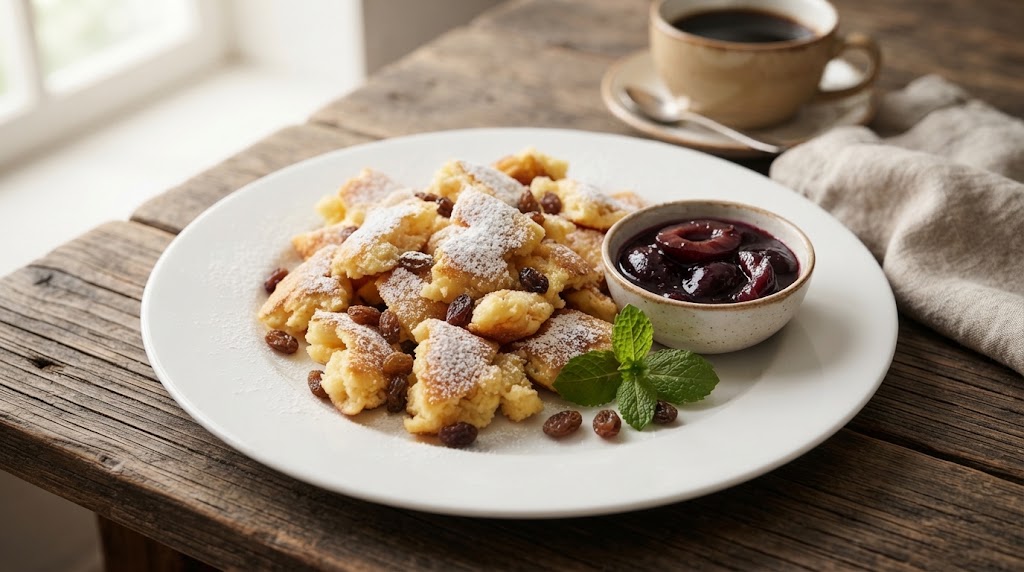
Summary: A thick, shredded pancake with raisins, caramelised in butter and served with plum compote. Ready in 30 minutes, serves 6.
Cooked this recipe? Share your result with the community.
Categories: Desserts, Austrian Cuisine
Success rate: not rated yet % of users cooked this recipe without problems
Quick Overview
- Dish: Kaiserschmarrn
- Categories: Desserts, Austrian Cuisine
- Cuisine: Austrian
- Main ingredient: Plain flour, 250 g + eggs, 6 pcs
- Guide: 12 Most Famous Austrian Dishes
- Total time: 30 minutes (15 minutes preparation + 15 minutes cooking)
- Difficulty: Medium
- Servings: 6 (portion weight: 180 g)
- Key technique: Pan-frying a thick pancake, then shredding it
- Preparation types: Pan-frying
- Dietary info & allergens: Contains gluten, eggs, milk
- Suitable for: Family dessert, afternoon treat, Sunday brunch
- Nutritional values (per portion): 425 kcal, Protein: 12 g, Fat: 18 g, Carbohydrates: 52 g
- Storage: 1 day in the fridge, not suitable for freezing
- Pairing: Coffee, plum compote, apple sauce
- In short: An Emperor’s dessert that looks like a mistake and tastes like a masterpiece.
- Last update: 28 September 2026
WAGUU says: “Kaiserschmarrn is a thick pancake that is torn apart with two forks and caramelised with sugar until the edges are crisp. The shredding is not a mistake — it is the whole point.”
Key Facts
| Prep time: | 15 minutes |
| Cooking time: | 15 minutes |
| Temperature: | Medium pan heat |
| Servings: | 6 |
At a Glance
Kaiserschmarrn is a thick, fluffy pancake that is torn into pieces with two forks while it cooks, then caramelised with sugar until the edges are crisp and the middle is soft. It is served with plum compote and a dusting of icing sugar. It looks like a mess and tastes like something an emperor would demand.
Ingredients
Base servings: 6 servings • Portion weight: 180 g
| Ingredient | Amount | Quality |
|---|---|---|
| Plain flour | 250 g | Fine, sifted |
| Eggs | 6 pcs | Large, free-range, separated |
| Whole milk | 400 ml | Warm |
| Caster sugar | 80 g | For the batter |
| Vanilla extract | 5 ml | Pure |
| Lemon zest | 1 tsp | From an unwaxed lemon |
| Fine sea salt | 3 g | A pinch, for the egg whites |
| Raisins | 80 g | Soaked in rum or warm water, drained |
| Butter | 80 g | Unsalted, for the pan |
| Caster sugar (for caramelising) | 40 g | For the pan |
| Icing sugar | 20 g | For dusting |
| Plum compote | 300 g | For serving |
Why You Will Love This Recipe
- Looks impressive, is easy: No special skills required — just a pan and two forks.
- Crisp edges, soft middle: The shredded pieces caramelise on all sides, giving every bite a mix of textures.
- Emperor-approved: Named after Emperor Franz Joseph, who was said to be fond of it.
Why it works: The batter is thicker than a normal pancake because the egg whites are whipped and folded in. This makes the pancake light and fluffy. Tearing it with two forks increases the surface area, so every piece gets caramelised with the sugar in the pan. The result is a dessert that is crisp on the edges, soft in the middle and deeply buttery.
Recipe Overview
Prep: 15 min | Cook: 15 min | Difficulty: Medium | Servings: 6 | Type: Dessert | Origin: Austrian
Detailed Method
Total progress: 0 % done
Phase 1: Making the Batter – 10 min
Equipment: Large bowl, whisk, stand mixer
1. Separate the eggs. Put the yolks into a large bowl with the flour, milk, 80 g caster sugar, vanilla extract and lemon zest. Whisk until smooth. In a clean dry bowl, whip the egg whites with a pinch of salt to stiff peaks. Fold one third of the whites into the batter, then fold in the rest gently with a spatula.
VKB: The batter is thick, pale yellow and airy. It falls off the spatula in a slow ribbon, not a fast stream.
Before you continue:
Fold the egg whites in gently. If you stir too hard, you knock the air out and the pancake will not rise.
Phase 2: Cooking the Pancake – 8 min
Equipment: Large non-stick frying pan (28 cm)
2. Melt half the butter in a large non-stick frying pan over medium heat. Pour in the batter and spread it evenly. Scatter the drained raisins over the top. Cook for 4–5 minutes, until the bottom is set and golden. Flip the pancake using a large plate or a spatula and cook for another 3–4 minutes.
VKB: The pancake is set and golden on the bottom. It has puffed slightly and the top is no longer wet.
Before you continue:
Keep the heat at medium. If the pan is too hot, the pancake burns before it sets. If it is too cold, it will not brown.
Phase 3: Shredding the Pancake – 3 min
Equipment: Two forks
3. Tear the pancake into bite-sized pieces with two forks, working directly in the pan. Do not cut it — tearing gives the ragged edges that crisp up when caramelised.
VKB: The pancake is torn into roughly equal pieces, about 3 cm across. The pieces have ragged edges, not clean cuts.
Before you continue:
Tearing, not cutting, is essential. The ragged edges catch the sugar and butter and turn crisp. Cut pieces stay soft.
Phase 4: Caramelising – 4 min
Equipment: Frying pan, spatula
4. Add the remaining butter and the 40 g of caster sugar to the pan. Toss the pieces so they are coated, and cook over medium-high heat for 3–4 minutes, stirring gently, until the sugar has melted and the pieces are golden and crisp at the edges.
VKB: The pieces are golden brown with darker, crisp edges. The sugar has melted and coats the pieces in a thin, glossy layer.
Before you continue:
Do not let the sugar burn. If it starts to smoke, pull the pan off the heat for a moment. Burnt sugar is bitter and ruins the dish.
Phase 5: Serving – 2 min
Equipment: Warm plates, icing sugar, plum compote
5. Divide the Kaiserschmarrn between warm plates. Dust generously with icing sugar and serve immediately with plum compote on the side.
VKB: The Kaiserschmarrn is on the table within 2 minutes of coming out of the pan. The icing sugar is visible on top and the compote is cold on the side.
Before you continue:
Serve immediately. Kaiserschmarrn loses its crisp edges within minutes of leaving the pan.
Required Equipment
| Item | Ideal size | Alternative | Risk |
|---|---|---|---|
| Large non-stick frying pan | 28 cm | Well-seasoned carbon steel pan | A small pan makes a thick pancake that does not cook through |
| Two forks | Standard table forks | Two spatulas | A knife gives clean cuts that do not crisp properly |
| Stand mixer or hand whisk | Balloon whisk attachment | Hand whisk | A poor whisk leaves the whites under-whipped |
Shopping List
Nutritional Profile
Values per portion (without side dish). Calculated from average nutritional values of ingredients.
| Nutrient | Per 100 g | Per 1 portion | Per 6 portions |
|---|---|---|---|
| Energy | 236 kcal | 425 kcal | 2550 kcal |
| Fat | 10.0 g | 18 g | 108 g |
| of which saturated | 5.6 g | 10 g | 60 g |
| Carbohydrates | 28.9 g | 52 g | 312 g |
| of which sugars | 16.7 g | 30 g | 180 g |
| Protein | 6.7 g | 12 g | 72 g |
| Salt | 0.3 g | 0.5 g | 3 g |
Reference intake of an average adult (8400 kJ / 2000 kcal).
WAGUU Pro Level
- Pro standard: Verified recipe with exact ratios and visual control points.
- Tip 1: Whip the egg whites to stiff peaks and fold them in gently. The air in the whites is what makes the pancake fluffy.
- Tip 2: Tear, do not cut. The ragged edges catch the sugar and butter and turn crisp.
- Tip 3: Caramelise in the pan, not in the oven. The direct heat gives the pieces a proper golden crust.
- Tip 4: Serve immediately. Kaiserschmarrn loses its crisp edges within minutes of leaving the pan.
Scientific Background
The egg whites in Kaiserschmarrn are whipped to stiff peaks and folded into the batter. This traps air in the mixture, which expands in the pan and makes the pancake light and fluffy. The sugar added at the end of cooking melts and caramelises on the surface of the torn pieces. Caramelisation is a chemical reaction — the sugar molecules break down and recombine into hundreds of new compounds with complex flavours. That is why the crisp edges taste so much more interesting than the soft middle.
Fine Dining – Professional Techniques
- Plate composition: Serve in a warm shallow bowl with a dusting of icing sugar and a small bowl of plum compote on the side.
- Texture contrasts: The crisp caramelised edges against the soft, airy middle.
- Temperature contrast: Serve hot with cold compote on the side.
- Aromatic additions: A pinch of cinnamon in the compote, or a few toasted almond flakes on top.
Sensory Radar
- Appearance: Golden-brown torn pieces, dusted with white icing sugar, with dark plum compote on the side.
- Aroma: Warm vanilla, caramelised sugar, butter.
- Taste: Sweet, buttery, with a hint of vanilla and lemon, and the tartness of the compote.
- Texture: Crisp edges, soft, airy middle.
Pairing
- COFFEE: A strong Viennese mélange or an espresso.
- WINE: Sweet Riesling, Tokaji, or a light Moscato.
- SOFT DRINK: Hot chocolate or fresh mint tea.
Preparation Variations
- With apple: Replace the raisins with chopped apple and add a pinch of cinnamon to the batter.
- With chocolate: Drizzle melted dark chocolate over the Kaiserschmarrn before serving.
Allergens and Dietary Information
Contains: Gluten, eggs, milk • Gluten: Yes (from flour) • Not suitable for: Coeliac disease, lactose intolerance, vegan
Suitable For
Family dessert, afternoon treat, Sunday brunch, ski lodge dinner
Substitution Catalogue
- Raisins: Dried cranberries, chopped dried apricots, or nothing at all
- Plum compote: Apple sauce, raspberry sauce, or apricot jam
- Whole milk: Semi-skimmed milk or oat milk
FAQ
Why is my Kaiserschmarrn soggy?
The pan was not hot enough when the batter went in. The first side must set before you tear it apart. Make sure the pan is at medium heat and the butter is sizzling before you add the batter.
Can I make Kaiserschmarrn without raisins?
Yes. Soak them in rum or warm water first if you use them — dry raisins will burn on the surface of the pancake. If you skip them entirely, the dish is still authentic.
Can I reheat Kaiserschmarrn?
Yes, in a dry pan over medium heat for two minutes, or in the oven at 160 °C for five minutes. Do not microwave it — it turns rubbery.
Why did my Kaiserschmarrn not rise?
The egg whites were not stiff enough, or they were over-folded. Whip them to stiff, glossy peaks and fold them in with a spatula in a figure-of-eight motion.
WAGUU Petr advises: Cooking for 6 or more?
6–8 people: Make two smaller pancakes rather than one large one. They cook more evenly and are easier to tear. • 10+ people: Cook the Kaiserschmarrn in batches and keep the finished batches warm in a 90 °C oven. Toss them with a little melted butter before serving.
Side Dishes and Serving
Storage and Reheating
Fridge: 1 day • Freezer: Not recommended • Reheating: Reheat in a dry pan over medium heat for 2 minutes, or in a 160 °C oven for 5 minutes.
Author: WAGUU Petr & Team • Published: 30 Sep 2026
More Recipes from This Article
More Recipes You Might Like
Why WAGUU?
Recipes on WAGUU go through a check of ingredient accuracy, method and nutritional values.
Photo Gallery from the Process
Community photos: Cook it, photograph it, and share the result.
You can upload photos in the comments below or send them by email.
Filmed a video of our recipe? Post a link to YouTube, YouTube Shorts, TikTok, Instagram Reels, Facebook Reels, Pinterest, Vimeo or X (Twitter) in the comments — we will be glad to publish it and help you and your content get noticed.
Most Common Mistakes
- Pan not hot enough – The pancake will not set and turns soggy. Make sure the butter is sizzling before you add the batter.
- Over-folding the egg whites – You knock the air out and the pancake does not rise. Fold gently with a spatula.
- Cutting instead of tearing – Cut pieces stay soft. Tearing gives the ragged edges that crisp up.
- Adding sugar too early – Sugar burns if it is added before the pancake is set. Add it only after you have torn the pancake apart.