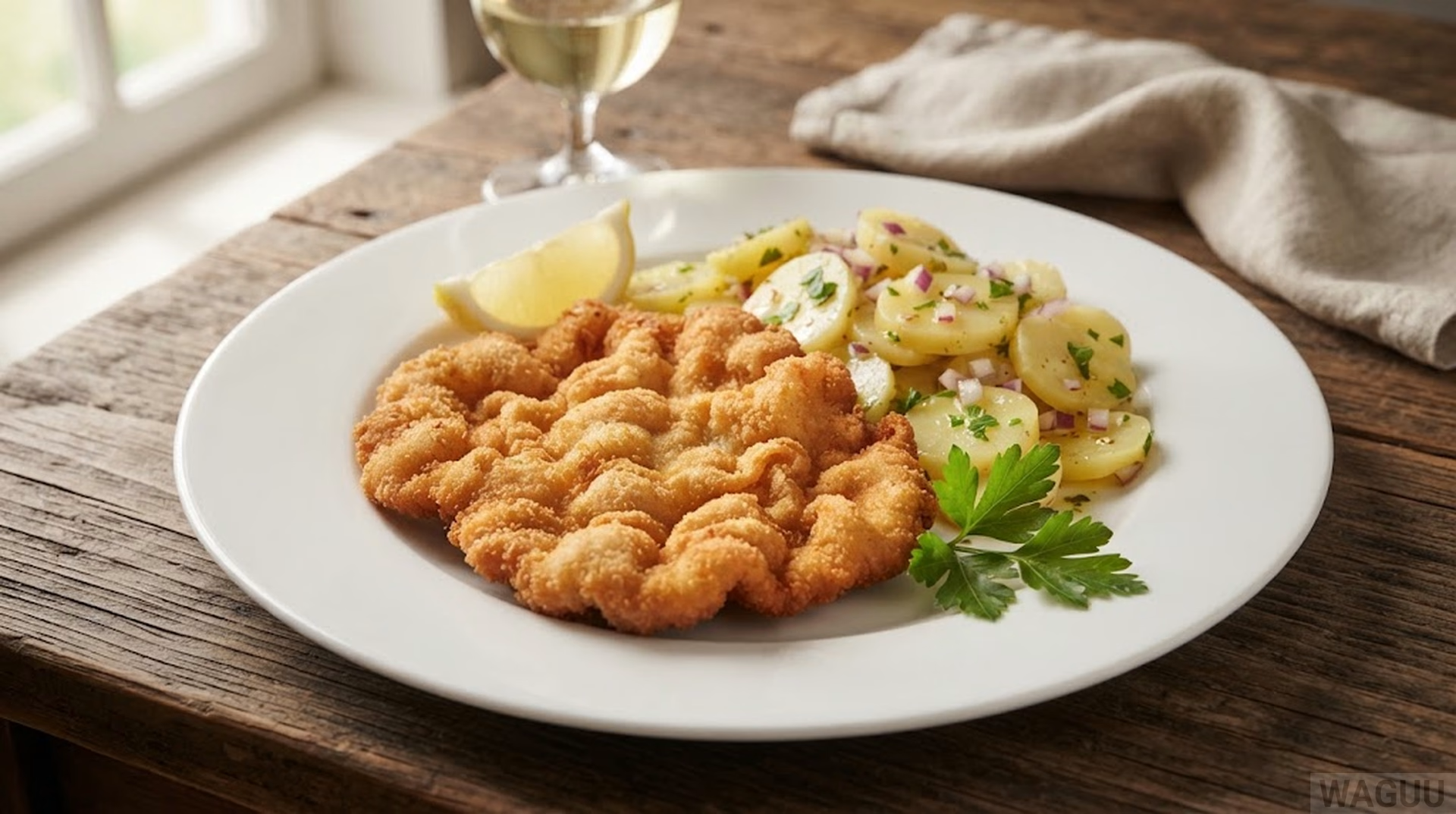
Summary: A thin veal cutlet in a light, puffy breadcrumb crust, shallow-fried in clarified butter. Ready in 30 minutes, serves 6.
Cooked this recipe? Share your result with the community.
Categories: Beef, Austrian Cuisine
Success rate: not rated yet % of users cooked this recipe without problems
Quick Overview
- Dish: Wiener Schnitzel
- Categories: Beef, Austrian Cuisine
- Cuisine: Austrian
- Main ingredient: Veal escalope, 900 g (thinly sliced from the leg)
- Guide: 12 Most Famous Austrian Dishes
- Total time: 30 minutes (15 minutes preparation + 15 minutes cooking)
- Difficulty: Medium
- Servings: 6 (portion weight: 180 g)
- Key technique: Shallow-frying in clarified butter
- Preparation types: Shallow-frying
- Dietary info & allergens: Contains gluten, eggs, milk
- Suitable for: Sunday lunch, festive menu, family dinner
- Nutritional values (per portion): 485 kcal, Protein: 38 g, Fat: 26 g, Carbohydrates: 22 g
- Storage: 1 day in the fridge, not suitable for freezing
- Pairing: Vienna lager, Grüner Veltliner, sparkling water with lemon
- In short: The benchmark of Austrian cooking — four ingredients, one pan, thirty minutes.
- Last update: 28 September 2026
WAGUU says: “A real Wiener Schnitzel has a crust that separates from the meat as you cut into it. If yours does not, the fat was not hot enough.”
Key Facts
| Prep time: | 15 minutes |
| Cooking time: | 15 minutes |
| Temperature: | 170–175 °C fat temperature |
| Servings: | 6 |
At a Glance
A proper Wiener Schnitzel is pounded thin, breaded in flour, egg and breadcrumbs, and shallow-fried in clarified butter until the crust puffs away from the meat and turns golden. Lemon on the side is not decoration — it is part of the dish.
Ingredients
Base servings: 6 servings • Portion weight: 180 g
| Ingredient | Amount | Quality |
|---|---|---|
| Veal escalopes | 900 g | From the leg, sliced 5 mm thick |
| Plain flour | 150 g | Fine, sifted |
| Eggs | 4 pcs | Large, free-range, at room temperature |
| Fine dry breadcrumbs | 250 g | Day-old white bread, finely ground |
| Clarified butter | 400 g | Butterschmalz, for frying |
| Fine sea salt | 15 g | For seasoning |
| Lemons | 2 pcs | Unwaxed, cut into wedges |
Why You Will Love This Recipe
- Four ingredients: Veal, flour, egg and breadcrumbs — nothing else goes into the coating.
- Fast: From fridge to plate in 30 minutes once the fat is hot.
- Teaches technique: Once you nail the breading, you can apply it to chicken, pork, fish or vegetables.
Why it works: The crust puffs because the moisture in the veal turns to steam and pushes the breading away from the meat. For that to happen, the fat must be hot enough to set the crust instantly — around 170 °C. A lower temperature means the breading absorbs oil and turns soggy.
Recipe Overview
Prep: 15 min | Cook: 15 min | Difficulty: Medium | Servings: 6 | Type: Main | Origin: Austrian
Detailed Method
Total progress: 0 % done
Phase 1: Preparing the Veal – 10 min
Equipment: Chopping board, meat mallet, cling film
1. Place each veal escalope between two sheets of cling film and pound it with a meat mallet to about 4 mm thickness. Work from the centre outwards to keep the thickness even. Pat the pounded escalopes dry with kitchen paper.
VKB: The escalope is evenly thin all over — you can see the light through it if you hold it up. No thick patches at the edges.
Before you continue:
Do not wash the veal. Washing spreads bacteria and prevents the crust from sticking. Pat it dry with kitchen paper instead.
Phase 2: Setting up the Breading Station – 5 min
Equipment: Three deep plates or shallow bowls
2. Put the flour in the first plate, beat the eggs with a fork in the second plate, and spread the breadcrumbs in the third plate. Season the flour lightly with a pinch of salt.
VKB: The eggs are completely beaten with no streaks of yolk or white. The breadcrumbs are dry and loose — no clumps.
Before you continue:
Use only one hand for the wet ingredients and one for the dry. This prevents your fingers from becoming breaded and keeps the coating clean.
Phase 3: Coating the Schnitzels – 10 min
Equipment: Three plates, tongs
3. Take one escalope and press it into the flour on both sides, shaking off any excess. Dip it into the beaten egg, letting the excess drip back into the plate. Lay it flat on the breadcrumbs and press gently so the crumbs stick. Turn it over and press again. Set the breaded escalope aside on a tray. Repeat with the remaining five escalopes.
VKB: The breadcrumbs stick in a single even layer. There are no bare patches of meat showing through and no thick clumps of breadcrumbs.
Before you continue:
Do not press the breadcrumbs onto the meat with your palm — it flattens the crust and stops it puffing. A light press with your fingertips is enough.
Phase 4: Heating the Fat – 5 min
Equipment: Large heavy frying pan (28 cm), kitchen thermometer
4. Put the clarified butter into a large heavy frying pan and heat it over medium-high heat until it reaches 170–175 °C. The fat should be at least 1.5 cm deep so the schnitzel can float freely.
VKB: A breadcrumb dropped into the fat sizzles immediately and rises to the surface within 2 seconds. If it sinks, the fat is too cold. If it burns instantly, the fat is too hot.
Before you continue:
Never let the fat smoke. If it starts to smoke, pull the pan off the heat for 30 seconds before continuing. Smoking fat gives the crust a bitter taste.
Phase 5: Frying the Schnitzels – 10 min
Equipment: Heavy frying pan, tongs, wire rack
5. Slide one breaded escalope into the hot fat. It will puff up immediately. Fry for 60–90 seconds on each side, gently moving the pan back and forth so the fat washes over the top of the schnitzel. When the crust is golden, lift it out with tongs and place it on a wire rack to drain. Repeat with the remaining schnitzels, frying no more than two at a time.
VKB: The crust is golden and puffed, with visible air pockets between the meat and the breading. It feels light when you lift it with tongs, not heavy with oil.
Before you continue:
Do not overcrowd the pan. Two schnitzels at a time is the maximum — more than that drops the fat temperature and you end up with greasy breading.
Phase 6: Serving – 2 min
Equipment: Warm plates, lemon wedges
6. Sprinkle each schnitzel with a pinch of fine sea salt. Serve immediately on warm plates with a lemon wedge on the side. The lemon is squeezed over the schnitzel at the table, not in the kitchen.
VKB: The schnitzel is on the plate within two minutes of coming out of the pan. The crust is still crisp when it reaches the table.
Required Equipment
| Item | Ideal size | Alternative | Risk |
|---|---|---|---|
| Heavy frying pan | 28 cm, cast iron or stainless steel | Non-stick pan | Thin pans lose heat when cold meat goes in |
| Kitchen thermometer | Digital, up to 200 °C | Breadcrumb test | Guessing the temperature leads to soggy crust |
| Meat mallet | Flat side, 500 g | Rolling pin | A light mallet tears the meat instead of flattening it |
Shopping List
Nutritional Profile
Values per portion (without side dish). Calculated from average nutritional values of ingredients.
| Nutrient | Per 100 g | Per 1 portion | Per 6 portions |
|---|---|---|---|
| Energy | 269 kcal | 485 kcal | 2910 kcal |
| Fat | 14.4 g | 26 g | 156 g |
| of which saturated | 8.3 g | 15 g | 90 g |
| Carbohydrates | 12.2 g | 22 g | 132 g |
| of which sugars | 1.1 g | 2 g | 12 g |
| Protein | 21.1 g | 38 g | 228 g |
| Salt | 0.8 g | 1.5 g | 9 g |
Reference intake of an average adult (8400 kJ / 2000 kcal).
WAGUU Pro Level
- Pro standard: Verified recipe with exact ratios and visual control points.
- Tip 1: Use veal from the leg, sliced 5 mm thick. Ask your butcher to slice it on the machine — hand-cutting rarely gives even thickness.
- Tip 2: Clarified butter (Butterschmalz) is the traditional frying fat. It has a higher smoke point than butter and gives the crust a nutty flavour.
- Tip 3: Move the pan back and forth while frying. The fat washing over the top of the schnitzel cooks the breading from above and creates the signature puff.
- Tip 4: Drain the schnitzels on a wire rack, not on kitchen paper. Paper traps steam and softens the crust.
Scientific Background
The puff of a Wiener Schnitzel is pure physics. The veal contains water. When the breaded escalope hits 170 °C fat, that water turns to steam. The steam has nowhere to go but out, and as it escapes it pushes the breading away from the meat. The crust sets in that puffed position within seconds. If the fat is too cold, the steam escapes slowly and the breading absorbs oil instead of puffing. If the fat is too hot, the crust burns before the meat cooks through.
Fine Dining – Professional Techniques
- Plate composition: Place the schnitzel slightly off-centre, with a lemon wedge on the upper right. Add a small quenelle of potato salad on the side.
- Texture contrasts: The crisp crust against the soft potato salad and the sharp lemon juice creates a three-way contrast.
- Temperature contrast: Serve the schnitzel hot, the potato salad at room temperature. The contrast wakes up the palate.
- Aromatic additions: A sprig of fresh parsley on the plate, not on the schnitzel — the crust stays crisp.
Sensory Radar
- Appearance: Golden-yellow crust, puffed and wavy at the edges, with a pale lemon wedge on the side.
- Aroma: Warm butter, toasted bread, a hint of veal.
- Taste: Mild veal, savoury breading, a bright lift of lemon at the end.
- Texture: Crisp crust that shatters, tender veal underneath, no greasiness.
Pairing
- BEER: Vienna lager, Märzen, or a light Zwickl.
- WINE: Grüner Veltliner, Welschriesling, or a light Blaufränkisch.
- SOFT DRINK: Sparkling water with lemon, or an apple spritzer (Apfelschorle).
Preparation Variations
- Pork schnitzel: Same technique, pork loin instead of veal. Faster browning, slightly juicier.
- Chicken schnitzel: Chicken breast pounded thin. Add 30 seconds per side.
Allergens and Dietary Information
Contains: Gluten, eggs, milk • Gluten: Yes (from flour and breadcrumbs) • Not suitable for: Coeliac disease, lactose intolerance, vegan, vegetarian
Suitable For
Sunday lunch, family dinner, festive menu, Austrian-themed dinner party
Substitution Catalogue
- Veal: Pork loin (slightly denser texture) or chicken breast (leaner)
- Clarified butter: Lard (traditional) or sunflower oil (no flavour contribution)
- Fine dry breadcrumbs: Panko (lighter but less traditional)
FAQ
Can I use pork instead of veal?
Yes. In Austria, a pork version is called “Schnitzel Wiener Art” and is very common. The technique is identical, but pork browns slightly faster so watch the heat.
Why does my breading fall off?
The meat was too wet, or you skipped the flour step. Pat the veal dry, coat it in flour first, then egg, then breadcrumbs. Let it rest for 5 minutes before frying.
Can I fry in sunflower oil?
You can, but clarified butter or lard gives a better flavour. Sunflower oil has no taste and the crust will be paler.
What can I serve with it?
Potato salad, parsley potatoes, or a green salad. A lemon wedge on the side is not optional — it is part of the dish.
WAGUU Petr advises: Cooking for 6 or more?
6–8 people: Fry in two batches and keep the finished schnitzels warm in a 90 °C oven on a wire rack. Do not stack them. • 10+ people: Bread all the schnitzels in advance on a tray and fry them just before serving. Have two pans going at once.
Side Dishes and Serving
Storage and Reheating
Fridge: 1 day (quality drops fast) • Freezer: Not recommended • Reheating: Reheat in a 200 °C oven on a wire rack for 5 minutes. Never microwave — the crust turns rubbery.
Author: WAGUU Petr & Team • Published: 30 Sep 2026
More Recipes from This Article
More Recipes You Might Like
Why WAGUU?
Recipes on WAGUU go through a check of ingredient accuracy, method and nutritional values.
Photo Gallery from the Process
Community photos: Cook it, photograph it, and share the result.
You can upload photos in the comments below or send them by email.
Filmed a video of our recipe? Post a link to YouTube, YouTube Shorts, TikTok, Instagram Reels, Facebook Reels, Pinterest, Vimeo or X (Twitter) in the comments — we will be glad to publish it and help you and your content get noticed.
Most Common Mistakes
- Fat too cold – The breading absorbs oil and turns soggy. Heat the fat to 170 °C and test with a breadcrumb.
- Schnitzel too thick – More than 5 mm and the meat will not cook through before the crust burns. Pound it thin.
- Crowding the pan – More than two schnitzels at a time drops the fat temperature. Fry in batches.
- Draining on kitchen paper – Paper traps steam and softens the crust. Use a wire rack.