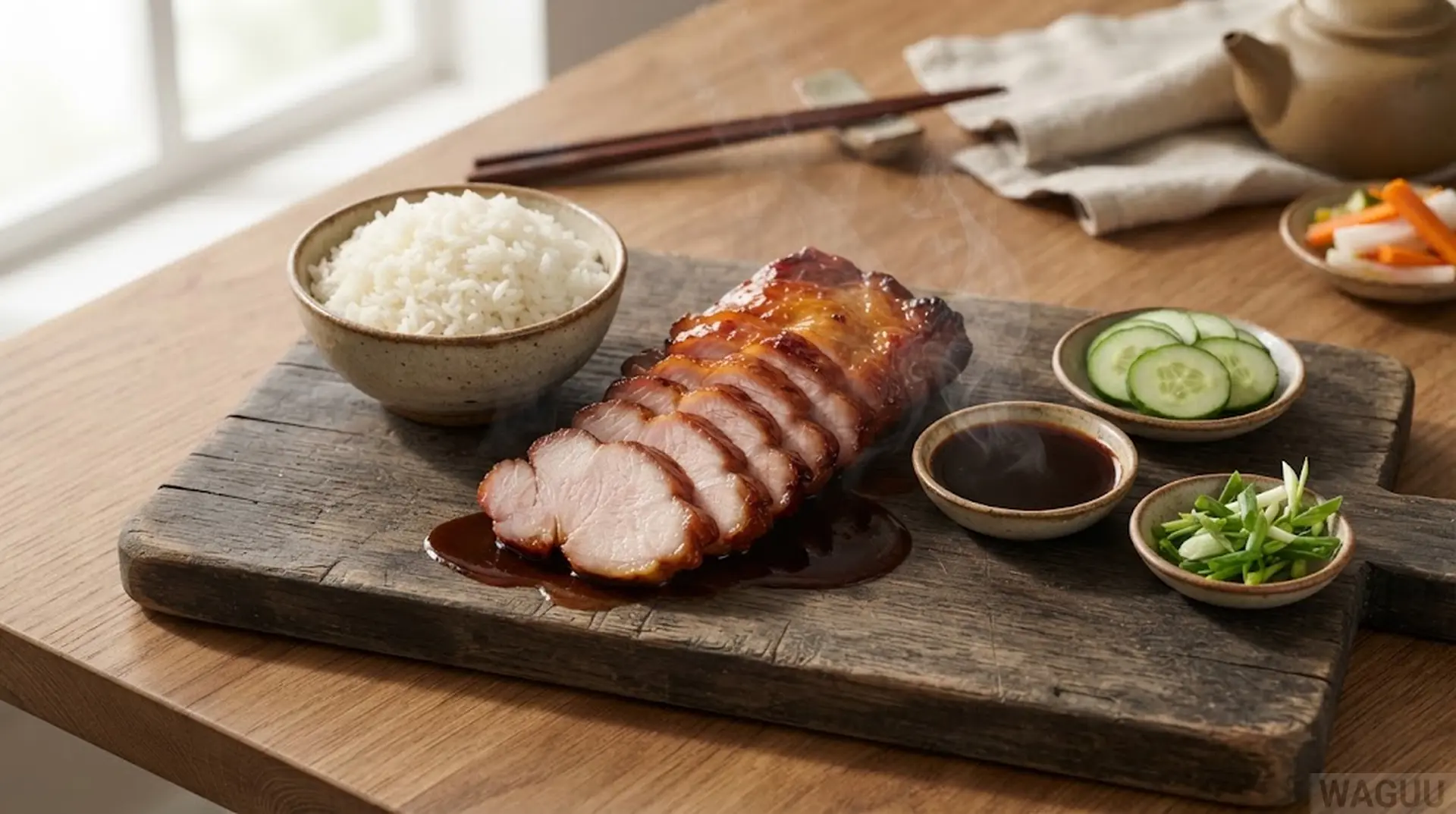
Summary: Cantonese roast pork made from boneless neck fillet cut into long strips. The marinade of hoisin, honey, two soy sauces, Shaoxing wine, sesame paste and five-spice works for twelve to twenty-four hours; the pork is then roasted on a rack and brushed three times with a glaze of honey and the pan juices until the surface turns glossy and caramelised. Served sliced thinly with rice and a quick cucumber pickle. Total time 90 minutes, base 6 servings.
Cooked this recipe? Share the result with the community.
Category: Pork · Chinese Cuisine
Success rate: not rated yet % of users managed this recipe
Quick overview
- Dish: Char siu – Cantonese roast pork with a glossy caramelised crust
- Category: Pork, Chinese Cuisine
- Cuisine: Chinese
- Main ingredient: Boneless pork neck, 1200 g (200 g per portion)
- Guide: 12 most famous Chinese dishes: traditional recipes from Chinese cuisine
- Total time: 90 minutes (30 minutes preparation + 60 minutes cooking), plus 12 to 24 hours marinating
- Difficulty: Easy
- Servings: 6 (Portion weight: 266 g)
- Key technique: A long marinade and glazing in thin layers during the last third of roasting
- Method types: Roasting, grilling to finish, oven-roasting on a rack
- Dietary info & allergens: soy, sesame
- Great for: A family Sunday lunch, a dinner party, a cold buffet, eating with your hands or on a plate
- Nutrition (per portion): 652 kcal, Protein: 36.8 g, Fat: 46.3 g, Carbohydrates: 21.9 g
- Storage: 4 days in the fridge, 2 months in the freezer
- Pairing: Light lager, dry
- In short: A long marinade, roasting on a rack and a glaze brushed on in layers – three steps that decide whether the crust stays glossy or burns.
WAGUU says: “Char siu is not cooked in its marinade, it is cooked above it. The marinade that drips off the meat is boiled separately and returned to the meat as a glaze.”
Key facts
| Preparation time: | 30 minutes plus 12 to 24 hours marinating |
| Cooking time: | 60 minutes |
| Temperature: | Oven 180 °C, then 220 °C, internal meat temperature 71 °C |
| Servings: | 6 (portion weight 266 g) |
At a glance
Char siu builds sweetness in two layers. The first sits in the marinade: honey and hoisin carry sugars that penetrate the surface and, over a long marinade, soften the outer fibres slightly. The second sits on the surface: a glaze of honey and strained pan juices goes on only in the last third of roasting, because sugar caramelises above 150 °C and turns bitter if it is held at that temperature too long. The pork therefore roasts first at a gentler heat so it warms through to the centre, and only then is the surface brought up to colour. Five-spice adds anise and cinnamon notes, sesame paste rounds the flavour and helps the marinade cling to the fat in the meat.
Ingredients
Base servings: 6 • Portion weight: 266 g
| Ingredient | Quantity | Quality |
|---|---|---|
| boneless pork neck | 1200 g | well marbled, cut into five centimetre strips |
| hoisin sauce | 100 g | sweet, for the marinade and the glaze |
| honey | 60 g | runny, for the glaze |
| soy sauce | 60 ml | light, naturally fermented |
| dark soy sauce | 30 ml | sweet, for the colour of the meat |
| Shaoxing rice wine | 50 ml | dry, to lift the smell of the meat |
| sesame paste | 30 g | 100 % sesame, no added sugar |
| five-spice powder | 4 g | freshly ground, no older than six months |
| garlic | 20 g | fresh, crushed |
| ginger | 20 g | fresh, grated finely |
| sesame oil | 20 ml | toasted, for the marinade |
Why you will love this recipe
- The marinade does the work: Everything happens in the fridge overnight. On the day you only put the meat in the oven and brush it three times.
- A crust that shines: Honey applied in thin layers builds a glassy surface that holds its gloss even when the meat is sliced thinly.
- Exact quantities for 6 servings: 200 g of pork per portion, 60 g of honey for the whole batch and 4 g of five-spice, which is enough for a clear aroma.
- Beginners can manage it: Six phases, five checkpoints and one oven. What separates a good result from an average one is the length of the marinade and the timing of the glaze.
Why it works: The marinade acts in two ways. Salt from the soy sauces partly breaks down the surface muscle fibres and opens a path for flavour; sugars from the honey and hoisin stay on the surface and caramelise during roasting. Five-spice contains star anise, fennel, cinnamon, cloves and Sichuan pepper; their aromatic compounds dissolve in fat, which is why they are released in the fatty outer layer of the neck. Sesame paste works as an emulsifier – it binds the water-based part of the marinade to the fat so the mixture does not separate and stays on the meat. Roasting on a rack lets the fat drip into the tray instead of stewing the meat in its own juices. The glaze is added only in the last third of cooking: sugar begins to caramelise around 150 °C and, held there too long, produces bitter compounds, so a glaze applied at the start would darken long before the centre was cooked.
Recipe overview
Prep: 30 min | Cook: 60 min | Difficulty: Easy | Servings: 6 | Type: Main course | Origin: Chinese
Detailed method
Overall progress: 0 % complete
Phase 1: Marinade – 20 min and 12 to 24 h in the fridge
Equipment: kitchen scales, bowl, fridge
1. Pat the pork neck dry with kitchen paper and cut it into strips five centimetres wide. In a bowl, mix the hoisin, both soy sauces, the Shaoxing wine, the sesame paste, five-spice, crushed garlic, grated ginger and sesame oil. Put the meat into the marinade and turn it with your hands so the mixture reaches every fold. Cover the bowl and leave it in the fridge for twelve to twenty-four hours, turning the meat once or twice.
Checkpoint: Every surface of the meat is covered in a thick, dark brown marinade. After twelve hours the pork feels firm at the surface and the marinade in the bowl has thickened.
Before you move on:
Do not wash the meat and do not scrape the marinade off before roasting. The layer on the surface carries the sugars that build the crust. Keep the marinade left in the bowl – it goes into the glaze.
Phase 2: Rack and glaze – 10 min
Equipment: oven, rack, roasting tray, brush
2. Heat the oven to 180 °C. Pour a centimetre of water into a roasting tray so the juices on the base do not burn, and set a rack inside it. Lay the strips on the rack so they do not touch, leaving room for the fat to drip away. Prepare the glaze: mix the marinade left in the bowl with the honey and a tablespoon of water.
Checkpoint: The oven holds 180 °C, the strips lie on the rack with space between them and the tray below holds a shallow layer of water. The glaze is smooth and glossy, with no lumps of honey.
Before you move on:
Never put the pork straight on the tray. It would stew in its own juices, the surface would stay pale and no crust would form. The rack is part of the technique, not decoration.
Phase 3: Roasting – 25 min
Equipment: oven, rack, meat thermometer
3. Put the tray and rack into the hot oven and roast for twenty-five minutes without opening the door. The meat warms through to the centre and the layer of marinade sets. The water in the tray evaporates slowly and keeps the oven humid, so the pork does not dry out.
Checkpoint: The surface is matte and dark brown and there is still liquid in the tray. The thermometer in the thickest strip reads 60 to 63 °C.
Before you move on:
Do not open the door during the first twenty-five minutes. Every opening drops the oven temperature and the meat then needs longer; the surface layer of marinade also fails to set evenly.
Phase 4: Glazing in layers – 15 min
Equipment: oven, brush, meat thermometer
4. Turn the oven up to 200 °C. Take the meat out, brush it with a thin layer of glaze on all sides and return it for five minutes. Repeat three times in total, letting the glaze set between each coat. After the third coat, check the internal temperature.
Checkpoint: The surface is dark amber and glossy, the glaze is dry to the touch and not sticky. The thermometer in the thickest part reads 71 °C and the juices run clear.
Before you move on:
Apply the glaze in thin layers and let each one set. A thick layer of honey burns on the surface within two minutes while the centre is still cooking.
Phase 5: Resting and slicing – 10 min
Equipment: board, sharp knife, foil
5. Move the pork to a board, cover it loosely with foil and leave it to rest for ten minutes. Then slice each strip on the diagonal across the grain into half centimetre slices. Cut with a single drawing motion rather than a sawing motion, so the crust does not separate from the meat.
Checkpoint: Only a little juice collects on the board, the slices hold their shape and the crust does not crack off them. The cut face is pale pink with a darker rim.
Before you move on:
Slice only after ten minutes of resting. Cut straight from the oven, the juices run onto the board and the slices end up dry even though the meat was cooked correctly.
Phase 6: Sauce from the tray and serving – 10 min
Equipment: small pan, whisk, sieve
6. Strain the liquid from the tray into a small pan, skim off the layer of fat and bring it to the boil. Simmer for three minutes until it reduces slightly, then take it off the heat and sharpen it with a spoon of the glaze. Arrange the sliced pork on a warmed plate, spoon the sauce over it and serve with jasmine rice, which is not part of the recipe.
Checkpoint: The sauce is glossy, slightly thick and coats the back of a spoon. The slices overlap on the plate, the sauce runs between them and nothing pools at the bottom.
Equipment needed
| Item | Ideal size | Alternative | Risk |
|---|---|---|---|
| roasting rack | 40 × 30 cm | a trivet from a pan set in a tray | meat on the tray stews in its juices and never forms a crust |
| meat thermometer | probe type, reads to 250 °C | check that the juices run clear at the thickest point | without measuring, overcooking is judged only by the colour of the surface |
| pastry brush | silicone, 4 cm wide | a spoon and kitchen paper | a thick layer of honey burns and turns bitter |
| sharp knife | 20 cm blade, thin | a filleting knife | a blunt knife tears the crust off and the slices break up |
| fine sieve | 16 cm | a tea strainer | unstrained pan juices carry burnt specks and the sauce tastes smoky |
Shopping list
Nutrition profile
Values per portion (as served, without rice). Calculated from average nutritional values of the ingredients. Portion weight 266 g. The calculation is based on the raw ingredients; part of the fat renders into the tray during roasting and is not counted back in.
| Nutrient | Per 100 g | Per portion | For 6 servings |
|---|---|---|---|
| Energy | 245 kcal | 652 kcal | 3911 kcal |
| Fat | 17.4 g | 46.3 g | 278.1 g |
| of which saturates | 11.2 g | 11.2 g | 11.2 g |
| Carbohydrates | 8.2 g | 21.9 g | 131.4 g |
| of which sugars | 14.8 g | 14.8 g | 14.8 g |
| Protein | 13.8 g | 36.8 g | 220.7 g |
| Salt | 2.8 g | 2.8 g | 2.8 g |
| of which sodium | 0.48 g | 1.26 g | 7.59 g |
Reference intake of an average adult (8400 kJ / 2000 kcal). Salt comes mainly from the hoisin and the two soy sauces; the dish is not salted further.
WAGUU Pro level
- Pro standard: A tested recipe with exact quantities and visual checkpoints.
- Tip 1: Marinate in a sealable plastic bag rather than an open bowl. The marinade reaches every fold and the fridge does not absorb the smell.
- Tip 2: Cut the neck into strips of equal thickness. Uneven strips finish cooking at different times and one of them is always dry.
- Tip 3: Use a spoon of the skimmed fat in the finished sauce. It improves the gloss and helps the sauce sit on the rice.
- Tip 4: Leftover slices are excellent in a sandwich, in noodles or in a cucumber salad. They keep four days in the fridge, though the crust will not stay crisp.
The science behind it
Char siu demonstrates two processes that are often confused: caramelisation and the Maillard reaction. Caramelisation is the transformation of sugars; honey contains glucose and fructose, which darken and change flavour between 150 and 170 °C. Maillard reactions take place between the amino acids of proteins and reducing sugars and produce both the brown colour and aromatic compounds with roasted and nutty notes. On the surface of glazed meat both happen at once, which is why the crust tastes so complex. Salt from the soy sauces acts osmotically on the surface: it draws some water out of the outer fibres and makes room for the marinade, which leaves the surface firmer and better able to hold its shape when sliced. Sesame paste behaves as an emulsifier; its proteins coat droplets of fat and keep them dispersed in the watery part of the marinade. Roasting on a rack lets the fat drain away, so the meat does not stew in its own juices and the surface can dry – the condition for a crust to form.
Fine dining – professional techniques
- Plating: Fan the slices across a warmed plate, spoon the sauce underneath rather than over the crust. The glaze stays glossy and dry that way.
- Texture contrast: Serve briefly blanched, chilled sugar snap peas or thin radish slices alongside. Their crunch lifts the soft meat.
- Temperature contrast: A cold cucumber pickle straight from the fridge sharpens the impression of the caramelised crust.
- Aromatic finish: Grate orange zest over the plate just before serving. The citrus oils meet the five-spice and open the aroma before the first bite.
Sensory radar
- Appearance: Dark amber slices with a glossy caramelised crust and a pale pink cut face. Light reflects off the surface in thin streaks.
- Aroma: Star anise and cinnamon from the five-spice, honey underneath and roasted pork with a hint of sesame.
- Taste: A sweet honey layer, savoury soy depth and a gentle spiced finish.
- Texture: Crust lightly brittle, the meat tender inside with fine fibres that cut cleanly across the grain.
Pairing
- Light lager: Hop bitterness cuts the sweet glaze. Serve at 6–8 °C.
- Dry
- Jasmine tea: A floral aroma cleanses the palate and lets the spices show.
- Homemade limeade: Acidity and fizz refresh after a rich mouthful.
Variations
- Char siu from chicken thighs: Boneless thighs marinate in the same mixture and roast at 200 °C for twenty-five minutes. Quicker and cheaper, though the crust is less glossy.
- Char siu on the barbecue: Roast over indirect heat at 180 °C for thirty minutes, then finish over direct heat for five. You gain a smoky note, the crust is less even.
- Char siu from pork leg: Leaner and it holds its shape better when sliced thinly, but it dries out more, so marinate six hours longer and serve with the sauce.
Allergens and dietary information
Contains: soy (soy sauce, dark soy sauce, hoisin sauce); sesame (sesame paste, sesame oil) • Gluten: check the soy sauces, the hoisin and the Shaoxing wine • Not suitable for: anyone with a soy or sesame allergy
Great for
A family Sunday lunch, a dinner party, a cold buffet, eating with your hands or on a plate, a lunchbox with rice the next day.
Substitution guide
- Pork neck: pork shoulder or leg. Shoulder is similarly fatty; leg is leaner and dries faster.
- Hoisin sauce: dark soy sauce with a spoon of honey and a pinch of five-spice. Sharper and less sweet.
- Sesame paste: sugar-free peanut butter. Stronger flavour and a darker marinade.
- Shaoxing rice wine: dry sherry. The aroma differs but it lifts the smell of the meat just as well.
- Five-spice powder: a mix of ground cinnamon, star anise and fennel in equal parts. Simpler but effective.
- Honey: golden syrup or maltose syrup. The crust is paler and the flavour less pronounced.
FAQ
How long should the pork marinate?
Twelve hours is the minimum, twenty-four is ideal. Longer adds nothing, because the salt only penetrates the surface layer, and the outer fibres begin to firm up.
Why is the glaze added at the end?
The sugar in honey caramelises from about 150 °C. On the meat from the start, it would darken and turn bitter within forty minutes while the centre was still raw.
Do I have to roast it on a rack?
Yes, if you want a crust. On the tray the meat stews in its own juices, the surface stays pale and the marinade dissolves into the pan.
How do I know when it is done?
The thermometer in the thickest part reads 71 °C and the juices run clear. If they are pink, return the meat to the oven for five minutes and measure again.
Can the marinade be used again?
Not as a marinade, but yes as a glaze, provided it is boiled first because it has held raw meat. Mix the boiled marinade with honey and use it for brushing.
Is char siu gluten free?
It depends on the soy sauces and the hoisin. Use tamari and a hoisin made without wheat starch. Rice wine, honey and sesame paste contain no gluten.
WAGUU Petr advises: cooking for 6 or more?
6–8 people: Increase the pork to 1600 g and the marinade by half. Roast on two racks and swap them halfway through so both cook evenly. • 10+ people: Roast two batches one after the other and hold the first in the oven at 80 °C under foil. Make the sauce from both trays at once, but season it only just before serving.
Sides and serving
Storage and reheating
Fridge: 4 days • Freezer: 2 months • Reheating: Warm the slices in the oven at 160 °C under foil for eight minutes, or in a dry pan for two minutes on each side. In the microwave the crust softens. Cold slices are excellent in a sandwich or in a noodle dish.
Author: WAGUU Petr & Team • Published: 8 Oct 2026 • Updated: 10 Oct 2026
More recipes from this article
Guide: 12 most famous Chinese dishes: traditional recipes from Chinese cuisine
Peking duck – celebratory roast duck with crisp skin, thin pancakes and a sweet sauce
Kung Pao chicken – spicy Sichuan chicken with peanuts, chilli and a sweet-savoury sauce
Mapo tofu – tofu in a spicy Sichuan sauce with minced meat and Sichuan pepper
Sweet and sour pork – fried pork pieces in the classic sweet and sour sauce
Dim sum – small Cantonese dishes, especially steamed dumplings and parcels
Xiaolongbao – delicate Shanghai dumplings filled with pork and hot soup
Chow mein – stir-fried wheat noodles with vegetables, meat or seafood
Yangzhou fried rice – fried rice with egg, prawns, ham and peas
Hot pot – a shared meal cooked in bubbling broth at the table
Dan dan noodles – Sichuan noodles with a spicy sauce and chilli oil
Wonton soup – clear broth with filled wonton dumplings and spring onion
Other recipes you might like
Why WAGUU?
Recipes on WAGUU are checked for accurate quantities, method and nutrition. In this recipe the amounts match across the ingredient table, the cooking phases, the shopping list and the print view – 1200 g of pork neck serves six at 200 g each, 60 g of honey is enough for three layers of glaze and 4 g of five-spice gives a clear aroma without bitterness.
Photo gallery from the process
Community photos: Cook it, photograph it and share the result.
Upload your photos in the comments below or send them by email.
Filmed a video following our recipe? Post a link to YouTube, YouTube Shorts, TikTok, Instagram Reels, Facebook Reels, Pinterest, Vimeo or X (Twitter) in the comments – we will gladly publish it and help get your work seen.
Most common mistakes
- A short marinade – the flavour stays on the surface and the meat is bland inside. Leave it in the fridge for twelve to twenty-four hours.
- Glaze applied at the start of roasting – the honey darkens and turns bitter before the meat cooks. Add it only in the final fifteen minutes, in three thin layers.
- Meat on the tray instead of a rack – it stews in its own juices and no crust forms. Set the rack over a tray with a little water.
- Slicing straight from the oven – the juices run out and the slices are dry. Rest the meat for ten minutes under foil.