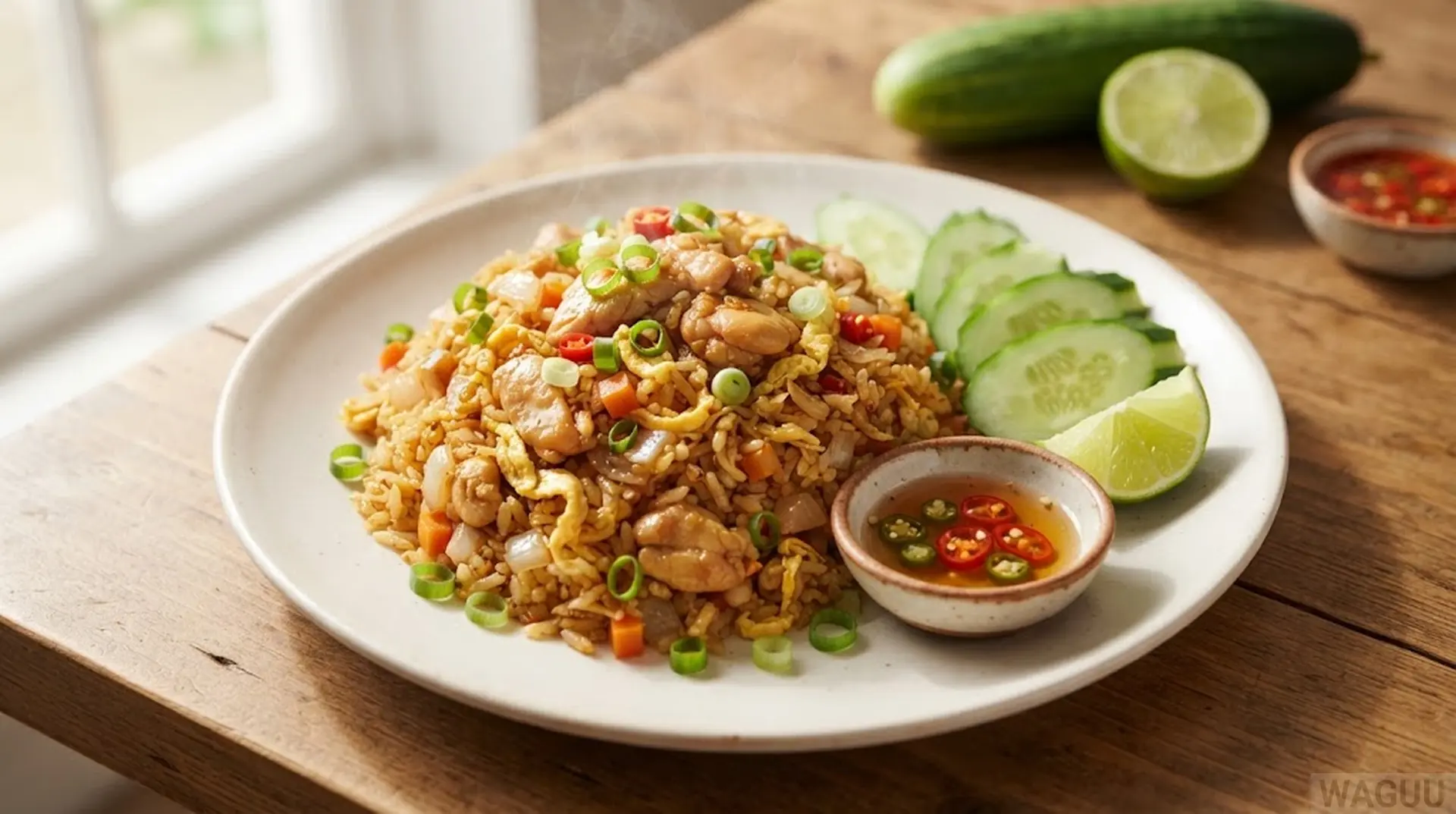
Summary: Cold jasmine rice is stir-fried in a wok with egg, chicken, onion, and vegetables, seasoned with fish sauce and soy sauce. It’s served with cucumber, lime, and scallions. Total time 45 minutes, makes 6 servings.
Did you make this recipe? Share your result with the community.
Category: Poultry · Thai Cuisine
Success rate: not rated yet% of users mastered this recipe
Quick overview
- Dish: Khao Pad – Thai fried rice with egg, vegetables, and chicken
- Category: poultry, thai-cuisine
- Cuisine: Thai
- Main ingredient: Jasmine rice, 21 oz (cooked, chilled) (quality specification)
- Guide: 12 most famous Thai dishes: traditional recipes from Thai cuisine
- Total time: 45 minutes (25 min prep + 20 min cooking)
- Difficulty: Easy
- Servings: 6 (Serving size: 10.8 oz)
- Key technique: Stir-frying chilled rice over high heat in a wok
- Cooking methods: Wok stir-fry, pan-fry
- Dietary info & allergens: fish (fish sauce), soy and gluten (soy sauce), egg (egg)
- Suitable for: Family dinner, dinner with friends, quick weekday lunch, or a festive multi-course table.
- Nutrition (per serving): 471 calories, Protein: 25.5 g, Fat: 18.4 g, Carbs: 50.9 g
- Storage: 3 days in fridge, 1 month in freezer
- Pairing: Thai lager, dry Pinot Grigio, iced green tea
- In short: Cooled jasmine rice is stir-fried in a wok with egg, chicken, onion, and vegetables, seasoned with fish sauce and soy sauce. Total time 45 minutes, 6 servings.
WAGUU says: “Fried rice is not made from fresh rice. A day in the fridge is half the recipe.”
Key facts
| Prep time: | 1.7 minutes |
| Cook time: | 1.4 minutes |
| Temperature: | Wok 425–465°F, rice chilled to 41°F |
| Servings: | 6 |
At a glance
Khao Pad relies on two things: rice must be cooked the day before and the wok must be screaming hot. Freshly cooked rice clumps in the wok and steams. Eggs are fried separately into a thin layer, and rice is added to them so it gets coated in fat and doesn’t get soggy.
Ingredients
Base servings: 6 servings • Serving size: 10.8 oz
| Ingredient | Amount | Quality |
|---|---|---|
| jasmine rice | 11 oz | cooked the day before, chilled |
| boneless chicken thigh | 18 oz | cut into small cubes, skinless |
| eggs | 4 pcs | fresh, room temperature |
| onion | 1 pcs | yellow, finely diced |
| garlic | 4 cloves | minced |
| carrot | 2 pcs | finely diced |
| scallions | 4 pcs | cut on the bias |
| fish sauce | 1.7 tbsp | fermented |
| soy sauce | 1.4 tbsp | light |
| oyster sauce | 1 tbsp | thick |
| turbinado sugar | 0.4 oz | finely ground |
| canola oil | 3.4 tbsp | neutral, high-heat |
| cucumber | 1 pcs | firm, sliced on the bias |
| lime | 2 pcs | cut into wedges |
Why you’ll love this recipe
- Quick dish from cooked rice: Rice is cooked the day before; the actual stir-fry takes ten minutes. The dish is done before new rice would even be cooked.
- Egg as the base, not an add-on: Eggs are fried separately into a thin layer and returned at the end. They keep the rice fluffy and add creaminess.
- Exact ratios for 6 servings: Ten and a half ounces of dry rice and one pound of meat. Servings can be recalculated based on diners, and rice is cooked separately.
Reliable results: Cooked rice loses surface moisture as it cools and the grains harden. That’s why it doesn’t clump when stir-fried. If fresh rice is used, steam inside the grains releases at high heat and the rice turns mushy. Fish sauce and soy sauce are added around the edge of the wok, where they heat up quickly and release aroma, not in the center, where they would make the rice soggy.
Recipe overview
Prep: 25 min | Cook: 20 min | Difficulty: Easy | Servings: 6 | Type: Main dish | Origin: Thai
Detailed instructions
Overall progress: 6 % done
Phase 1: Cooking rice the day before – 12 min
Equipment: pot with lid, colander
1. Rinse the rice until the water runs clear and let it drain. Cook it in a 1:1.5 ratio with the lid on until the water is absorbed.
2. Spread the cooked rice on a baking sheet and let it cool. Then cover and refrigerate for at least four hours, preferably overnight.
QC: Grains are fluffy, separate, and dry on the surface after chilling. Rice doesn’t hold together in a clump.
Before you move to the next step:
Fresh rice will clump and get mushy in the wok. A day in the fridge is part of the recipe, not a shortcut.
Phase 2: Preparing ingredients – 15 min
Equipment: cutting board, small bowls
1. Cut the chicken into 1/2-inch cubes, dice the onion and carrot finely, and mince the garlic. Slice the scallions on the bias.
2.In a small bowl, stir together the fish sauce, soy sauce, and oyster sauce with the sugar. Beat the eggs in a second bowl.
QC:All ingredients are cut to the same size and the sauce is mixed. There’s no time for chopping once the wok is hot.
Before you move to the next step:
Large pieces of vegetables won’t heat through in the wok. Cut them small; stir-frying takes only a few minutes.
Phase 3: Eggs and meat – 5 min
Equipment:wok, metal spatula
1.Heat the wok over the highest flame, pour in half the oil, and add the beaten eggs. Let them set into a thin layer, then break them into pieces with the spatula. Transfer to a plate.
2.Add the remaining oil to the wok, add the chicken, and stir-fry until it turns white and golden. Add the garlic and onion and stir-fry until fragrant.
QC:The eggs are in dry strands, not clumps. The meat is browned on all sides and the water has evaporated.
Before you move to the next step:
Meat in a cold wok releases water and steams. The wok must be hot enough to shimmer with faint smoke.
Phase 4: Rice and vegetables – 5 min
Equipment:wok, spatula
1.Add the cooled rice to the wok and break it up with the spatula. Stir-fry over high heat until the grains are hot and start to jump.
2.Add the carrot and stir-fry for two minutes so it stays crisp. Then pour the sauce down the side of the wok and stir everything briefly.
QC:The rice grains separate and don’t stick together. There’s no water at the bottom of the wok and the rice smells lightly toasted.
Before you move to the next step:
Don’t stir the rice in a circular motion; it will get mushy. Toss it with the spatula and add it to the wok in batches.
Phase 5: Return the eggs and season – 3 min
Equipment:wok, spatula
1.Return the eggs to the wok and add the scallions. Stir everything briefly so the ingredients come together.
2.Taste the rice and add a splash of fish sauce or lime juice if needed.
QC:The rice is hot, the grains are separate, and the eggs are evenly distributed. The flavor is salty with a mild sweetness.
Before you move to the next step:
Don’t return the eggs to the wok before the last minute, or they’ll break apart and the rice will get wet.
Phase 6: Serving – 3 min
Equipment:warmed plates
1.Mound the rice on warmed plates into a low pile. Place diagonal cucumber slices and a lime wedge alongside.
2.Serve a small bowl of fish sauce, chile, and lime juice on the side so each guest can adjust the rice to taste.
QC:The rice is fluffy, the cucumber is cold and crisp, and the lime smells fresh.
Required equipment
| Cookware | Ideal size | Alternative | Risk |
|---|---|---|---|
| wok | 12-inch diameter, thick bottom | large deep skillet | a thin wok will burn the rice before it heats through |
| metal spatula | 4-inch blade | two wooden spoons | a plastic spatula will bend at high heat |
| pot with lid | 3-quart capacity | rice cooker | a thin bottom will scorch the rice at the bottom |
| sheet pan for cooling | 12 × 16 inches | large bowl | rice in a pile cools slowly and gets damp |
Shopping list
Nutrition profile
Values per 1 serving (without sides). Calculated from average nutritional values of ingredients.
| Nutrient | Per 100 g | Per 1 serving | Per 6 servings |
|---|---|---|---|
| Energy | 644 kJ / 154 kcal | 1971 kJ / 471 kcal | 11824 kJ / 2826 kcal |
| Fat | 6.0 g | 18.4 g | 110.4 g |
| of which saturated | 1.2 g | 3.6 g | 21.4 g |
| Carbohydrates | 16.7 g | 50.9 g | 305.4 g |
| of which sugars | 16.7 g | 50.9 g | 305.4 g |
| Protein | 8.4 g | 25.5 g | 153.0 g |
| Salt | 0.7 g | 2.2 g | 13.0 g |
Reference intake of an average adult (8400 kJ / 2000 kcal).
WAGUU Pro level
- Pro standard: Tested recipe with precise ratios and visual checkpoints.
- Tip 1: Tested recipe with precise ratios and visual checkpoints.
- Tip 2: The grains are fluffy, separate, and dry on the surface after chilling. The rice doesn’t clump together. Fresh rice will stick and turn mushy in the wok. A day in the fridge is part of the recipe, not a shortcut.
- Tip 3: All ingredients are cut to the same size and the sauce is mixed. There’s no time for chopping once the wok is hot. Large pieces of vegetables won’t heat through in the wok. Cut them small; stir-frying takes only a few minutes.
- Tip 4: Set out the ingredients in small bowls before you start. Thai cooking happens over high heat, and there’s no time to portion ingredients while cooking.
Scientific background
As rice cools, starch retrogradation occurs—amylose and amylopectin rearrange into a crystalline structure that is firmer and less sticky. This process is the foundation of fried rice. The Maillard reaction on the rice creates a toasted flavor, helped by the small amount of sugar in the sauce.
Fine Dining – Professional techniques
- Plate composition: Press the rice into a small metal ring and unmold it in the center of the plate. It looks like a restaurant portion, but it’s the same rice.
- Texture contrasts: Top with a thin omelet slice and a cilantro leaf. The contrast of yellow and green keeps the dish fresh.
- Temperature contrast: Serve a small bowl of thinly sliced cucumber on the side. The cold vegetable cleanses the palate from the saltiness.
- Aromatic additions: Finish with half a lime and a packet of chile flakes. Guests adjust the rice themselves, which is common in Thailand.
Sensory radar
- Appearance: The rice is light golden, fluffy, with pieces of meat, yellow carrot, and green onion rings.
- Aroma: Wok-fried rice with garlic and egg, fresh lime after stirring.
- Taste: Salty fish sauce with a touch of sugar sweetness, finishing with fresh lime and mild heat.
- Texture: Rice grains are separate and firm, vegetables crisp, egg soft.
Pairings
- Thai lager: A lager with higher carbonation cleanses the palate of oil. Serve it at 43°F.
- dry Pinot Grigio: Pinot Grigio with mild acidity stands up to soy sauce. Avoid oaked wines.
- iced green tea: Iced green tea with lime, unsweetened. The tannins in tea calm the saltiness of fish sauce.
Variations
- Khao Pad with Shrimp:: Replace chicken with shrimp, which stir-fry for only two minutes. The rice is sweeter and lighter, add an extra dash of fish sauce.
- Vegetarian Khao Pad:: Omit meat and use firm tofu and peas. Pat tofu dry and stir-fry separately so it doesn’t break apart among the rice.
Allergens and Dietary Information
Contains: fish (fish sauce), soy and gluten (soy sauce), egg (egg) • Gluten: yes, in soy sauce (for gluten-free use tamari) • Not suitable for: people with fish, soy, and egg allergies, those with celiac disease
Suitable for
Family dinner, dinner with friends, quick weekday lunch, or a festive multi-course table.
FAQ
Does the rice need to be a day old?
Four hours in the refrigerator is enough. What matters is that the grains are chilled and dry on the surface. Fresh warm rice will steam and become mushy in the wok.
What rice to use?
Jasmine or other long-grain rice. Short-grain rice is sticky and will clump in the wok.
Can I use frozen vegetables?
Yes, but they must be thawed and dried. Water from frozen vegetables will make the rice mushy, so rinse them with hot water first and pat dry.
What can I substitute for fish sauce?
Soy sauce with a tablespoon of lime juice. The flavor will be less briny. For a vegetarian version, also omit oyster sauce and use mushroom sauce.
Why is the rice greasy?
Too much oil or the wok wasn’t hot enough. Stir-fry the rice in batches and measure the oil, three tablespoons per batch is enough.
How to add heat?
Crush chili with garlic and add them to the oil at the beginning. For a spicier dish, add chili flakes with lime at the table.
WAGUU Petr’s tip: Cooking for 6 or more?
6–8 people: Heat the wok or pan in batches and keep the finished dish warm in an oven at 175°F. Add the flavor components (fish sauce, lime, sugar) at the end, otherwise the aroma will fade. • 10+ people: Prepare the base (paste, broth, or marinade) in double batch and save half for the next day. Fill the wok at most two-thirds full, otherwise the ingredients will steam instead of stir-fry.
Sides and Serving
Serving: Serve the rice on a warmed plate with cucumber slices, a lime wedge, and spring onion rings. Put a bowl of fish sauce and chili on the table.
Storage and Reheating
Refrigerator: 3 days • Freezer: 1 month • Reheating: Refrigerator: 3 days • Freezer: 1 month • Reheating: in a pan for two minutes over high heat, with a splash of water
Satay Gai – Grilled marinated chicken skewers with peanut sauce and pickled vegetables
Author: WAGUU Petr & Team • Published: 8 Oct 2026 • Updated: 10 Oct 2026
More recipes from the article
Guide: 12 most famous Thai dishes: traditional recipes from Thai cuisine
Pad Thai – stir-fried rice noodles with egg, shrimp, tofu, tamarind, peanuts, and lime
Tom Yum Goong – spicy and sour soup with shrimp, lemongrass, galangal, and chili
Tom Kha Gai – coconut soup with chicken, galangal, lemongrass, and lime leaves
Green Curry (Gaeng Keow Wan) – green curry with coconut milk, chicken, and Thai basil
Red Curry (Gaeng Daeng) – red curry from red paste and coconut milk with beef
Red Curry (Gaeng Daeng) – red curry from red paste and coconut milk with beef
Som Tam – spicy green papaya salad with chili, lime, fish sauce, and peanuts
Pad Kra Pao – stir-fried meat with Thai basil, chili, and garlic, served with rice and a fried egg
Khao Soi – northern Thai noodle soup with coconut curry, chicken, and crispy noodles
Satay Gai – grilled marinated chicken skewers with peanut sauce and pickled vegetables
Mango Sticky Rice (Khao Niao Mamuang) – sticky rice with coconut milk and ripe mango
More recipes you might like
Why WAGUU?
WAGUU recipes are checked for accuracy of ingredients, procedures, and nutritional values.
Photo gallery from the process
Photos from the community: Cook, take a photo, and share your result.
You can upload photos in the comments below or send them to our email.
Did you film a video of the process for our recipe? Paste a link to YouTube, YouTube Shorts, TikTok, Instagram Reels, Facebook Reels, Pinterest, Vimeo, or X (Twitter) in the comments – we’ll be happy to publish it and help you and your content get noticed.
Most common mistakes
- Cooking rice the day before – Fresh rice will clump and become mushy in the wok. A day in the refrigerator is part of the recipe, not a shortcut.
- Preparing ingredients – Large pieces of vegetables won’t heat through in the wok. Cut them small, stir-frying takes only a few minutes.
- Egg and meat – Meat in a cold wok will release water and steam. The wok must be heated until faint smoke appears.
- Rice and vegetables – Don’t stir the rice in a circular motion, it will become mushy. Toss it with a spatula and add it to the wok in batches.