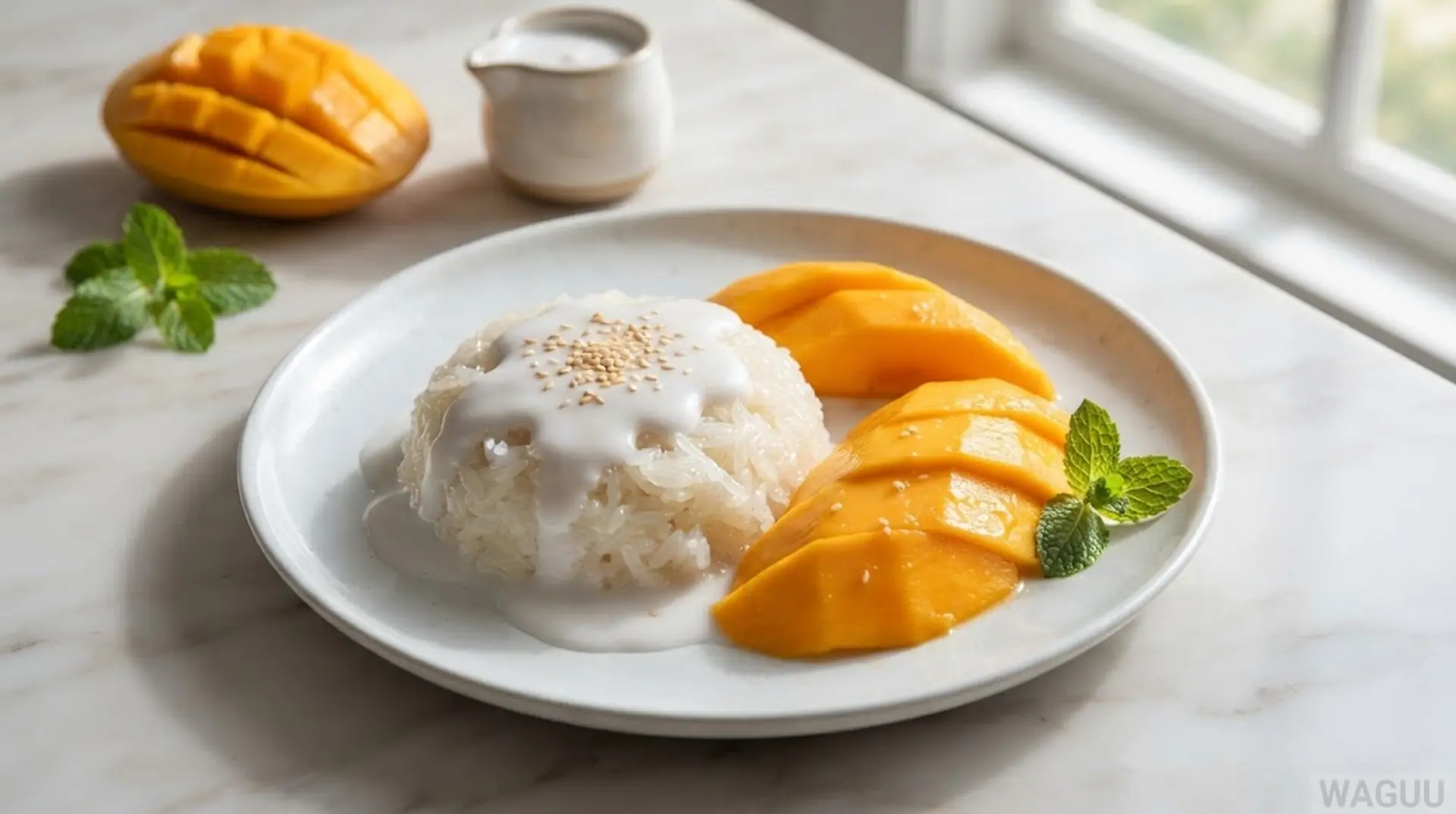
Summary: Sticky rice is soaked, steamed, and while still hot, drenched in sweet coconut milk that soaks in. It’s served with ripe mango and a salty coconut topping. Total time 75 minutes, makes 12 dessert servings.
Did you make this recipe? Share your result with the community.
Category: Desserts · Thai Cuisine
Success rate: not rated yet % of users nailed this recipe
Quick overview
- Dish: Mango Sticky Rice (Khao Niao Mamuang) – sticky rice with coconut milk and ripe mango
- Category: desserts, thai-cuisine
- Cuisine: Thai
- Main ingredient: Sticky rice, 14 oz (raw, soaked) (quality spec)
- Guide: 12 most famous Thai dishes: traditional recipes from Thai cuisine
- Total time: 75 minutes (20 min prep + 55 min cooking)
- Difficulty: Medium
- Servings: 12 (Serving weight: 8.2 oz)
- Key technique: Steaming sticky rice and soaking it with coconut milk
- Preparation types: Steaming, soaking
- Dietary info & allergens: none of the 14 major allergens (based on ingredients used)
- Good for: Family dinner, dinner with friends, quick weeknight lunch, or a festive multi-course table.
- Nutrition (per 1 serving): 309, Protein: 4.6 g, Fat: 11.3 g, Carbs: 47.3 g
- Storage: 2 days in the fridge, 0 months in the freezer
- Pairing: fruity sour beer, sweet Moscato d’Asti, iced jasmine tea
- In short: Sticky rice is soaked, steamed, and while still hot, doused with sweet coconut milk, which soaks in. Total time 75 minutes, 12 servings.
WAGUU says: “Sticky rice isn’t boiled in water. It’s steamed so the grains hold together, and the milk is poured in while it’s still hot.”
Key facts
| Prep time: | 1.4 minutes |
| Cook time: | 55 minutes |
| Temperature: | Steaming at 212 °F, coconut milk heated to 158 °F (not boiled) |
| Servings: | 6 |
The gist
Mango Sticky Rice is a dessert made of two simple things: sticky rice and mango. What matters is that the rice is steamed, not boiled, and that it’s soaked with coconut milk while still hot – cold rice won’t absorb the milk. The salty coconut topping at the end isn’t a mistake, but a counterbalance to the mango’s sweetness.
Ingredients
Base servings: 12 servings • Serving weight: 8.2 oz
| Ingredient | Amount | Quality |
|---|---|---|
| sticky rice | 14 oz | Thai, white, not jasmine |
| coconut milk | 2.1 cups | full-fat, for soaking |
| coconut cream | 10 tbsp | for the salty topping |
| turbinado sugar | 4.0 oz | finely ground |
| fine sea salt | 1 tsp | for both the coconut milk and the topping |
| ripe mango | 3 pcs | ripe, soft to the touch, sweet |
| toasted sesame seeds | 0.7 oz | white, dry-toasted |
| cornstarch | 1 tsp | to thicken the topping |
| water | 3.4 cups | for soaking the rice |
Why you’ll love this recipe
- Rice that holds its shape: Sticky rice is steamed and soaked with coconut milk while hot. The grains hold together and the dessert can be eaten with a spoon.
- Salty counterbalance to sweetness: The salty coconut topping isn’t a mistake. Salt tempers the mango’s sweetness so the dessert doesn’t taste cloying after the first few bites.
- Exact ratios for 12 servings: Fourteen ounces of rice, three mangoes, and seventeen fluid ounces of coconut milk. The dessert is cut into twelve servings, and the count recalculates.
Success guaranteed: Sticky rice contains almost only amylopectin, which is why the grains stick together and hold their shape after cooking. In water, the rice would fall apart and lose its stickiness, so it’s steamed. Hot rice has an open starch structure and absorbs the coconut milk. Once cooled, the starch closes up and the milk stays on the surface. The salty topping reduces the perception of sweetness.
Recipe overview
Prep: 20 min min | Cook: 55 min min | Difficulty: Medium | Servings: 12 | Type: Dessert | Origin: Thai
Detailed instructions
Overall progress: 6 % done
Phase 1: Soaking the sticky rice – 10 min
Equipment: large bowl, strainer
1. Rinse the rice in cold water three times, until the water is only slightly cloudy. Don’t rinse it for long, sticky rice loses starch and the grains won’t stick together.
2. Cover the rice with cold water so it’s submerged, and let it rest. Then drain it and let it drip dry.
QC: The grains are white, swollen, and can be crushed with a fingernail. The water after draining isn’t milky white.
Before you move to the next step:
Don’t leave the rice without water after soaking, the edges of the grains will dry out and won’t heat through in the steamer.
Phase 2: Steaming – 30 min
Equipment: steamer or metal strainer over a pot, lid
1. Pour water into the pot so it doesn’t touch the bottom of the steamer. Bring the water to a boil and spread the rice in the steamer in a thin layer.
2. Steam the rice covered, until the grains turn translucent and are soft. Halfway through, flip the rice once with a wooden spoon so it heats evenly.
QC: The grains are translucent, shiny, and stuck together, but not mushy. The rice smells like grain.
Before you move to the next step:
Rice in a thick layer steams unevenly. Spread it in a thin layer and let the steam flow through.
Phase 3: Soaking with coconut milk – 10 min
Equipment: saucepan, bowl
1. In a saucepan, heat the coconut milk with the sugar and salt to 158 °F, just below boiling. The sugar must dissolve, but the milk must not boil.
2. Transfer the hot rice to a bowl and pour the warm coconut milk over it. Stir and let the rice rest until the milk is absorbed.
QC: The rice is shiny, moist, and no milk remains in the bowl. The grains hold together and don’t fall apart when scooped with a spoon.
Before you move to the next step:
Cold rice won’t absorb coconut milk and it will pool at the bottom. Always pour it over while the rice is still hot.
Phase 4: Salty Coconut Topping – 8 min
Equipment: small saucepan, whisk
1. In a small saucepan, warm the coconut cream with a pinch of salt and a teaspoon of sugar. Dissolve the cornstarch in a tablespoon of cold water and stir it into the cream.
2. Cook the cream for one minute, stirring constantly, until it thickens slightly. Then remove from heat and let it cool.
QC: The topping is smooth, glossy, and drips from the spoon in a thin stream. The taste is salty with a gentle sweetness.
Before you move to the next step:
Don’t salt the topping at the start. Add salt only after tasting; coconut cream is naturally sweet.
Phase 5: Mango Prep – 8 min
Equipment: cutting board, sharp knife
1. Peel the mango and cut the flesh into thin slices along the pit. Arrange the slices on a plate and keep them in the refrigerator until you serve the dessert.
2. A ripe mango is fragrant at the stem and soft to the touch. Let a hard mango ripen at room temperature for two days.
QC: The mango slices are firm but tender to the bite, without fibers along the pit. They smell sweet.
Before you move to the next step:
An unripe mango is sour and fibrous and will detract from the dessert. If the mango is hard, sweeten it with a spoonful of sugar and let it sit for an hour.
Phase 6: Assembling the Dessert – 4 min
Equipment: chilled plates, spoons
1. On a chilled plate, spoon a mound of the soaked rice and spread it into a low oval. Arrange the mango slices in a fan next to it.
2. Pour a spoonful of the salty coconut topping over the rice and sprinkle with toasted sesame seeds. Serve the dessert immediately.
QC: The rice holds its mound shape, the topping drips down its edge, and the mango slices are cold and glossy.
Required Equipment
| Item | Ideal Size | Alternative | Risk |
|---|---|---|---|
| rice steamer | 24 cm diameter, with lid | metal sieve over a pot | a thick layer of rice steams unevenly |
| large bowl | 3 L capacity | wide stainless steel bowl | a small bowl will crush the rice during soaking |
| small saucepan | 1 L capacity | heavy-bottomed saucepan | a thin bottom will scorch the coconut cream |
| wooden spoon | 30 cm long | silicone spatula | a metal spoon will crush the rice grains |
Shopping List
Nutrition Profile
Values per 1 serving (without side). Calculated from average nutrient values of ingredients.
| Nutrient | Per 100 g | Per 1 serving | Per 6 servings |
|---|---|---|---|
| Energy | 556 kJ / 133 kcal | 1293 kJ / 309 kcal | 15514 kJ / 3708 kcal |
| Fat | 4.9 g | 11.3 g | 135.6 g |
| of which saturated | 3.9 g | 9.0 g | 108.0 g |
| Carbohydrates | 20.4 g | 47.3 g | 567.6 g |
| of which sugars | 20.4 g | 47.3 g | 567.6 g |
| Protein | 2.0 g | 4.6 g | 55.2 g |
| Salt | 0.2 g | 0.5 g | 6.2 g |
Reference intake of an average adult (8400 kJ / 2000 kcal).
WAGUU Pro Level
- Pro standard: Verified recipe with precise ratios and visual checkpoints.
- Tip 1: Verified recipe with precise ratios and visual checkpoints.
- Tip 2: The grains are white, swollen, and can be crushed with a fingernail. The water after draining is not milky white. Don’t leave the rice without water after soaking; the edges of the grains will dry out and won’t heat through in the steamer.
- Tip 3: The grains are translucent, glossy, and stick together but aren’t mushy. The rice smells like grain. Rice in a thick layer steams unevenly. Spread it in a thin layer and let the steam pass through.
- Tip 4: Prepare the ingredients on the table in small bowls beforehand. Thai cooking is done over high heat and there’s no time to divide ingredients during cooking.
Scientific Background
Amylopectin swells at around 160°F and forms a gel that holds the grains together. Soaking the rice for several hours shortens the steaming time because water penetrates to the center of the grain. The coconut fat in the milk carries aroma and slows starch retrogradation, so the dessert stays soft even after cooling.
Fine Dining – Professional Techniques
- Plate composition: Press the rice into a small mold and unmold it in the center of a chilled plate. It holds its shape and looks like a restaurant dessert.
- Texture contrasts: Arrange the mango slices in a fan along the edge of the plate. The contrast of white and orange is the basis of the presentation.
- Temperature contrast: Pour the topping at the table, not in the bowl. It drips down the rice and the guest sees it.
- Aromatic additions: Finally, sprinkle with toasted sesame seeds and place a mint leaf. Sesame keeps its crunch and mint adds fresh aroma.
Sensory Radar
- Appearance: A mound of glossy white rice, next to it a fan of orange mango, white topping dripping down the rice, and a sprinkle of sesame.
- Aroma: Sweet aroma of coconut and ripe mango, complemented by toasted sesame.
- Taste: Sweet mango with a gentle saltiness from the topping and a creamy coconut flavor.
- Texture: Rice soft and sticky, mango juicy and soft, sesame crunchy.
Pairings
- fruit sour beer: Fruit sour beer with gentle acidity balances the sweetness of the rice. Serve at 40°F.
- sweet Moscato d’Asti: Moscato d’Asti with low alcohol and gentle effervescence pairs with mango. Serve chilled at 45°F.
- iced jasmine tea: Iced jasmine tea without sugar. The floral aroma pairs with coconut and sesame adds a nutty note.
Variations
- Mango Sticky Rice with Black Rice:: Replace half of the glutinous rice with black glutinous rice, which steams ten minutes longer. The dessert gets a purple color and nutty flavor.
- Mango Sticky Rice with Durian:: Add two tablespoons of durian flesh to the mango slices. The aroma is strong and sweetness higher, so reduce the sugar in the coconut milk.
Allergens and Dietary Information
Contains: none of the 14 major allergens (based on ingredients used) • Gluten: no, recipe is gluten-free • Not suitable for: those with lactose intolerance should omit the coconut milk topping; recipe is naturally free of milk protein
Suitable for
Family dinner, dinner with friends, quick weeknight lunch, or a festive multi-course table.
FAQ
Where to find sticky rice?
In Asian markets, labeled as glutinous or sticky rice. Jasmine rice is not a substitute; the grains won’t stick together.
Do I need to soak the rice?
Yes, at least four hours, ideally overnight. Without soaking, the rice won’t steam through to the center of the grain.
Can I cook the rice in a pot?
Sticky rice will break down in water and lose its stickiness. If you don’t have a steamer, use a sieve set over a pot of boiling water.
Why is the topping salty?
Salt in the topping reduces the perception of sweetness and keeps the dessert balanced. If you omit it, the dessert will be too sweet after two spoonfuls.
How to tell a ripe mango?
It smells sweet at the stem and gives slightly when pressed. Let a hard mango ripen for two days at room temperature; it won’t ripen in the refrigerator.
How to store the dessert?
Store rice and mango separately in the refrigerator and combine just before serving. Rice keeps for two days; after reheating in a steamer, it softens.
WAGUU Petr advises: Cooking for 6 or more?
6–8 people: Heat a wok or pan in batches and keep the finished dish warm in an oven at 80°F. Add flavor components (fish sauce, lime, sugar) at the end, otherwise the aroma fades. • 10+ people: Prepare the base (paste, broth, or marinade) in double quantity and save half for the next day. Fill the wok no more than two-thirds full, otherwise the ingredients steam instead of stir-fry.
Sides and Serving
Serving: Serve the dessert on a chilled plate: a scoop of rice, mango slices, a spoonful of salty coconut topping, and a mint leaf. Eaten with a spoon, cold.
Storage and Reheating
Refrigerator: 2 days • Freezer: 0 months • Reheating: Refrigerator: 2 days • Freezer: 0 months • Reheating: steam the rice for three minutes, serve mango cold
Satay Gai – Grilled marinated chicken skewers with peanut sauce and pickled vegetables
Author: WAGUU Petr & Team • Published: 8 Oct 2026 • Updated: 10 Oct 2026
More recipes from the article
Guide: 12 most famous Thai dishes: traditional recipes from Thai cuisine
Pad Thai – stir-fried rice noodles with egg, shrimp, tofu, tamarind, peanuts, and lime
Tom Yum Goong – spicy and sour soup with shrimp, lemongrass, galangal, and chili
Tom Kha Gai – coconut soup with chicken, galangal, lemongrass, and lime leaves
Green Curry (Gaeng Keow Wan) – green curry with coconut milk, chicken, and Thai basil
Red Curry (Gaeng Daeng) – red curry from red paste and coconut milk with beef
Red Curry (Gaeng Daeng) – red curry from red paste and coconut milk with beef
Som Tam – spicy green papaya salad with chili, lime, fish sauce, and peanuts
Pad Kra Pao – stir-fried meat with Thai basil, chili, and garlic, served with rice and a fried egg
Khao Pad – Thai fried rice with egg, vegetables, and chicken
Khao Soi – northern Thai noodle soup with coconut curry, chicken, and crispy noodles
Satay Gai – grilled marinated chicken skewers with peanut sauce and pickled vegetables
More recipes you might like
Why WAGUU?
WAGUU recipes are checked for accuracy of ingredients, methods, and nutritional values.
Photo gallery from the process
Community photos: Cook, take a photo, and share your result.
You can upload photos in the comments below or send them by email.
Did you film a video of our recipe? Paste a link to YouTube, YouTube Shorts, TikTok, Instagram Reels, Facebook Reels, Pinterest, Vimeo, or X (Twitter) in the comments – we’ll be happy to publish it and help you and your content get noticed.
Most common mistakes
- Soaking sticky rice – Don’t leave the rice without water after soaking; the edges of the grains will dry out and won’t heat through in the steamer.
- Steaming – Rice in a thick layer steams unevenly. Spread it in a thin layer and let steam pass through.
- Absorbing coconut milk – Cold rice won’t absorb coconut milk and it will stay at the bottom. Always pour it over while still hot.
- Salty coconut topping – The topping is not salted at the beginning. Add salt only after tasting; coconut cream is already sweet.