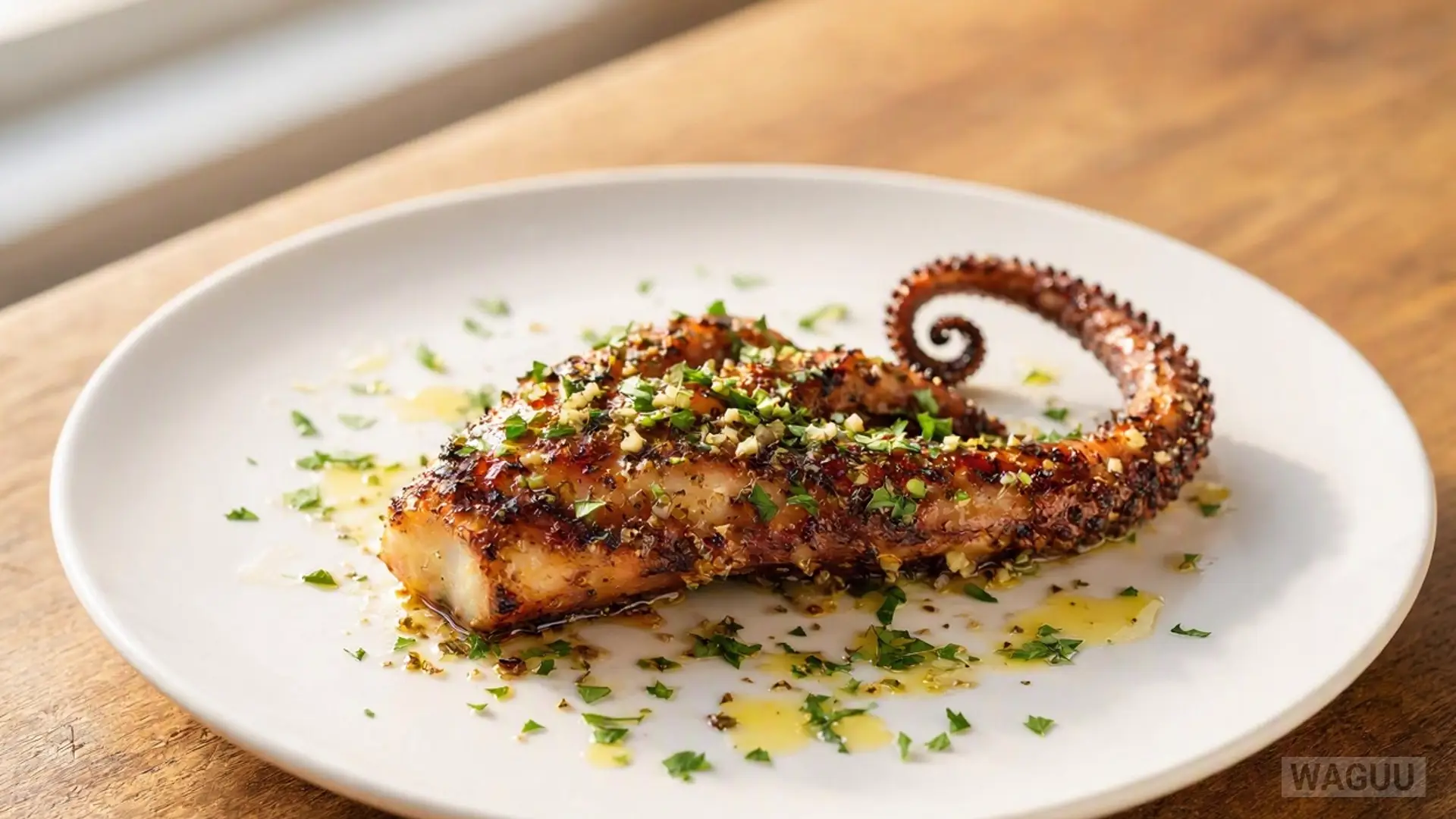
Summary: Tender whole octopus tenderized in simmering water with aromatic herbs, then charred to perfection on a smoking-hot grill and finished with a bright dressing of extra virgin olive oil, fresh lemon juice, crushed garlic, and wild oregano — a classic Mediterranean seafood delicacy prepared in 60 minutes for 6 servings.
Did you make this recipe? Share the result with the community.
Category: Main Dishes, Fish and Seafood
Success rate: not rated yet% of users successfully made this recipe
Quick overview
- Dish: Grilled Octopus
- Category: Main Dishes, Fish and Seafood
- Cuisine: Mediterranean Cuisine
- Main ingredient: Fresh octopus, 4 lb (frozen and thawed, premium ocean-caught)
- Guide: 12 Most Popular Mediterranean Dishes: Favorite Mediterranean Cuisine Recipes
- Total time: 60 minutes (40 min prep + 20 min cooking)
- Difficulty: Intermediate
- Servings: 6 servings (Serving weight: 220 g)
- Key technique: Simmering for tenderization followed by high-heat charring on a grill
- Preparation types: Boiling, Grilling
- Dietary info & Allergens: Gluten-Free, Lactose-Free, Seafood
- Suitable for: Seafood lovers, summer dinners, festive gatherings, low-carb diets
- Nutritional values (per 1 serving): 280 kcal, Protein: 32.0 g, Fat: 14.5 g, Carbs: 3.2 g
- Storage: 2 days in the fridge, 1 month in the freezer
- Pairing: Crisp Pilsner, Assyrtiko white wine, iced sparkling water with lemon
- In a nutshell: Tender, smoky ocean flavors kissed by lemon, garlic, and wild oregano.
- Last updated: May 20, 2024
WAGUU says: “Freezing the octopus beforehand breaks down the tough connective tissue naturally, guaranteeing melt-in-your-mouth tenderness every single time.”
How to take it further: Serve on a white 26 cm plate warmed to 40 °C, keep the full 26 cm plate in frame; place a glass of water with lime, a linen napkin and fresh herbs in the softly blurred background.
Key facts
| Prep time: | 40 minutes |
| Cooking time: | 20 minutes |
| Temperature: | 212 °F (simmering) / 500 °F (grilling) |
| Number of servings: | 6 servings |
In a nutshell
Bring the breezy romance of Greek seaside tavernas directly to your backyard patio with this iconic grilled octopus recipe. Featuring succulent tentacles charred over open flames and dressed simply in the Mediterranean trinity of olive oil, fresh lemon juice, and aromatic herbs, it is an unforgettable culinary masterpiece.
Ingredients
Base servings: 6 servings • Serving weight: 220 g
| Ingredient | Quantity | Quality |
|---|---|---|
| Whole octopus | 4 lb | Fresh or thawed, cleaned |
| Extra virgin olive oil | 0.33 cup | Cold-pressed Greek extra virgin |
| Lemon juice | 0.25 cup | Freshly squeezed |
| Garlic cloves | 3 cloves | Minced finely |
| Dried oregano | 1 tbsp | Greek wild oregano |
| Fresh parsley | 0.25 cup | Chipped flat-leaf |
| Sea salt | 1 tsp | Coarse flaked sea salt |
| Black pepper | 0.5 tsp | Freshly cracked |
| Bay leaves | 2 pieces | Dried whole leaves |
| Red wine vinegar | 2 tbsp | Quality wine vinegar |
Why you’ll love this recipe
- Restaurant Quality at Home: Achieve that signature tender texture and smoky char found in top coastal tavernas without complex equipment.
- Incredibly Healthy: Packed with lean protein, omega-3 fatty acids, and essential minerals while remaining naturally low in carbohydrates.
- Simple Ingredients: Relies on pantry staples like olive oil, garlic, and lemon to elevate the pure, natural flavor of the seafood.
Success guaranteed: Follow our precise simmering technique and high-heat grilling rules to ensure your octopus is never rubbery.
Recipe overview
Prep: 40 min | Cooking: 20 min | Difficulty: Intermediate | Servings: 6 | Type: Main Course | Origin: Mediterranean Cuisine
Detailed instructions
Overall progress: 0% completed
Phase 1: Preparing and Cleaning the Octopus – 10 min
Appliances: Sink, Cutting board, Chef’s knife
1. Thoroughly rinse the 4 lb whole octopus under cold running water. Inspect the cavity and ensure the beak and internal organs have been completely removed by your fishmonger, or carefully cut them out using a sharp chef’s knife. Rinse the tentacles thoroughly to remove any residual sand or grit.
CP: Octopus is completely clean, free of grit, and ready for simmering.
Before moving to the next step:
Ensure the octopus is fully thawed if previously frozen; never attempt to boil frozen octopus directly as it cooks unevenly.
Phase 2: Simmering and Tenderizing – 30 min
Appliances: Large stockpot, Stovetop, Tongs
2. Fill a large stockpot with water, add 2 dried bay leaves, and bring to a rolling boil over high heat. Using sturdy kitchen tongs, grasp the octopus by the head and dip the tentacles into the boiling water for 3 seconds, repeating this curling process 3 times. Then, submerge the entire octopus into the pot, reduce the heat to low, cover with a lid, and gently simmer at 212 °F for 25 to 30 minutes until a skewer inserts easily into the thickest part of a tentacle.
CP: A metal skewer slides smoothly into the thickest part of the meat with zero resistance.
Before moving to the next step:
Do not overboil the octopus during this stage; it should remain slightly firm so it does not fall apart on the grill.
Phase 3: Cooling and Portioning – 10 min
Appliances: Cutting board, Chef’s knife, Tongs
3. Remove the cooked octopus from the boiling water using tongs and transfer it to a clean cutting board. Allow it to rest at room temperature for 10 minutes until cool enough to handle. Once cooled, use a sharp chef’s knife to separate the tentacles from the head, keeping the tentacles intact and discarding or reserving the head separately.
CP: Tentacles are neatly separated and ready for oiling and seasoning.
Before moving to the next step:
Pat the tentacles completely dry with paper towels to ensure a pristine sear and prevent oil flare-ups on the grill.
Phase 4: Seasoning and Oiling – 5 min
Appliances: Mixing bowl, Basting brush
4. Place the separated octopus tentacles into a large mixing bowl. Drizzle with 2 tablespoons of extra virgin olive oil, season evenly with 1 tsp of coarse sea salt and 0.5 tsp of freshly cracked black pepper, and toss gently to ensure every tentacle is thoroughly coated.
CP: Tentacles are evenly coated with oil, salt, and pepper.
Before moving to the next step:
Preheat your outdoor grill or heavy cast-iron grill pan until it reaches a blazing 500 °F to secure an exceptional char.
Phase 5: Grilling to Perfection – 5 min
Appliances: Outdoor grill or cast-iron grill pan, Tongs
5. Place the seasoned octopus tentacles directly onto the preheated hot grill grates operating at 500 °F. Grill undisturbed for 2 to 3 minutes per side, pressing down lightly with tongs, until deep grill marks form and the outer skin becomes wonderfully crisp and smoky.
CP: Beautiful dark char lines are visible across the tentacles with a smoky aroma.
Before moving to the next step:
Transfer the grilled octopus immediately to a warm serving platter before preparing the fresh dressing.
Phase 6: Dressing and Final Plating – 5 min
Appliances: Small bowl, Whisk, Serving platter
6. In a small bowl, whisk together 0.33 cup of extra virgin olive oil, 0.25 cup of freshly squeezed lemon juice, 2 tbsp of red wine vinegar, 3 minced garlic cloves, 1 tbsp of dried wild oregano, and 0.25 cup of chopped fresh parsley. Generously drizzle this vibrant dressing over the warm grilled octopus tentacles on the platter, garnish with lemon wedges, and serve immediately.
CP: Octopus is glistening with herb dressing, fragrant with garlic and lemon, and ready for the table.
Required equipment
| Utensil | Ideal size | Alternative | Risk |
|---|---|---|---|
| Large stockpot | 8-quart capacity | Large Dutch oven | Boiling over if heat is too high |
| Kitchen tongs | 12-inch metal tongs | Grilling spatula | Dropping heavy octopus into water |
| Outdoor grill | Gas or charcoal grill | Heavy cast-iron grill pan | Sticking if grates are not oiled |
Shopping list
Nutrition profile
Values per 1 serving (excluding side dishes). Calculated from average ingredient nutrition values.
| Nutrient | Per 100 g | Per 1 serving | Per 6 servings |
|---|---|---|---|
| Energy | 127.3 kcal | 280.0 kcal | 1680.0 kcal |
| Fat | 6.6 g | 14.5 g | 87.0 g |
| of which saturates | 0.9 g | 2.0 g | 12.0 g |
| Carbohydrates | 1.5 g | 3.2 g | 19.2 g |
| of which sugars | 0.4 g | 0.9 g | 5.4 g |
| Protein | 14.5 g | 32.0 g | 192.0 g |
| Salt | 0.5 g | 1.1 g | 6.6 g |
Reference intake of an average adult (8400 kJ / 2000 kcal).
WAGUU Pro level
- Pro standard: Verified recipe with precise ratios and visual checkpoints.
- Tip 1: Always use previously frozen octopus if fresh isn’t available from a local fisherman; the freezing process breaks down tough collagen fibers, ensuring tenderness.
- Tip 2: Never add salt to the simmering water, as salt draws out moisture and can toughen the texture of the octopus meat.
- Tip 3: Flash-sear the octopus over very high heat for only 2 to 3 minutes per side to achieve a smoky exterior without overcooking the tender interior.
- Tip 4: Emulsify the olive oil and lemon dressing vigorously before pouring it over the warm tentacles so it clings to the charred edges.
Scientific background
Octopus muscle tissue is rich in tough collagen and connective tissue. When subjected to moist heat simmering at 212 °F, this collagen gradually denatures and transforms into gelatin, tenderizing the meat. Subsequent dry-heat exposure on a hot grill at 500 °F triggers the Maillard reaction between amino acids and reducing sugars on the surface, creating complex savory aromas and a delightful crispy char while preserving the tender interior.
Fine Dining – Professional techniques
- Plate composition: Arrange curving charred tentacles in a fan shape on a matte white ceramic plate, drizzling the bright herb vinaigrette symmetrically over the top.
- Texture contrasts: Pair the crispy, smoky exterior of the tentacles with the tender, succulent meat underneath.
- Temperature contrast: Serve the hot freshly grilled octopus alongside a cool, refreshing squeeze of room-temperature lemon and herb emulsion.
- Aromatic garnishes: Finish with micro-planed lemon zest, whole fresh oregano sprigs, and flaky sea salt crystals for visual and sensory brilliance.
Sensory radar
- Appearance: Deep charcoal grill marks contrasting with vibrant purple-red tentacles and glistening golden oil.
- Aroma: Smoky charcoal notes combined with pungent garlic, bright citrus, and earthy wild oregano.
- Taste: Clean oceanic sweetness balanced by sharp lemon acidity, rich olive oil, and savory garlic depth.
- Texture: Pleasantly crisp and charred on the outside, meltingly tender and succulent on the inside.
Pairing
- BEER: Crisp, refreshing Czech Pilsner with herbal hop bitterness.
- WINE: Chilled Greek Assyrtiko white wine with high minerality and citrus notes.
- NON-ALCOHOLIC: Sparkling water infused with fresh lemon slices and crushed mint leaves.
Various preparation methods
- Oven Broiled Method: If outdoor grilling is unavailable, broil the seasoned tentacles under your oven broiler on high for 4 to 5 minutes until charred.
- Red Wine Braise: Simmer the octopus in a mixture of red wine, water, and aromatics instead of plain water for deeper fruity notes and a rich burgundy hue.
Allergens and dietary information
Contains: Seafood (Mollusks) • Gluten: Gluten-Free • Not suitable for: Shellfish allergies, vegan diets, vegetarian diets
Suitable for
Seafood enthusiasts, summer dinner parties, Mediterranean-themed menus, and healthy low-carb lifestyles.
Substitution guide
- Fresh octopus: Use frozen and thawed whole octopus (yields identical tender results).
- Red wine vinegar: Substitute with fresh lemon juice or white balsamic vinegar.
- Dried oregano: Substitute with fresh chopped oregano leaves (use double the amount).
FAQ
Do I need to freeze the octopus before cooking?
Yes, freezing breaks down the tough connective tissue naturally. Most store-bought octopus has already been frozen at sea, but if buying fresh, freeze it for at least 24 hours.
Why do you dip the tentacles in boiling water three times?
Curling the tentacles in and out of the boiling water shocks the outer muscle fibers, causing them to curl tightly and trapping moisture inside while setting the skin.
How do I know when the octopus is tender enough?
A metal skewer or paring knife should pierce the thickest part of the tentacle with virtually no resistance, similar to testing a boiled potato.
Can I grill the octopus ahead of time?
You can simmer and portion the octopus in advance, storing it in the fridge, but for the best crispy texture and smoky flavor, grill and dress it just before serving.
WAGUU Petr advises: Cooking for 12 or more people?
12–16 people: Purchase two 4 lb octopuses and simmer them in separate large stockpots to maintain even water temperature and cooking time. • 20+ people: Simmer the octopuses in batches ahead of time, keep them refrigerated until party time, and finish them on a large flat-top grill in rapid succession.
Sides and serving
- Greek Salad (Horiatiki) – Crisp tomatoes, cucumbers, feta, and Kalamata olives (not included in the recipe)
- Grilled Pita Bread – Brushed with olive oil and sprinkled with sea salt (not included in the recipe)
Serving: Serve warm on a large platter garnished with fresh lemon wedges and chopped parsley.
Storage and reheating
Fridge: 2 days days • Freezer: 1 months months • Reheating: Gently warm in a skillet over medium heat with a splash of olive oil for 3 minutes.
Author: WAGUU Petr & Team • Published: 26 Aug 2026 • Updated: 31 Oct 2026
More Recipes in This Article
Other recipes you might enjoy
Why WAGUU?
Recipes on WAGUU undergo checks for ingredient accuracy, procedures, and nutritional values.
Process photo gallery
Community photos: Cook, take a picture, and share your results.
You can upload photos in the comments below or send them via email.
Did you record a video of your process for our recipe? Paste a link to YouTube, YouTube Shorts, TikTok, Instagram Reels, Facebook Reels, Pinterest, Vimeo, or X (Twitter) in the comments – we’d love to share it and help give you and your content more visibility.
Common mistakes
- Skipping the Freezing Step – Cooking fresh, unfrozen octopus without prior freezing or proper mechanical tenderizing results in tough, rubbery meat.
- Adding Salt to the Simmering Water – Salting the boiling water draws out moisture and toughens the octopus tissue during the tenderization phase.
- Overcooking on the Grill – Leaving the octopus on the grill too long causes the meat to dry out and lose its succulent, tender texture.
- Skipping the Rest Period – Failing to let the octopus cool slightly after simmering makes handling difficult and prevents the oil dressing from adhering properly.