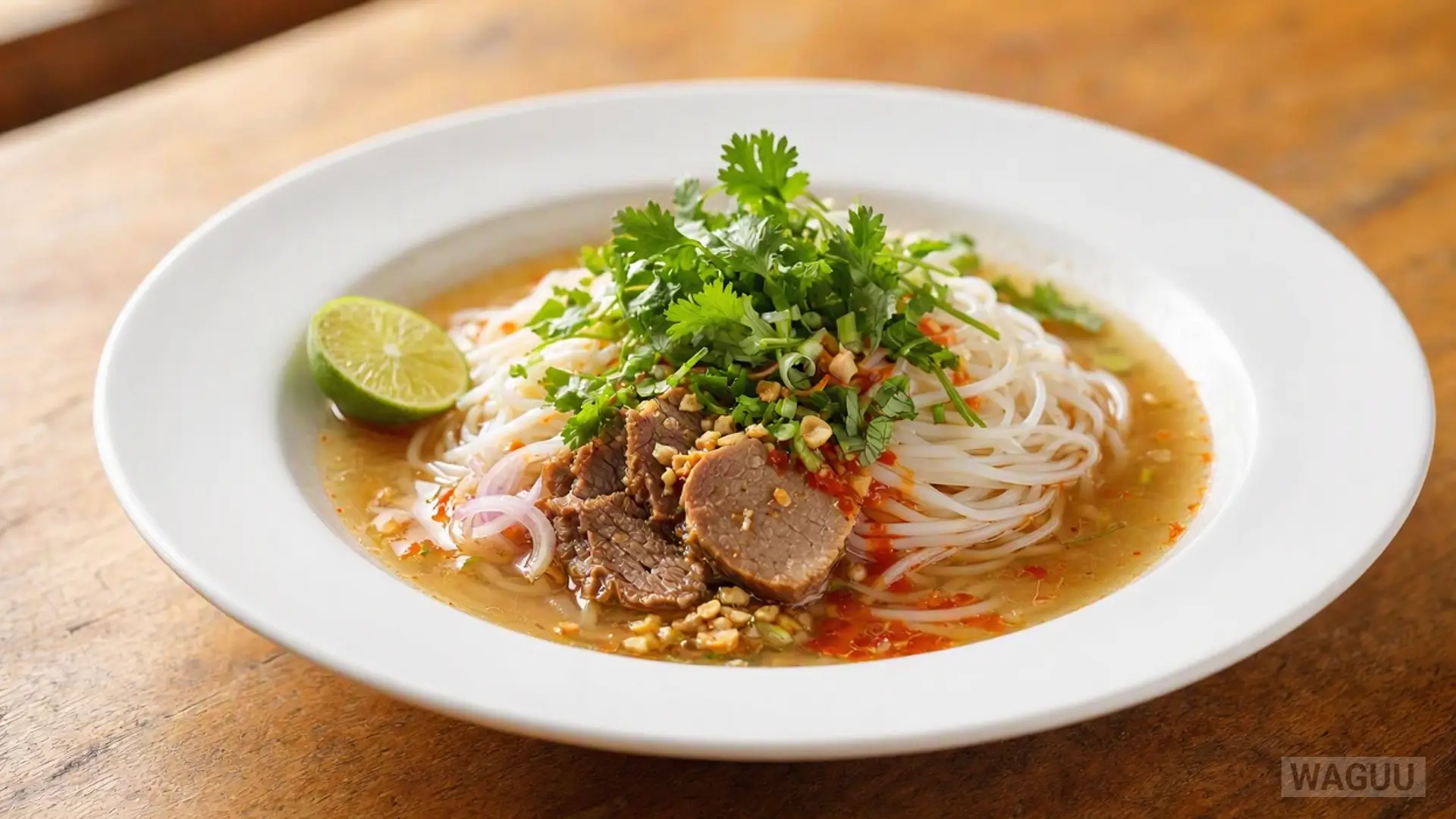
Summary: Bún Bò Huế is a bold, spicy Vietnamese noodle soup featuring beef shank, pork knuckle, thick rice vermicelli, and an intensely aromatic broth infused with lemongrass, fermented shrimp paste, and chili oil, prepared in 3 hours and 30 minutes for 6 servings.
Did you make this recipe? Share the result with the community.
Category: Main Dishes, Soups
Success rate: not rated yet% of users successfully made this recipe
Quick overview
- Dish: Bún Bò Huế
- Category: Main Dishes, Soups
- Cuisine: Vietnamese Cuisine
- Main ingredient: Beef shank, 2.5 lb (bone-in shank, well-marbled)
- Guide: 12 Most Popular Vietnamese Dishes: Favorite Recipes of Vietnamese Cuisine
- Total time: 210 minutes (30 min prep + 180 min cooking)
- Difficulty: Advanced
- Servings: 6 servings (Serving weight: 650 g)
- Key technique: Long bone broth simmer with lemongrass infusion
- Preparation types: Boiling, simmering, frying
- Dietary info & Allergens: Contains fish sauce and fermented shrimp paste; gluten-free
- Suitable for: Lunch, dinner, festive gatherings
- Nutritional values (per 1 serving): 540 kcal, Protein: 38.0 g, Fat: 22.0 g, Carbs: 48.0 g
- Storage: 3 days in the fridge, 2 months in the freezer
- Pairing: Vietnamese Lager, Jasmine Green Tea, Fresh Lime Soda
- In a nutshell: An iconic, fiery masterpiece from Vietnam’s imperial city blending lemongrass, rich beef marrow, and thick rice noodles.
- Last updated: March 30, 2025
WAGUU says: “The secret to an authentic Bún Bò Huế lies in the careful balance of fermented shrimp paste, fresh lemongrass, and chili oil simmered into a rich beef bone broth.”
How to take it further: Warm the 26 cm plate, plate the portion in the center with a clean rim; put a glass of water with lime, cutlery and a few herb leaves behind it.
Key facts
| Prep time: | 30 minutes |
| Cooking time: | 180 minutes |
| Temperature: | Simmering at 200 °F (93 °C) |
| Number of servings: | 6 servings |
In a nutshell
Bún Bò Huế is the crown jewel of Central Vietnamese cuisine, offering an unforgettable symphony of fiery chili, fragrant lemongrass, savory beef marrow, and slippery rice noodles that warms the soul with every single spoonful.
Ingredients
Base servings: 6 servings • Serving weight: 650 g
| Ingredient | Quantity | Quality |
|---|---|---|
| Beef shank | 2.5 lb | Bone-in, well-marbled |
| Pork knuckle | 2.0 lb | Cut into thick rounds |
| Beef marrow bones | 3.0 lb | Fresh and cleaned |
| Lemongrass stalks | 6.0 pcs | Fresh, firm stalks |
| Yellow onion | 2.0 pcs | Whole, charred |
| Shallots | 4.0 pcs | Peeled and minced |
| Garlic cloves | 6.0 cloves | Freshly minced |
| Fermented shrimp paste | 3.0 tbsp | Mắm ruốc Huế style |
| Fish sauce | 4.0 tbsp | First-press premium quality |
| Annatto seeds | 2.0 tbsp | For vibrant red oil |
| Vegetable oil | 3.0 tbsp | Neutral cooking oil |
| Asian chili flakes | 2.0 tbsp | Crushed hot chili |
| Rock sugar | 1½ tbsp | Natural sweetener |
| Salt | 1.0 tbsp | Fine sea salt |
| Thick rice vermicelli noodles | 1.5 lb | Bún bò style thick noodles |
| Fresh banana blossoms | 1½ cups | Thinly shredded |
| Bean sprouts | 2.0 cups | Fresh and crisp |
| Fresh herbs | 2.0 cups | Mint, cilantro, and perilla |
| Lime wedges | 6.0 wedges | Fresh juicy limes |
Why you’ll love this recipe
- Authentic Central Flavors: Recreates the legendary spicy and aromatic profile straight from Huế.
- Deep Broth Complexity: Combines marrow bones, beef shank, and pork knuckle for an exceptionally rich soup base.
- Vibrant Presentation: Features stunning red chili oil and a mountain of fresh crisp herbs and banana blossoms.
Success guaranteed: Follow the precise boiling and skimming techniques for a clear yet deeply flavored broth.
Recipe overview
Prep: 30 min | Cooking: 180 min | Difficulty: Advanced | Servings: 6 servings | Type: Soup | Origin: Vietnamese Cuisine
Detailed instructions
Overall progress: 0% completed
Phase 1: Blanching the Bones and Meats – 20 min
Appliances: Stockpot, stove
1. Place the beef marrow bones, beef shank, and pork knuckle into a large stockpot and cover with cold water. Bring to a rolling boil over high heat and let boil vigorously for 10 minutes to purge impurities. Drain the bones and meats completely, then wash them thoroughly under cold running water, scrubbing away any scum.
CP: Bones are clean and free of surface impurities.
Before moving to the next step:
Ensure all bone surfaces are thoroughly rinsed to keep the final broth crystal clear.
Phase 2: Simmering the Broth – 150 min
Appliances: Stockpot, ladle
2. Return the cleaned bones, beef shank, and pork knuckle to the clean stockpot. Add 6 quarts of fresh water, charred yellow onions, and 4 smashed lemongrass stalks. Bring to a gentle boil, then reduce heat to maintain a simmer at 200 °F (93 °C). Skim any rising foam continuously for the first 30 minutes. Simmer uncovered for 2.5 hours until the meats are tender.
CP: Beef shank yields easily to a fork test.
Before moving to the next step:
Remove cooked meats promptly to prevent them from becoming over-soft.
Phase 3: Preparing the Chili Satay Oil – 15 min
Appliances: Small skillet, spatula
3. Heat vegetable oil in a small skillet over medium heat. Add annatto seeds and cook for 3 minutes until the oil turns bright red, then discard the seeds. Add minced shallots, minced garlic, finely minced remaining lemongrass, and Asian chili flakes. Sauté gently for 3-4 minutes until aromatic and deeply colored, then set aside.
CP: Satay oil is fragrant with a vibrant red hue.
Before moving to the next step:
Do not overheat the annatto oil or the spices will burn and taste bitter.
Phase 4: Seasoning the Broth – 15 min
Appliances: Small bowl, whisk, stockpot
4. In a small bowl, dissolve the fermented shrimp paste in 1 cup of warm broth, stir well, and let sediment settle. Pour the clear liquid into the main stockpot. Season the broth with fish sauce, rock sugar, salt, and half of the prepared chili satay oil. Simmer for another 15 minutes to allow all flavors to meld perfectly.
CP: Broth balances savory, spicy, and subtle sweet notes.
Before moving to the next step:
Leave any gritty sediment from the shrimp paste behind in the bowl.
Phase 5: Preparing Noodles and Slicing Meat – 10 min
Appliances: Pot, colander, cutting board, knife
5. Cook the thick rice vermicelli noodles in boiling water according to package instructions until al dente, then drain and rinse thoroughly under cold water. Slice the cooked beef shank into thin bite-sized pieces and cut the pork knuckle rounds into manageable serving portions.
CP: Noodles are chewy and springy, not mushy.
Before moving to the next step:
Rinse cooked noodles in cold water to stop cooking and remove excess starch.
Phase 6: Assembly and Serving – 10 min
Appliances: Serving bowls, ladle
6. Divide the prepared noodles among 6 large serving bowls. Top with sliced beef shank and pork knuckle. Ladle the boiling hot, aromatic broth over the noodles and meats. Garnish with remaining chili satay oil, shredded banana blossoms, bean sprouts, fresh herbs, and lime wedges.
CP: Soup is served piping hot with vibrant garnishes.
Required equipment
| Utensil | Ideal size | Alternative | Risk |
|---|---|---|---|
| Large stockpot | 8-quart capacity | Large soup pot | Boiling over if too full |
| Skillet | 10-inch pan | Saucepan | Splattering hot oil |
| Colander | Medium mesh | Pasta strainer | Noodle loss |
Shopping list
Nutrition profile
Values per 1 serving (excluding side dishes). Calculated from average ingredient nutrition values.
| Nutrient | Per 100 g | Per 1 serving | Per 6 servings |
|---|---|---|---|
| Energy | 83.1 kcal | 540.0 kcal | 3240.0 kcal |
| Fat | 3.4 g | 22.0 g | 132.0 g |
| of which saturates | 1.2 g | 7.8 g | 46.8 g |
| Carbohydrates | 7.4 g | 48.0 g | 288.0 g |
| of which sugars | 0.5 g | 3.2 g | 19.2 g |
| Protein | 5.8 g | 38.0 g | 228.0 g |
| Salt | 0.3 g | 1.95 g | 11.7 g |
Reference intake of an average adult (8400 kJ / 2000 kcal).
WAGUU Pro level
- Pro standard: Verified recipe with precise ratios and visual checkpoints.
- Tip 1: Always blanch bones beforehand to ensure a clear broth without grey impurities.
- Tip 2: Use authentic mắm ruốc Huế for the true signature aroma of Central Vietnam.
- Tip 3: Simmer the broth gently; rapid boiling will cloud the soup base.
- Tip 4: Serve with extra lime wedges and fresh bird’s eye chilies for heat adjustment.
Scientific background
Long simmering breaks down collagen in beef marrow bones and pork knuckles into gelatin, giving the broth its rich, mouth-coating texture while extracting deep savory glutamates.
Fine Dining – Professional techniques
- Plate composition: Arrange noodles neatly in the bowl before draping uniformly sliced meats on top.
- Texture contrasts: Balance tender braised meats against crisp bean sprouts and shredded banana blossoms.
- Temperature contrast: Ensure the broth is boiling hot when poured over room-temperature noodles.
- Aromatic garnishes: Top with vibrant red satay oil and freshly torn aromatic herbs just before service.
Sensory radar
- Appearance: Deep amber broth topped with vibrant red chili oil and fresh green herbs.
- Aroma: Pungent lemongrass, fermented shrimp paste, and rich beef marrow.
- Taste: Spicy, savory, subtly sweet, and intensely umami-rich.
- Texture: Slippery thick noodles, tender braised meats, and crisp fresh vegetables.
Pairing
- BEER: Crisp Vietnamese Lager
- WINE: Off-dry Riesling
- NON-ALCOHOLIC: Fresh Lime Soda with Mint
Various preparation methods
- Pressure Cooker Method: Speed up the bone broth simmering time by using an electric pressure cooker.
- Vegetarian Adaptation: Substitute mushroom broth, tofu puffs, and vegetarian fish sauce for a meatless version.
Allergens and dietary information
Contains: Fish, Crustaceans • Gluten: Gluten-free • Not suitable for: Vegetarians, Vegans, Shellfish allergy
Suitable for
Lunch, dinner, festive gatherings, and Asian cuisine enthusiasts
Substitution guide
- Beef shank: Beef chuck roast
FAQ
Can I use regular rice noodles instead of thick bún noodles?
Traditional Bún Bò Huế uses thick round rice noodles which hold up better to the robust broth, but standard vermicelli can be used in a pinch.
Is the fermented shrimp paste mandatory?
Yes, mắm ruốc is essential for the authentic distinct flavor profile characteristic of Huế soups.
How do I reduce the spice level?
Simply reduce the amount of chili flakes and chili satay oil added to the broth.
Can I make the broth ahead of time?
Yes, the broth tastes even better when simmered a day in advance and reheated before serving.
WAGUU Petr advises: Cooking for 12 or more people?
12–16 people: Double all ingredients and use a 16-quart stockpot • 20+ people: Split the broth preparation across two separate pots for even heat distribution.
Sides and serving
- Lime wedges and sliced chili – for adjusting acidity and heat at the table (not included in the recipe)
- Hoisin and Sriracha sauce – for dipping meats (not included in the recipe)
Serving: Serve steaming hot in deep bowls with fresh herbs and lime.
Storage and reheating
Fridge: 3 days • Freezer: 2 months • Reheating: Simmer gently on the stove until piping hot.
Author: WAGUU Petr & Team • Published: 25 Aug 2026 • Updated: 31 Oct 2026
More Recipes in This Article
Other recipes you might enjoy
Why WAGUU?
Recipes on WAGUU undergo checks for ingredient accuracy, procedures, and nutritional values.
Process photo gallery
Community photos: Cook, take a picture, and share your results.
You can upload photos in the comments below or send them via email.
Did you record a video of your process for our recipe? Paste a link to YouTube, YouTube Shorts, TikTok, Instagram Reels, Facebook Reels, Pinterest, Vimeo, or X (Twitter) in the comments – we’d love to share it and help give you and your content more visibility.
Common mistakes
- Skipping the bone blanching – Leads to a cloudy and bitter broth.
- Rushing the simmer time – Fails to extract deep collagen and rich marrow flavors.
- Omiting fermented shrimp paste – Results in a generic soup instead of authentic Bún Bò Huế.
- Overcooking the noodles – Makes noodles mushy and ruins the texture contrast.