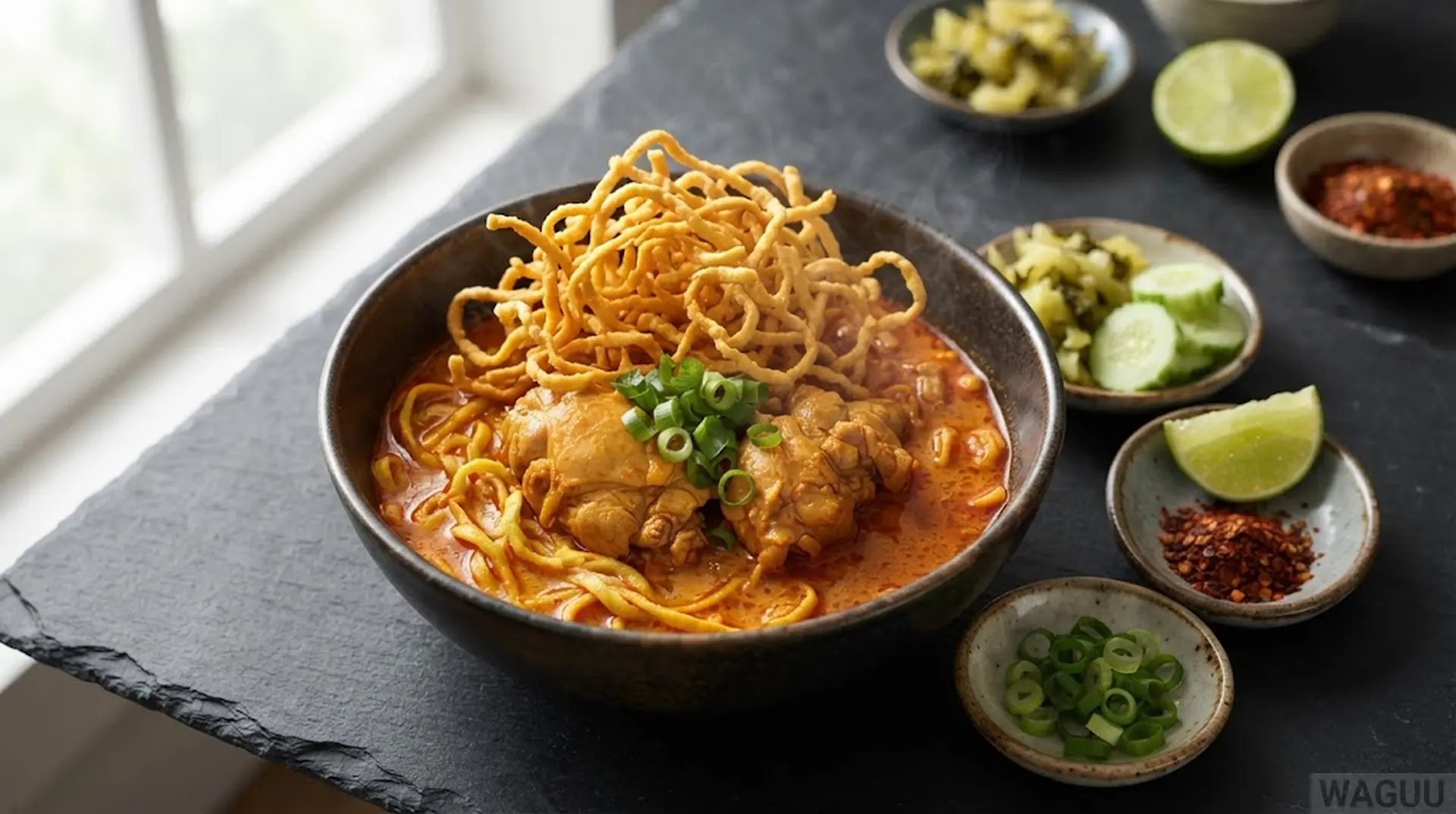
Summary: Chicken thighs simmer in a coconut curry with curry paste, then cooked egg noodles are added to the soup. A handful of crispy fried noodles is sprinkled on top, and the soup is finished with lime, pickled vegetables, and chili. Total time 75 minutes, base 6 servings.
Did you make this recipe? Share your result with the community.
Category: Poultry · Thai Cuisine
Success rate: not rated yet % of users nailed this recipe
Quick overview
- Dish: Khao Soi – Northern Thai noodle soup with coconut curry, chicken, and crispy noodles
- Category: poultry, thai-cuisine
- Cuisine: Thai
- Main ingredient: Chicken thigh, 2 lb (boneless, skinless) (quality specification)
- Guide: 12 most famous Thai dishes: traditional recipes from Thai cuisine
- Total time: 75 minutes (25 min prep + 50 min cooking)
- Difficulty: Challenging
- Servings: 6 (Serving weight: 1.2 lb)
- Key technique: Dissolving curry paste in coconut milk and using noodles two ways – boiled and fried
- Preparation types: Simmering in coconut milk, frying noodles
- Dietary info & allergens: gluten and eggs (egg noodles), shellfish and fish (curry paste, fish sauce)
- Suitable for: Family dinner, dinner with friends, quick weeknight lunch, or a festive multi-course table.
- Nutrition facts (per 1 serving): 774, Protein: 39.5 g, Fat: 44.2 g, Carbs: 54.5 g
- Storage: 3 days in the fridge, 1 month in the freezer
- Pairing: Thai lager, dry Riesling, coconut water with lime
- In short: Chicken thigh is simmered in coconut curry with curry paste, then cooked egg noodles are added to the soup. Total time 75 minutes, 6 servings.
WAGUU says: “Khao Soi is known for its crispy handful on top. Skip that and you just have curry with noodles.”
Key facts
| Prep time: | 1.7 minutes |
| Cook time: | 2.0 minutes |
| Temperature: | Simmer 185–194 °F, fry noodles 355 °F |
| Servings: | 6 |
At a glance
Khao Soi is a soup of two textures: soft noodles in coconut curry and a handful of crispy noodles on top. Without the second layer, it would just be curry with noodles. The oil temperature when frying and not boiling the soup too hard are crucial, otherwise the coconut milk breaks.
Ingredients
Base servings: 6 servings • Serving weight: 1.2 lb
| Ingredient | Amount | Quality |
|---|---|---|
| boneless chicken thigh | 32 oz | skinless, cut into larger chunks |
| coconut milk | 3.4 cups | full-fat |
| red curry paste | 1.5 oz | Northern Thai, no artificial colors |
| chicken broth | 3 cups | unsalted |
| khao soi noodles | 14 oz | egg, thin |
| fish sauce | 1.7 tbsp | fermented |
| palm sugar | 0.7 oz | dark |
| ground turmeric | 1 tsp | for color and aroma |
| canola oil | 2.7 tbsp | for frying noodles (300 ml in the pot, only the absorbed part ends up in the dish) |
| pickled vegetables | 5.5 oz | cabbage and cucumber, fermented |
| lime | 2 pcs | for wedges |
| red chili | 3 pcs | dried, crushed |
| green onion | 3 pcs | cut into bias rings |
| fresh cilantro | 1 pcs | bunch, chopped |
Why you’ll love this recipe
- Two textures in one bowl: Soft boiled noodles in coconut curry and a crispy handful of fried ones on top. The contrast is the heart of the recipe.
- Northern Thai classic: Khao Soi comes from Chiang Mai and is made with a curry paste not used elsewhere in Thailand. The flavor is mild and spiced.
- Exact ratios for 6 servings: Five ounces of meat per serving, 27 fl oz of coconut milk, and noodles used two ways. Servings can be recalculated.
Guaranteed success: The curry paste dissolves in the thick part of the coconut milk, where the spices fry in the fat and release their color. The noodles fry in oil at 355 °F – at lower temperatures they soak up fat and get soggy. The acid from lime and the tang of pickled vegetables cut through the richness of coconut milk, so they are added at the table.
Recipe overview
Prep: 25 min | Cook: 50 min | Difficulty: Challenging | Servings: 6 | Type: Main dish | Origin: Thai
Detailed instructions
Total progress: 6 % done
Phase 1: Dissolving the paste and searing the meat – 10 min
Equipment: deep saucepan, wooden spoon
1. Skim the thick top layer from the coconut milk and heat it in the saucepan until the fat separates. Add the curry paste and ground turmeric and fry until fragrant.
2. Add the chicken thigh chunks and coat them in the paste. Fry until they turn white on the surface.
QC: The paste is dissolved, the color is bright orange, and the meat is coated. The spice aroma is sharp, not burnt.
Before you move to the next step:
Turmeric burns easily and turns bitter. Fry it in the fat for only half a minute and add the meat right away.
Phase 2: Simmering the meat – 25 min
Equipment: saucepan with lid
1. Pour in the rest of the coconut milk and the chicken broth. Bring the soup to 185–194 °F, just below a boil.
2.Simmer the meat covered until it turns tender. Shake the pot now and then so the coconut milk does not stick to the bottom.
QC:The meat shreds with a spoon and holds its shape. The broth is smooth and creamy, with no separated fat.
Before you move on:
A hard boil breaks coconut milk and the broth splits into water and oil. Keep the heat below a simmer.
Phase 3: Cooking the noodles – 5 min
Equipment:large pot, colander
1.Bring water to a boil in a large pot and salt it. Add two-thirds of the noodles and cook until tender but still firm.
2.Drain the cooked noodles, rinse them under hot water so they do not stick, and divide them among warmed deep bowls.
QC:The noodles are soft but hold their shape and do not clump. They form a light layer in the bottom of each bowl.
Before you move on:
Do not leave the noodles sitting in the colander, they will stick. Rinse them under hot water and get them into the bowls right away.
Phase 4: Frying the crispy noodles – 5 min
Equipment:deep skillet, slotted spoon
1.Heat oil to 360°F in a deep skillet. Test the temperature with a piece of noodle: when bubbles form around it right away, the oil is ready.
2.Break the remaining noodles into small handfuls and fry them for a few seconds until golden. Lift them out with a slotted spoon onto paper towels.
QC:The fried noodles are golden, dry, and crisp to the touch. They leave no grease spot on the paper towel.
Before you move on:
Noodles dropped into oil that is not hot enough soak up fat and go soft. The oil must be at 360°F.
Phase 5: Seasoning the broth – 3 min
Equipment:saucepan, small bowl
1.Pull the saucepan off the heat and stir in the fish sauce and palm sugar. Mix and taste.
2.Ladle the broth over the noodles in the bowls and pile a handful of fried noodles on top.
QC:The broth is creamy, salty and sweet, and the fried noodles stay crisp on the surface.
Before you move on:
Do not let the fried noodles sit in the broth, they go soft. Scatter them on at the table just before serving.
Phase 6: Serving with condiments – 3 min
Equipment:small bowls
1.Set a small bowl of pickled vegetables, a lime wedge, crushed chile, and sliced scallions next to each bowl.
2.Scatter chopped cilantro over the broth and serve right away. Each guest adds lime and vegetables to taste.
QC:The broth is hot, the fried noodles crisp on top, and the vegetables cold. The bowls are warmed.
Equipment needed
| Cookware | Ideal size | Alternative | Risk |
|---|---|---|---|
| deep saucepan | 4 qt capacity | wide pot with lid | a narrow pot will not let the curry paste dissolve |
| deep frying skillet | 9.5 in diameter | wok with high sides | a shallow skillet will make the oil splatter |
| slotted spoon | 4 in diameter | wire skimmer | without draining the oil, the noodles turn greasy |
| oil thermometer | up to 390°F | test with a piece of noodle | oil that is too cool makes the noodles soak up fat |
Shopping list
Nutrition facts
Values per 1 serving (without condiments). Calculated from average nutrient values of the ingredients.
| Nutrient | Per 100 g | Per 1 serving | Per 6 servings |
|---|---|---|---|
| Energy | 594 kJ / 142 kcal | 3238 kJ / 774 kcal | 19430 kJ / 4644 kcal |
| Fat | 8.1 g | 44.2 g | 265.2 g |
| of which saturated | 4.5 g | 24.4 g | 146.5 g |
| Carbohydrates | 10.0 g | 54.5 g | 327.0 g |
| of which sugars | 10.0 g | 54.5 g | 327.0 g |
| Protein | 7.2 g | 39.5 g | 237.0 g |
| Salt | 0.6 g | 3.1 g | 18.5 g |
Reference intake of an average adult (8400 kJ / 2000 kcal).
WAGUU Pro level
- Pro standard: Tested recipe with exact ratios and visual checkpoints.
- Tip 1: Tested recipe with exact ratios and visual checkpoints.
- Tip 2: The paste is dissolved, the color is deep orange, and the meat is coated. The spice smells sharp, not burnt. Turmeric scorches easily and turns bitter. Fry it in the fat for only half a minute and add the meat right away.
- Tip 3: The meat shreds with a spoon and holds its shape. The broth is smooth and creamy, with no separated fat. A hard boil breaks coconut milk and the broth splits into water and oil. Keep the heat below a simmer.
- Tip 4: Set out the ingredients in small bowls before you turn on the heat. Thai cooking runs on high heat and there is no time to portion things out mid-cook.
The science behind it
Egg noodles contain gluten and egg, which lose moisture fast when fried in hot oil and build a crisp structure. Above 360°F the surface water evaporates before the fat can soak in. That is why fried noodles stay dry and crisp even when they sit on the broth.
Fine Dining – Professional techniques
- Plate composition: Put the cooked noodles in a deep bowl first, then the meat, and finally the broth. Scatter the fried noodles on at the table.
- Texture contrast: Lay the crisp handful across the center of the bowl in a thin layer. It sits above the broth and stays crisp to the last spoonful.
- Temperature contrast: Put the pickled vegetables in a small bowl next to the main bowl. Each guest adds them to taste.
- Aromatic garnishes: Finish with a lime wedge and a cilantro leaf on the rim of the bowl. The aroma meets the curry before the first bite.
Sensory radar
- Appearance: The soup is orange and creamy, topped with a pile of golden fried noodles and green cilantro.
- Aroma: Curry spices with coconut, then lime and pickled vegetables after stirring.
- Taste: Gentle sweetness of coconut with the heat of curry and the tartness of lime at the end.
- Texture: Boiled noodles soft, fried ones crispy, meat tender, and vegetables cold and crunchy.
Pairing
- Thai lager: A lager with higher carbonation cleanses the palate of coconut fat. Serve it at 43°F.
- Dry Riesling: Riesling with acidity stands up to curry and coconut. Avoid oaked red wines.
- Coconut water with lime: Coconut water with lime. Light sweetness mirrors coconut milk and lime provides acidity.
Variations
- Beef Khao Soi:: Replace chicken with beef shank and extend simmering time to one hour. The soup gains a deeper flavor and darker color.
- Vegetarian Khao Soi:: Omit meat and use firm tofu, mushrooms, and cauliflower. Choose curry paste without shrimp paste and replace fish sauce with soy sauce.
Allergens and Dietary Information
Contains: gluten and eggs (egg noodles), crustaceans and fish (curry paste, fish sauce) • Gluten: yes, in egg noodles • Not suitable for: people with allergies to gluten, eggs, crustaceans, and fish, individuals with celiac disease
Suitable for
Family dinner, dinner with friends, quick weekday lunch, or a festive multi-course table.
FAQ
What noodles to use for Khao Soi?
Thin egg noodles that can be both boiled and fried. Rice noodles cannot be fried; they fall apart in oil.
Can I substitute curry paste?
Red curry paste with a teaspoon of ground curry powder. The taste will be closer to the classic, but northern Thai paste also contains turmeric and cinnamon.
Why do fried noodles become soft?
They were fried in oil that was not hot enough, or they sat in the soup too long. Fry them at 350°F and sprinkle on the plate just before serving.
How to make the soup milder?
Reduce curry paste to one ounce and add two tablespoons of coconut cream. A tablespoon of peanut butter also tames the heat.
Can I use other meat?
Yes, beef shank simmers for an hour, pork shoulder for forty minutes. Chicken is the quickest and traditional in Chiang Mai.
What are pickled vegetables?
Sauerkraut or cucumber pickled in vinegar with sugar and salt. A cucumber salad with vinegar and a tablespoon of sugar can substitute.
WAGUU Petr advises: Cooking for 6 or more people?
6–8 people: Heat the wok or pan in batches and keep the finished dish warm in an oven at 175°F. Add flavor components (fish sauce, lime, sugar) at the end, otherwise the aroma fades. • 10+ people: Prepare the base (paste, broth, or marinade) in double quantity and save half for the next day. Fill the wok no more than two-thirds full, otherwise the ingredients steam instead of stir-fry.
Sides and Serving
Serving: Serve the soup in a deep bowl with a handful of fried noodles on top. Put pickled vegetables, lime, and chili on the side.
Storage and Reheating
Refrigerator: 3 days • Freezer: 1 month • Reheating: Refrigerator: 3 days • Freezer: 1 month • Reheating: over low heat to 175°F, fry crispy noodles fresh
Satay Gai – Grilled marinated chicken skewers with peanut sauce and pickled vegetables
Author: WAGUU Petr & Team • Published: 8 Oct 2026 • Updated: 10 Oct 2026
More recipes from the article
Guide: 12 most famous Thai dishes: traditional recipes of Thai cuisine
Pad Thai – stir-fried rice noodles with egg, shrimp, tofu, tamarind, peanuts, and lime
Tom Yum Goong – spicy and sour soup with shrimp, lemongrass, galangal, and chili
Tom Kha Gai – coconut soup with chicken, galangal, lemongrass, and lime leaves
Green Curry (Gaeng Keow Wan) – green curry with coconut milk, chicken, and Thai basil
Red Curry (Gaeng Daeng) – red curry from red paste and coconut milk with beef
Red Curry (Gaeng Daeng) – red curry from red paste and coconut milk with beef
Som Tam – spicy green papaya salad with chili, lime, fish sauce, and peanuts
Pad Kra Pao – stir-fried meat with Thai basil, chili, and garlic, served with rice and a fried egg
Khao Pad – Thai fried rice with egg, vegetables, and chicken
Satay Gai – marinated grilled chicken skewers with peanut sauce and pickled vegetables
Mango Sticky Rice (Khao Niao Mamuang) – sticky rice with coconut milk and ripe mango
More recipes you might like
Why WAGUU?
Recipes on WAGUU are checked for accuracy of ingredients, procedures, and nutritional values.
Photo gallery of the process
Community photos: Cook, take a photo, and share the result.
You can upload photos in the comments below or send them by email.
Did you film a video of the process for our recipe? Paste a link to YouTube, YouTube Shorts, TikTok, Instagram Reels, Facebook Reels, Pinterest, Vimeo, or X (Twitter) in the comments – we’ll be happy to publish it and help promote you and your content.
Most common mistakes
- Dissolving the paste and searing the meat – Turmeric burns easily and becomes bitter. Fry it in fat for only half a minute and immediately add the meat.
- Simmering the meat – A rapid boil breaks coconut milk and the soup separates into water and oil. Keep the temperature below boiling.
- Cooking the noodles – Don’t leave noodles in the colander too long; they stick together. Rinse them with hot water and immediately put them in bowls.
- Frying crispy noodles – Noodles placed in oil that is not hot enough absorb fat and become soft. The oil temperature must be 350°F.