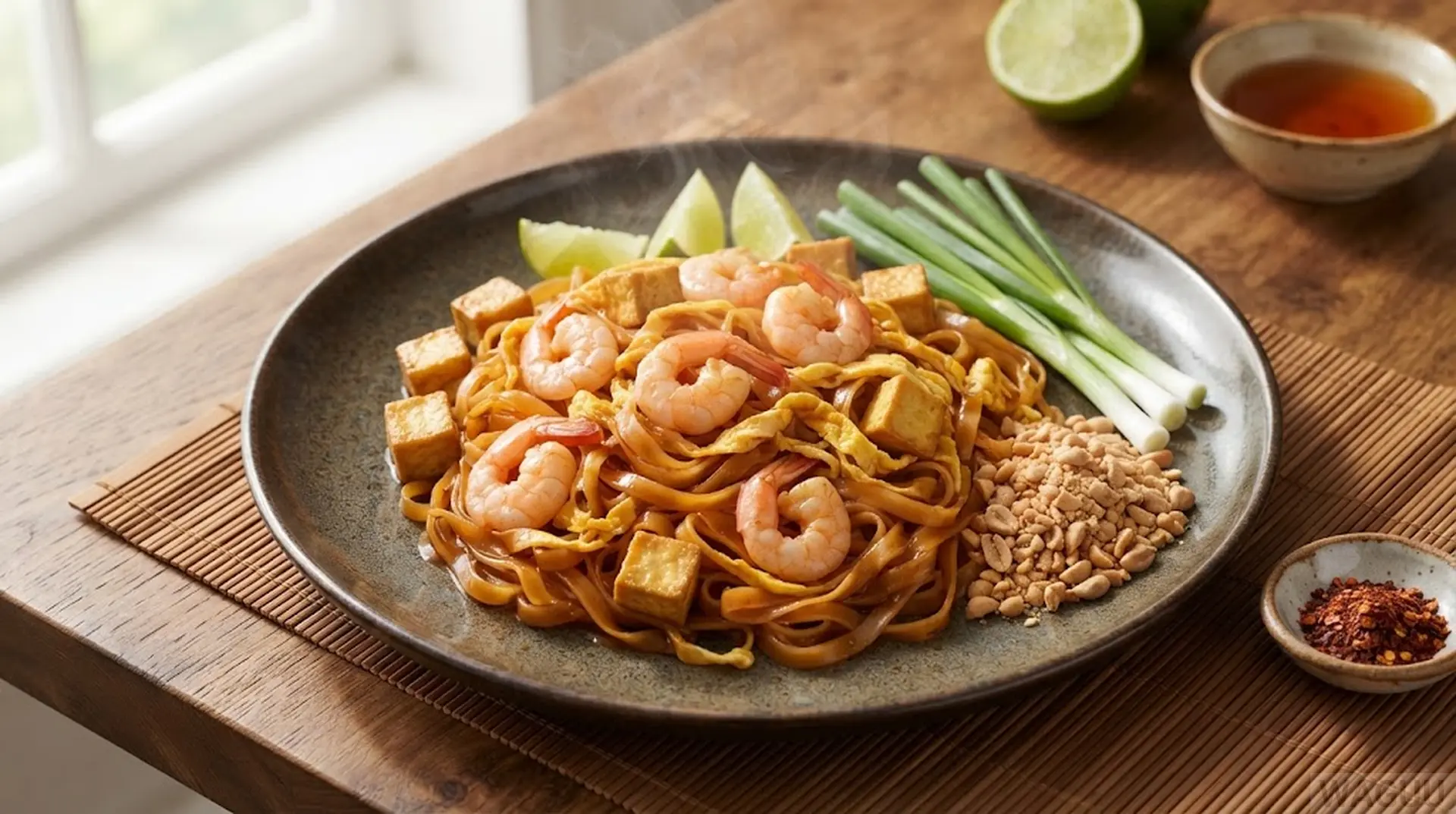
Summary: Rice noodles soaked in warm water, stir-fried in a wok with egg, shrimp, and tofu, seasoned with tamarind paste, fish sauce, and palm sugar. On the plate, they’re topped with roasted peanuts, lime, and fresh scallions. Total time 50 minutes, makes 6 servings.
Did you cook this recipe? Share your result with the community.
Categories: noodles,thai-cuisine
Success rate: not rated yet% of users mastered this recipe
Quick overview
- Dish: Pad Thai – stir-fried rice noodles with egg, shrimp, tofu, tamarind, peanuts, and lime
- Categories: noodles, thai-cuisine
- Cuisine: Thai
- Main ingredient: Rice noodles, 10.5 oz (wide, 5 mm) (quality specification)
- Guide: 12 most famous Thai dishes: traditional recipes of Thai cuisine
- Total time: 50 minutes (30 min prep + 20 min cooking)
- Difficulty: Medium
- Servings: 6 (Serving weight: 9 oz)
- Key technique: Soaking noodles in warm water and stir-frying in a wok in small batches
- Preparation types: Wok stir-frying, pan preparation
- Dietary info & allergens: fish (fish sauce), egg (egg), shellfish (shrimp), peanuts (roasted peanuts), soy (tofu)
- Suitable for: Family dinner, dinner with friends, quick weekday lunch, or a festive multi-course table.
- Nutrition facts (per serving): 537, Protein: 26.2 g, Fat: 22.0 g, Carbs: 58.7 g
- Storage: 3 days in fridge, 1 month in freezer
- Pairing: Thai lager, dry Riesling, iced lime tea
- In short: Rice noodles soaked in warm water, stir-fried in a wok with egg, shrimp, and tofu, seasoned with tamarind paste, fish sauce, and palm sugar. Total time 50 minutes, 6 servings.
WAGUU says: “Pad Thai isn’t about what you put in, but when you put it in. Noodles are stir-fried dry, sauce comes at the end.”
Key facts
| Prep time: | 1.0 minutes |
| Cook time: | 1.4 minutes |
| Temperature: | Wok heated to 425–465 °F, water for soaking noodles 105–115 °F |
| Servings: | 6 |
At a glance
Pad Thai is known for three things: noodles are soft but hold their shape, egg is scrambled into thin strands, and the sauce is sour, salty, and sweet at the same time. The order in which ingredients go into the wok matters, and the noodles must not be wet before stir-frying. If you add all ingredients at once, you get steamed noodles, not stir-fried.
Ingredients
Base servings: 6 servings • Serving weight: 9 oz
| Ingredient | Amount | Quality |
|---|---|---|
| wide rice noodles | 11 oz | wide 5 mm, made from rice flour, not rice starch |
| shrimp | 11 oz | raw, peeled, deveined, medium size |
| firm tofu | 7.0 oz | firm, cubed, drained |
| eggs | 3 pcs | fresh, room temperature |
| tamarind paste | 2.0 oz | seedless, thick |
| fish sauce | 1/4 cups | fermented from anchovies, no added sugar |
| palm sugar | 1.5 oz | dark, grated |
| canola oil | 1/4 cups | neutral flavor, for high heat |
| garlic | 4 cloves | fresh, finely chopped |
| red onion | 1 pcs | smaller, sliced into thin wedges |
| scallions | 4 pcs | fresh, sliced diagonally |
| roasted peanuts | 3.0 oz | unsalted, coarsely crushed |
| lime | 2 pcs | juicy, for wedges and juice |
| dried chili | 1 tsp | coarse flakes, for seasoning at the table |
Why you’ll love this recipe
- Three flavors in one sauce: Tamarind, fish sauce, and palm sugar are mixed separately and added to the wok all at once. The ratio can be adjusted to taste anytime.
- Quick dinner after soaking: Noodles soak on their own while you chop vegetables. The actual stir-frying takes fifteen minutes and even a beginner can handle it.
- Exact ratios for 6 servings: Ten and a half ounces of noodles, ten and a half ounces of shrimp, and a sauce that balances three flavors. Servings can be recalculated based on diners.
Success guaranteed: Rice noodles are soaked in warm water before stir-frying, not boiling. Starch grains swell and noodles soften but stay firm. If noodles are boiled, starch leaches out and they clump during stir-frying. Tamarind paste and lime add acidity that keeps the flavor fresh against sweet palm sugar. Fish sauce provides salt and umami, so no additional salt is added to the sauce.
Recipe overview
Prep: 30 min | Cook: 20 min | Difficulty: Medium | Servings: 6 | Type: Main dish | Origin: Thai
Detailed instructions
Total progress: 6 % done
Phase 1: Soaking rice noodles – 25 min
Equipment: large bowl, colander
1. Place noodles in a large bowl and cover with warm water. Run your hand through several times to prevent sticking, and let rest until they bend easily. Drain water and let noodles drip in a colander.
2. Spread drained noodles on a clean towel and let them dry on the surface. Wet noodles steam in the wok and clump together.
QC: Noodles can be bent into an arc without breaking and are not wet to the touch. They hold shape between fingers and do not clump.
Before moving to the next step:
Do not leave noodles in water longer than needed. Over-soaked noodles fall apart in the wok and turn the recipe into mush. Use soaked noodles within an hour.
Phase 2: Tamarind and palm sugar sauce – 5 min
Equipment: small bowl, whisk
1. Put tamarind paste in a small bowl and cover with a little warm water. Whisk into a smooth paste without lumps, then add fish sauce and grated palm sugar.
2.Stir the mixture until the sugar dissolves. Taste it: it should be sour, salty, and sweet in equal balance, with none overpowering the others.
QC:The sauce is smooth, with no tamarind grit, and coats the back of a spoon in a thin film. When you taste it, sourness, saltiness, and sweetness alternate, not just one note.
Before you move to the next step:
If the sauce is too thick, the noodles will clump. Thin it with a tablespoon of warm water and taste again.
Phase 3: Prepping ingredients for the wok – 10 min
Equipment: cutting board, small bowls, wok
1.Pat the shrimp dry with paper towels, cut the tofu into 3/4-inch cubes, and place each in separate bowls. Mince the garlic, slice the shallot into thin wedges, and cut the scallions on the bias.
2. Crush the peanuts coarsely with a rolling pin or knife, and cut the limes into wedges. Arrange all bowls around the wok in the order they will go in.
QC: The ingredients are cut to uniform size, the shrimp are dry, and each ingredient has its own bowl. At the wok, there’s no time for chopping.
Before you move to the next step:
Wet shrimp will steam in their own water in the wok and lose their firmness. Always dry them before stir-frying and keep them in the fridge for a bit.
Phase 4: Stir-frying shrimp and tofu – 4 min
Equipment: wok, metal spatula
1.Heat the wok over the highest flame until a faint smoke rises. Pour in half the oil, add the shrimp, and stir-fry briefly until they turn pink and curl into a C shape. Remove to a plate.
2. Add the remaining oil to the wok and add the tofu. Stir-fry on all sides until golden brown and transfer to the plate with the shrimp.
QC: The shrimp are pink, firm, and not releasing water. The tofu has a crust on all sides and holds its shape when you push it with the spatula.
Before you move to the next step:
If puddles of water form in the wok, it wasn’t hot enough. Pour off the water, reheat the wok, and stir-fry in smaller batches.
Phase 5: Noodles, eggs, and sauce – 8 min
Equipment: wok, spatula, two wooden spoons
1.Heat the remaining oil in the wok, add the garlic and shallot, and stir-fry just until fragrant. Add the drained noodles and toss with the spatula to coat with oil and prevent burning.
2. Push the noodles to the side of the wok, pour the beaten eggs into the center, and let them set into a thin layer. Then scramble them into the noodles with the spatula, add the sauce, and mix everything with two wooden spoons until the noodles turn golden.
QC: The noodles are shiny but not greasy, and the color is evenly amber. The eggs form thin strands in the noodles, not clumps.
Before you move to the next step:
Don’t stir the noodles in a circular motion; they’ll clump. Toss them with the spatula and pull them apart with two wooden spoons.
Phase 6: Returning shrimp and serving – 3 min
Equipment: wok, serving plate
1.Return the shrimp and tofu to the wok, add the scallions, and stir briefly to warm everything through. Add a tablespoon of lime juice if needed.
2. Divide the Pad Thai among plates and sprinkle with crushed peanuts. Place a lime wedge and a small bowl of chili flakes with each serving.
QC: The noodles are hot, the shrimp aren’t overcooked, and the peanuts stay crunchy on top. There’s no liquid on the plate.
Required equipment
| Cookware | Ideal size | Alternative | Risk |
|---|---|---|---|
| wok | 12-inch diameter, thick bottom | large deep skillet with nonstick surface | a thin wok will burn the noodles at the bottom before they can be coated |
| metal spatula | 4-inch blade | two wooden spoons | a plastic spatula will bend at 425°F and tear the noodles |
| large bowl | 4-quart capacity | roasting pan with high sides | a small bowl won’t let the noodles spread out and they’ll clump |
| kitchen scale | 1-gram resolution | measuring cup for 10 oz noodles | estimating the noodle amount determines whether the sauce is absorbed |
Shopping list
Nutrition profile
Values per 1 serving (without sides). Calculated from average nutritional values of ingredients.
| Nutrient | Per 100 g | Per 1 serving | Per 6 servings |
|---|---|---|---|
| Energy | 883 kJ / 211 kcal | 2247 kJ / 537 kcal | 13481 kJ / 3222 kcal |
| Fat | 8.7 g | 22.0 g | 132.0 g |
| of which saturated | 1.2 g | 0.11 oz | 17.9 g |
| Carbohydrates | 23.1 g | 58.7 g | 352.2 g |
| of which sugars | 23.1 g | 58.7 g | 352.2 g |
| Protein | 10.3 g | 26.2 g | 157.2 g |
| Salt | 1.3 g | 3.4 g | 20.3 g |
Reference intake of an average adult (8400 kJ / 2000 kcal).
WAGUU Pro level
- Pro standard: Verified recipe with precise ratios and visual checkpoints.
- Tip 1: Verified recipe with precise ratios and visual checkpoints.
- Tip 2: The noodles can be bent into an arc without breaking and are not wet to the touch. They hold their shape between your fingers and don’t stick together in clumps. Don’t leave the noodles in water longer than needed. Over-soaked noodles will fall apart in the wok and turn the recipe into mush. Use soaked noodles within an hour.
- Tip 3: The sauce is smooth, with no tamarind grit, and coats the back of a spoon in a thin film. When you taste it, sourness, saltiness, and sweetness alternate, not just one note. If the sauce is too thick, the noodles will clump. Thin it with a tablespoon of warm water and taste again.
- Tip 4: Prepare the ingredients on the table in small bowls beforehand. Thai cuisine is cooked over high heat and there’s no time to portion ingredients during cooking.
Scientific background
Rice noodles are made from rice flour, so they are gluten-free and soften quickly in water. The starch on the surface dries quickly at the wok’s high heat and forms a thin layer that keeps the noodles from sticking. The eggs are beaten and left to set in a thin layer, then mixed into the noodles. The shrimp and tofu are stir-fried separately because they need higher heat than the noodles.
Fine Dining – Professional techniques
- Plate composition: Spread the Pad Thai on a warm plate in a low mound and top with three shrimp you set aside. It looks like a restaurant portion, but it’s the same ingredients.
- Texture contrasts: Mix in a tablespoon of toasted sesame seeds and a handful of fresh cilantro along with the peanuts. The crunchy and fresh layer balances the sweet sauce.
- Temperature contrast: A lime wedge chilled in the fridge adds temperature contrast. The cold juice on hot noodles wakes up the tamarind aroma.
- Aromatic additions: Place a small bowl of fish sauce with lime and chili on the edge of the plate. Guests can adjust their portion themselves, which is a common serving style in Thailand.
Sensory radar
- Appearance: The noodles are amber-colored and glossy, with pink shrimp, golden tofu cubes, and green scallion rings throughout. Crushed peanuts are scattered on top.
- Aroma: First tamarind and roasted peanuts, then citrusy lime, and finally garlic and scallions.
- Taste: Sour, salty, and sweet flavors follow one another in a single bite. The heat comes only from the chili flakes added at the table.
- Texture: The noodles are soft but springy, the shrimp firm, the tofu has a crust, and the peanuts are crunchy.
Pairings
- Thai lager: A light, crisp lager with high carbonation cleanses the palate of tamarind and peanut paste. Serve it chilled at 43–46°F.
- dry Riesling: A Riesling with high acidity pairs with the sourness of tamarind and lime. Sweeter styles will overpower the fish sauce.
- iced tea with lime: Strong iced tea with lime and a bit of brown sugar. The acidity and tannins of the tea calm the chili heat.
Variations
- Chicken Pad Thai:: Slice chicken breast thinly and stir-fry it instead of shrimp. The chicken needs an extra minute, and remove it before adding the noodles so it doesn’t toughen.
- Pad Thai with extra egg:: Add one egg for every two servings and let it set in a thin layer. This version is shrimp-free, so it suits vegetarians who eat eggs.
Allergens and Dietary Information
Contains: fish (fish sauce), eggs (egg), shellfish (shrimp), peanuts (roasted peanuts), soy (tofu) • Gluten: no, the recipe is gluten-free (rice noodles, fish sauce, tamarind) • Not suitable for: people with allergies to fish, shellfish, eggs, peanuts, and soy
Suitable for
Family dinner, dinner with friends, quick weekday lunch, or a festive multi-course table.
FAQ
What noodles to use for Pad Thai?
Wide rice noodles about 1/4 inch wide. Thin noodles overcook and lose their shape, and glass noodles made from mung bean starch have a different texture.
Do I need to pre-cook the noodles?
No. Soak the noodles in warm water until they bend easily. Cooked noodles will break apart in the wok because their starch has already been released into the water.
Can I skip the tamarind?
Tamarind provides the main sourness of the recipe. You can only partially substitute it: use the same amount of lime juice and a tablespoon of vinegar; the flavor will be sharper and less fruity.
Why are my noodles sticking?
They are not drained well, or there are too many in the wok. Spread the noodles on a towel, stir-fry in batches, and toss them by lifting rather than stirring in circles.
What can I use instead of shrimp?
Chicken sliced thinly or firm tofu. Stir-fry chicken for one minute longer than shrimp and remove it before adding the noodles.
How do I know the sauce is balanced?
Taste it from a spoon: first sourness, then saltiness, and finally sweetness. If one dominates, add a little of the missing one.
WAGUU Petr advises: Cooking for 6 or more?
6–8 servings: Heat the wok or pan in batches and keep the finished dish warm in an oven at 175°F. Add the flavor components (fish sauce, lime, sugar) at the end, or the aroma will fade. • 10+ servings: Prepare the base (paste, broth, or marinade) in double quantity and save half for the next day. Fill the wok no more than two-thirds full, or the ingredients will steam instead of stir-fry.
Sides and Serving
Serving: Serve Pad Thai on a warm plate with a lime wedge, a handful of roasted peanuts, and fresh scallions. Put a bowl of chili flakes and a small bowl of fish sauce with lime on the table.
Storage and Reheating
Refrigerator: 3 days • Freezer: 1 month • Reheating: Refrigerator: 3 days • Freezer: 1 month • Reheating: heat a wok, add a tablespoon of water, and warm the noodles for two minutes covered
Satay Gai – Grilled marinated chicken skewers with peanut sauce and pickled vegetables
Author: WAGUU Petr & Team • Published: 8 Oct 2026 • Updated: 10 Oct 2026
More recipes from the article
Guide: 12 most famous Thai dishes: traditional recipes from Thai cuisine
Tom Yum Goong – spicy and sour soup with shrimp, lemongrass, galangal, and chili
Tom Kha Gai – coconut soup with chicken, galangal, lemongrass, and lime leaves
Green Curry (Gaeng Keow Wan) – green curry with coconut milk, chicken, and Thai basil
Massaman Curry – aromatic curry with beef, coconut milk, potatoes, and peanuts
Som Tam – spicy green papaya salad with chili, lime, fish sauce, and peanuts
Som Tam – spicy green papaya salad with chili, lime, fish sauce, and peanuts
Pad Kra Pao – stir-fried meat with Thai basil, chili, and garlic, served with rice and a fried egg
Khao Pad – Thai fried rice with egg, vegetables, and chicken
Khao Soi – northern Thai noodle soup with coconut curry, chicken, and crispy noodles
Satay Gai – grilled marinated chicken skewers with peanut sauce and pickled vegetables
Mango Sticky Rice (Khao Niao Mamuang) – sticky rice with coconut milk and ripe mango
More recipes you might like
Why WAGUU?
WAGUU recipes are checked for accuracy of ingredients, procedures, and nutritional values.
Photo gallery from the process
Community photos: Cook, take a photo, and share the result.
You can upload photos in the comments below or send them by email.
Did you film a video of our recipe? Paste the link to YouTube, YouTube Shorts, TikTok, Instagram Reels, Facebook Reels, Pinterest, Vimeo, or X (Twitter) in the comments – we’ll be happy to publish it and help you and your content get noticed.
Most common mistakes
- Soaking rice noodles – Don’t leave the noodles in water longer than needed. Over-soaked noodles break apart in the wok and turn the recipe into mush. Use soaked noodles within an hour.
- Tamarind and palm sugar sauce – If the sauce is too thick, the noodles will clump. Thin it with a tablespoon of warm water and taste again.
- Prepping ingredients for the wok – Wet shrimp will steam in the wok and lose their firmness. Always pat them dry before stir-frying and chill them briefly.
- Stir-frying shrimp and tofu – If puddles form in the wok, it wasn’t hot enough. Pour off the water, reheat the wok, and stir-fry in smaller batches.