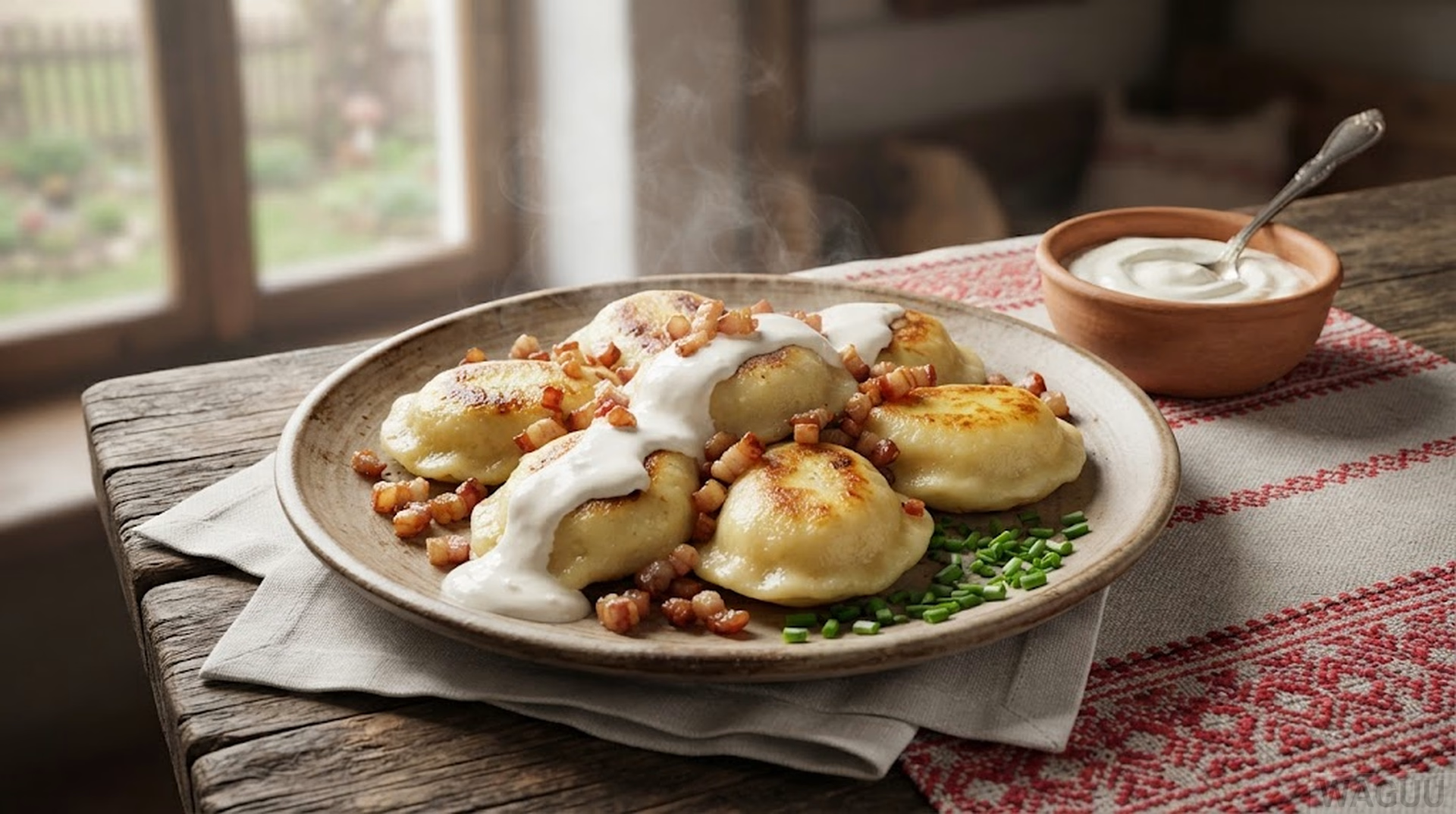
Summary: Thin dough parcels filled with bryndza, boiled and served with crisp bacon or thick sour cream. Slovak pierogi – versatile, freezer-friendly, ready in about 1 hour 15 minutes, serves 6.
Cooked the recipe? Share the result with the community.
Category: Pasta, Slovak Cuisine
Success rate: not rated yet % of users managed this recipe
Quick overview
- Dish: Bryndza Pierogi with Bacon or Sour Cream
- Category: Pasta, Slovak Cuisine
- Cuisine: Slovak
- Main ingredient: Bryndza (Slovak sheep cheese), 500 g, at room temperature
- Guide: 12 Most Famous Slovak Dishes: Traditional Recipes from Slovak Cuisine
- Total time: 75 minutes (50 min prep + 25 min cooking)
- Difficulty: Medium
- Servings: 6 (Portion weight: 380 g)
- Key technique: Making a soft unleavened dough, sealing pierogi by hand, boiling
- Preparation types: Boiling, pan-frying (bacon)
- Dietary info & allergens: Contains milk, gluten, eggs. Not suitable for lactose-free, gluten-free or vegan diets.
- Suitable for: Family lunch, casual dinner, freezer-friendly batch cooking
- Nutrition per serving: 740 kcal, Protein: 30 g, Fat: 32 g, Carbohydrates: 82 g
- Storage: 3 days in the fridge, 3 months in the freezer (uncooked or boiled)
- Pairing: Buttermilk, light lager, dry Riesling
- In short: Soft parcels of bryndza wrapped in thin dough – boil them, fry them, or freeze them.
- Last updated: 21 September 2026
WAGUU says: “Pierogi are the quiet hero of Slovak cooking. They wait in the freezer until you need them.”
Key facts
| Prep time: | 50 minutes |
| Cook time: | 25 minutes |
| Temperature: | Boiling water (100 °C) |
| Servings: | 6 |
At a glance
Thin, tender dough folded around a filling of bryndza, boiled until they float, then served with crisp bacon or thick sour cream. A Slovak classic that freezes beautifully and feeds a family with little effort.
Ingredients
Base servings: 6 servings • Portion weight: 380 g
| Ingredient | Amount | Quality |
|---|---|---|
| Plain flour | 500 g | Plus extra for dusting |
| Egg | 1 pc | Large, free-range, room temperature |
| Water, lukewarm | 200 ml | Warm to the touch, not hot |
| Fine sea salt | 1 tsp | Plus more for the water |
| Bryndza (Slovak sheep cheese) | 500 g | Soft, crumbly, room temperature |
| Streaky bacon, dry-cured | 200 g | Cut into 1 cm strips |
| Sour cream, full-fat (18–20 %) | 200 g | For serving (alternative to bacon) |
| Unsalted butter | 40 g | For tossing the boiled pierogi |
| Chives, fresh | 20 g | Finely chopped |
Why you will love this recipe
- Freezer-friendly: Make a double batch, freeze the uncooked pierogi on a tray, then bag them. They cook from frozen in 5 minutes.
- Two ways to serve: Bacon for a hearty meal, sour cream for a lighter one. Both are traditional.
- Simple dough: Flour, water, egg, salt. No rising, no resting overnight, no special equipment.
Why it works: A soft, unleavened dough made with lukewarm water is elastic enough to seal but tender enough to bite through. Boiling sets the dough and warms the bryndza filling at the same time, so the first bite releases a creamy, tangy centre. Tossing the boiled pierogi in butter stops them sticking and gives the surface a slight sheen.
Recipe overview
Prep: 50 min | Cooking: 25 min | Difficulty: Medium | Servings: 6 | Type: Main course | Origin: Slovak
Detailed method
Total progress: 0 % done
Phase 1: Making the dough – 15 min
Equipment: Large bowl, fork, work surface, cling film
1. Sift the flour into a large bowl and make a well in the centre. Add the egg, 1 tsp salt, and the lukewarm water. Mix with a fork, drawing the flour in from the sides. When the mixture becomes too stiff for the fork, tip it onto a lightly floured surface and knead by hand for 6–8 minutes until smooth, soft, and slightly elastic. Wrap in cling film and rest for 30 minutes at room temperature.
VKB: The dough is smooth and supple, springs back when pressed, and does not stick to your hands or the work surface.
Before you continue:
Do not skip the 30-minute rest. If you roll the dough immediately, it will shrink back and tear while you shape the pierogi.
Phase 2: Preparing the filling – 5 min
Equipment: Bowl, fork
2. Put the bryndza in a bowl and work it with a fork until it is soft and spreadable. If it is very salty, mix in 2 tablespoons of full-fat sour cream to soften the taste. Do not add salt yet – bryndza is naturally salty.
VKB: The bryndza is soft, creamy, and easy to spread with a knife. No dry lumps.
Phase 3: Shaping the pierogi – 30 min
Equipment: Rolling pin, 8 cm round cutter (or a glass), fork, floured tray
3. Divide the dough into 3 pieces. Roll each piece on a lightly floured surface to 2 mm thickness. Cut out rounds with the cutter. Place 1 teaspoon of bryndza filling in the centre of each round. Fold the dough over into a half-moon and press the edges firmly with your fingers. Crimp the sealed edge with the tines of a fork. Place the finished pierogi on a floured tray, not touching each other.
VKB: Each pierogi is sealed, the fork marks are visible, and no filling is leaking at the edges. The dough does not tear when you fold it.
Before you continue:
Do not overfill the pierogi. One teaspoon of bryndza is enough. Too much filling will burst the seal during boiling and the pierogi will lose their shape.
Phase 4: Boiling the pierogi – 10 min
Equipment: Large pot, slotted spoon
4. Bring a large pot of well-salted water to a rolling boil. Slide the pierogi into the water in batches of 10–12 – do not overcrowd. Stir gently once with a slotted spoon so they do not stick to the bottom. Boil for 3–4 minutes. They are done when they float to the surface and the dough looks slightly translucent. Remove with a slotted spoon and put into a bowl with the butter. Toss gently to coat.
VKB: The pierogi float, are plump, and the surface looks slightly glossy from the butter. None of them have opened at the seam.
Phase 5: Cooking the bacon – 5 min
Equipment: Frying pan (28 cm)
5. Heat a dry frying pan over medium heat. Add the bacon strips and fry for 4–5 minutes until golden and crisp. Remove from the pan with a slotted spoon and drain briefly on kitchen paper.
VKB: The bacon is deep golden brown, crisp, and has rendered most of its fat.
Phase 6: Serving – 2 min
Equipment: Warm plates or bowls
6. Divide the buttered pierogi between six warm plates. Top with the crisp bacon and a spoon of sour cream on the side, or serve with sour cream only for a lighter version. Sprinkle with chives and serve immediately.
VKB: The pierogi are glossy, plump, and steaming gently. The bacon is still crisp and the sour cream is cool against the hot dough.
Required equipment
| Item | Ideal size | Alternative | Risk |
|---|---|---|---|
| Rolling pin | 45 cm wooden | Wine bottle, clean and floured | Uneven thickness – the dough tears when folded |
| Round cutter | 8 cm diameter | Glass or small bowl | A blunt edge seals poorly and the pierogi open during boiling |
| Large pot | 5 litres, wide | Two smaller pots | A small pot forces you to cook in many batches, and the water cools too much |
Shopping list
Nutritional profile
Values per 1 serving (without any side dish). Calculated from average nutritional values of the ingredients.
| Nutrient | Per 100 g | Per 1 serving | Per 6 servings |
|---|---|---|---|
| Energy | 195 kcal | 740 kcal | 4440 kcal |
| Fat | 8.4 g | 32 g | 192 g |
| of which saturates | 4.0 g | 15 g | 90 g |
| Carbohydrates | 21.6 g | 82 g | 492 g |
| of which sugars | 2.1 g | 8 g | 48 g |
| Protein | 7.9 g | 30 g | 180 g |
| Salt | 1.4 g | 5.2 g | 31.2 g |
Reference intake of an average adult (8400 kJ / 2000 kcal).
WAGUU Pro level
- Pro standard: Verified recipe with exact proportions and visual checkpoints.
- Tip 1: Roll the dough as thin as you dare – 2 mm is ideal. Thicker dough makes heavy, doughy pierogi.
- Tip 2: Rest the rolled dough for 10 minutes before cutting. It firms up slightly and cuts more cleanly.
- Tip 3: Freeze uncooked pierogi on a floured tray for 1 hour, then bag them. They keep for 3 months and cook straight from frozen.
- Tip 4: For an extra layer of flavour, brush boiled pierogi with butter and briefly pan-fry them in a hot pan – they crisp up on one side.
Scientific background
Bryndza pierogi owe their texture to the balance between gluten development and starch gelatinisation. The dough contains enough gluten to hold its shape when folded and crimped, but not so much that it becomes tough and chewy. Resting the dough allows the gluten strands to relax, which makes it easier to roll thin. During boiling, the starch in the flour gelatinises and the gluten coagulates, setting the dough into a tender, slightly translucent skin. The bryndza inside heats through and softens, releasing its salty, tangy liquid into the parcel. The result is a single bite that combines the tender dough, the creamy filling, and the crisp bacon on top.
Fine Dining – Professional techniques
- Plate composition: Arrange three pierogi in a row, leaning against each other, with a stripe of sour cream underneath and crisp bacon scattered over.
- Texture contrast: Add a scatter of toasted breadcrumbs or fried onions for a crunchy layer against the soft dough.
- Temperature contrast: Serve the pierogi very hot and the sour cream cold from the fridge.
- Aromatic additions: A little grated lemon zest in the sour cream lifts the whole dish.
Sensory radar
- Appearance: Plump, pale half-moon parcels with crimped edges, glistening slightly from the butter.
- Aroma: Warm dough, salty sheep cheese, and the smoky richness of bacon.
- Taste: Tangy, salty, and rich from the bryndza; fresh and grassy from the chives.
- Texture: Tender dough that yields to the bite, creamy filling, crisp bacon on top.
Pairing
- BEER: A light lager or a wheat beer. The carbonation balances the richness of the bryndza.
- WINE: Dry Riesling or Sauvignon Blanc. Crisp acidity against the creamy filling.
- SOFT DRINK: Buttermilk, kefir, or žinčica (sheep whey).
Variations of preparation
- Pan-fried after boiling: Boil the pierogi, drain, then pan-fry in butter until golden on both sides.
- Baked: Layer boiled pierogi in a buttered dish, pour over sour cream, and bake at 180 °C for 15 minutes.
Allergens and dietary information
Contains: Milk, gluten, eggs • Gluten: Yes (plain flour) • Not suitable for: Coeliac disease, lactose intolerance, vegan diets
Suitable for
Family meals, batch cooking, freezer filling, casual dinners. Good for beginners who have shaped dumplings before.
Substitution catalogue
- Bryndza: 50:50 mix of feta and full-fat ricotta. Adjust the salt.
- Sour cream: Crème fraîche or full-fat Greek yoghurt.
- Bacon: Smoked pancetta or diced ham.
FAQ
Can I freeze pierogi before boiling?
Yes. Freeze them on a floured tray for 1 hour, then transfer to a freezer bag. Cook straight from frozen in boiling water for 5–6 minutes.
Why do my pierogi open during boiling?
Either the seal is not tight enough or there is too much filling. Press the seam firmly and crimp with a fork. Use only 1 teaspoon of filling.
Can I use a pasta machine?
Yes. Roll the dough through the widest setting 3 times, folding between each pass, then through to setting 4 (about 2 mm thick).
How do I reheat pierogi?
Pan-fry in butter over medium heat for 3–4 minutes per side. Do not microwave – they turn tough.
WAGUU Petr advises: Cooking for 6 or more?
6–8 people: Make a double batch and freeze half. Boil in batches and keep warm in a low oven (60 °C). • 10+ people: Prepare all pierogi ahead, refrigerate on trays, and boil in four or five batches just before serving.
Sides and serving
Storage and reheating
Fridge: 3 days (boiled) • Freezer: 3 months (uncooked or boiled) • Reheating: Pan-fry in butter. Do not microwave.
Author: WAGUU Petr & Team • Published: 22 Sep 2026
More recipes from this article
Guide: 12 Most Famous Slovak Dishes: Traditional Recipes from Slovak Cuisine
Bryndza Dumplings with Bacon and Crackling
Slovak Sauerkraut Soup with Smoked Meat
Slovak Dumplings with Sauerkraut and Bacon
Slovak Potato Pancakes with Garlic and Marjoram
Demikát: Traditional Slovak Bryndza Soup
Slovak Potato Rolls with Poppy Seeds
Slovak Roast Goose with Potato Flatbread and Cabbage
Bryndza Soup with Potatoes and Bacon
More recipes you might like
Why WAGUU?
WAGUU recipes are checked for accuracy of ingredients, methods and nutritional values.
Photo gallery from the process
Photos from the community: Cook it, photograph it, and share the result.
You can upload photos in the comments below or send them by email.
Have you filmed a video of your version of our recipe? Post a link to YouTube, YouTube Shorts, TikTok, Instagram Reels, Facebook Reels, Pinterest, Vimeo or X (Twitter) in the comments – we will happily feature it and help you and your content get seen.
Most common mistakes
- Rolling the dough too thick – Thick dough stays doughy after boiling and hides the filling.
- Overfilling the pierogi – More than 1 teaspoon of bryndza bursts the seal.
- Not resting the dough – The dough shrinks back and tears as you roll it.
- Boiling too many at once – The water cools, the pierogi stick together and tear.