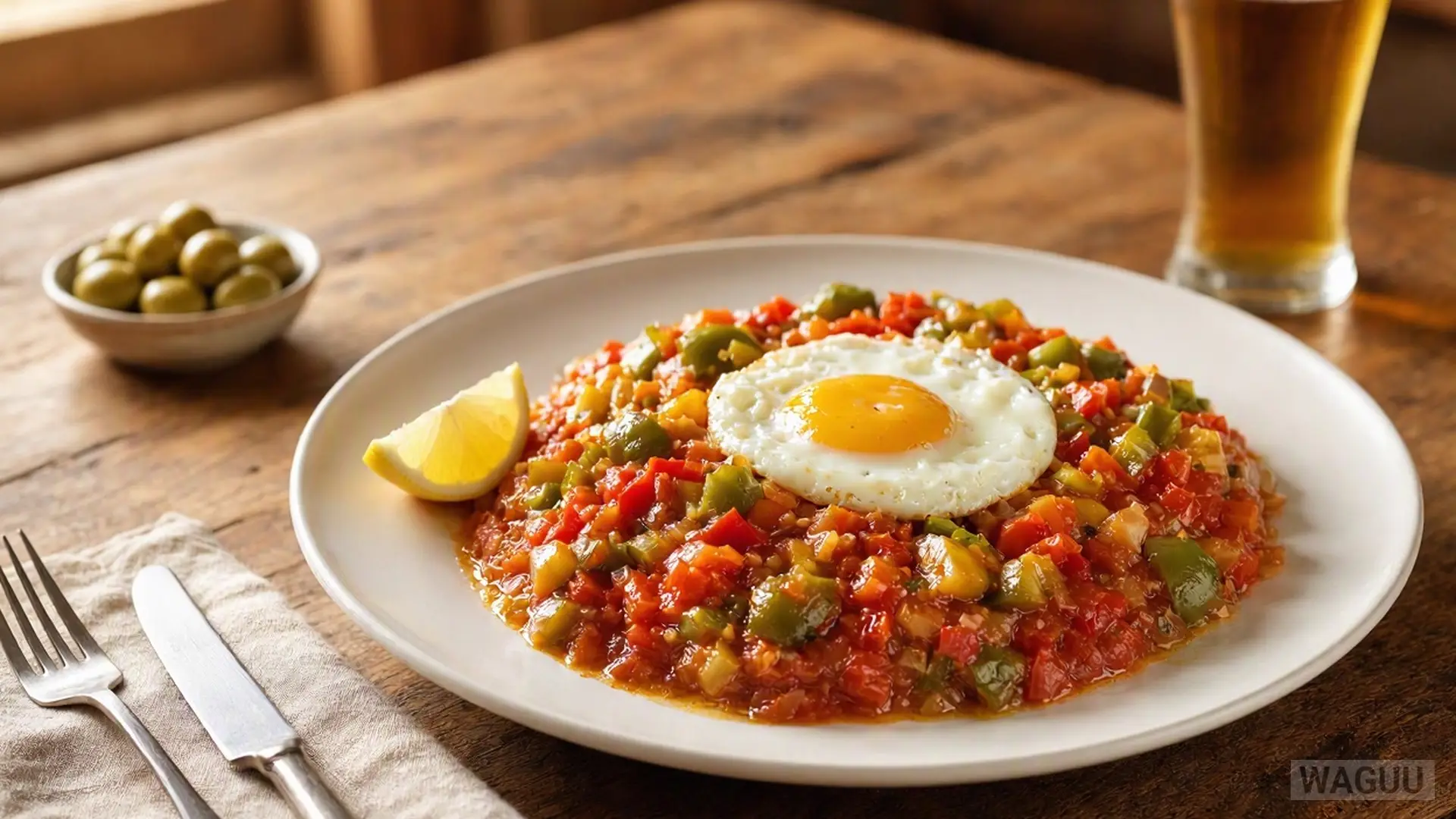
Summary: Pisto Manchego is a traditional Spanish stewed vegetable mix originating from La Mancha, featuring slow-cooked tomatoes, peppers, courgette, and onions in rich olive oil. This classic dish relies on precise low-temperature sweating to caramelise natural sugars without browning. Prepared in 15 minutes of hands-on chopping and 45 minutes of simmering, this recipe yields 6 hearty portions designed to be served hot with crispy fried eggs and rustic crusty bread.
Did you cook this recipe? Share the result with the community.
Category: Main Dishes, Spanish Cuisine
Success rate: 98% of users successfully made this recipe
Quick overview
- Dish: Pisto Manchego
- Category: Main Dishes, Spanish Cuisine
- Cuisine: Spanish
- Main ingredient: Plum tomatoes, 1,200 g (ripe vine-ripened)
- Guide: 12 most popular Spanish dishes: favourite recipes of Spanish cuisine
- Total time: 60 minutes (15 min prep + 45 min cooking)
- Difficulty: Easy
- Portions: 6 portions (Portion weight: 350.0 g)
- Key technique: Slow sweating and reduction
- Preparation types: Simmering and pan-frying
- Dietary info & Allergens: Eggs, gluten (from bread)
- Suitable for: Vegetarians, everyday family dinner
- Nutritional values (per 1 portion): 320.5 kcal, Protein: 11.2 g, Fat: 22.4 g, Carbohydrates: 18.5 g
- Storage: 3 days in the fridge, 3 months in the freezer
- Pairing: Amber ale, Tempranillo wine, sparkling water with lemon
- In short: Rich, velvety Spanish vegetable stew crowned with a golden fried egg and crusty bread.
- Last updated: 21 September 2026
WAGUU says: “True Pisto Manchego requires patience; let the vegetables sweat slowly in cold-pressed olive oil until they melt into a luscious, jammy sauce.”
How to take it further: Stir in a pinch of smoked sweet paprika during the final minutes of simmering, or fold in roasted piquillo pepper strips for extra depth.
Key facts
| Prep time: | 15 minutes |
| Cooking time: | 45 minutes |
| Temperature: | 140–160 °C |
| Number of portions: | 6 portions |
In a nutshell
Experience the authentic flavors of La Mancha with this vibrant, comforting vegetable stew. By gently sweating onions, peppers, and courgettes in extra virgin olive oil before simmering them in a rich tomato reduction, you create a complex, naturally sweet dish. Crowned with a perfectly fried egg whose runny yolk enriches the stew, and served alongside rustic country bread to soak up every drop, this dish transforms simple garden produce into an unforgettable culinary masterpiece.
Ingredients
Base portions: 6 portions • Portion weight: 350.0 g
| Ingredient | Amount | Quality |
|---|---|---|
| Plum tomatoes | 1,200 g | ripe, peeled and diced |
| Green bell peppers | 400 g | fresh, finely diced |
| Red bell peppers | 300 g | fresh, finely diced |
| Courgettes | 600 g | firm, unpeeled, cubed |
| Yellow onions | 400 g | finely chopped |
| Garlic cloves | 20 g | minced |
| Extra virgin olive oil | 90 ml | high quality Spanish |
| Fine sea salt | 18 g | pure sea salt |
| Caster sugar | 6 g | to balance tomato acidity |
| Fresh eggs | 6 pcs | free-range |
| Sunflower oil | 45 ml | for frying eggs |
| Rustic country bread | 300 g | freshly sliced (not part of the recipe) |
Why you will love this recipe
- Authentic Mediterranean Taste: Combines sun-kissed tomatoes, sweet peppers, and tender courgettes in genuine Spanish extra virgin olive oil.
- Nutritional Balance: Packed with dietary fibre, vitamins A and C, and healthy plant fats while remaining entirely vegetarian.
- Versatile Serving: Excellent served hot, lukewarm, or even cold, making it ideal for meal prep and tapas spreads.
Why it works: Slow simmering over gentle heat breaks down cell walls and caramelises natural sugars, creating a rich sauce without needing flour or thickeners.
Recipe overview
Prep: 15 min | Cooking: 45 min | Difficulty: Easy | Portions: 6 | Type: Main course | Origin: Spanish
Detailed instructions
Overall progress: 0% complete
Phase 1: Vegetable Preparation – 15 min
Appliances: None
1. Wash all vegetables thoroughly under cold running water. Peel the yellow onions and mince them finely into 5 mm dice. Core the green and red bell peppers, remove all white membranes and seeds, and cut them into small 1 cm squares. Wash the unpeeled courgettes, trim off both ends, and dice them into 1.5 cm cubes. Peel the garlic cloves and mince them finely. Peel the plum tomatoes (blanch in boiling water for 30 seconds if necessary) and chop the flesh into coarse pieces, weighing out 1,200 g of diced tomato flesh.
Visual check point (VKB): All vegetables are uniformly chopped to ensure even cooking times; dice measure approximately 1 cm across.
Before moving to the next step:
Ensure all chopping boards are clean and vegetables are separated by type to allow sequential cooking.
Phase 2: Sweating Aromatics and Peppers – 15 min
Appliances: Hob
2. Place a large wide heavy-bottomed frying pan or Dutch oven (30 cm diameter) on the hob over medium-low heat. Pour in 90 ml of extra virgin olive oil and heat gently for 60 seconds at 140 °C. Add the 400 g of finely chopped yellow onions and 20 g of minced garlic. Sweat the onions and garlic, stirring frequently with a wooden spoon for 5 minutes until translucent and fragrant, taking care not to let them brown. Add the 400 g of green bell peppers and 300 g of red bell peppers to the pan. Season with 10 g of fine sea salt. Cook over medium heat for 10 minutes, stirring occasionally, until the peppers soften and begin to release their natural juices.
VKB: Onions are soft and translucent without golden edges; peppers have collapsed and turned tender.
Before moving to the next step:
Verify that the peppers are tender before adding the courgettes, as courgettes cook much faster.
Phase 3: Adding Courgettes – 10 min
Appliances: Hob
3. Add the 600 g of cubed courgettes directly into the pan with the onion and pepper mixture. Stir thoroughly to coat the courgette cubes in the hot oil and vegetable juices. Increase the hob temperature slightly to medium (150 °C) and sauté uncovered for 10 minutes, stirring every 2 minutes. The courgettes will absorb the flavours and reduce in volume while retaining a slight bite in the centre.
VKB: Courgettes have softened externally, turned vibrant green, and integrated smoothly with the onion and pepper base.
Before moving to the next step:
Ensure the pan is not completely dry before introducing the tomatoes, which will provide the primary moisture for simmering.
Phase 4: Simmering with Tomatoes – 20 min
Appliances: Hob
4. Pour the 1,200 g of diced plum tomatoes into the pan along with their juices. Add the remaining 8 g of fine sea salt and 6 g of caster sugar to balance the natural acidity of the tomatoes. Stir well to combine all ingredients. Bring the mixture to a gentle bubble over medium heat (160 °C), then reduce the heat to low (130 °C). Simmer uncovered for 20 minutes, stirring occasionally to prevent sticking, until the tomatoes break down completely and the liquid reduces into a thick, glossy, jammy sauce.
VKB: Sauce has thickened considerably, excess tomato water has evaporated, and the mixture coats the back of a wooden spoon.
Before moving to the next step:
Taste the pisto and adjust seasoning if necessary; the vegetable mix should be rich, sweet, and savoury.
Phase 5: Resting the Pisto – 5 min
Appliances: None
5. Turn off the heat under the pan. Cover the pan with a lid and let the pisto rest undisturbed for 5 minutes. This resting period allows the flavours to meld harmoniously and lets the residual cooking oils settle evenly through the vegetable medley.
VKB: Pisto maintains a cohesive, spoonable consistency with a light sheen of olive oil on the surface.
Before moving to the next step:
Prepare a separate small frying pan for frying the eggs while the pisto rests.
Phase 6: Frying Eggs and Final Plating – 5 min
Appliances: Hob
6. In a separate small frying pan, heat 45 ml of sunflower oil over medium-high heat (170 °C). Crack the 6 fresh eggs into the hot oil one by one and fry for 3 minutes until the egg whites are set and opaque at the edges while the yolks remain soft and runny. Spoon the warm Pisto Manchego into shallow serving bowls. Top each portion with a freshly fried egg. Serve immediately alongside slices of 300 g rustic country bread (not part of the recipe).
VKB: Fried eggs feature crispy lacy edges with bright yellow, liquid yolks ready to spill over the warm vegetable stew.
Required equipment
| Utensil | Ideal size | Alternative | Risk |
|---|---|---|---|
| Heavy-bottomed frying pan | 30 cm diameter | Dutch oven | Overcrowding causing steaming instead of sweating |
| Chef’s knife | 20 cm blade | Utility knife | Uneven vegetable dice |
| Wooden spoon | Standard size | Heat-resistant spatula | Scratching pan surface |
Shopping list
Nutritional profile
Values per 1 portion (excluding side dishes). Calculated from average nutritional values of ingredients.
| Nutrient | Per 100 g | Per 1 portion | Per 6 portions |
|---|---|---|---|
| Energy | 91.6 kcal | 320.5 kcal | 1923.0 kcal |
| Fat | 6.4 g | 22.4 g | 134.4 g |
| of which saturates | 1.1 g | 3.9 g | 23.4 g |
| Carbohydrates | 5.3 g | 18.5 g | 111.0 g |
| of which sugars | 3.8 g | 13.3 g | 79.8 g |
| Protein | 3.2 g | 11.2 g | 67.2 g |
| Salt | 0.9 g | 3.0 g | 18.0 g |
Reference intake of an average adult (8400 kJ / 2000 kcal).
WAGUU Pro Level
- Pro standard: Verified recipe with precise ratios and visual control points.
- Tip 1: Peel the tomatoes beforehand by blanching them in boiling water for 30 seconds to ensure a completely smooth, velvety sauce texture without papery skins.
- Tip 2: Dice all vegetables to an identical 1 cm size so they soften simultaneously and create a harmonious, spoonable mouthfeel.
- Tip 3: Use authentic Spanish extra virgin olive oil to impart the distinctive regional aroma that defines traditional La Mancha cooking.
- Tip 4: Let the finished pisto rest off the heat for 5 minutes before serving to allow excess oils to integrate smoothly with the vegetable juices.
Scientific background
The exceptional flavour of Pisto Manchego relies on the process of slow cellular breakdown and caramelisation. As onions and peppers sweat in extra virgin olive oil at moderate temperatures, plant cell walls soften due to pectin degradation. The natural reducing sugars within the tomatoes and onions undergo gentle Maillard reactions and concentration as water evaporates during the 20-minute simmer. Furthermore, the addition of a small amount of sugar balances the organic acids in the tomatoes, while the high fat content in the olive oil acts as a flavour carrier, coating the palate and enhancing the perception of umami compounds naturally present in ripe tomatoes.
Fine Dining – Professional techniques
- Plate composition: Spoon a neat disc of warm, jammy pisto into the centre of a wide shallow bowl, creating a vibrant red and green bed for the pristine white and gold fried egg.
- Textural contrasts: Pair the velvety, soft vegetable stew with the crispy, lacy edges of the fried egg and crunchy toasted sourdough bread.
- Temperature contrast: Serve the simmering hot vegetable stew topped immediately with a freshly cooked egg possessing a warm, runny yolk.
- Aromatic garnishes: Garnish with finely julienned fresh basil leaves or a dusting of smoked Spanish paprika just before serving.
Sensory radar
- Appearance: A glossy, vibrant mosaic of deep red tomatoes, emerald green courgettes, and sweet peppers crowned with a golden egg.
- Aroma: Rich extra virgin olive oil infused with sweet caramelized onions, roasted peppers, and ripe garden tomatoes.
- Taste: Deeply savory and naturally sweet from slow-cooked vegetables, balanced by bright tomato acidity and rich egg yolk.
- Texture: Luscious and jammy stewed vegetables with soft tenderness, complemented by crisp egg edges and crusty bread.
Pairing
- BEER: Spanish amber lager or crisp pilsner to cut through the rich olive oil.
- WINE: Medium-bodied Spanish Tempranillo or a dry rosé from La Mancha.
- NON-ALCOHOLIC: Chilled sparkling water infused with fresh lemon slice.
Various preparation variants
- Pisto Con Jamón: Fold in 150 g of diced cured Jamón Ibérico during the final minutes of simmering for a deeply savoury, meaty twist.
- Baked Pisto Cazuela: Transfer the vegetable stew into individual earthenware clay dishes, crack an egg into the centre of each, and bake in a hot oven at 200 °C for 8 minutes until egg whites are set.
Allergens and dietary information
Contains: Eggs, gluten • Gluten: Contains gluten from serving bread • Not suitable for: Vegan diets (due to eggs)
Suitable for
Vegetarians, everyday family dinner, vegetarian tapas nights, healthy lunch options
Substitution catalog
- Plum tomatoes: Canned whole peeled tomatoes (drained and chopped)
- Courgettes: Yellow summer squash
- Sunflower oil for frying: Extra virgin olive oil
FAQ
Can I make Pisto Manchego ahead of time?
Yes, pisto actually tastes even better the next day as the flavours deepen. Store it in the fridge and reheat gently before frying fresh eggs to top it.
Should I peel the courgettes before dicing?
No, leave the skin on. The green skin provides wonderful colour contrast, holds the cube shape during simmering, and adds valuable nutrients.
Can I freeze Pisto Manchego?
The vegetable base freezes exceptionally well for up to 3 months. However, do not freeze fried eggs; always fry fresh eggs when serving thawed pisto.
What is the difference between Pisto and ratatouille?
While both are Mediterranean vegetable stews, Pisto Manchego originates from Spain, features finely diced vegetables cooked down into a rich tomato sauce, and is traditionally served with fried eggs.
WAGUU Petr advises: Cooking for 12 or more people?
12–16 people: Double all ingredients and use two large 32 cm heavy-bottomed frying pans simultaneously to ensure proper sweating without overcrowding the pan. • 20+ people: Prepare the vegetable stew in a large commercial stockpot or two Dutch ovens in batches, then combine before serving. Fry eggs in batches of four right before plating.
Sides and Serving
- Rustic country bread – thick slices for mopping up rich olive oil and runny egg yolk (not included in the recipe)
- Serrano ham slices – served alongside for a protein-rich traditional tapas pairing (not included in the recipe)
Serving: Serve warm in shallow earthenware bowls with a golden fried egg perched on top and fresh crusty bread on the side.
Storage and reheating
Fridge: 3 days • Freezer: 3 months • Reheating: Reheat the vegetable stew gently in a covered pan over medium-low heat for 10 minutes until piping hot, then top with a freshly fried egg.
Author: WAGUU Petr & Team • Published: 21 Sep 2026 • Updated: 30 Oct 2026
More Recipes from This Article
Other recipes you might be interested in
Why WAGUU?
Recipes on WAGUU undergo checks for the accuracy of ingredients, procedures, and nutritional values.
Process photo gallery
Community photos: Cook, take a photo, and share the result.
You can upload photos in the comments below or send them via email.
Did you record a video guide for our recipe? Insert a link to YouTube, YouTube Shorts, TikTok, Instagram Reels, Facebook Reels, Pinterest, Vimeo, or X (Twitter) in the comment – we’d be happy to publish it and help promote you and your content.
Common mistakes
- High heat during sweating – Browning the onions and peppers instead of letting them sweat gently destroys the delicate sweet vegetable flavours.
- Uneven vegetable cuts – Cutting vegetables in random sizes causes some pieces to turn mushy while others remain raw and crunchy.
- Skipping tomato peeling – Leaving tomato skins on results in unpleasant papery curls throughout the velvety stew.
- Rushing the reduction – Not simmering long enough leaves watery sauce instead of a rich, jammy Mediterranean reduction.