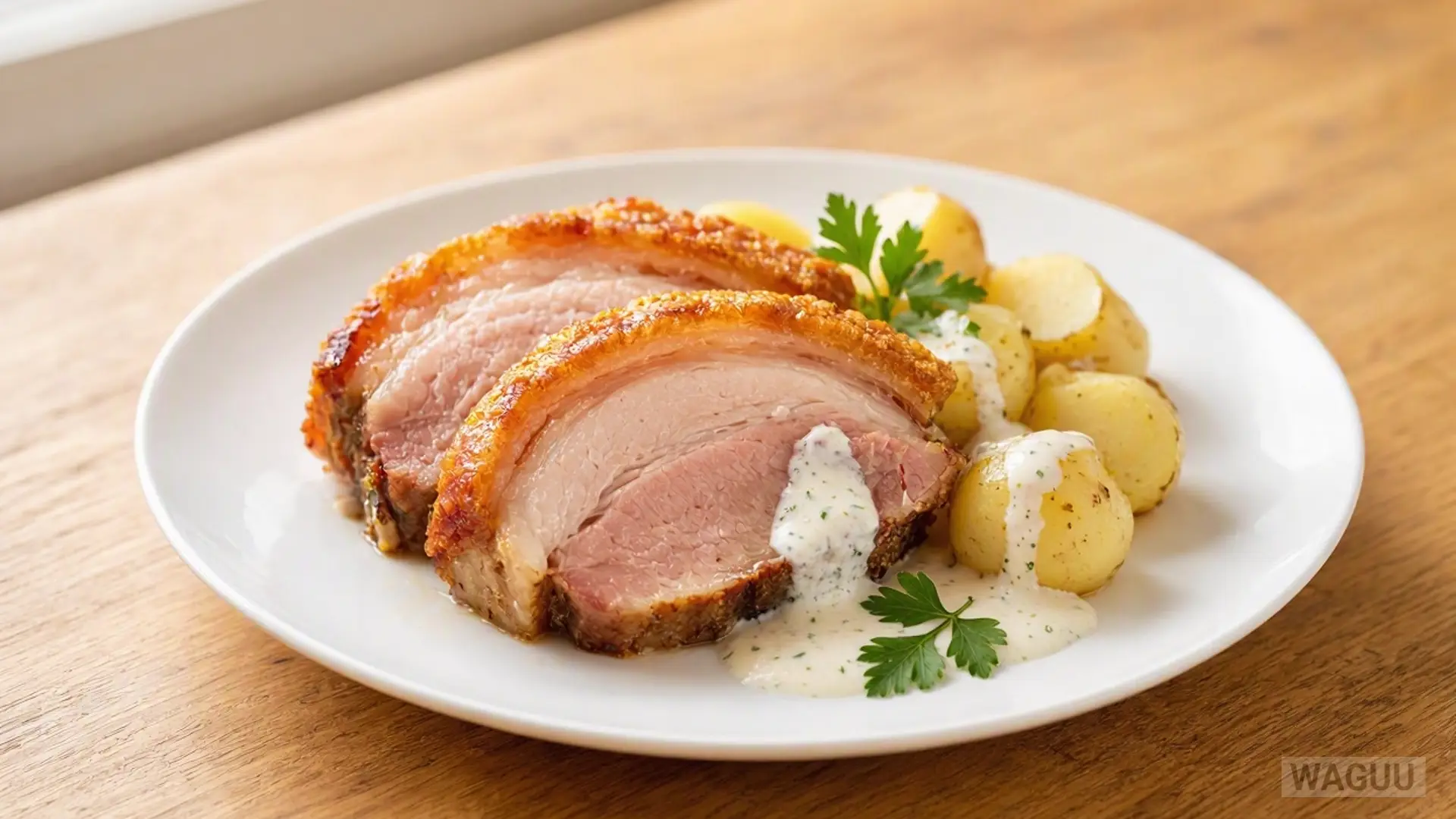
Summary: Stegt Flæsk med Persillesovs – Danish speciality of crispy fried pork belly served with boiled potatoes and parsley sauce. Main ingredient is thick-cut pork belly, preparation technique involves pan-frying until ultra-crispy combined with a traditional butter and milk parsley roux sauce, total preparation and cooking time is 55 minutes, designed for 6 portions.
Did you cook this recipe? Share the result with the community.
Category: Main Dishes, Pork
Success rate: not rated yet% of users successfully made this recipe
Quick overview
- Dish: Stegt Flæsk med Persillesovs
- Category: Main Dishes, Pork
- Cuisine: Danish
- Main ingredient: Pork belly, 1200 g (premium thick-cut pork belly slices with skin)
- Guide: 12 most popular Scandinavian dishes: favourite recipes of Scandinavian cuisine
- Total time: 55 minutes (15 min prep + 40 min cooking)
- Difficulty: Easy
- Portions: 6 portions (Portion weight: 450 g)
- Key technique: Slow rendering and pan-frying for maximum crispiness
- Preparation types: Pan-frying, boiling
- Dietary info & Allergens: Contains dairy (milk, butter), gluten-free option available
- Suitable for: Traditional family dinners, hearty weekend lunches
- Nutritional values (per 1 portion): 720 kcal, Protein: 32.5 g, Fat: 61.2 g, Carbohydrates: 12.4 g
- Storage: 3 days in the fridge, 2 months in the freezer
- Pairing: Traditional Danish Pilsner, sparkling water with lemon, crisp dry white wine
- In short: The ultimate comfort food of Denmark featuring crispy pork belly, smooth parsley cream sauce, and tender boiled potatoes.
- Last updated: 2026-03-30
WAGUU says: “Achieving the legendary crunch on the pork belly requires starting the slices in a cold pan so the fat renders out slowly before the meat crisps up.”
Key facts
| Prep time: | 15 minutes |
| Cooking time: | 40 minutes |
| Temperature: | Medium-high heat for frying, simmering for sauce |
| Number of portions: | 6 portions |
In a nutshell
Stegt Flæsk med Persillesovs is widely celebrated as the national dish of Denmark. It combines intensely crispy, salt-cured pork belly slices with velvety, herb-infused parsley sauce and plain boiled potatoes. Simple, rustic, and bursting with traditional Nordic flavors.
Ingredients
Base portions: 6 portions • Portion weight: 450 g
| Ingredient | Amount | Quality |
|---|---|---|
| Pork belly slices | 1200 g | Thick-cut, bone-in or boneless, with skin |
| Coarse salt | 15 g | Sea salt for seasoning |
| Potatoes | 1200 g | Waxy new potatoes, peeled |
| Butter | 60 g | Unsalted European-style butter |
| Plain flour | 50 g | All-purpose wheat flour |
| Whole milk | 600 ml | Full-fat 3.5% milk |
| Fresh parsley | 40 g | Fresh flat-leaf parsley, finely chopped |
| White pepper | 2 g | Ground white pepper |
| Water | 1500 ml | For boiling potatoes |
Why you will love this recipe
- Authentic Danish tradition: Experience the genuine taste of Denmark as voted by the Danish people as the absolute national dish.
- Incomparable texture contrast: Ultra-crispy, golden pork belly pairs perfectly with creamy, fragrant parsley sauce and soft potatoes.
- Simple ingredients, sublime results: Uses basic everyday pantry staples transformed through traditional culinary technique into a feast.
Success guaranteed: Follow the precise temperature steps and rendering times for foolproof crispy pork belly every single time.
Recipe overview
Prep: 15 min | Cooking: 40 min | Difficulty: Easy | Portions: 6 | Type: Main dish | Origin: Danish
Detailed instructions
Overall progress: 0% complete
Phase 1: Potato preparation and boiling – 20 min
Appliances: Stove, cooking pot
1. Peel 1200 g of waxy potatoes and rinse them thoroughly in cold water. Cut any exceptionally large potatoes in half so they cook evenly within 20 minutes.
VKB: Cooking pot with lid, vegetable peeler, chef’s knife
Before moving to the next step:
Ensure the potatoes are submerged in 1500 ml of salted water before bringing them to a boil on the stove.
Phase 2: Boiling potatoes – 20 min
Appliances: Stove
2. Place the pot of potatoes on the stove over high heat, add 10 g of salt, and bring to a rolling boil. Reduce heat to medium, cover with a lid, and simmer gently for 20 minutes until tender when pierced with a fork.
VKB: Stove burner
Before moving to the next step:
Test potato tenderness with a sharp knife; drain the water once cooked and keep covered to stay warm.
Phase 3: Pork belly preparation – 5 min
Appliances: Cutting board
3. Take 1200 g of thick-cut pork belly slices and pat them completely dry with paper towels. Sprinkle both sides generously with 15 g of coarse sea salt to draw out moisture and enhance crispiness during frying.
VKB: Wooden cutting board, chef’s knife
Before moving to the next step:
Ensure the pork slices are uniform in thickness so they fry at an even rate in the skillet.
Phase 4: Frying pork belly – 20 min
Appliances: Large skillet, stove
4. Arrange the salted pork belly slices in a large cold skillet in a single layer without overcrowding. Turn the stove to medium heat and fry for 20 minutes, turning occasionally, until the fat renders out and the slices become deeply golden and ultra-crispy.
VKB: Large heavy-bottomed frying pan, kitchen tongs
Before moving to the next step:
Transfer the fried pork belly to a paper towel-lined wire rack to drain excess fat and maintain maximum crispiness.
Phase 5: Making parsley sauce roux – 5 min
Appliances: Saucepan, whisk, stove
5. Melt 60 g of butter in a medium saucepan over medium heat. Whisk in 50 g of plain flour and cook the roux for 2 minutes while stirring constantly, taking care not to let it brown.
VKB: Medium saucepan, wire whisk
Before moving to the next step:
Ensure the flour and butter paste is smooth and bubbling gently before pouring in the dairy.
Phase 6: Finishing parsley sauce – 10 min
Appliances: Whisk, stove
6. Gradually pour 600 ml of whole milk into the roux while whisking vigorously to prevent lumps. Simmer for 8 minutes until thickened, then stir in 40 g of freshly chopped parsley and 2 g of white pepper. Serve hot alongside the crispy pork belly and boiled potatoes.
VKB: Saucepan, ladle
Required equipment
| Utensil | Ideal size | Alternative | Risk |
|---|---|---|---|
| Large frying pan | 28 cm diameter | Cast iron skillet | Overcrowding causes steaming instead of frying |
| Saucepan | 2 litre capacity | Small stockpot | Scorching milk if heat is too high |
| Wire whisk | 25 cm length | Silicone spatula | Lumps forming in the roux |
Shopping list
Nutritional profile
Values per 1 portion (excluding side dishes). Calculated from average nutritional values of ingredients.
| Nutrient | Per 100 g | Per 1 portion | Per 6 portions |
|---|---|---|---|
| Energy | 160.0 kcal | 720.0 kcal | 4320.0 kcal |
| Fat | 13.6 g | 61.2 g | 367.2 g |
| of which saturates | 5.2 g | 23.4 g | 140.4 g |
| Carbohydrates | 2.8 g | 12.4 g | 74.4 g |
| of which sugars | 0.8 g | 3.6 g | 21.6 g |
| Protein | 7.2 g | 32.5 g | 195.0 g |
| Salt | 0.9 g | 4.1 g | 24.6 g |
Reference intake of an average adult (8400 kJ / 2000 kcal).
WAGUU Pro Level
- Pro standard: Verified recipe with precise ratios and visual control points.
- Tip 1: Always start the pork belly in a cold pan to ensure even rendering of fat before the exterior browns.
- Tip 2: Add freshly chopped parsley at the very end of sauce preparation to preserve its bright green color and herbal aromatics.
- Tip 3: Use waxy potatoes that hold their shape well when boiled rather than starchy baking potatoes.
- Tip 4: Keep the fried pork belly on a wire rack rather than flat on paper towels to prevent condensation on the bottom crust.
Scientific background
The exceptional texture of stegt flæsk relies on slow thermal rendering of subcutaneous adipose tissue. Starting in a cold pan allows the temperature to rise gradually, melting intramuscular fat and causing collagen to gelatinize while proteins undergo Maillard browning reactions, creating a shatteringly crisp exterior crust.
Fine Dining – Professional techniques
- Plate composition: Stack precise slices of pork belly elegantly next to perfectly uniform butter-glazed potatoes, generously napped with velvety parsley sauce.
- Textural contrasts: Contrast the crunch of crystal-crisp pork skin with the silken smoothness of dairy-rich parsley sauce.
- Temperature contrast: Serve piping hot pork belly immediately alongside warm potatoes and sauce for an optimal dining experience.
- Aromatic garnishes: Garnish with freshly plucked parsley sprigs and a dusting of cracked white pepper for elevated visual appeal.
Sensory radar
- Appearance: Golden-brown crispy pork slices paired with vibrant green speckled white sauce and tender potatoes.
- Aroma: Rich roasted pork fat combined with fresh herbal parsley notes and creamy butter.
- Taste: Savory, deeply umami, salty pork balanced by mild creamy sauce and earthy potatoes.
- Texture: Crisp, crunchy exterior yielding to tender pork meat, paired with velvety smooth sauce.
Pairing
- BEER: Traditional Danish dark lager or crisp Pilsner to cut through the richness of the pork.
- WINE: Dry Riesling or Grüner Veltliner with high acidity to balance the fatty belly and creamy sauce.
- NON-ALCOHOLIC: Sparkling elderflower cordial or iced herbal tea with lemon.
Various preparation variants
- Oven-baked variant: Bake pork belly slices on a wire rack inside a roasting tin at 200°C for 35 minutes for a less hands-on approach.
- Gluten-free variant: Substitute wheat flour with cornstarch or rice flour when making the roux for the parsley sauce.
Allergens and dietary information
Contains: Dairy (milk, butter), gluten • Gluten: Contains wheat flour in sauce roux • Not suitable for: Lactose intolerance, vegetarian, vegan diets
Suitable for
Traditional family dinners, Scandinavian themed feasts, hearty weekend lunches
Substitution catalog
- Whole milk: Oat milk or semi-skimmed milk can be used for a lighter sauce profile.
FAQ
Why start the pork belly in a cold pan?
Starting in a cold pan allows the hard fat to render out slowly before the meat surface browns, resulting in an evenly crisp texture without burning.
Can I prepare the parsley sauce in advance?
It is best served immediately, but you can keep it warm on very low heat whisking occasionally with a splash of milk if it thickens too much.
What kind of potatoes work best?
Waxy new potatoes or firm boiling potatoes hold their shape and absorb the creamy parsley sauce wonderfully.
How do I prevent lumps in the parsley sauce?
Add the milk gradually in small splashes while whisking vigorously and continuously until fully incorporated into the roux.
WAGUU Petr advises: Cooking for 12 or more people?
12–16 people: Cook the pork belly in batches on baking sheets in a 200°C convection oven and scale up the sauce in a large stockpot • 20+ people: Utilize multiple ovens and commercial catering equipment to maintain consistent crispiness and serving temperature.
Sides and Serving
- Pickled beetroot – Tangy sliced beetroot (not included in the recipe)
- Danish mustard – Sharp yellow mustard for dipping (not included in the recipe)
Serving: Serve piping hot on warmed plates with boiled potatoes smothered in parsley sauce and crispy pork belly stacked beside them.
Storage and reheating
Fridge: 3 days • Freezer: 2 months • Reheating: Reheat pork belly in a hot oven to restore crispiness; gently warm the parsley sauce on the stovetop with a splash of milk.
Author: WAGUU Culinary Team • Published: 2026-03-30
More Recipes from This Article
Other recipes you might be interested in
Why WAGUU?
Recipes on WAGUU undergo checks for the accuracy of ingredients, procedures, and nutritional values.
Process photo gallery
Community photos: Cook, take a photo, and share the result.
You can upload photos in the comments below or send them via email.
Did you record a video guide for our recipe? Insert a link to YouTube, YouTube Shorts, TikTok, Instagram Reels, Facebook Reels, Pinterest, Vimeo, or X (Twitter) in the comment – we’d be happy to publish it and help promote you and your content.
Common mistakes
- Starting in a hot pan – Causes the outer layers to burn before the fat has time to properly render and crisp up.
- Overcrowding the skillet – Leads to steaming instead of frying, resulting in soft and rubbery pork belly.
- Adding flour and butter roux to boiling milk – Creates stubborn lumps that ruin the velvety texture of the parsley sauce.
- Using starchy potatoes – Causes potatoes to disintegrate during boiling rather than holding a firm shape on the plate.