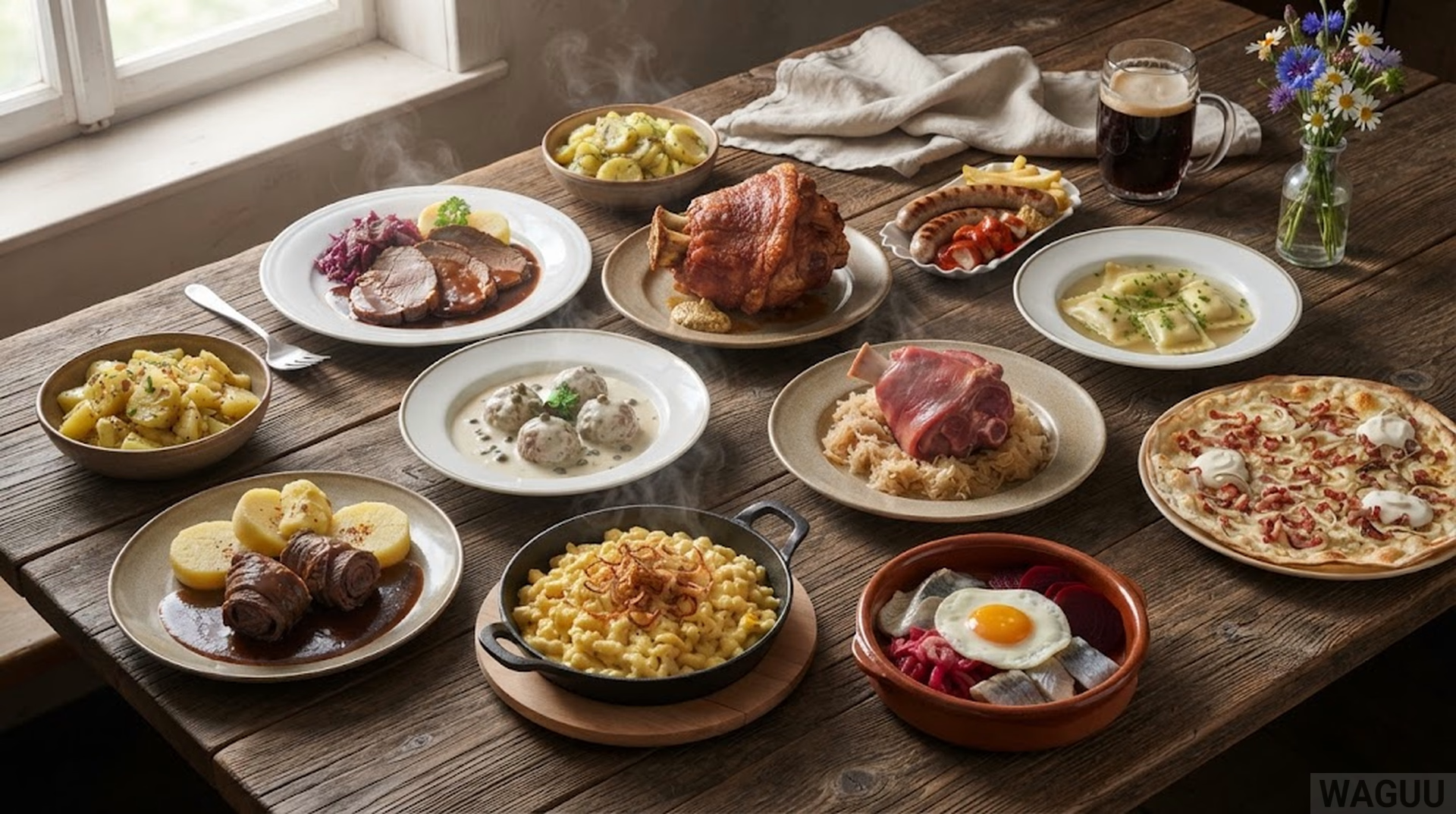
Summary: A complete guide to twelve of the most iconic German dishes – from Sauerbraten to Labskaus. For American home cooks who want to prepare authentic German food, with detailed recipes, techniques and background. Reading time: 14 minutes.
Category: Articles |
Reading time: 14 minutes
Photo gallery from the process
Have you made any of these variations? Share a photo in the comments below the recipe – we will happily add it to the gallery. Filmed a video? Post a link to YouTube, YouTube Shorts, TikTok, Instagram Reels, Facebook Reels, Pinterest, Vimeo or X (Twitter) in the comments and we will feature it.
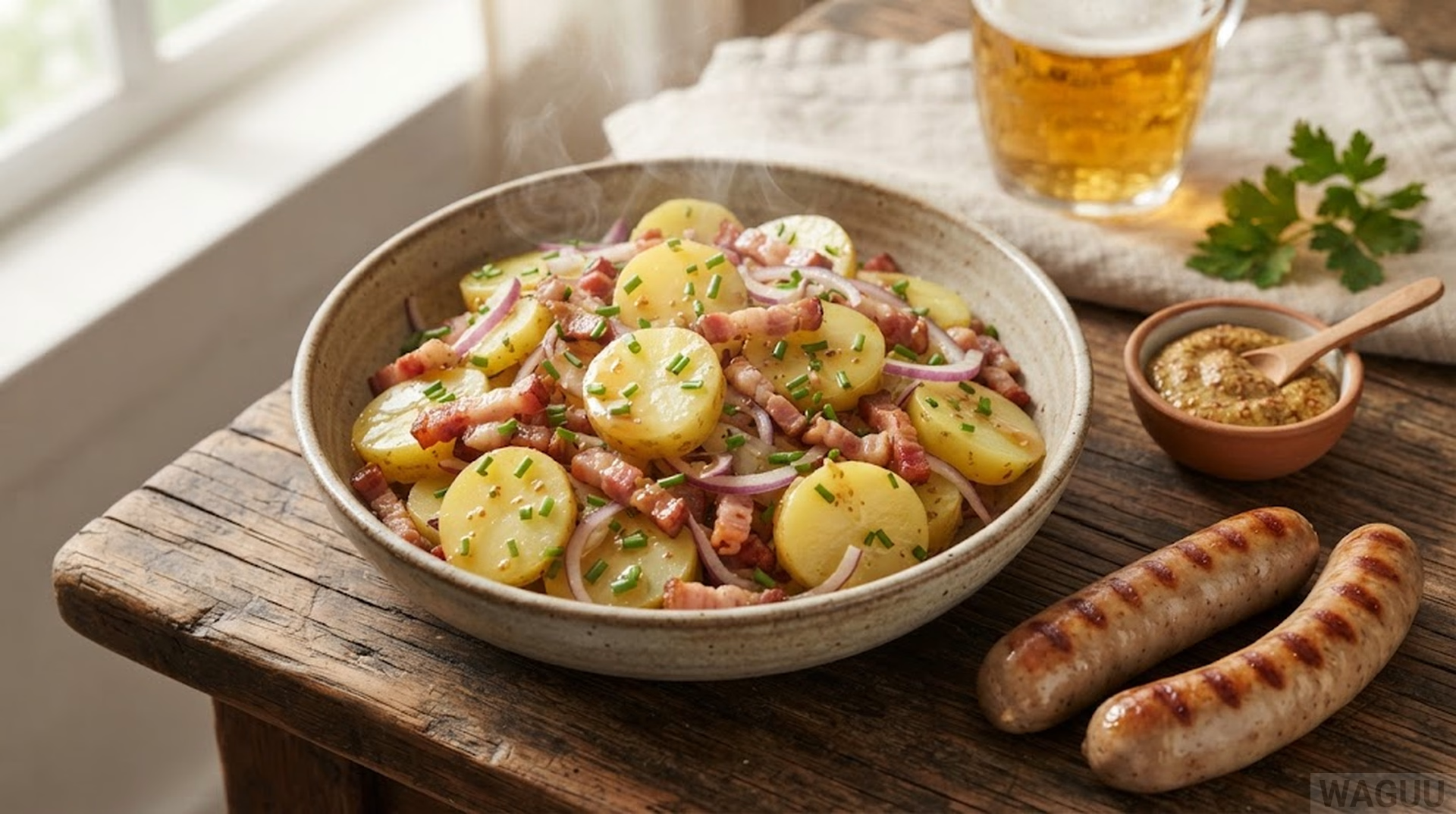
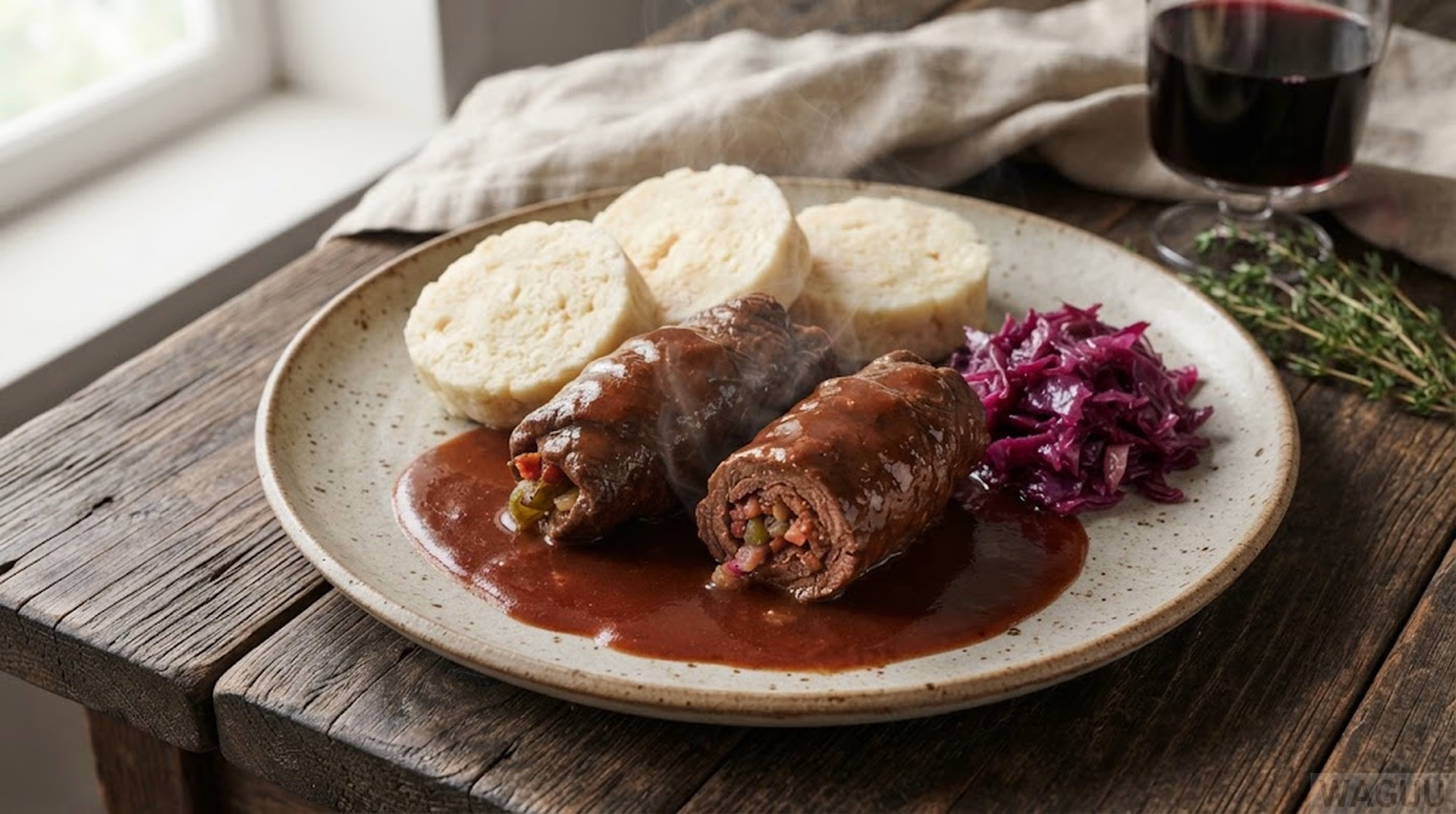
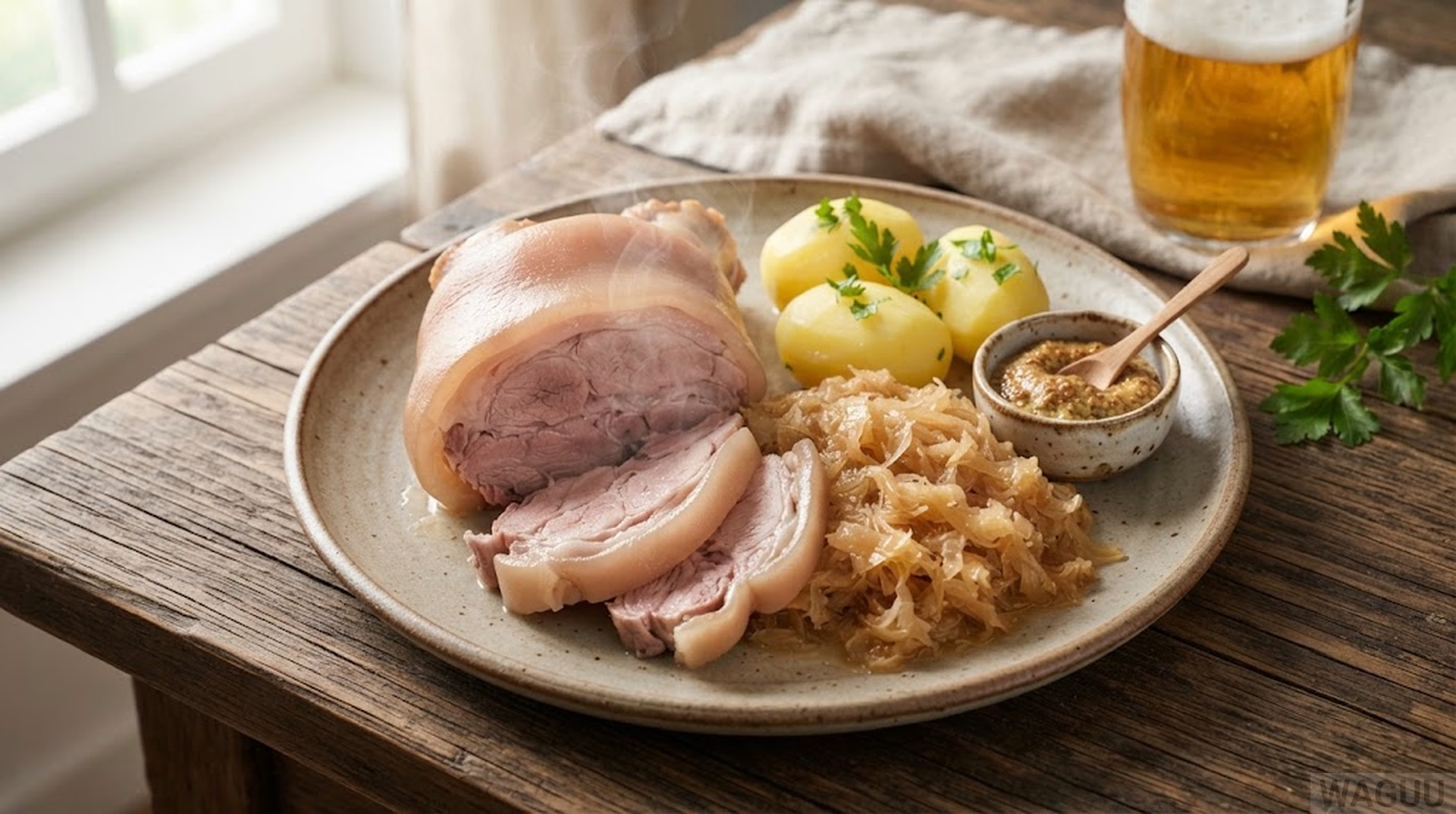
German cooking is far more than bratwurst and sauerkraut. It is a broad culinary tradition stretching from Bavaria to the North Sea, from slow braises to delicate Swabian pasta. This guide covers twelve dishes that define German food – what they are, how they are made, and how to serve them properly at home.
Quick overview
- Topic / Dish: Twelve most famous German dishes
- Category: Articles, American German Cuisine
- Cuisine: German
- Included recipes: Sauerbraten, Schweinshaxe, Bratwurst, Currywurst, Schwäbische Maultaschen, Königsberger Klopse, Eisbein mit Sauerkraut, Rouladen, Kartoffelsalat, Käsespätzle, Flammkuchen, Labskaus
- Key techniques: Marinating, braising, roasting, poaching, pan-frying, pasta making, baking
- Physicochemical background: Acid marinating, collagen conversion, Maillard reactions, starch gelatinization
- Common mistakes: Rushing a Sauerbraten marinade, boiling Schweinshaxe, overcooking Bratwurst, soggy Kartoffelsalat
- In short: German cooking is built on patience, acidity and pork – and it is easy to get right once you know the technique.
- Last updated: September 26, 2026
WAGUU says: “German cooking rewards patience more than skill. If you can wait for a marinade and respect a braise, you can cook half of this list tonight.”
Key facts
| Prep time (varies): | 30–60 min (plus marinating overnight for Sauerbraten) |
| Cooking time (varies): | 30 min – 3 hours |
| Main ingredient: | Beef, pork, potatoes, flour, cabbage |
| Servings: | 6 per recipe |
| Difficulty: | Easy to medium |
Method at a glance
- Choose one dish and read the recipe carefully.
- Prepare all ingredients in advance (mise en place).
- Marinate, braise, roast or boil according to the technique.
- Prepare the traditional side dish (dumplings, potatoes, cabbage, bread).
- Rest, slice and serve – German food is served hot and generous.
In a nutshell
- Honest ingredients: Pork, beef, potatoes, cabbage, flour and butter – nothing exotic.
- Long cooking: Most German classics are built on slow braising or roasting.
- Acid and salt: Vinegar, sauerkraut, mustard and pickles are structural, not decorative.
- Regional diversity: Bavaria cooks differently from the Rhineland and the North.
- Bread and dumplings: German cuisine is unthinkable without them.
- Result: Deep, warming, satisfying food that does not need to be modernized to be excellent.
Who this guide is for: Beginner – start with Bratwurst, Currywurst or Kartoffelsalat. Intermediate – Sauerbraten, Rouladen and Königsberger Klopse will teach you braising and sauce work. Advanced – Schwäbische Maultaschen, Käsespätzle and Sauerbraten from scratch will test your precision.
The twelve dishes in detail
Each of the following twelve dishes is presented in two ways: first as a short overview here, and then as a full recipe in the “Choose your recipe” section. The description below tells you what it is, what makes it distinctive, and how it fits into German cooking.
If you are new to German food, read the descriptions in order. The first three dishes (Sauerbraten, Schweinshaxe, Bratwurst) are the ones most Americans recognize. The next group (Currywurst, Maultaschen, Königsberger Klopse) shows the country’s regional diversity. The final group (Eisbein, Rouladen, Kartoffelsalat, Käsespätzle, Flammkuchen, Labskaus) is a mix of northern, western and southern traditions that together form the German table.
1. Sauerbraten – the marinated beef roast
Sauerbraten is Germany’s national roast. A piece of beef – traditionally top round, bottom round or chuck – is marinated for two to four days in a mixture of vinegar, water, red wine and aromatics (juniper, cloves, bay, peppercorns, onion, carrot). The long acid soak tenderizes the meat and gives it its characteristic sour-sweet flavor. It is then dried, seared and braised slowly in the strained marinade, finished with a roux, gingersnap cookies or dark chocolate, and served with red cabbage and potato dumplings.
The dish exists in several regional versions: the Rhineland version is sourer, the Swabian version adds raisins, and some families finish it with a spoonful of beet syrup for a deeper color. The important thing is the balance between acid, sweetness and the deep beefy flavor of the roast. Sauerbraten is not difficult, but it refuses to be rushed.
Serve it sliced (about ½ inch thick) on a warm plate, with the sauce spooned over, a spoonful of red cabbage on the side and one or two dumplings. Beer or a dry Riesling works well; a glass of cold apple juice is the classic non-alcoholic pairing.
2. Schweinshaxe – the Bavarian pork knuckle
Schweinshaxe is the roast pork knuckle that most visitors associate with Bavarian beer halls. The knuckle (front or rear) is scored, rubbed with salt, caraway and garlic, and roasted slowly until the skin is dark, crisp and crackling-like while the meat inside stays juicy and pulls cleanly off the bone.
The technique is simple but demands attention: start the knuckle in a hot oven (400 °F) to set the skin, then lower the temperature (325 °F) and roast for two to two and a half hours, basting occasionally with beer or stock. The last fifteen minutes are at high heat (425 °F) to finish the crackling. If the skin softens, the whole dish loses its point.
Serve with potato dumplings, sauerkraut and a dark beer. In Bavaria, Schweinshaxe is often eaten directly from the bone, with mustard on the side.
3. Bratwurst – the German sausage
Bratwurst is not one sausage but a family of sausages that differ by region: the coarse Thuringian bratwurst, the fine Nuremberg bratwurst (small, marjoram-scented), and the long, thin Franconian versions. The base is pork, sometimes with veal, seasoned with salt, pepper, marjoram, caraway and sometimes nutmeg or lemon zest, filled into natural casings.
Bratwurst can be grilled, pan-fried or cooked directly in a broth. The essential rule is gentle heat: a bratwurst that bursts loses its juices. Cook it over medium heat for eight to twelve minutes, turning often, until it is evenly browned and just cooked through.
Serve with a hard roll, sweet mustard, and either potato salad or sauerkraut. A wheat beer or a light lager is the standard drink.
4. Currywurst – the Berlin street classic
Currywurst was invented in Berlin after World War II and has since become the most recognizable German street food. A pork sausage (usually a fine, skinless bratwurst) is pan-fried or grilled, sliced into bite-sized pieces, and covered with a warm tomato sauce seasoned with curry powder, paprika, a touch of sugar and vinegar. It is served with a wooden fork, a bread roll and fries.
The sauce is the heart of the dish. A good Currywurst sauce is not ketchup – it is a cooked sauce built from tomato passata, onion, curry powder, paprika, Worcestershire sauce, a little sugar and vinegar. The balance is sweet-sour-spicy, with the curry powder toasted briefly to wake up its aroma.
Serve it in a shallow bowl or on a paper plate, with fries, a bread roll and a cold beer.
5. Schwäbische Maultaschen – Swabian stuffed pasta
Maultaschen are large, rectangular pasta pockets from Swabia, filled with a mixture of ground meat, spinach, bread soaked in milk, onion, parsley and nutmeg. The pasta dough is similar to Italian egg pasta: flour, eggs, a pinch of salt and a little water. The pockets are about the size of a palm, sealed on all sides, and either poached in broth or sliced and pan-fried in butter with onions.
The dish has a famous legend: Cistercian monks are said to have hidden meat inside the pasta during Lent, when meat was forbidden. Whether true or not, it captures the spirit of the dish – a hearty meal wrapped in a thin, delicate dough.
Serve them in a clear beef broth, or sliced and fried in butter with onions on top. A green salad and a glass of Trollinger or a light beer complete the meal.
6. Königsberger Klopse – meatballs in caper sauce
Königsberger Klopse (named after the former East Prussian city of Königsberg) are poached veal or pork meatballs served in a pale, creamy sauce with capers and lemon. The meatballs are light, bound with bread soaked in milk, egg and a little onion, and gently poached in salted water or broth so they stay tender.
The sauce is a velouté or light roux-based sauce, enriched with cream, a squeeze of lemon and a handful of capers. Some versions add a splash of white wine and a little anchovy for depth. The dish is traditionally served with boiled potatoes or mashed potatoes and a beetroot salad.
Königsberger Klopse is a good example of how German cooking uses acid and salt carefully – the capers and lemon are not optional, they are the point.
7. Eisbein mit Sauerkraut – pork knuckle with sauerkraut
Eisbein is the northern counterpart to Schweinshaxe: instead of roasting, the pork knuckle is boiled or slowly simmered with root vegetables, bay leaves, peppercorns and juniper, then served with sauerkraut and boiled potatoes or pea purée. The meat becomes soft and almost spoon-tender; the skin stays on and is served in slices.
In Berlin, Eisbein is usually accompanied by pease pudding and a mustard sauce; in other parts of northern Germany, sauerkraut and boiled potatoes are more common. The dish is traditionally winter food, served with a cold beer or a shot of clear schnapps.
Eisbein is often confused with Schweinshaxe, but the technique is different: Schweinshaxe is roasted and crisp, Eisbein is poached and soft. Both are worth cooking.
8. Rouladen – German beef rolls
Rouladen are thin slices of beef rolled around a filling of bacon, onion, mustard and dill pickle (sometimes with a piece of carrot or a little sausage), then pinned with a toothpick or tied with string and braised in a red wine or beef stock sauce until tender.
The technique is straightforward but delicate: you need thin, even slices (about ¼ inch), a firm roll, and a slow braise. The sauce is usually finished with a little cream or sour cream and sometimes a spoonful of redcurrant jelly. Rouladen are traditionally served with potato dumplings, red cabbage and the sauce from the pan.
Rouladen is a Sunday dish in most German families – it is not difficult, but it takes time and attention.
9. Kartoffelsalat – German potato salad
Kartoffelsalat is not one dish but two main traditions. In southern Germany, the salad is made with a warm broth-and-vinegar dressing, sliced waxy potatoes, onion and sometimes a little mustard; in the north, mayonnaise and boiled eggs are more common. Both versions are served as a side dish, but they taste completely different.
The southern version is essentially a warm potato salad: boiled waxy potatoes are sliced while still warm, then dressed with hot beef or vegetable stock, vinegar, oil, mustard, onion and seasoning. The potatoes absorb the dressing and become soft but not mushy. The northern version is made from cooled potatoes, mayonnaise, yogurt, mustard, onion and boiled egg.
Serve it as a side dish for Bratwurst, Schnitzel or any roast meat, and also on its own with a bread roll.
10. Käsespätzle – Swabian cheese noodles
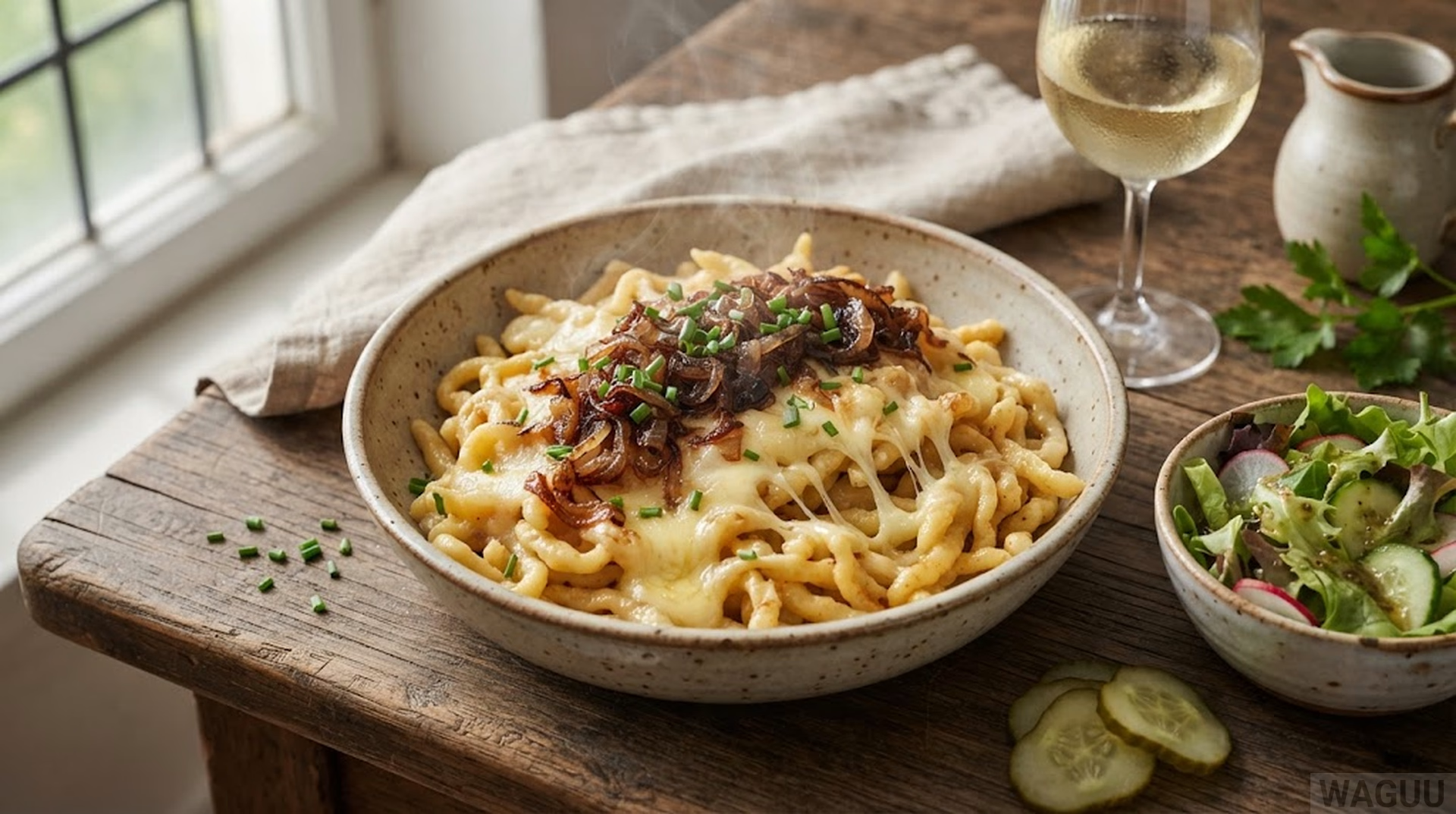
Käsespätzle is the German answer to macaroni and cheese: small egg noodles (Spätzle) layered with grated cheese (usually Emmental or Bergkäse) and fried onions, then baked briefly or served directly from the pan. The noodles are made from a soft dough of flour, eggs, salt and a little water, either scraped from a board or pressed through a Spätzle press.
The dish is a staple in Swabia and in the Allgäu, and it appears on almost every regional menu. Käsespätzle are usually topped with roasted onions and served with a green salad; a light beer or a glass of apple juice is the standard drink.
Käsespätzle is easy to make and very hard to make badly – but you need the right cheese and a firm but soft dough.
11. Flammkuchen – the Alsatian flatbread
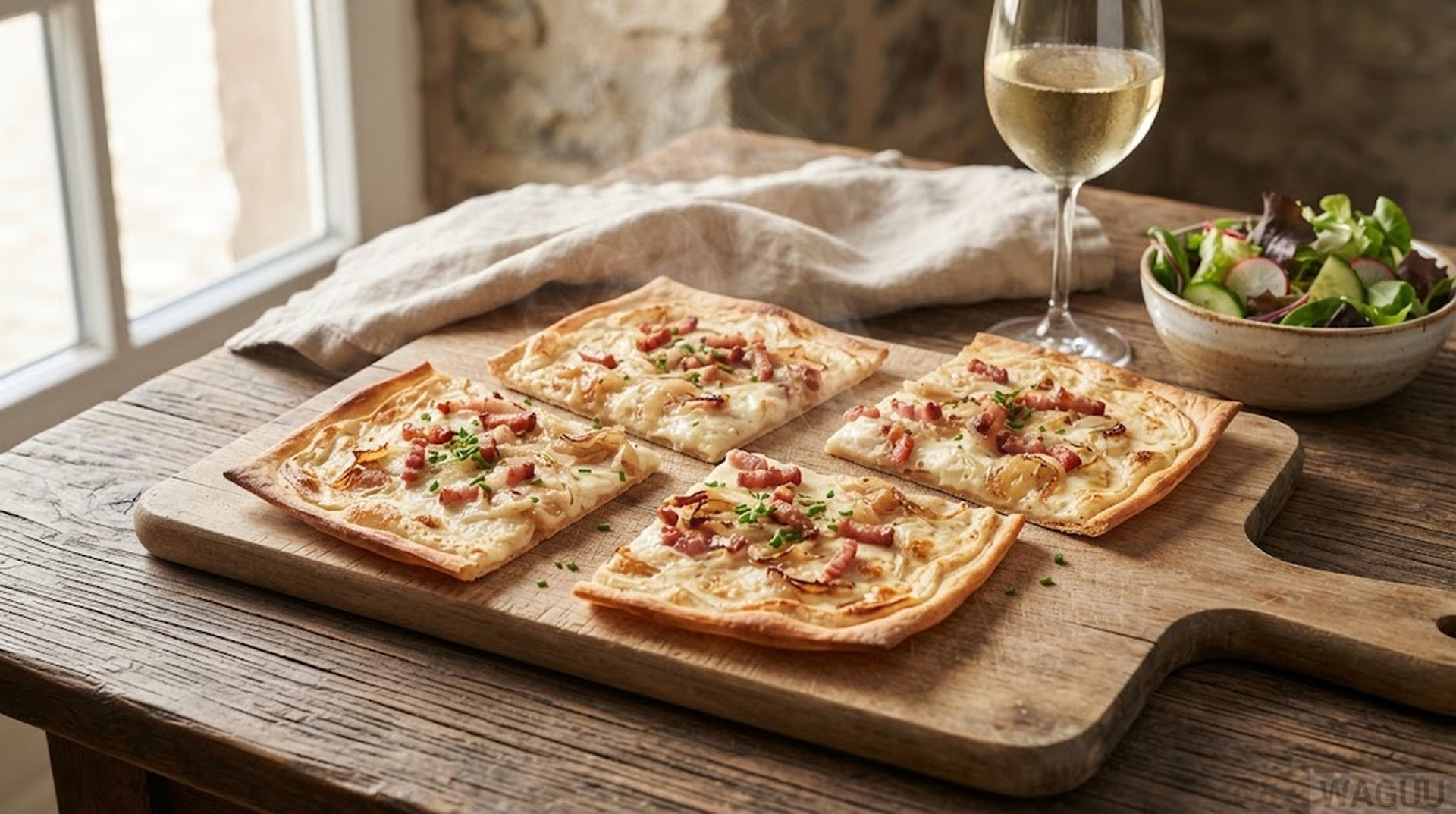
Flammkuchen is a thin, crisp flatbread from Alsace and south-western Germany, made from a simple dough of flour, water, oil and salt, topped with crème fraîche or sour cream, thin slices of onion and small pieces of bacon. It is baked at very high heat (480 °F) for only a few minutes, until the edges are blistered and the base is crisp.
The dish is traditionally eaten with a glass of Riesling or a light beer, and is often served as a starter or a light main course. Modern versions add mushrooms, cheese, pumpkin or even fruit, but the classic version – crème fraîche, onion, bacon – is still the best.
Flammkuchen is best made in a very hot oven, ideally on a pizza stone or steel. The dough is rolled very thin and the toppings are used sparingly.
12. Labskaus – the northern sailor’s dish
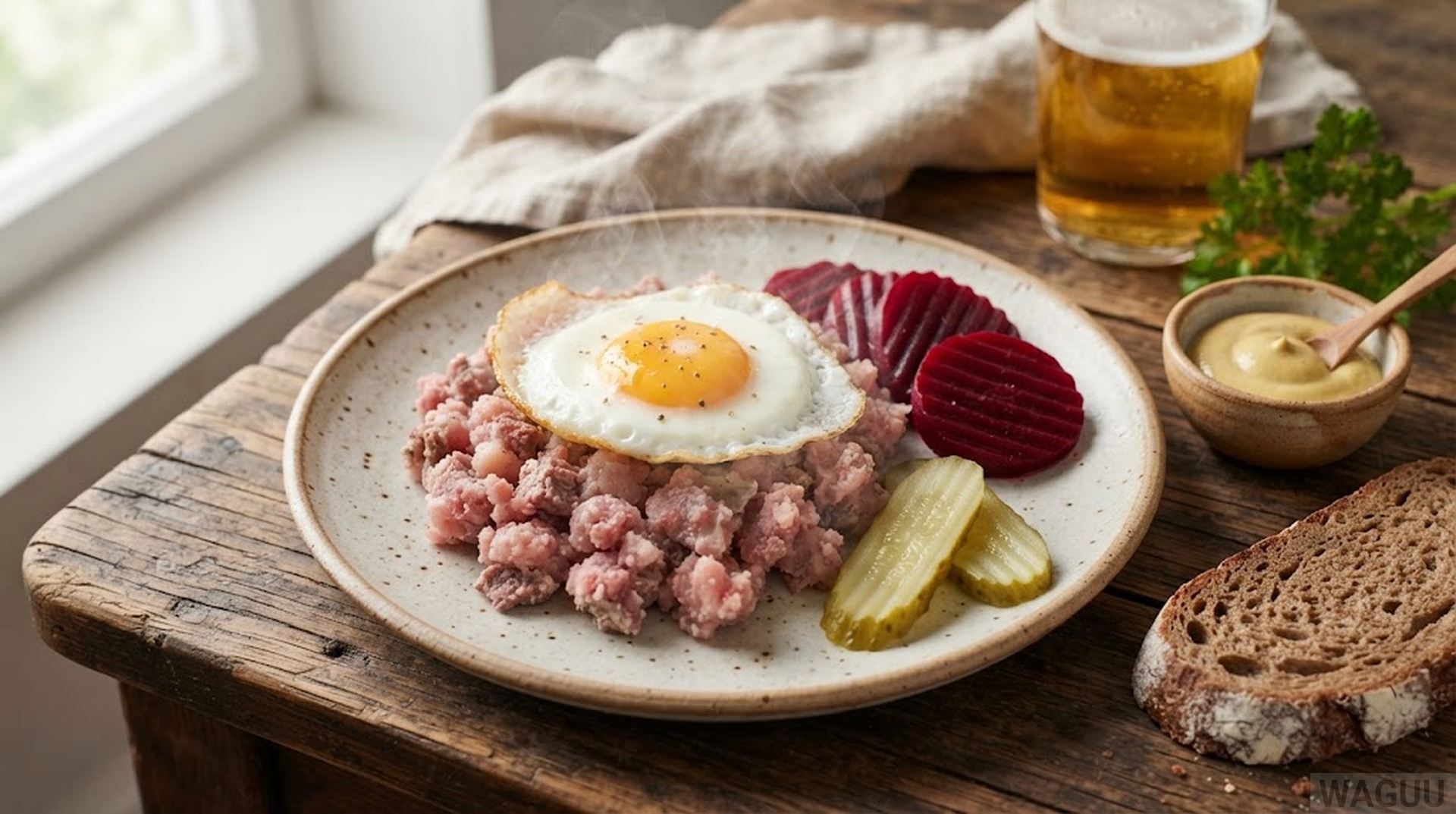
Labskaus is a northern German dish of mashed potatoes, salted or corned beef, onion and sometimes beetroot, all cooked together into a pink, thick mash. It is served with a fried egg on top, a pickled cucumber or herring on the side, and often a beetroot salad. It looks unusual but tastes excellent – the combination of salt beef, potato and beetroot is deeply savory and slightly sweet.
The dish originated as sailor food in the 18th and 19th centuries, when ships carried salted meat, potatoes and preserved beetroot. It is now a Hamburg and Bremen specialty, eaten mostly in winter, and served with a cold beer.
Labskaus is not for everyone, but it is one of the most distinctive dishes in German cooking. If you like corned beef hash and beetroot, you will enjoy this.
| Dish | Region | Main technique |
|---|---|---|
| Sauerbraten | Rhineland, Swabia | Marinating and braising |
| Schweinshaxe | Bavaria | Slow roasting |
| Bratwurst | Thuringia, Franconia, Nuremberg | Grilling or pan-frying |
| Currywurst | Berlin | Pan-frying and sauce making |
| Schwäbische Maultaschen | Swabia | Pasta making and poaching |
| Königsberger Klopse | East Prussia | Poaching and sauce work |
| Eisbein mit Sauerkraut | Berlin, Northern Germany | Poaching |
| Rouladen | Nationwide | Rolling and braising |
| Kartoffelsalat | South (broth) vs. North (mayo) | Boiling and dressing |
| Käsespätzle | Swabia, Allgäu | Noodle making and baking |
| Flammkuchen | Alsace, Rhineland | High-heat baking |
| Labskaus | Hamburg, Bremen | Mashing and mixing |
WAGUU Pro Tip: If you want to cook two or three of these dishes in one week, start with Kartoffelsalat and Bratwurst on day one, Sauerbraten on day three (marinate from day one), and finish with Maultaschen or Käsespätzle. The marinade and the braise do most of the work; you just need to plan ahead.
Frequently asked questions
What is the single most iconic German dish?
Sauerbraten is widely considered the national dish, but Schweinshaxe and Bratwurst are just as recognizable outside Germany. If you are new to German food, start with Bratwurst and Kartoffelsalat.
Do I need special equipment?
No. A heavy Dutch oven with a lid, a large skillet and a baking sheet cover almost every recipe on this list. For Maultaschen and Spätzle you will need a rolling pin and either a Spätzle press or a board and scraper.
How long does Sauerbraten really need to marinate?
Two to four days in the fridge, turning once a day. Two days is the minimum for a noticeable sourness; four days gives a deeper, more traditional flavor. Less than 24 hours and the dish is closer to a normal pot roast.
Can I make these dishes ahead of time?
Sauerbraten, Rouladen, Königsberger Klopse and Eisbein all improve if made a day ahead and gently reheated. Kartoffelsalat (southern version) is best served warm, but the northern version improves after a few hours in the fridge.
Also known as: German cuisine classics, traditional German food, Bavarian and Swabian cooking
Author: WAGUU Petr & Team • Published: 28 Sep 2026
Conclusion
German cooking does not need modernizing to be excellent. It is honest, slow, seasonal and regional, built on ingredients that have been available in central Europe for centuries. The twelve dishes in this guide cover the full range – from the festive Sauerbraten to the street-food simplicity of Currywurst, from the sailor’s Labskaus to the Swabian Maultaschen. Pick one, cook it carefully, and you will understand why these dishes have lasted.
Choose your recipe
Each dish below is a full recipe with detailed method, key facts, nutritional profile and FAQ. Pick one and start cooking.
Sauerbraten – Marinated beef roast braised in aromatic sauce with red cabbage and dumplings.
Schweinshaxe – Bavarian roast pork knuckle with crisp crackling skin.
Bratwurst – German grilled sausage with mustard, bread and potato salad.
Currywurst – Berlin street-food classic with tomato-curry sauce.
Schwäbische Maultaschen – Swabian stuffed pasta pockets in broth or pan-fried.
Königsberger Klopse – Poached meatballs in caper cream sauce.
Eisbein mit Sauerkraut – Poached pork knuckle with sauerkraut and potatoes.
Rouladen – German beef rolls with bacon, onion and pickle.
Kartoffelsalat – German potato salad, two regional versions.
Käsespätzle – Swabian egg noodles with melted cheese and onions.
Flammkuchen – Thin Alsatian flatbread with crème fraîche, onion and bacon.
Labskaus – Northern German mash of potato, salted beef and beetroot.
Other possible variations
Sauerbraten with gingersnap sauce
A Rhineland variation that uses crumbled gingersnap cookies instead of a flour roux to thicken the sauce. The cookies add sweetness, spice and a darker color. Suitable for anyone who wants a richer, sweeter sauce. The main ingredients stay the same – beef, vinegar, wine, root vegetables – but the finish is different.
Schweinshaxe in dark beer
A Bavarian variant where the knuckle is basted with dark beer (Dunkelbier) during the last hour of roasting. The beer caramelizes on the skin and deepens the flavor of the meat. Suitable for anyone who already likes Schweinshaxe and wants a more aromatic version.
Nuremberg bratwurst
A smaller, finer sausage from Nuremberg, seasoned with marjoram and served three or six to a portion on a pewter plate with sauerkraut or potato salad. The flavor is more delicate than a Thuringian bratwurst, and the sausages cook in about six to eight minutes.
Currywurst with homemade fries
The classic Berlin combination: a sliced Currywurst with thick-cut fries (Pommes) and a bread roll. The sauce is the same as the base recipe, but the fries replace the usual bread-only serving. Suitable for anyone who wants a full meal rather than a snack.
Maultaschen fried in butter with onions
Instead of serving the Maultaschen in broth, slice them into thick strips and fry them in foaming butter with sliced onion until golden. This is the “geröstet” version, and it is often served with a green salad. Suitable for anyone who prefers their pasta crisp rather than soft.
Königsberger Klopse with dill
A variation from the Baltic coast where fresh dill is added to the sauce alongside the capers. The dill brings a fresh, slightly anise-like note that works well with the lemon and cream. Suitable for anyone who likes a lighter, herbier sauce.
Eisbein with pease pudding
The classic Berlin version: boiled pork knuckle served with a thick purée of yellow split peas (Erbspüree), mustard sauce and boiled potatoes. The pease pudding adds a soft, slightly sweet contrast to the salty meat. Suitable for anyone who wants the full Berlin experience.
Rouladen with red wine and cream
A variation where the braising liquid is red wine and beef stock, finished with a spoonful of sour cream and a little redcurrant jelly. The sauce becomes richer and glossier. Suitable for anyone who wants a more festive version of the dish.
Kartoffelsalat, northern mayonnaise version
The northern German version uses cooled waxy potatoes, mayonnaise, yogurt, mustard, onion, hard-boiled egg and a little pickle. It is creamier and colder than the southern broth-based version. Suitable for anyone who prefers a classic “deli-style” potato salad.
Käsespätzle with bacon
A Swabian variation that adds small pieces of fried bacon (Speck) between the layers of Spätzle and cheese. The bacon adds salt and smoke; the dish becomes richer and heartier. Suitable for anyone who does not want a vegetarian version.
Flammkuchen with mushrooms and cheese
A modern variation that replaces the bacon with sliced mushrooms and a mild cheese (such as Gruyère or Emmental). The dish becomes vegetarian and slightly more substantial. Suitable for anyone who wants a meat-free version without losing the character of the dish.
Labskaus with fried herring
The full Hamburg version, served with a fried or pickled herring fillet on top of the Labskaus alongside the fried egg. The herring adds a briny, slightly acidic note that cuts through the richness of the mash. Suitable for anyone who likes fish and wants the authentic experience.
Know another variation? Add your own suggestion below.
Missing a recipe?
Tell us what recipe you would like us to add. We will do our best to publish it soon!
Frequently asked questions about other variations
- Can I use a slow cooker for Sauerbraten? Yes, but brown the meat first and reduce the sauce on the stovetop at the end. Slow cookers do not develop the Maillard flavor that the initial sear gives.
- What is the difference between Schweinshaxe and Eisbein? Schweinshaxe is roasted and crisp; Eisbein is poached and soft. Same cut of meat, completely different technique and result.
- Can I make Bratwurst without a casing? Yes, but the texture will be different. The casing keeps the juices in and gives the sausage its snap. If you cannot find natural casings, shape the meat into small patties and fry them.
- Is Currywurst always pork? Traditionally yes, but some modern versions use veal or a mix. The sauce is what defines the dish, not the meat.
- Do I need a pasta machine for Maultaschen? No. A rolling pin and a sharp knife are enough. The dough should be thin but strong enough to hold the filling.
- Can I freeze Königsberger Klopse? The meatballs freeze well; the sauce is best made fresh. Freeze the meatballs for up to two months, thaw overnight and reheat in fresh sauce.
- How do I make a crisp Schweinshaxe skin? Dry the skin thoroughly, score it, salt it and start the roasting at high heat. The last fifteen minutes at 425 °F finish the crackling.
- Is Kartoffelsalat served warm or cold? The southern version is warm; the northern version is cold. Both are correct – it depends on the region.
Contact: 12-most-famous-german-dishes-traditional-recipes-us@waguu.online