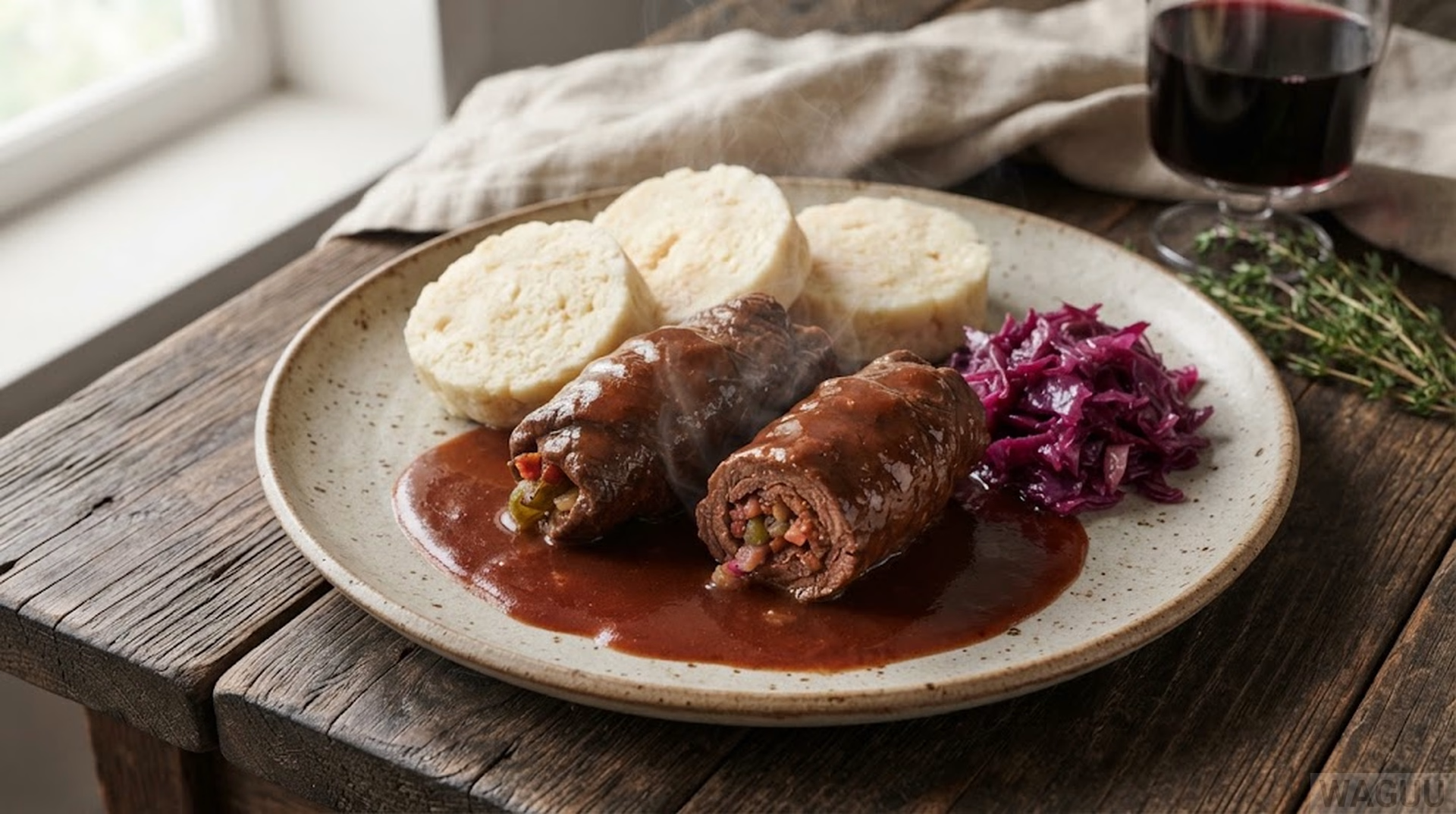
Summary: Thin beef slices rolled around bacon, onion, mustard and dill pickle, braised in red wine sauce. Serves 6, ready in about 2.5 hours.
Cooked this recipe? Share the result with the community.
Category: American Beef, American German Cuisine
Success rate: not rated yet % of users managed this recipe
Quick overview
- Dish: Rouladen – German Beef Rolls with Bacon and Pickle
- Category: American Beef, American German Cuisine
- Cuisine: German (nationwide)
- Main ingredient: Beef top round, 12 thin slices (about 2.6 lb total)
- Guide: 12 Most Famous German Dishes
- Total time: 150 minutes (30 min prep + 120 min cooking)
- Difficulty: Medium
- Servings: 6 (portion weight: 8.8 oz)
- Key technique: Rolling and braising
- Preparation types: Braising, pan-searing
- Dietary info & allergens: Contains gluten, mustard, sulfites, celery
- Suitable for: Sunday lunch, festive menu, family celebration
- Nutrition (per portion): 520 kcal, Protein: 44 g, Fat: 30 g, Carbohydrates: 12 g
- Storage: 4 days in the fridge, 3 months in the freezer
- Pairing: Dry Riesling, Pinot Noir, apple cider
- In short: Thin beef rolls filled with bacon, onion, mustard and pickle, braised in red wine until tender.
- Last updated: September 26, 2026
WAGUU says: “Rouladen is the dish that teaches you patience. Roll them tight, braise them slow, and the sauce rewards you.”
Key facts
| Prep time: | 30 min |
| Cook time: | 2 hours |
| Temperature: | 325 °F oven |
| Servings: | 6 |
At a glance
Twelve thin slices of beef top round, each spread with mustard, topped with bacon, chopped onion and a strip of dill pickle, then rolled, pinned with toothpicks and seared. Braised slowly in red wine with root vegetables until the meat is fork-tender, then finished with a glossy sauce. Served with potato dumplings, red cabbage and a spoonful of the sauce.
Ingredients
Base servings: 6 • Portion weight: 8.8 oz
| Ingredient | Amount | Quality |
|---|---|---|
| Beef top round | 2.6 lb | 12 thin slices, about ¼ inch thick |
| Dijon mustard | ¼ cup | for spreading |
| Streaky bacon | 6.3 oz | 12 thin slices |
| Yellow onions | 3 pcs | finely chopped |
| Dill pickles | 4 pcs | cut into 12 strips |
| Kosher salt | 1 ½ tsp | |
| Black pepper | ¾ tsp | freshly ground |
| Beef tallow | 3 tbsp | for searing |
| Carrots | 2 pcs | roughly chopped |
| Celery root | 5.3 oz | peeled, cubed |
| Dry red wine | 1 ⅔ cups | Pinot Noir or similar |
| Beef stock | 2 ½ cups | |
| Bay leaves | 3 pcs | dried |
| All-purpose flour | ¼ cup | for the roux |
| Sour cream | ½ cup | to finish the sauce |
| Redcurrant jelly | 1 tbsp | to balance the sauce |
Why you will love this recipe
- Rich and comforting: The combination of beef, bacon, mustard and pickle is deeply savory.
- Better the next day: The flavor deepens overnight and the sauce thickens.
- Freezer-friendly: Freeze the rolls in the sauce and reheat for a quick meal.
Why it works: The thin slices of beef cook quickly and stay tender, while the filling – bacon, onion, mustard and pickle – provides salt, fat, acidity and sweetness in every bite. The long braise at 325 °F converts collagen into gelatin, giving the sauce its body. The sour cream and redcurrant jelly at the end balance the wine’s acidity and add richness.
Recipe overview
Prep: 30 min | Cook: 120 min | Difficulty: Medium | Servings: 6 | Type: Main course | Origin: German
Detailed method
Overall progress: 0 % done
Phase 1: Preparing the rolls – 20 min
Equipment: Chopping board, sharp knife, toothpicks or kitchen string
1. Lay the beef slices flat on a board. Season lightly with salt and pepper. Spread each slice with a thin layer of mustard, then lay a slice of bacon on top. Sprinkle with chopped onion and place a strip of dill pickle at one end. Roll each slice tightly, tucking in the sides as you go. Secure with a toothpick or tie with kitchen string.
VKB: The rolls hold their shape and do not unroll when lifted with tongs. The filling is evenly distributed.
Before you continue:
Roll tightly but do not squash. If the rolls are too loose they will fall apart during braising; if too tight, the filling will squeeze out.
Phase 2: Searing – 15 min
Equipment: Heavy Dutch oven with lid
2. Heat the beef tallow in a heavy Dutch oven over medium-high heat. Sear the rouladen on all sides until deep brown, about 2–3 minutes per side. Work in batches – do not crowd the pan. Remove and set aside on a plate.
VKB: Each roll is dark brown on all sides. The bottom of the pan has a brown glaze (fond), not black burnt bits.
Before you continue:
Do not move the rolls while searing. If you move them too soon, the meat will tear. Wait for them to release naturally from the pan.
Phase 3: Braising – 100 min
Equipment: Same Dutch oven, oven at 325 °F
3. Add the chopped carrot and celery root to the Dutch oven and sauté for 4–5 minutes. Pour in the red wine and scrape the bottom of the pan to release the browned bits. Add the beef stock and bay leaves. Return the rouladen to the Dutch oven, cover with the lid and transfer to the oven. Braise at 325 °F for 1 hour 40 minutes, turning the rolls once halfway through.
VKB: The meat is fork-tender – a fork slides in with almost no resistance. The sauce has reduced and darkened.
Before you continue:
Do not open the oven more than once during braising. Every time you open the door, the temperature drops and the cooking time extends.
Phase 4: Finishing the sauce – 10 min
Equipment: Small saucepan, whisk, sieve
4. Remove the rouladen from the Dutch oven, cover loosely with foil and rest for 10 minutes. Strain the cooking liquid through a sieve into a saucepan, pressing the vegetables to extract all the flavor. Whisk in the flour (or make a small roux with 2 tbsp butter and ¼ cup flour in a separate pan and whisk into the liquid). Simmer for 5 minutes. Stir in the sour cream and redcurrant jelly, then season with salt and pepper.
VKB: The sauce is glossy, coats the back of a spoon and tastes balanced – rich, slightly sweet, with a hint of red wine.
Phase 5: Serving – 10 min
Equipment: Warm plates, sharp knife
5. Remove the toothpicks or string from the rouladen. Place two rolls on each warm plate, spoon the sauce over and serve with potato dumplings and red cabbage.
VKB: The rolls hold together when sliced. The sauce is glossy and coats the meat evenly.
Required equipment
| Item | Ideal size | Alternative | Risk |
|---|---|---|---|
| Heavy Dutch oven with lid | 5 qt, oven-safe to 400 °F | Deep roasting pan with foil | Thin pans scorch the sauce on the bottom |
| Chopping board | Large, flat | Large plate | Small board makes rolling harder |
| Toothpicks or kitchen string | 12 pieces | Skewers cut in half | Rolls unrolling during cooking |
Shopping list
Nutritional profile
Values per 1 portion (without side dish). Calculated from average nutritional values of the ingredients.
| Nutrient | Per 100 g | Per portion | Per 6 portions |
|---|---|---|---|
| Energy | 208 kcal | 520 kcal | 3120 kcal |
| Fat | 12 g | 30 g | 180 g |
| of which saturates | 5.2 g | 13 g | 78 g |
| Carbohydrates | 4.8 g | 12 g | 72 g |
| of which sugars | 2 g | 5 g | 30 g |
| Protein | 17.6 g | 44 g | 264 g |
| Salt | 0.7 g | 1.75 g | 10.5 g |
Reference intake of an average adult (8400 kJ / 2000 kcal).
WAGUU Pro level
- Pro standard: Verified recipe with precise ratios and visual control points.
- Tip 1: Ask your butcher to cut the beef into thin rouladen slices – they will do it more evenly than you can at home.
- Tip 2: Use a mixture of Dijon and German sweet mustard (or a mild mustard) – the Dijon gives heat, the sweet mustard gives depth.
- Tip 3: If the sauce tastes too sharp at the end, add more redcurrant jelly. If it tastes too sweet, add a splash of red wine vinegar.
- Tip 4: Rouladen are better the next day. Cool them in the sauce overnight, then slice them cold and reheat gently in the sauce.
Scientific background
Braising is a combination of dry and moist heat. The initial sear produces Maillard reactions, which create the browned flavor compounds on the surface of the meat. The long braise at a gentle temperature (around 200 °F) then converts the collagen in the beef into gelatin, which gives the meat its tenderness and the sauce its body. The wine’s acidity and the pickled cucumber help balance the richness of the bacon and beef.
Fine dining – professional techniques
- Plate composition: Two rouladen on a warm plate, sliced on the diagonal, sauce spooned over, potato dumplings to one side and red cabbage to the other.
- Texture contrasts: The soft meat against the firm dumpling and the slightly crunchy cabbage.
- Temperature contrast: Everything served hot, with a cold beer or Riesling on the side.
- Aromatic additions: A few sprigs of fresh thyme or a strip of orange zest on the plate.
Sensory radar
- Appearance: Dark brown rolls, glossy red-wine sauce, red cabbage and pale dumplings.
- Aroma: Red wine, bay, bacon and a hint of mustard.
- Taste: Rich, savory, slightly sour from the pickle, with a long finish.
- Texture: Fork-tender beef, soft filling, velvety sauce.
Pairing
- Beer: A dark lager or a Bavarian dunkel.
- Wine: A dry German Riesling or a light Pinot Noir.
- Non-alcoholic: Cold apple cider or sparkling water with lemon.
Preparation variations
- With red wine and cream: Use 1 ⅔ cups red wine and finish with ½ cup sour cream (as in the base recipe).
- With beer: Replace the red wine with dark beer for a richer, slightly sweeter sauce.
Allergens and dietary information
Contains: gluten, mustard, sulfites, celery, milk • Gluten: contains (flour roux, mustard) • Not suitable for: celiac disease, low-fat diets
Suitable for
Sunday lunch, festive menu, family celebration, meal prep
Substitution catalogue
- Beef top round: Bottom round or sirloin (ask your butcher for thin rouladen slices)
- Streaky bacon: Pancetta or thin rashers of smoked bacon
- Redcurrant jelly: Cranberry sauce or a teaspoon of honey
FAQ
How thin should the beef slices be?
About ¼ inch. If they are too thick, the rolls will be tough; too thin and they will tear when rolling.
Can I use a slow cooker?
Yes. Sear the rolls first, then cook on low for 6–7 hours. Reduce the sauce on the stovetop at the end.
My rouladen unrolled during cooking. What did I do wrong?
Either they were not rolled tightly enough or the toothpicks were not secure. Roll them tight and use two toothpicks per roll if needed.
What is the classic side dish?
Potato dumplings (Kartoffelklöße) and braised red cabbage. In some regions, boiled potatoes or bread dumplings are also served.
WAGUU Petr advises: Cooking for 6 or more?
6–8 people: Two rolls per person is enough as a main course. Make extra sauce. • 10+ people: Sear in batches and braise in a wider casserole (or two pans). Keep the first batch warm in the sauce while the second cooks.
Sides and serving
- Potato dumplings – classic (not part of the recipe)
- Braised red cabbage – traditional (not part of the recipe)
- Boiled potatoes with parsley – lighter option (not part of the recipe)
Serving: Two rolls per portion, sliced on the diagonal, with the sauce spooned over and red cabbage and dumplings on the side.
Storage and reheating
Fridge: 4 days • Freezer: 3 months • Reheating: Reheat gently on the stovetop in the sauce, covered, for 15 minutes. Do not microwave – it toughens the meat.
Author: WAGUU Petr & Team • Published: 28 Sep 2026
More recipes from this article
Guide: 12 Most Famous German Dishes
Other recipes you might enjoy
Why WAGUU?
WAGUU recipes are checked for accuracy of ingredients, methods and nutritional values.
Photo gallery from the process
Community photos: Cook it, photograph it and share the result.
You can upload photos in the comments below or send them by email.
Filmed a video of this recipe? Post a link to YouTube, YouTube Shorts, TikTok, Instagram Reels, Facebook Reels, Pinterest, Vimeo or X (Twitter) in the comments – we will feature it and help your content reach more people.
Common mistakes
- Rolling too loosely: Loose rolls will unroll during braising. Roll tight and secure with two toothpicks if needed.
- Not drying the meat: Wet slices will steam instead of searing. Pat them dry with paper towels before rolling.
- Adding too much liquid: The rouladen should be braised, not boiled. The liquid should come no more than halfway up the rolls.
- Skipping the redcurrant jelly: It balances the wine’s acidity and adds gloss to the sauce. Do not leave it out.