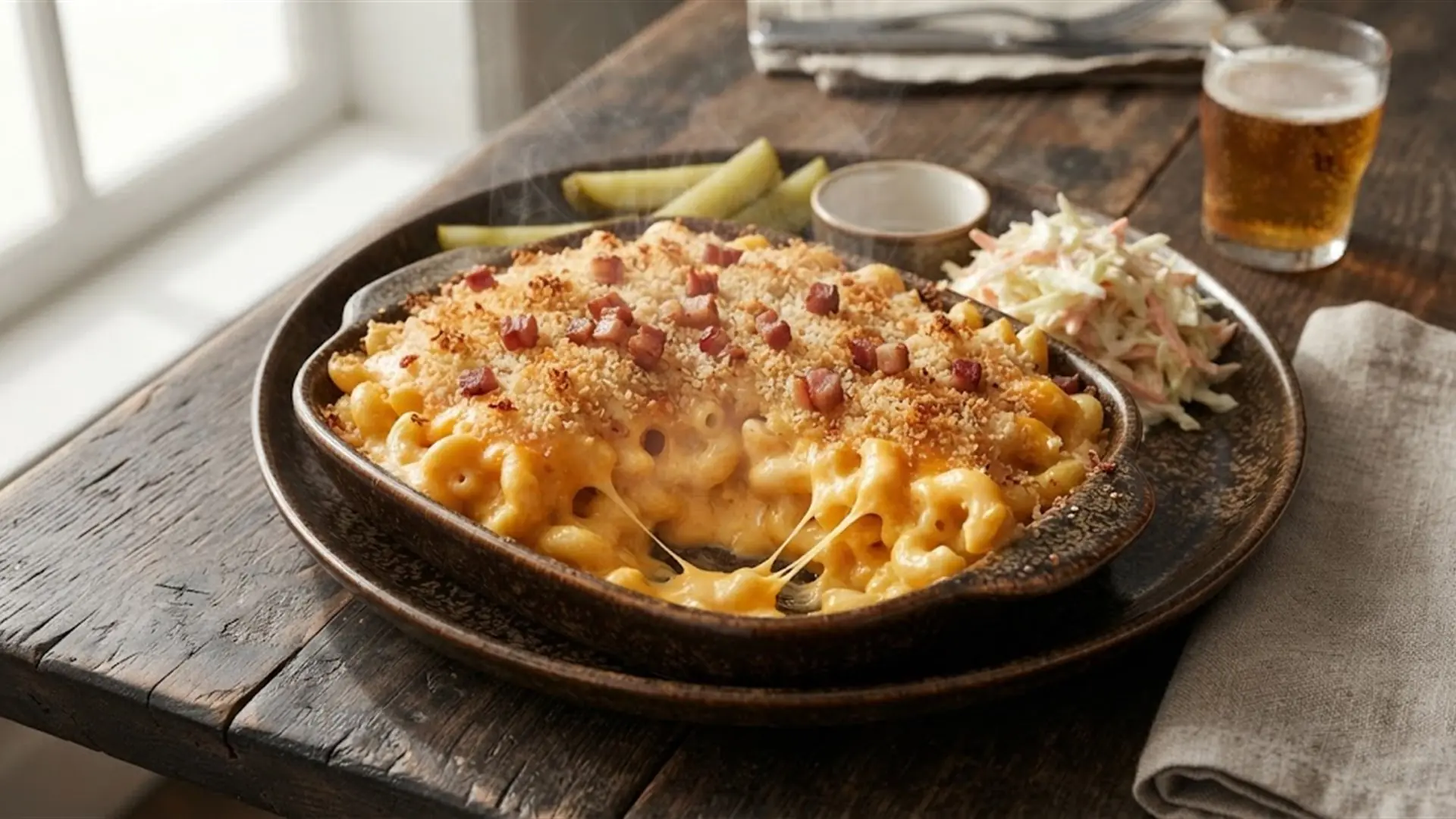
Summary: Short pasta in a thick cheese sauce made from a roux, with two types of cheese and a parmesan and breadcrumb crust. The sauce holds together thanks to the roux and Dijon mustard, and the pasta is cooked just under al dente so it doesn’t go soft in the oven. Total time 47 minutes, makes 6 servings.
Have you cooked this recipe? Share your result with the community.
Category: Pasta, American cuisine
Success rate: not rated yet % of users managed this recipe
Quick overview
- Dish: Mac and Cheese – pasta with a rich cheese sauce, often made with cheddar, baked until golden
- Category: Pasta, American cuisine
- Cuisine: American
- Main ingredient: Short pasta, 500 g
- Guide: 12 most famous American dishes: traditional recipes from American cuisine
- Total time: 47 minutes (18 minutes preparation + 29 minutes cooking)
- Difficulty: Easy
- Servings: 6 (Serving weight: 324 g)
- Key technique: Making a roux and cheese sauce, baking in the oven
- Cooking methods: Classic cooking, gratinating, baking
- Dietary info & Allergens:gluten, sulphites, milk, mustard
- Suitable for: Quick family dinner, lunch for kids, parties, a side dish for meat
- Nutritional values (per 1 serving): 802 kcal, Protein: 35.8 g, Fat: 37.6 g, Carbohydrates: 78.5 g
- Storage: 3 days in the fridge, 2 months in the freezer
- Pairing: Pale lager, dry white wine, homemade lemonade
- In short: Roux, two cheeses and short pasta – three things that decide whether the sauce holds together and whether the pasta stays firm.
WAGUU says: “Cheese sauce doesn’t split because of the cheese, but because of the temperature. If you melt the cheese into the roux off the heat and in batches, it stays smooth even when reheated.”
Key facts
| Preparation time: | 18 minutes |
| Cooking time: | 29 minutes |
| Temperature: | Oven 190 °C, milk heated to 60 °C |
| Number of servings: | 6 (serving weight 324 g) |
At a glance
The base is a roux – butter and flour cooked with milk. The starch from the flour binds the fat and water and creates a network in which the cheese melts without separating into fat and protein. Two types of cheese are no accident: cheddar adds flavour, gouda adds stretch. The pasta is cooked just under al dente because it will soften further in the oven and absorb some of the sauce.
Ingredients
Base servings: 6 servings • Serving weight: 324 g
| Ingredient | Amount | Quality |
|---|---|---|
| short pasta (macaroni) | 500 g | durum semolina, ridged |
| whole milk | 800 ml | fresh, 3.5 % fat |
| cheddar cheese | 250 g | mature, grated |
| gouda cheese | 150 g | young, grated |
| butter | 60 g | 82 %, for the roux |
| plain flour | 45 g | type 450, sifted |
| Dijon mustard | 15 g | smooth, medium hot |
| breadcrumbs | 40 g | finely ground |
| parmesan | 40 g | aged at least 12 months |
| nutmeg | 1 g | freshly grated |
| ground black pepper | 2 g | freshly ground |
| fine sea salt | 4.4 g | for the pasta and the sauce |
| chives | 10 g | fresh, chopped |
Why you’ll love this recipe
- Ready in 47 minutes: The whole dish from one pan and one baking dish, no marinating and no special equipment.
- A sauce that holds: The roux and Dijon mustard stabilise the cheese, so the sauce won’t split even when reheated.
- Exact ratios for 6 servings: 500 g pasta, 400 g cheese and 800 ml milk is enough for six servings of 324 g.
- A beginner can do it: Almost the whole recipe happens in one pan and only temperature and the order of steps matter.
Why it works: A roux of butter and flour binds water and fat into a single network in which the melted cheese disperses into tiny droplets instead of clumping together. When cheese is added to a boiling sauce, the proteins tighten and squeeze out the fat – the sauce splits. That’s why the cheese is added at around 70 °C and in batches. Dijon mustard contains emulsifiers that strengthen this network; it also counteracts the excessive sweetness of the milk and cheese. The pasta is cooked just under al dente because it will absorb more water from the sauce while baking – if it were already soft from the pan, it would turn to mush in the oven.
Recipe overview
Preparation: 18 min | Cooking: 29 min | Difficulty: Easy | Servings: 6 | Type: Main course | Origin: American
Detailed method
Overall progress: 0 % done
Phase 1: Pasta and preparation – 12 min
Equipment: large pot, kitchen scales, grater
4.4 Bring water to the boil in a large pot, salt it and cook the pasta for two minutes less than stated on the packet – just under al dente. Drain the pasta but do not rinse it with water. Meanwhile, grate the cheddar, gouda and parmesan and leave them in bowls off the heat. Preheat the oven to 190 °C.
VKB: The pasta is firm to the bite, still noticeably harder in the centre than when done. All three cheeses are grated in separate bowls and the oven is heated to 190 °C.
Before you move on:
Do not rinse the drained pasta. Water washes away the starch from the surface, which is then missing from the sauce and makes it thin. Just let it drain in the colander.
Phase 2: Roux and milk base – 8 min
Equipment: deep frying pan or wide pot, whisk
2.49 Melt the butter in a deep frying pan over medium heat, sprinkle in the plain flour and whisk for two minutes until the mixture starts to smell fragrant and loses the taste of raw flour. Then gradually pour in the warm milk, stirring constantly to avoid lumps. Cook the base for three minutes until it thickens enough to fall from the whisk in ribbons.
VKB: The base is smooth, lump-free, and coats the back of the whisk. When you lift the whisk, the mixture runs off in wide ribbons and a continuous layer remains on the surface of the whisk.
Before you move on to the next step:
Add the milk warm and in stages. Cold milk added to a hot roux will form lumps that will not whisk out. If lumps do form, strain the base through a fine sieve.
Phase 3: Cheese sauce – 6 min
Equipment: pan, whisk, thermometer
4.4 Take the pan off the heat and let the base cool for two minutes, until the thermometer reads 70 °C. Then stir in the Dijon mustard, nutmeg, ground black pepper and the remaining salt. Add the cheese a handful at a time – cheddar first, then gouda – and stir after each handful until it has melted. Finally, stir in the drained pasta.
VKB: The sauce is smooth and glossy, with no visible specks of fat and no stringy cheese. The pasta is completely coated and no liquid is left at the bottom of the bowl.
Before you move on to the next step:
Never add cheese to a boiling sauce, and do not try to rescue a split sauce with more cheese. If it splits, add a tablespoon of cold milk and stir off the heat.
Phase 4: Baking – 18 min
Equipment: baking dish, oven
4. Transfer the mixture to a baking dish roughly 30 × 20 cm. In a small bowl, mix the breadcrumbs, grated Parmesan and the melted butter from the bottom of the pan, scatter the mixture over the surface and put the dish into an oven preheated to 190 °C. Bake for 18 minutes, until the surface turns golden brown.
VKB: The crust is golden brown and sounds hollow when tapped with a teaspoon. The sauce bubbles around the edges of the dish, but the centre does not wobble.
Before you move on to the next step:
If the crust is browning too quickly, cover the dish with foil and continue baking. Taking the dish out of the oven will not cook the sauce through and it will be runny.
Phase 5: Resting and serving – 5 min
Equipment: wire rack, knife
5. Take the dish out of the oven and leave it to stand for five minutes. During that time the sauce absorbs some of the water from the pasta and firms up. Cut portions with a knife or scoop them out with a spoon, and scatter freshly chopped chives over each portion on the plate.
VKB: A cut portion holds its shape and does not spread out on the plate. The sauce clings to the pasta and no free liquid is left at the bottom of the dish.
Required equipment
| Utensils | Ideal size | Alternative | Risk |
|---|---|---|---|
| deep frying pan or wide saucepan | 26 cm diameter, 3 l capacity | heavy-based saucepan | in a thin-based pan the roux catches and the sauce turns bitter |
| baking dish | 30 × 20 cm, 6 cm deep | cast-iron pan or ceramic dish | in too deep a dish the crust will not form evenly |
| whisk | silicone, with thick wires | wooden spoon and fast stirring | a thin whisk will not break up lumps, it only smears them around the edges |
| thermometer | probe, up to 150 °C | estimate by cooling time | without measuring, the cheese goes into a boiling sauce and it splits |
| grater | coarse holes | shop-bought grated cheese | pre-grated cheese contains starch and thickens the sauce too much |
Shopping list
Nutritional profile
Values per 1 portion (without side dish). Calculated from average nutritional values of the ingredients. Portion weight 324 g.
| Nutrient | Per 100 g | Per 1 portion | Per 6 portions |
|---|---|---|---|
| Energy | 247 kcal | 802 kcal | 4810 kcal |
| Fat | 11.6 g | 37.6 g | 225.6 g |
| of which saturates | 7.1 g | 23.0 g | 138.0 g |
| Carbohydrate | 24.2 g | 78.5 g | 470.7 g |
| of which sugars | 3.2 g | 10.3 g | 61.8 g |
| Protein | 11.0 g | 35.8 g | 214.5 g |
| Salt | 0.77 g | 2.49 g | 18.60 g |
| of which sodium | 0.38 g | 1.24 g | 7.44 g |
Reference intake of an average adult (8400 kJ / 2000 kcal).
WAGUU Pro level
- Pro standard: A verified recipe with precise ratios and visual checkpoints.
- Tip 1: Allow 6 g of flour per 100 ml of milk. A thicker roux makes the sauce pasty, a thinner one breaks down and separates during baking.
- Tip 2: Grate the cheeses on a coarse grater and leave them at room temperature for 20 minutes. Cold cheese cools the sauce and melts more slowly.
- Tip 3: Scatter the crust topping only just before putting the dish in the oven. Breadcrumbs that get damp will not brown and stay pale and soft.
- Tip 4: When reheating, add a tablespoon of milk to the portion and warm it in the oven at 160 °C. In a microwave the sauce separates into fat and protein.
The science behind it
Cheese sauce is an emulsion, that is, a system of tiny droplets of fat dispersed in a water-based medium. Milk and cheese contain proteins that act as emulsifiers: they bind both water and fat on their surface and keep the droplets apart. Above 80 °C these proteins coagulate and lose their ability to hold fat, which is why the sauce splits if boiled hard. The roux comes into play differently: the starch from the flour swells above 60 °C and absorbs water, which increases the viscosity of the sauce so that the fat droplets cannot merge. The citric and acetic acid from the Dijon mustard lower the pH and so prevent the formation of long strands of milk protein – these are exactly what make cheese string out instead of melting. Nutmeg and pepper, on the other hand, affect how we perceive flavour: they dampen the impression of richness and bring out the milky sweetness.
Fine Dining – Professional techniques
- Plate composition: Scoop the portion with two spoons to form an oval quenelle, and place three chive leaves and a few drops of smoked paprika oil on the crust.
- Textural contrasts: Alongside the crust, add crispy fried onions to the plate. A soft sauce needs at least one firm texture in every mouthful.
- Temperature contrast: Serve in a warmed dish and place a cold tomato salad alongside. The difference in temperature brings out the milky flavour of the cheese.
- Aromatic touches: Just before serving, grate a little lemon zest over the portion. The fruity oils cut through the fat and refresh the impression of the pasta.
Sensory radar
- Appearance: A golden-brown crust with fine grains of Parmesan, beneath it a smooth pale orange sauce and yellow pasta in the cut.
- Aroma: Baked milk and butter, a pronounced undertone of mature cheese, and a delicate note of nutmeg at the end.
- Taste: The salty, milky flavour of the cheese, a mild sharpness from the Dijon mustard and the sweetness of the milk. The Parmesan in the crust adds a salty finish.
- Texture: The crust crisp, the sauce thick and silky, the pasta firm to the bite. The layers stay distinct.
Pairing
- Pale lager: The bitterness of the hops cuts through the fat of the cheese. Serve chilled at 6–8 °C.
- Dry white wine: Sauvignon Blanc or unoaked Chardonnay. The acidity balances the creamy flavour.
- Homemade lemonade with lemon: The acidity cuts through the rich dish. A suitable option for children and drivers.
- Apple cider: The fruit acidity and tannins work against the richness and complement the flavour of the cheddar.
Different preparation variations
- Without baking: Leave the sauce with the pasta for two minutes over a low heat after combining and serve straight from the pan. You save 18 minutes, but there is no crust.
- With smoked bacon: Fry 120 g of bacon in advance and use its fat instead of half the butter. The flavour is more pronounced and the saltiness higher, so reduce the salt by a third.
- With caramelised onion: Fry two onions for 30 minutes until brown and stir them into the sauce. The sweetness of the onion balances the saltiness of the cheese.
Allergens and dietary information
Contains: milk (whole milk, Cheddar cheese, Gouda cheese, butter); gluten (short pasta, plain flour, breadcrumbs); sulphites (short pasta); mustard (Dijon mustard) • Gluten: yes, in the pasta and in the roux • Not suitable for: people with coeliac disease, lactose intolerance, egg and mustard allergy
Suitable for
A quick weeknight dinner, lunch for children, a party for six to ten people, a side dish for grilled meat, a homemade version of a fast food meal.
Substitution catalogue
- Cheddar: mature Edam or Moravian loaf. The flavour will be milder, the melt similar.
- Gouda: Edam or young Gouda. The melt stays the same, the flavour changes only slightly.
- Parmesan: Gran Moravia or another long-matured hard cheese. The saltiness is slightly lower, so only salt the crust lightly.
- Macaroni: penne, fusilli or conchiglie. The hollow shape absorbs the sauce better, while smooth surfaces coat it better.
- Whole milk: 12% cooking cream diluted with water in a 1:1 ratio. The sauce will be thicker and less sweet.
- Dijon mustard: whole-grain mustard mixed with a teaspoon of vinegar. The sharpness will be higher.
FAQ
Why does my sauce curdle?
Most often because the cheese went into a boiling sauce. Take the pan off the heat, wait until the thermometer reads 70 °C, and add the cheese in handfuls.
Can I use just one type of cheese?
Yes, but you lose two qualities. Cheddar adds flavour, Gouda adds melt. If you use only cheddar, the sauce will be tasty but thinner and grainier.
How do I prevent lumps in the roux?
Pour the milk in warm and in stages, not all at once, and keep whisking. If lumps form, strain the base through a fine sieve and return it to the pan.
Can I prepare the recipe in advance?
Yes, prepare the mixture in a bowl, cover and leave in the fridge for up to 24 hours. Sprinkle the crust on just before baking and bake for five minutes longer.
How do I reheat leftovers so the sauce stays smooth?
In the oven at 160 °C with the lid on, with a spoonful of milk on top. In the microwave the sauce separates into fat and protein and stays grainy.
Why is the pasta cooked for a shorter time?
During baking it absorbs water from the sauce and softens further. If it were already soft from the pan, after 18 minutes in the oven it would turn to mush.
WAGUU Petr advises: Cooking for 6 or more people?
6–8 people: Use two baking dishes instead of one – in one large layer the sauce does not heat through and the crust forms unevenly. • 10+ people: Double the batch and bake in three dishes, or prepare the sauce in two pans at the same time. Always cook the pasta in a separate pan with plenty of water so it does not stick together.
Sides and serving
Storage and reheating
Fridge: 3 days • Freezer: 2 months • Reheating: In the oven at 160 °C for 15 minutes with the lid on, with a spoonful of milk on the surface. Leave frozen portions in the fridge overnight and reheat slowly, as rapid heating will split the sauce.
Author: WAGUU Petr & Team • Published: 6 Oct 2026 • Updated: 9 Oct 2026
More recipes from the article
Guide: The 12 most famous American dishes: traditional recipes from American cuisine
Barbecue Ribs – slow-roasted or smoked pork ribs brushed with barbecue sauce
Pulled Pork – slow-roasted or smoked pork shredded into strands and served with barbecue sauce
More recipes you might like
Why WAGUU?
Recipes on WAGUU go through a check of the accuracy of ingredients, methods and nutritional values. For this recipe, the quantities are given in the same form in the ingredient table, in the individual stages of the method, in the shopping list and in the printable version – 45 g of flour and 800 ml of milk correspond to a roux that will hold 400 g of cheese in a smooth sauce.
Photo gallery from the method
Photos from the community: Cook it, photograph it and share the result.
You can upload photos in the comments below or send them by email.
Have you filmed a video of the method for our recipe? Post a link to YouTube, YouTube Shorts, TikTok, Instagram Reels, Facebook Reels, Pinterest, Vimeo or X (Twitter) in the comments – we will gladly publish it and help raise the profile of you and your content.
Most common mistakes
- Cheese into a boiling sauce – the proteins seize and the sauce separates into fat and water. Let the base cool to 70 °C and add the cheese in handfuls.
- Soft pasta from the pan – it turns to mush in the oven. Cook it for two minutes less than the packet states.
- Rinsing the pasta – this washes away the starch that thickens the sauce. Just let the pasta drain in a colander.
- Cold milk into a hot roux – lumps form that will not whisk out. Warm the milk to 60 °C beforehand.