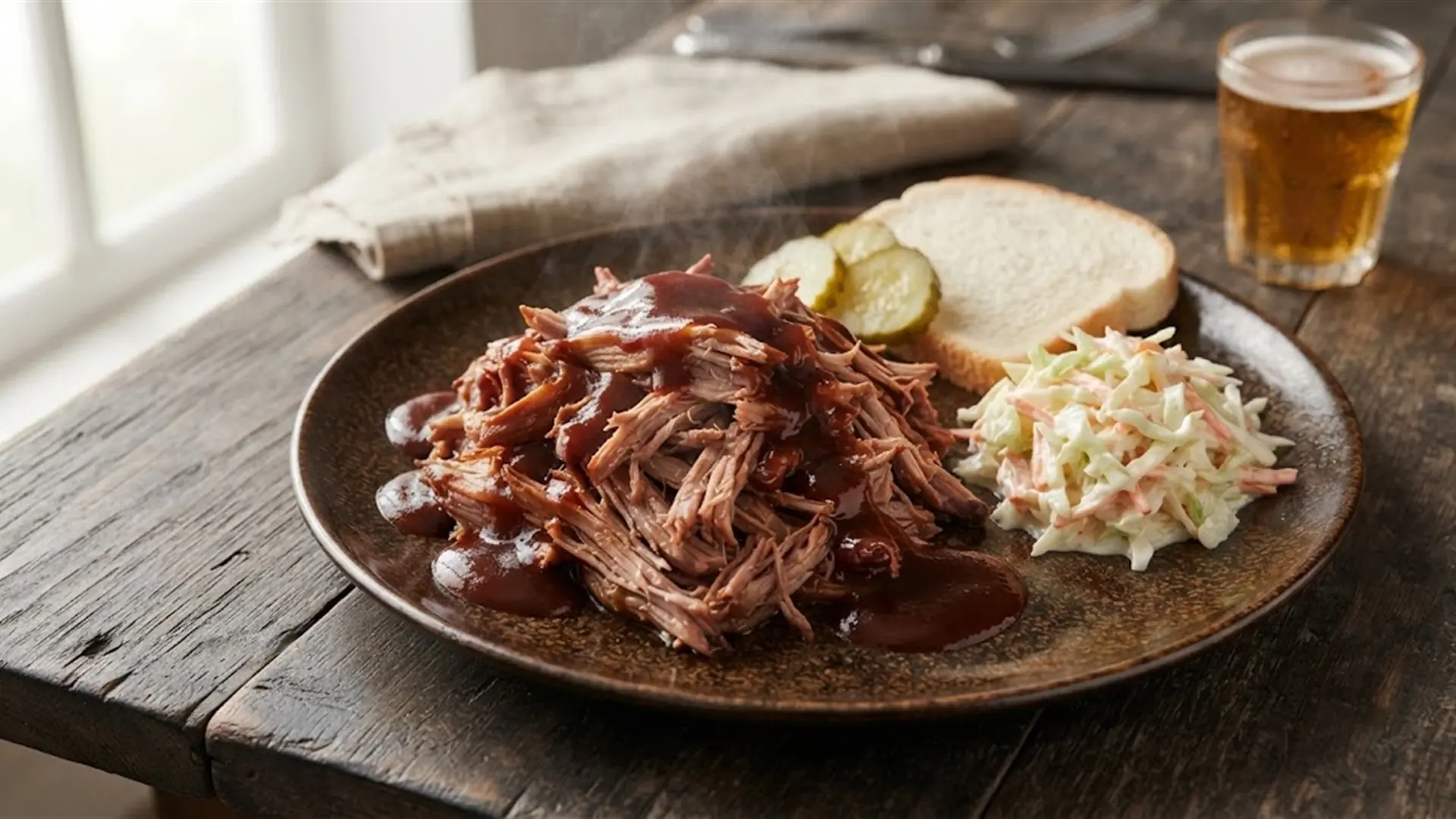
Summary: Pork shoulder rubbed with Dijon mustard and a dry spice mix, marinated overnight and then smoked or roasted at 115°C for about six hours, until the internal temperature reaches around 90°C. The meat rests, is pulled apart with a fork into shreds and mixed with barbecue sauce and the defatted pan juices. Base of 6 servings, serving weight 412 g.
Have you cooked the recipe? Share the result with the community.
Category: Pork, American cuisine
Success rate: not rated yet % of users managed the recipe
Quick overview
- Dish: Pulled Pork
- Category: Pork, American cuisine
- Cuisine: American
- Main ingredient: Boneless pork shoulder, 1600 g (with a fat layer on the surface, skinless)
- Guide: 12 most famous American dishes: traditional recipes from American cuisine
- Total time: 420 minutes (35 min preparation + 360 min cooking + 25 min finishing), plus 12 hours marinating in the fridge
- Difficulty: Medium
- Servings: 6 (Serving weight: 412 g)
- Key technique: Slow smoking or roasting at low temperature, basting and resting the meat before pulling
- Preparation types: Smoking, Roasting, Slow cooking
- Dietary info & allergens:mustard, sulphites
- Suitable for: Weekend cooking, parties and family celebrations, batch cooking and freezing
- Nutritional values (per 1 serving): 781 kcal, Protein: 52.5 g, Fat: 51.9 g, Carbohydrates: 24.9 g
- Storage: 4 days in the fridge, 3 months in the freezer
- Pairing: Pale lager or American pale ale, Zinfandel or Shiraz, iced tea with lemon or apple cider
- In short: One large pork shoulder, a bowl of dry spice mix and six hours at low temperature – the meat then falls apart with a fork into shreds and is mixed with barbecue sauce and the defatted pan juices.
WAGUU says: “Pulled pork is pork shoulder left at a low temperature for so long that the collagen turns into gelatine and the meat can be pulled apart with a fork. Time and temperature are what matter, not the amount of seasoning.”
Key facts
| Preparation time: | 35 minutes (plus 12 hours marinating in the fridge) |
| Cooking time: | 360 minutes (6 hours), 5 to 7 hours depending on the thickness of the shoulder |
| Temperature: | 115°C in the oven or in a smoker; the meat is done at an internal temperature of around 90°C |
| Number of servings: | 6 (serving weight 412 g) |
In a nutshell
A large pork shoulder, a bowl of dry spice mix and six hours at low temperature. The meat is left alone during roasting, just basted and topped up with liquid every hour. At the end it is pulled apart with a fork into shreds, mixed with barbecue sauce and the defatted pan juices and served in a toasted bun with coleslaw. There isn’t much work involved, it’s just worth planning it for a day when you’re at home.
Ingredients
Base servings: 6 servings • Serving weight: 412 g
| Ingredient | Amount | Quality |
|---|---|---|
| Boneless pork shoulder | 1600 g | With a fat layer on the surface, skinless, from chilled meat |
| Coarse sea salt | 15.8 g | Unrefined, coarser grain |
| Brown sugar | 30 g | Cane, moist, lump-free |
| Ground sweet paprika | 18 g | Sweet, not hot, deep red |
| Smoked paprika | 6 g | Dried over a fire, strongly smoky |
| Ground black pepper | 5 g | Freshly ground |
| Ground cumin | 4 g | Ground just before use |
| Garlic powder | 6 g | Dried, finely ground |
| Ground chilli | 2 g | Cayenne pepper, finely ground |
| Dijon mustard | 30 g | Smooth, medium hot |
| Apple cider | 250 ml | Cloudy, with no added sugar |
| Pork stock | 200 ml | Unsalted, no flavourings |
| Liquid smoke | 3.50 ml | Natural, with no added flavourings |
| Apple cider vinegar | 100 ml | Unfiltered, 5% acidity |
| Barbecue sauce | 200 ml | Thick, with a molasses content, not flavoured ketchup |
Why you’ll love this recipe
- No expensive equipment: A smoker takes the result up a notch, but the recipe works in a regular oven too. The smoky undertone comes from the liquid smoke in the basting liquid and the smoked paprika in the dry mix.
- An hour of work, the rest is time: The active work takes about an hour. The rest is waiting, during which the meat cooks by itself and you just baste the surface every hour.
- It keeps and freezes well: The finished meat keeps for four days in the fridge and three months in the freezer. One batch gives you buns, a plate with potatoes and a tortilla filling.
Why it works: Pork shoulder contains connective tissue with a high proportion of collagen. At a meat temperature between 70 and 90°C, the collagen turns into gelatine, which binds water and gives the meat the tenderness that a fork can pull into shreds. The low ambient air temperature of 115°C keeps the surface below the point at which the sugar in the rub burns, and at the same time is enough for the inside of the meat to reach 90°C. Resting after cooking moves the juice from the surface back into the fibres, so the meat doesn’t leak on the chopping board.
Recipe overview
Preparation: 35 min | Cooking: 360 min | Difficulty: Medium | Servings: 6 | Type: Main course | Origin: American cuisine
Detailed method
Overall method: 0 % done
Phase 1: Dry spice mix and meat preparation – 20 min
Appliances: Kitchen scale, bowl, baking tray with a rack (no heat source)
15.8 Pat the shoulder dry with a paper towel and trim any remaining skin from the surface. Leave the fat layer on the surface about 5 mm thick – during long roasting the fat renders and the meat underneath stays juicy. Leave the meat aside for now and in a bowl prepare a dry mix from coarse sea salt, brown sugar, ground sweet paprika, smoked paprika, ground black pepper, ground cumin, garlic powder and ground chilli. Stir until the mixture is evenly crumbly and lump-free.
VKB: The mixture is brick red, crumbly and even, with no lumps of brown sugar. The surface of the shoulder is matte and dry to the touch, the fat layer is the same thickness across the whole surface.
Before you move to the next step:
Do not wash the meat. Water on the surface encourages bacterial growth and the dry mix doesn’t stick to wet meat. Pat the shoulder dry with a paper towel and work with it cold from the fridge.
Phase 2: Rubbing and marinating overnight – 15 min
Equipment: Fridge, sealable container or large zip-lock bag
15.8 Rub the entire surface of the pork shoulder with Dijon mustard. The mustard acts as a binder for the dry rub to cling to and adds a subtle tang. Then coat the meat all over with the spice mix and massage it into the folds. Place it in a sealable container or a large bag, put it in the fridge and leave for 12 hours. During that time the salt and sugar are drawn beneath the surface.
VKB: The surface of the meat is evenly coated with the brick-coloured rub and no pink shows through anywhere. After 12 hours the rub is moist and clinging to the surface, with only a small amount of liquid at the bottom of the container.
Before you move on to the next step:
Marinate in the fridge, not on the worktop. The sugar in the rub absorbs moisture from warm air, the rub runs off and the meat loses its crust. Seal the container and place it on a shelf where nothing can drip onto other foods.
Phase 3: Smoking or roasting – the first two and a half hours – 150 min
Equipment: Smoker or oven, roasting tin, rack, meat thermometer
3. Heat the smoker or oven to 115 °C. Pour the apple juice, pork stock and liquid smoke into the roasting tin. The liquid smoke adds a smoky undertone when you are roasting in the oven. Place the meat on the rack above the tin, fat side up, and slide it into the heated space so that it does not touch the tin. Close the door and do not open it for the first two and a half hours.
VKB: After two and a half hours the surface is dark red to mahogany in colour and dry to the touch. There is about a centimetre of liquid in the roasting tin and fat is beginning to render on its surface.
Before you move on to the next step:
Do not open the door for the first two hours. Every time you open it, heat and smoke escape, the surface of the meat cools and the cooking time is drawn out. Check the meat with a thermometer, not by guessing from the colour.
Phase 4: Mopping and basting – 120 min
Equipment: Smoker or oven, pastry brush, meat thermometer
4. Make a mop from the cider vinegar and apple juice. Every hour, take the meat out, brush it all over and return it. If the liquid in the tin has evaporated, top it up with the remaining pork stock so the drippings do not catch. In the last half hour of this phase, brush the meat with barbecue sauce. The sugar in the sauce darkens and turns bitter with long exposure to heat, so it belongs at the end.
VKB: The bark holds together and does not flake off. The internal temperature of the meat is between 75 and 80 °C. The drippings in the tin are dark brown, the fat sits on the surface and does not catch on the bottom.
Before you move on to the next step:
You can tell barbecue sauce was applied too early by the black patches and the bitter taste of the bark. The sugar and molasses in the sauce can only take a short spell in the heat, so add it in the last hour of cooking.
Phase 5: Finishing and resting – 90 min
Equipment: Smoker or oven, meat thermometer, foil, clean tea towel, cool box
15.8 Continue cooking the meat until the internal temperature in the thickest part reaches around 90 °C. The total cooking time is usually between 5 and 7 hours and depends on the thickness of the shoulder. Then take the meat out, wrap it loosely in a double layer of foil, cover with a clean tea towel and leave to rest for 45 minutes. In a cooler environment you can place it in a closed cool box.
VKB: The thermometer in the thickest part reads 90 °C and its tip passes through the meat without resistance. After resting, the meat in the foil is still hot and juice that has not run out is trapped in the parcel.
Before you move on to the next step:
Do not pull the meat straight after taking it out of the oven. Hot fibres tear into short pieces when pulled and the juice runs out onto the board. Let it rest for 45 minutes in the foil, and only then pull it.
Phase 6: Pulling into strands and finishing – 25 min
Equipment: Two forks or a meat hook, large bowl, sieve, spoon
6. Pour the drippings that formed from the basting out of the tin through a sieve into a bowl and spoon off the fat from the surface. The defatted drippings go back into the meat, the fat is discarded. Transfer the meat to a large bowl and pull it apart against the grain with two forks until it opens into pieces 3 to 5 mm thick. Pick out any larger pieces of fat and cartilage. Add the barbecue sauce and the defatted drippings to the meat, stir and leave for 5 minutes to warm through.
VKB: The meat opens into strands 3 to 5 mm thick with no solid pieces. Once mixed with the sauce, the mixture holds together on a fork and no clear liquid separates at the bottom of the bowl.
Required equipment
| Utensils | Ideal size | Alternative | Risk |
|---|---|---|---|
| Roasting tin with rack | 35 × 25 cm, rack 2 cm above the base | Baking tray with a wire rack and a deep foil base | Without a rack the meat stews in its own juices and the surface does not brown |
| Meat thermometer | Digital, range up to 130 °C | Oven probe with an external display | Without measuring temperature, cooking time is guessed from time alone and the meat is easily overcooked |
| Pastry brush | Silicone, 4 cm wide | Spoon and pouring in stages | A bristle brush sheds hairs and scorches in the oven |
Shopping list
Nutritional profile
Values per 1 portion (without sides). Calculated from average nutritional values of the ingredients. Portion weight 412 g. The values are based on all the ingredients in the recipe, i.e. the meat, the rub, the basting liquid and the barbecue sauce.
| Nutrient | Per 100 g | Per 1 portion | Per 6 portions |
|---|---|---|---|
| Energy | 189 kcal | 781 kcal | 4685 kcal |
| Fat | 12.6 g | 51.9 g | 311.3 g |
| of which saturates | 4.4 g | 18.3 g | 109.9 g |
| Carbohydrate | 6.0 g | 24.9 g | 149.6 g |
| of which sugars | 4.6 g | 18.8 g | 112.7 g |
| Protein | 12.7 g | 52.5 g | 315.2 g |
| Salt | 0.85 g | 3.5 g | 16.84 g |
Reference intake of an average adult (8400 kJ / 2000 kcal). The salt comes from the rub, the barbecue sauce and the stock; some remains in the poured-off liquid. If you serve the meat in a bun, add the values for the side.
WAGUU Pro level
- Pro standard: A verified recipe with precise ratios and visual checkpoints.
- Tip 1: Choose the shoulder by the layer of fat on the surface and the proportion of connective tissue. Pieces from the top of the shoulder have a thicker fat layer and withstand longer cooking than the leaner ends.
- Tip 2: Insert the thermometer into the meat from the side, not down through the bark. That way you measure the temperature in the centre of the thickest part and the bark stays intact.
- Tip 3: Let the drippings cool before defatting. The fat sets on the surface and can be lifted off in one piece with a spoon; warm drippings mix with the liquid and defatting takes ages.
- Tip 4: Pull the meat between two people with two forks, against the grain. Shorter strands mix into the sauce better and the mixture then holds in a bun.
The science behind it
The shoulder is a muscle that carried the weight of the body, so it contains a high proportion of collagen in the connective tissue. Collagen breaks down with heat over a wide temperature range, fastest between 70 and 90 °C, and turns into gelatine. This binds water and dissolves in the mouth as we eat, which we perceive as tenderness. If the meat went above 95 °C, the water would evaporate faster than the gelatine can bind it and the result is dry. During cooking, the meat stalls for a longer period at around 65 to 75 °C roughly halfway through the process; this is the balance between the heat flowing into the meat and the cooling caused by water evaporating from the surface. You can speed up this phase by wrapping the meat in foil. On a third level, smoke plays a part: particles from burning wood or from liquid smoke settle on the surface, where they react with proteins and create colour and aromatic compounds. The dark bark also forms through reactions between sugars and proteins at lower temperatures than those of frying.
Fine Dining – Professional techniques
- Plate composition: Place a mound of pulled pork in the centre of a shallow plate and spoon the strained drippings over it. Put a small mound of coleslaw alongside and a quarter of a toasted bun cut into thin slices.
- Textural contrasts: Tender meat needs something crunchy – sliced bark from the surface of the shoulder, fried onions or fresh cabbage. Trim the bark while it is still warm and cut it into 3 mm wide strips.
- Temperature contrast: Serve the meat hot and the coleslaw cold, taken straight from the fridge just before serving. The difference in temperature is noticeable on the first spoonful.
- Aromatic accents: To finish, add a few drops of cider vinegar and grated lime zest. The acid cuts through the smoke and brings out the fruity note of the juice.
Sensory radar
- Appearance: Dark mahogany bark, beneath it pale pink strands glistening with sauce. On the plate the meat falls apart into individual strands.
- Aroma: Smoke, sweet paprika and caramelised sugar. Once mixed with the drippings, a tart note of vinegar and apples comes through.
- Taste: Sweet and smoky notes from the rub, saltiness from the salt and acidity from the vinegar. Bitterness appears only if the sauce darkens too much during cooking.
- Texture: Stringy, soft, with no tough connective tissue. The strands can be separated with a fork without pressure, but do not fall apart into mush.
Pairing
- Beer: A light lager with higher bitterness that cuts through the smoke on the palate, or an American pale ale with citrusy hops. A dark stout suits smoked meat less well, as its roasted notes overlap with the smoke.
- Wine: Zinfandel or Shiraz with soft tannins and higher alcohol. The wine’s acidity and fruitiness balance the sweetness of the barbecue sauce.
- Soft drinks: Iced tea with lemon, apple juice or homemade lime and mint lemonade. Sparkling water with a slice of apple works too, it cleanses the fat on the tongue.
Different preparation methods
- Slow cooker pulled pork: Put the meat in a slow cooker on low and cook for 8 to 10 hours until it falls apart. Half the liquid is enough, as less water evaporates. Suitable for households without a smoker and for preparing overnight.
- Pulled pork from pork leg: The leg is leaner, is ready an hour or two earlier and dries out more easily. Baste more generously and brush the meat every half hour. Suitable for those who want less fat.
- Pressure cooker pulled pork: Cut the meat into four pieces, add 200 ml of stock and cook for 60 minutes at high pressure. Then let the pressure drop naturally and transfer the meat under the grill so the surface takes on colour. Suitable for a weekday.
- Coffee rub pulled pork: Add 8 g of finely ground coffee to the dry mix. The coffee won’t come through as bitterness but as depth and a darker bark colour. Suitable for a bolder profile.
Allergens and dietary information
Contains: sulphites (apple cider, barbecue sauce, cider vinegar); mustard (barbecue sauce, Dijon mustard); celery (barbecue sauce) • Gluten: the recipe itself is gluten-free, gluten is in the bun in which the meat is served • Not suitable for: people with an allergy to mustard, celery or fish; if you’re on a reduced-salt diet, adjust the recipe according to the note in the nutritional profile
Suitable for
Weekend cooking, parties and family celebrations, batch cooking, freezing and reheating later. Even a beginner can manage the recipe if they have a meat thermometer and plan six hours of time. Also suitable for households without a smoker, an oven and liquid smoke are all you need.
Substitution guide
- Boneless pork shoulder: Boneless pork leg – leaner meat, an hour or two shorter roasting time and a greater risk of drying out. Same weight.
- Brown sugar: Cane sugar or maple syrup. Increase the syrup to 40 ml and let the dry mix dry out for 10 minutes so it doesn’t clump.
- Apple juice: Apple juice with no added sugar or apple cider. With cider, the alcohol evaporates during roasting and the fruity flavour remains.
- Liquid smoke: Another 3 g of smoked paprika and a tablespoon of drippings from smoked bacon. The smoky undertone will be gentler and more about colour than aroma.
- Dijon mustard: Wholegrain mustard or honey mustard. The honey version adds sweetness to the rub, so reduce the brown sugar by 10 g.
- Pork stock: Vegetable stock or water with a tablespoon of apple cider vinegar. The flavour will be lighter, but the meat will stay juicy.
- Barbecue sauce: Homemade sauce from ketchup, apple cider vinegar, brown sugar and smoked paprika. Keep the ratio at 200 ml ketchup, 40 ml vinegar, 20 g sugar and 2 g smoked paprika.
FAQ
Can I make pulled pork without a smoker?
Yes. An oven at 115 °C gives equally tender meat, it just lacks smoke. The smoky undertone comes from liquid smoke in the basting liquid and smoked paprika in the dry mix. The difference is mainly noticeable in the aroma of the bark, not in the texture of the meat.
What cut of meat should I use if I don’t have shoulder?
Pork leg or the upper part of the shoulder with the bone. The leg is leaner and ready sooner, so baste it more generously. Shoulder with the bone roasts half an hour to an hour longer, count the weight including the bone.
Why does the cooking stall halfway through?
The internal temperature lingers around 65 to 75 °C for a while, because some of the heat is used up evaporating water from the surface of the meat. It’s not a fault with the oven or the thermometer. Wrapping the meat in foil or slightly raising the oven temperature by 10 °C helps.
Can I prepare the meat a day ahead?
Yes. Cooked and pulled meat keeps in a sealed container in the fridge for four days. Stir in the sauce only when reheating, so the meat stays more tender. Reheat gently in a pan with a tablespoon of water or in the oven at 150 °C under foil.
How spicy is the recipe?
2 g of ground chilli per 1600 g of meat gives only a mild warmth that most diners won’t perceive as hot. For a bolder version, increase the chilli to 5 g and add hot sauce to the barbecue sauce when finishing, not to the rub.
How do I know the meat is done?
By the thermometer, not by the clock. You need around 90 °C in the thickest part and the tip of the thermometer should pass through the meat without resistance. If the meat falls apart on its own as you take it out, it’s overcooked and some of the juices have been lost.
What do I do with the drippings if we don’t eat them all?
Strained and defatted drippings can be frozen in small containers for up to three months and used as a base for sauce with other meat. The fat from the surface can be used for roasting potatoes, the flavour is smoky and sweet.
WAGUU Petr advises: Cooking for 6 or more people?
6–8 people: Increase the shoulder to 2400 g, the dry mix to one and a half times and use 350 ml of barbecue sauce. The cooking time extends by an hour or two, the thickness of the meat and the thermometer are what matter. 10+ people: Roast two 2000 g shoulders side by side on two racks, swap them halfway through and baste with 300 ml of stock. Prepare the dry mix twice, brush the meat with one mix of 150 ml vinegar and 250 ml juice.
Sides and serving
Storage and reheating
Fridge: 4 days • Freezer: 3 months • Reheating: Reheat the meat gently in a pan with a tablespoon of water or stock under a lid, in the oven at 150 °C under foil, or in the microwave in a sealed container. Stir in the sauce only after it’s warmed through, otherwise the meat will fall apart during long reheating. Let frozen meat defrost in the fridge overnight, then reheat it as fresh.
Author: WAGUU Petr & Team • Published: 6 Oct 2026 • Updated: 9 Oct 2026
More recipes from the article
More recipes you might like
Why WAGUU?
Recipes on WAGUU go through a check of the accuracy of ingredients, methods and nutritional values. For this recipe, that means the quantities in the ingredients match the sum of the quantities in all stages of the method, the shopping list is built from the same items and the nutritional values are recalculated per portion weight of 412 g.
Photo gallery from the method
Photos from the community: Cook it, photograph it and share the result.
You can upload photos in the comments below or send them by email.
Have you filmed a video of the method for our recipe? Post a link to YouTube, YouTube Shorts, TikTok, Instagram Reels, Facebook Reels, Pinterest, Vimeo or X (Twitter) in the comments – we’ll happily publish it and help get you and your content noticed.
Most common mistakes
- Temperature too high – at 160 °C and above, the surface burns before the inside reaches 90 °C. Cook at 115 °C and watch the temperature in the meat, not the time in the recipe.
- Barbecue sauce applied at the start – the sugar and molasses in the sauce darken and turn bitter. Add the sauce only in the last hour of cooking and stir the rest into the finished meat.
- Meat without resting – if you pull the meat while it’s hot, the juice runs out onto the board and the fibres tear into short pieces. Leave it for 45 minutes in foil.
- Dry roasting tin and burnt drippings – if the basting liquid evaporates and the bottom stays dry, the drippings burn and bitterness gets into the meat. Top up with the rest of the stock as soon as there’s less than a centimetre of liquid in the tin.