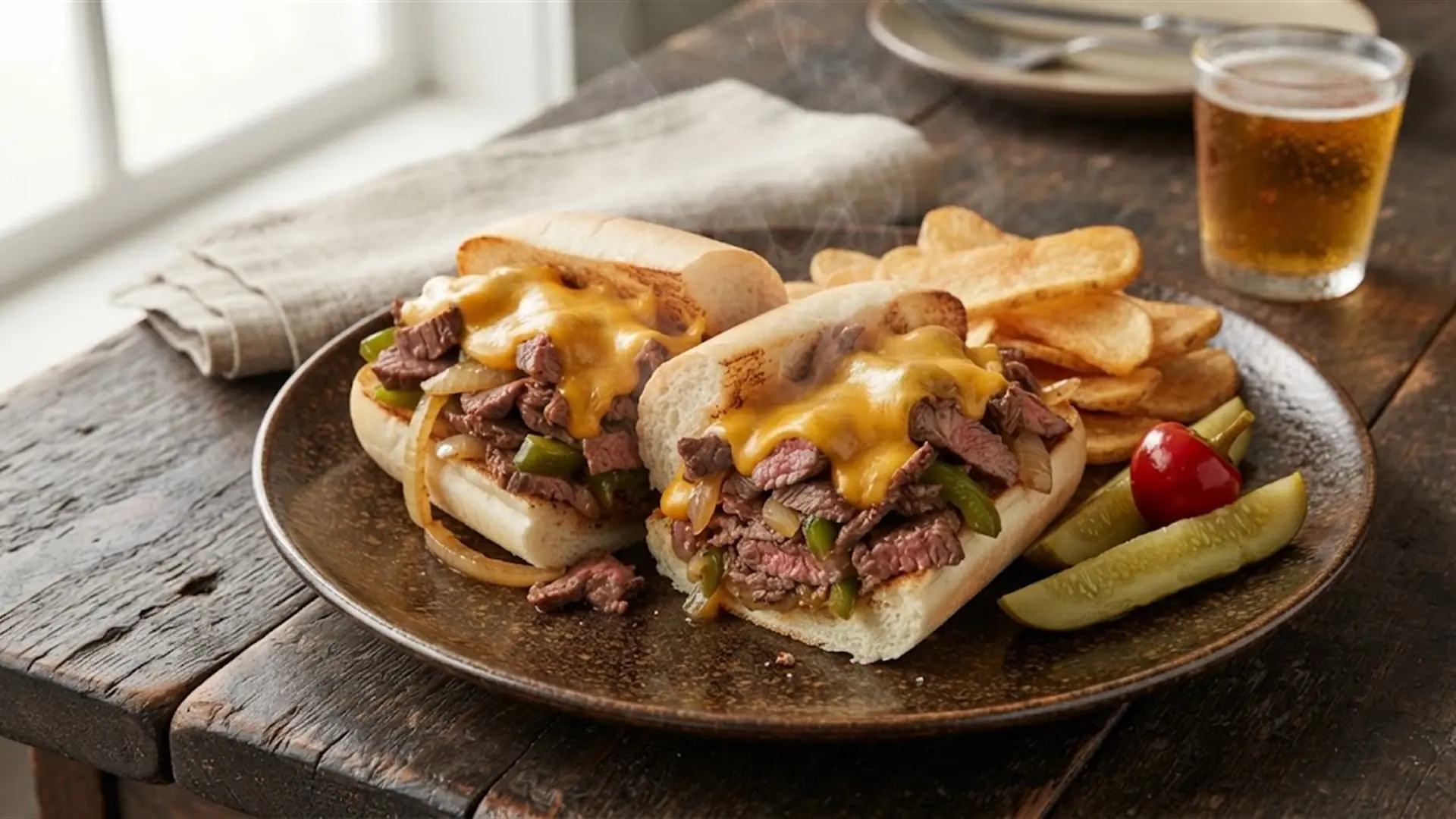
Summary: Thin slices of beef topside seared on a griddle with onions and green pepper, with melted provolone cheese in a long roll. The meat is frozen for 30 minutes before slicing so it can be cut into translucent slices, and it is seared quickly over high heat. Total time 47 minutes, base 6 servings.
Have you cooked the recipe? Share the result with the community.
Category: Beef, American cuisine
Success rate: not rated yet % of users managed the recipe
Quick overview
- Dish: Philly Cheesesteak – sliced beef with melted cheese in a long roll, a classic street food from Philadelphia
- Category: Beef, American cuisine
- Cuisine: American
- Main ingredient: Beef topside, 900 g
- Guide: 12 most famous American dishes: traditional recipes from American cuisine
- Total time: 47 minutes (25 minutes preparation + 22 minutes cooking)
- Difficulty: Easy
- Servings: 6 (Serving weight: 370 g)
- Key technique: Slicing the meat thinly, searing quickly on a very hot griddle
- Cooking methods: Pan-frying, grilling and roasting
- Dietary info & Allergens:gluten, milk, fish
- Suitable for: Quick dinner, weekday lunch, party, food on the go
- Nutritional values (per 1 serving): 653 kcal, Protein: 48.5 g, Fat: 28.3 g, Carbohydrates: 50.6 g
- Storage: 2 days in the fridge, 1 month in the freezer
- Pairing: Pale lager, dry red wine, homemade lemonade
- In short: Frozen meat sliced into translucent slices, a red-hot griddle and cheese melted under a lid – three things that decide whether the meat will be juicy and the cheese stringy.
WAGUU says: “A cheesesteak isn’t cooked, it’s brought together. The meat, onions and pepper are seared in one place in a few minutes and the cheese melts right on top of them.”
Key facts
| Preparation time: | 25 minutes |
| Cooking time: | 22 minutes |
| Temperature: | Griddle 220–240 °C, internal meat temperature 60 °C for medium |
| Number of servings: | 6 (serving weight 370 g) |
At a glance
The whole dish stands on the thickness of the slices. Meat frozen for 30 minutes firms up enough to be cut into slices two to three millimetres thick; such slices cook through on a red-hot griddle in a minute and stay juicy. The onions and pepper are seared separately so they keep their texture, and the cheese is melted directly on the meat under a lid, where the heat from the meat melts it without direct heat.
Ingredients
Base servings: 6 servings • Serving weight: 370 g
| Ingredient | Amount | Quality |
|---|---|---|
| beef topside | 900 g | aged, with fine marbling, whole |
| long rolls | 6 pcs | soft, 80 g, for cheesesteak |
| onion | 300 g | yellow, medium-sized |
| green pepper | 250 g | firm, without bruises |
| provolone cheese | 180 g | semi-hard, sliced |
| rapeseed oil | 30 ml | for searing, high smoke point |
| butter | 40 g | 82 %, for toasting the rolls |
| Worcestershire sauce | 20 ml | fermented, containing anchovies |
| fine sea salt | 8.3 g | for the meat and the vegetables |
| ground black pepper | 4 g | freshly ground |
| ground garlic | 4 g | dried, ground |
Why you’ll love this recipe
- Ready in 47 minutes: 22 minutes of that at the griddle. The rest is slicing and preparation, which you can do in advance.
- The meat stays juicy: Thin slices cook through in a minute, so they don’t have time to dry out, even if you use a leaner topside.
- Precise ratios for 6 servings: 150 g meat, 30 g cheese and 80 g roll per serving. The vegetables are counted separately.
- A beginner can manage it: Five stages, one pan and clear checkpoints. Only the griddle temperature matters.
Why it works: When thin slices are seared on a griddle at 220 to 240 °C, the surface of the meat dries out within seconds and its temperature exceeds 140 °C; the Maillard reactions kick in, creating a brown crust and aromatic compounds. Because the slice is thin, the heat penetrates to the centre before the water can evaporate from the whole piece – the meat stays juicy. The onions and pepper are seared separately: they contain water that would lower the temperature on the griddle and the meat would stew instead of searing. The cheese is melted on the meat under a lid, where the moist heat from the meat melts it; the direct heat of the griddle would dry out the cheese and separate the fat. Worcestershire sauce adds umami and acidity, which caramelises on the griddle and enhances the flavour of the meat.
Recipe overview
Preparation: 25 min | Cooking: 22 min | Difficulty: Easy | Servings: 6 | Type: Main course | Origin: American
Detailed method
Overall progress: 0 % done
Stage 1: Preparing the meat and vegetables – 25 min
Equipment: freezer, kitchen scale, sharp knife
1. Pat the beef topside dry with kitchen paper, wrap it in cling film and put it in the freezer for 30 minutes – the meat firms up but doesn’t freeze. Meanwhile, slice the onion into thin half-rings and the green pepper into half-centimetre-wide strips. Cut the rolls open lengthways, but don’t cut all the way through.
VKB: The meat is firm on the surface and cold to the touch, but the knife goes into it without pressure. The onion and pepper are cut into equally thick pieces.
Before you move to the next step:
Don’t leave the meat in the freezer for more than 40 minutes. Frozen meat breaks when sliced and the slices aren’t even, so they cook through at different times on the griddle.
Stage 2: Slicing and searing the vegetables – 12 min
Equipment: large cast-iron pan or griddle, kitchen spatula
8.3 Cut the firm meat across the grain into slices 2 to 3 mm thick. Heat half the oil in a cast-iron pan and sear the onion with half the salt and pepper for 6 minutes, until it starts to turn golden. Add the green pepper and sear for another 4 minutes so it stays firm. Transfer the vegetables to a plate and wipe the pan.
VKB: The onion is translucent with golden edges, the pepper firm and glossy. No water remains in the pan, only a thin layer of fat.
Before you move to the next step:
Take the vegetables out of the pan and wipe the pan. If they stayed in, they would release water when the meat is seared and the meat would stew instead of searing.
Stage 3: Searing the meat – 6 min
Equipment: cast-iron pan, kitchen spatula
8.3 Heat the pan to 220–240 °C until it starts to smoke faintly from the surface, then add the remaining oil. Divide the meat into two portions. Spread the first portion across the pan in a single layer, add the minced garlic and fry for 60 to 90 seconds without stirring, then flip the slices and fry for another 30 seconds. Transfer the cooked meat to the vegetables and fry the second portion the same way with the remaining salt and pepper.
VKB: The slices have a brown crust on the edges, are pink inside, and no water remains in the pan. The meat feels springy to the touch, not tough.
Before you move on to the next step:
Do not stir the meat in the pan with a spoon the whole time. If the slices are constantly tossed around, they won’t release their juices and won’t develop a crust.
Phase 4: Cheese and rolls – 6 min
Appliances: pan with lid, oven or toaster
4. Return the meat to the pan, mix it with the vegetables and pour over the Worcestershire sauce. Lay slices of provolone cheese over the piles of meat and cover with the lid for two minutes, until the cheese melts. Meanwhile, toast the rolls cut-side in the oven or toaster and butter them.
VKB: The cheese is completely melted, stretches when pulled with the spatula and doesn’t release fat. The cut sides of the rolls are golden brown and the butter has soaked in.
Phase 5: Filling and serving – 3 min
Appliances: kitchen spatula, knife
5. Slide the spatula under the pile of meat and cheese and transfer it into the toasted roll. Press the filled roll lightly with your palm so the layers hold together, and serve immediately. Fill the remaining rolls the same way.
VKB: The filling stays in the roll and doesn’t slide out when pressed. The cheese remains stretchy, and no fat pools on the plate.
Required equipment
| Utensils | Ideal size | Alternative | Risk |
|---|---|---|---|
| cast-iron pan or griddle | 28 cm diameter, thick base | heavy stainless steel pan | a thin base won’t hold the heat, so the meat steams instead of frying and releases water |
| sharp meat knife | 20 cm blade, smooth | fish knife or electric slicer | a blunt knife crushes the slices and the meat releases its juices during cutting |
| pan lid | glass, for a 28 cm pan | foil or baking tray | without a lid the cheese won’t soften and stays firm |
| kitchen spatula | thin, 10 cm wide | two turners | a thick spatula breaks up the pile and the filling spills out of the roll |
| meat thermometer | probe type | checking the colour when cut | thin slices cook quickly, so without measuring they easily overcook |
Shopping list
Nutritional profile
Values per 1 portion (without side dish). Calculated from average nutritional values of the ingredients. Portion weight 370 g.
| Nutrient | Per 100 g | Per 1 portion | Per 6 portions |
|---|---|---|---|
| Energy | 177 kcal | 653 kcal | 3917 kcal |
| Fat | 7.7 g | 28.3 g | 169.9 g |
| of which saturates | 3.4 g | 12.5 g | 75.1 g |
| Carbohydrates | 13.7 g | 50.6 g | 303.3 g |
| of which sugars | 1.9 g | 7.1 g | 42.5 g |
| Protein | 13.1 g | 48.5 g | 290.7 g |
| Salt | 0.95 g | 3.5 g | 19.44 g |
| of which sodium | 0.35 g | 1.30 g | 7.78 g |
Reference intake of an average adult (8400 kJ / 2000 kcal).
WAGUU Pro level
- Pro standard: Verified recipe with precise ratios and visual checkpoints.
- Tip 1: Always slice the meat against the grain, not along it. The slices then break into short fibres when bitten and don’t resist.
- Tip 2: Heat the griddle empty for five minutes. A drop of water must evaporate instantly, only then put the meat on it.
- Tip 3: Place the cheese on the meat in a single layer and remove the lid as soon as it melts. A longer stay under the lid dries out the cheese and releases fat.
- Tip 4: Toast the rolls cut-side and butter them only after toasting. Butter on a cold roll won’t soak in and stays on the surface.
Scientific background
Speed here is technique, not haste. A thin slice of meat has a large surface area and small volume, so heat from the griddle penetrates to its centre within tens of seconds. At the surface, the temperature exceeds 140 °C and Maillard reactions begin between amino acids and reducing sugars – creating a brown crust and aromatic compounds. For a thick piece of meat, the same time would mean a raw centre; for a slice two millimetres thick, on the other hand, it’s enough. The water the meat releases evaporates instantly on the hot griddle, which is why the slices don’t boil in their own juices. The onion and pepper are fried separately because they contain over 90% water; if they were on the griddle with the meat, the surface temperature would drop below 140 °C and only a grey layer would form instead of a crust. Provolone cheese melts at 60 to 70 °C, and under the lid it’s melted by the moist heat from the meat, not direct heat. Worcestershire sauce contains glutamates from anchovies, which enhance the perception of meaty flavour, and acetic acid, which partially caramelises on the griddle.
Fine Dining – Professional techniques
- Plate composition: Cut the roll diagonally into two halves and stand them on the plate cut-side forward so the layer of meat and stretchy cheese is visible. Place a small bowl of gravy alongside.
- Textural contrasts: Add a pickled gherkin or crunchy pepper to the softened onion. The filling is soft, so it needs at least one firm texture.
- Temperature contrast: Fill the roll with hot filling and serve with a cold tomato salad. The temperature difference highlights the flavour of the cheese.
- Aromatic additions: Before serving, grate a little lemon zest over the filling and add a few drops of olive oil. It freshens the richness of the cheese.
Sensory radar
- Appearance: Golden-brown roll, pink meat with brown edges protruding from the cut, melted cheese and glossy onion with strips of pepper.
- Aroma: Seared beef and butter from the roll, the sweet smell of fried onion and a subtle vinegary note of Worcestershire sauce.
- Flavour: Meaty and salty cheese flavour, sweetness of onion and a mild acidity and pepper heat at the end.
- Texture: Roll soft with a crisp crust, meat tender, cheese stretchy, onion soft and pepper firm.
Pairing
- Light lager: Hop bitterness cuts through the fat from the cheese. Serve chilled at 6–8 °C.
- Dry red wine: Cabernet Sauvignon or Merlot with lower tannin content. Tannins bind with the proteins in the meat.
- Homemade lemonade: The acidity refreshes after a rich meal. A non-alcoholic option for children and drivers.
- Iced tea with lemon: Tannins tighten the mouth after fat and the lemon balances it out.
Variations of preparation
- With cheddar and extra onion: Replace the provolone cheese with 180 g of cheddar and increase the onion to 400 g. The flavour is more pronounced and saltier.
- Spicy version: Add 2 g of ground chilli and 30 g of pickled peppers. The heat only comes through once you bite into it.
- Without the bun: Serve the filling on a plate with roast potatoes. The dish loses its sandwich character but remains gluten-free.
Allergens and dietary information
Contains: milk (provolone cheese, butter); celery (Worcestershire sauce); fish (Worcestershire sauce); gluten (hot dog buns) • Gluten: yes, in the bun • Not suitable for: people with coeliac disease, lactose intolerance, fish and celery allergies
Suitable for
A quick weeknight dinner, lunch on the go, a party for six to ten people, a post-workout meal thanks to its high protein content.
Substitution guide
- Beef ribeye: beef topside or fillet. Topside is leaner and dries out faster, fillet is more tender and more expensive.
- Provolone cheese: Edam, Gouda or Cheddar. The melt will be similar, the flavour more pronounced with Cheddar.
- Submarine rolls: a baguette cut into 15 cm pieces or ciabatta. A harder crust will crack when filled.
- Worcestershire sauce: soy sauce with a tablespoon of vinegar and a pinch of anchovy paste. The saltiness is higher, so reduce the salt by a third.
- Green pepper: red pepper or pickled peppers. Red is sweeter, pickled is more sour.
- Rapeseed oil: sunflower or peanut oil. Peanut oil can withstand a higher temperature.
FAQ
Why is the meat frozen before slicing?
Chilled meat holds its shape and the knife cuts equally thin slices. Warm meat gets squashed when sliced and the slices are thicker at the edges, so they cook unevenly in the pan.
Which meat is best?
Beef ribeye or topside. Stick to cuts without thick sinews – sinew won’t cook through in the pan and will stay tough in the bun.
Can I use a different cheese?
Yes. Provolone holds its shape and stretches. Cheddar is more pronounced and saltier, Edam stretches less. Cheese with a high fat content separates more quickly in the pan.
Why is the vegetables fried separately?
Onions and peppers contain over 90% water. In the pan they would release water and the meat would stew instead of frying, so no crust would form.
Can I prepare the recipe in advance?
Yes, slice the meat and fry the vegetables up to 24 hours ahead and store them in the fridge. Leave the actual frying of the meat and melting of the cheese until the last minute.
How to reheat leftovers so the bun doesn’t go hard?
Reheat the filling in a pan with the lid on and put it into a freshly baked bun. Reheating a filled bun in the microwave means the crust goes soggy and the filling dries out.
WAGUU Petr advises: Cooking for 6 or more people?
6–8 people: Fry the meat in three batches of 300 g and keep the cooked slices in the oven at 80 °C. Always let the pan return to 220 °C between batches. • 10+ people: Set up two pans side by side or use a large griddle. Keep the sliced meat in the fridge and fry in stages, bake the buns just before filling.
Sides and serving
Storage and reheating
Fridge: 2 days • Freezer: 1 month • Reheating: Reheat the filling in a pan at 160 °C with the lid on for 5 minutes and place it into a freshly baked bun. Leave frozen filling in the fridge overnight.
Author: WAGUU Petr & Team • Published: 6 Oct 2026 • Updated: 9 Oct 2026
More recipes from the article
Guide: 12 most famous American dishes: traditional recipes from American cuisine
Barbecue Ribs – slow-roasted or smoked pork ribs brushed with barbecue sauce
Pulled Pork – slow-roasted or smoked pork shredded into strands and served with barbecue sauce
Mac and Cheese – pasta with a rich cheese sauce, often made with Cheddar, baked until golden
More recipes you might like
Why WAGUU?
Recipes on WAGUU are checked for accuracy of ingredients, methods and nutritional values. For this recipe, the quantities are given in the same form in the ingredients table, in the individual stages of the method, in the shopping list and in the printable version – 900 g of meat corresponds to six portions of 150 g, 180 g of cheese to six slices of 30 g.
Photo gallery from the method
Photos from the community: Cook it, photograph it and share the result.
You can upload photos in the comments below or send them by email.
Have you filmed a video of the method for our recipe? Post a link to YouTube, YouTube Shorts, TikTok, Instagram Reels, Facebook Reels, Pinterest, Vimeo or X (Twitter) in the comments – we’ll be happy to publish it and help raise the profile of you and your content.
Most common mistakes
- Thick slices of meat – the outside burns while the inside stays raw. Chill the meat in the freezer before slicing and cut into 2 to 3 mm slices.
- Cold or half-empty pan – the meat releases water and stews. Heat the pan empty for five minutes until it starts to smoke on the surface.
- Vegetables with the meat in the pan – the water from the vegetables lowers the temperature and the meat doesn’t fry. Fry the vegetables separately and return them only at the end.
- Cheese under the lid for too long – it dries out and the fat separates. Put the lid on the pan for two minutes and serve immediately.