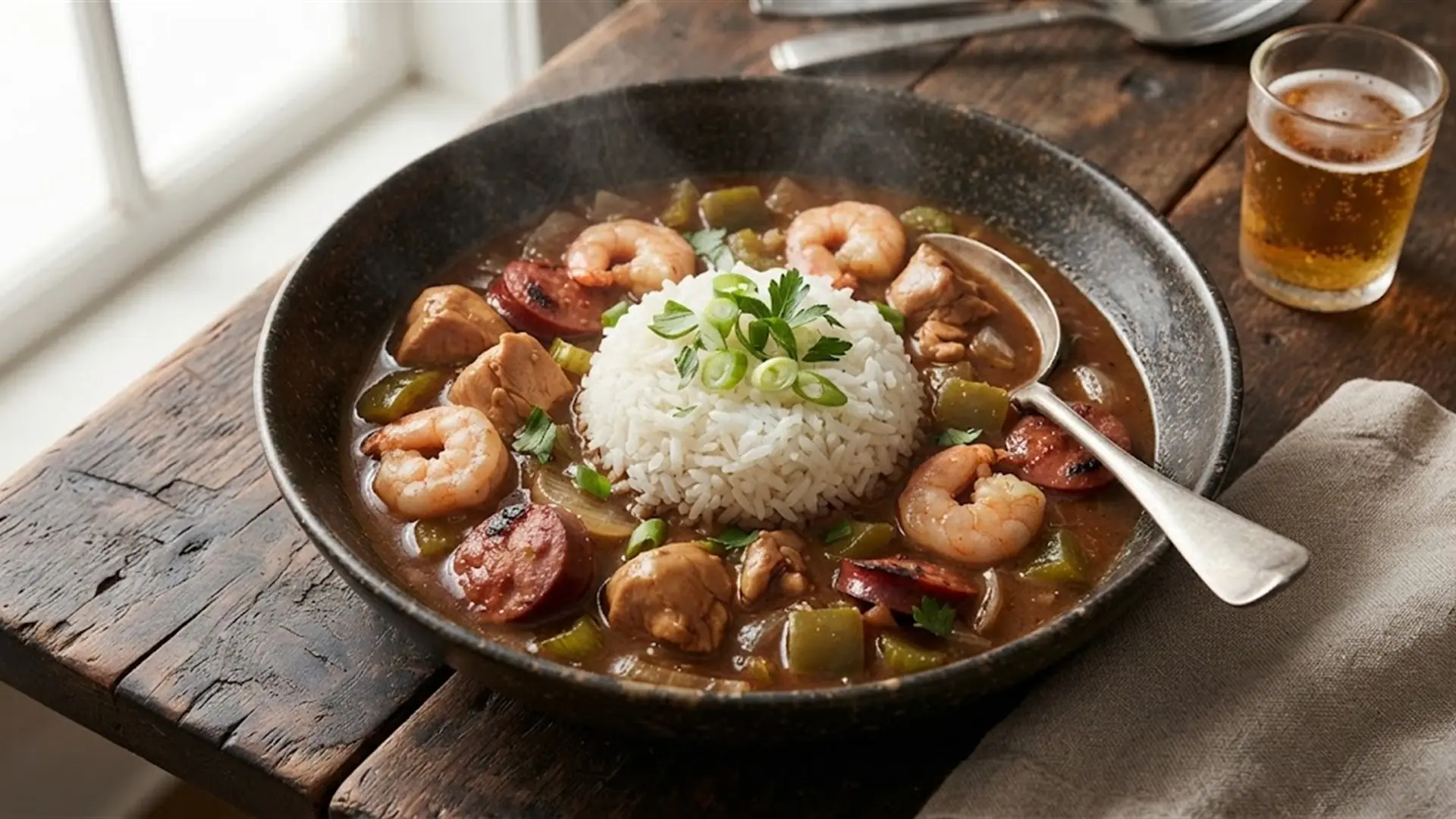
Summary: A thick Louisiana stew with a dark roux, chicken, smoked sausage, prawns and okra, served with rice cooked separately. The flavour comes from the dark roux, which is toasted for 20 minutes until it turns the colour of dark chocolate. Total time 90 minutes, makes 6 servings.
Have you cooked this recipe? Share your result with the community.
Category: Soups, American cuisine
Success rate: not rated yet % of users managed this recipe
Quick overview
- Dish: Gumbo – a thick Louisiana dish in the style of a meat or seafood stew with vegetables and a heavily spiced base
- Category: Soups, American cuisine
- Cuisine: American
- Main ingredient: Plain flour for the roux and chicken thighs, 80 g and 600 g
- Guide: The 12 most famous American dishes: traditional recipes from American cuisine
- Total time: 90 minutes (25 minutes preparation + 65 minutes cooking)
- Difficulty: Challenging
- Servings: 6 (Serving weight: 617 g)
- Key technique: Toasting a dark roux, stewing, cooking the rice separately
- Preparation types: Stewing, classic cooking
- Dietary info & Allergens:crustaceans, gluten, celery
- Suitable for: Weekend cooking, parties, winter dinner, guests
- Nutritional values (per 1 serving): 765 kcal, Protein: 45.9 g, Fat: 32.9 g, Carbohydrates: 70.2 g
- Storage: 3 days in the fridge, 2 months in the freezer
- Pairing: Cold lager, iced tea, dry rosé wine
- In short: Patience with the roux, a vegetable base and prawns added in the last two minutes – three things that decide whether the gumbo turns out dark and full-bodied or just a thin soup.
WAGUU says: “Gumbo stands or falls by the roux. Until it’s the colour of dark chocolate, it doesn’t have the flavour it should have – and if it burns, you have to start again.”
Key facts
| Preparation time: | 25 minutes |
| Cooking time: | 65 minutes |
| Temperature: | Roux at 150–170 °C, stewing at 95 °C, internal temperature of the chicken 75 °C |
| Number of servings: | 6 (serving weight 617 g) |
At a glance
Gumbo differs from jambalaya in two things: the base and the rice. The base is a dark roux made from flour and oil, which is toasted for twenty minutes; during this the flour loses the taste of raw starch and gains colour and a deep nutty flavour. The rice is served separately, cooked in salted water so that it stays fluffy and soaks up the stew on the plate. Okra thickens the dish naturally – its slime is soluble fibre that binds water.
Ingredients
Base servings: 6 servings • Serving weight: 617 g
| Ingredient | Amount | Quality |
|---|---|---|
| boneless chicken thighs | 600 g | fresh, skin left on |
| smoked sausage | 250 g | coarse-ground, with a high meat content |
| prawns | 300 g | peeled, deveined |
| long-grain rice | 360 g | long grain, cooked separately |
| plain flour | 80 g | type 450, for a dark roux |
| rapeseed oil | 80 ml | for the roux, high smoke point |
| onion | 250 g | yellow, medium-sized |
| celery | 150 g | stick celery, firm stalks |
| green pepper | 200 g | firm, without bruises |
| garlic | 20 g | fresh, 4 cloves |
| okra | 200 g | fresh or frozen, sliced |
| chicken stock | 1000 ml | unsalted, homemade or from a cube |
| ground sweet paprika | 8 g | sweet, ground |
| cayenne pepper | 3 g | ground, hot |
| ground black pepper | 3 g | freshly ground |
| fine sea salt | 2 g | according to the saltiness of the stock |
Why you’ll love this recipe
- A flavour you won’t find elsewhere: The dark roux gives the dish a nutty depth that no spice can replace.
- A dish for the whole day: Ninety minutes at the stove, but for most of the time you’re just watching the roux and letting it stew.
- Precise ratios for 6 servings: 100 g chicken, 50 g sausage and 50 g prawns per serving, 60 g rice per person.
- An experienced cook can handle it: Five stages and one technique that the whole dish rests on – the dark roux.
Why it works: The dark roux is created by controlled breakdown of starch and proteins. When toasted at 150 to 170 °C, the flour loses water, its starch breaks down into shorter chains and the proteins react with sugars in Maillard reactions. The result is a dark colour and a flavour that isn’t bitter but nutty and smoky. The toasting takes twenty minutes because at a higher temperature the flour would burn and turn bitter. Okra thickens differently from flour: it contains soluble fibre which, once cooked, creates a mucilaginous structure that binds water; this gives the dish body without a floury taste. The prawns are added in the last two minutes because their proteins contract and squeeze out water during longer cooking. The rice is cooked separately in salted water so that it stays fluffy – in the stew it would soak up fat and become heavy.
Recipe overview
Preparation: 25 min | Cooking: 65 min | Difficulty: Challenging | Servings: 6 | Type: Main course | Origin: American
Detailed method
Overall progress: 0 % done
Stage 1: Preparing the ingredients – 15 min
Equipment: kitchen scales, chopping board, knife
1. Pat the chicken thighs dry with kitchen paper and cut into 3-centimetre cubes. Slice the sausage into rounds, leave the prawns whole. Dice the onion, celery and pepper, crush the garlic. Slice the okra into 2-centimetre rounds. Get the flour, oil and stock ready.
VKB: All ingredients are chopped and measured into bowls by the stove. The chicken is dry, the vegetables are cut into equal-sized pieces, and the flour and oil are measured into bowls.
Before you move on to the next step:
Do not wash the chicken. Water spreads bacteria around the kitchen and the meat then steams in the pan instead of searing. Dry it with a paper towel.
Phase 2: Dark roux – 20 min
Equipment: heavy pot with a thick base, wooden spoon
2. In a heavy pot, combine the rapeseed oil with the plain flour and place over a medium heat. Stir continuously with a wooden spoon for 20 minutes; the mixture will go through colours from pale beige through honey and reddish-brown to the colour of dark chocolate. As soon as it reaches that colour, take the pot off the heat immediately.
VKB: The roux is the colour of dark chocolate and smells nutty and toasty, not burnt. It is smooth and runs off the spoon in a thin stream.
Before you move on to the next step:
Do not leave the roux unattended for even a moment. The difference between a dark roux and a burnt one is half a minute; if black specks appear, throw it away and start again.
Phase 3: Vegetable base – 10 min
Equipment: pot, wooden spoon
3. Add the onion, celery and pepper to the warm roux and stir for 6 minutes over a medium heat until the vegetables soften. Add the crushed garlic, ground sweet paprika, cayenne pepper and black pepper and stir for 30 seconds. Pour in the chicken stock in stages and whisk so the roux dissolves without lumps.
VKB: The vegetables are soft, the roux has dissolved completely and the liquid is evenly dark, with no lighter lumps at the bottom.
Before you move on to the next step:
Add the stock in stages, stirring constantly. If you pour it in all at once into a hot roux, lumps will form that will not stir out.
Phase 4: Simmering – 30 min
Equipment: pot with lid, meat thermometer
4. Add the chicken, sausage and okra and cook for 25 minutes over a gentle heat so the dish only bubbles lightly. Stir occasionally from the bottom while it simmers so the roux does not catch. After 25 minutes, taste and season with fine sea salt according to the saltiness of the stock and sausage.
VKB: The chicken is tender and the thermometer reads 75 °C. The okra has broken down and the dish has thickened enough that a spoon stands tilted in the ragout. No fat is pooling on the surface.
Before you move on to the next step:
Do not boil the ragout hard. A vigorous boil will break the emulsion of the roux, the fat will separate and an oily slick will appear on the surface.
Phase 5: Prawns, rice and serving – 15 min
Equipment: rice pot, colander, deep plates
5. Cook the rice separately in salted water according to the packet instructions and drain. Add the prawns to the ragout and cook for two minutes until they turn pink and curl up. Take the pot off the heat and let the dish rest for five minutes. Put a portion of rice in a deep plate, ladle the ragout over it and serve.
VKB: The prawns are pink and curled into a C shape, firm to the touch. The rice is fluffy and the grains separate. The ragout holds on the spoon and does not soak into the rice straight away.
Required equipment
| Utensils | Ideal size | Alternative | Risk |
|---|---|---|---|
| heavy pot with a thick base | 5 l capacity, 26 cm diameter, cast iron | enamelled casserole | in a thin base the roux will catch and turn bitter during toasting |
| wooden spoon | long, with a flat end | silicone spatula heat-resistant to 200 °C | a metal spoon will heat up in the hot roux and burn it |
| whisk | silicone, with thick wires | wooden spoon and fast stirring | a thin whisk will not break up lumps of roux |
| meat thermometer | probe type | check the colour of the juices | the chicken steams in the thick ragout and overcooks easily without measuring |
| separate rice pot | 2 l capacity with lid | rice cooker | rice cooked in the ragout soaks up fat and is heavy |
Shopping list
Nutritional profile
Values per 1 portion (including rice). Calculated from average nutritional values of the ingredients. Portion weight 617 g.
| Nutrient | Per 100 g | Per 1 portion | For 6 portions |
|---|---|---|---|
| Energy | 121 kcal | 795 kcal | 4769 kcal |
| Fat | 5.3 g | 32.9 g | 197.1 g |
| of which saturates | 1.2 g | 7.3 g | 43.8 g |
| Carbohydrate | 11.4 g | 70.2 g | 421.4 g |
| of which sugars | 0.7 g | 4.1 g | 24.5 g |
| Protein | 7.4 g | 45.9 g | 275.5 g |
| Salt | 0.55 g | 3.36 g | 20.18 g |
| of which sodium | 0.22 g | 1.34 g | 8.07 g |
Reference intake of an average adult (8400 kJ / 2000 kcal). The salt comes mainly from the smoked sausage, prawns and stock; with a homemade unsalted stock, reduce the salt to 5 g.
WAGUU Pro level
- Pro standard: Verified recipe with precise ratios and visual checkpoints.
- Tip 1: Keep the oil-to-flour ratio at 1 : 1 by weight. With more flour the roux burns, with more oil it never darkens.
- Tip 2: Toast the roux over a medium heat and stir continuously; only once it is the colour of honey should you turn up the heat. Toasting it faster means bitterness.
- Tip 3: Add the okra two minutes before the end of simmering if you want it to stay firm. If you cook it the whole time, it breaks down completely and thickens the dish.
- Tip 4: Serve the rice in a separate bowl or put it in the plate before the ragout. If you stir it into the pot, it will be rubbery the next day.
The science behind it
A dark roux is the result of two processes happening at once. At 150 to 170 °C, wheat starch breaks down into shorter chains that are sweeter and bind water better, while at the same time proteins react with sugars in Maillard reactions – producing the brown colour and aromatic compounds with nutty and smoky notes. That is exactly why the roux must not be toasted fiercely: above 180 °C the sugars burn and bitter compounds form. The roux also acts as an emulsifier. The starch chains coat droplets of fat and keep them dispersed in the liquid, so the ragout does not split even after a long simmer. Okra thickens by a different principle: it contains soluble fibre which forms a viscous network when heated and binds water; this gives the dish body without a floury taste. The aromatic compounds from the spices – capsaicin from the cayenne pepper and pigments from the paprika – are fat-soluble, which is why they need to be toasted in the roux to be released. The prawns are cooked for two minutes because with longer cooking their muscle proteins contract, water is squeezed out and the flesh becomes rubbery.
Fine Dining – Professional techniques
- Plate composition: Put the rice in a ring in a deep plate, ladle the ragout over it and place three prawns in a fan in the middle. Wipe the rim of the plate.
- Textural contrasts: Serve the thick ragout with crusty toasted bread and a pickled gherkin. A soft ragout needs a firm texture as a counterpoint.
- Temperature contrast: Serve the ragout very hot, but the rice warm rather than hot. The ragout then holds its temperature longer on the plate.
- Aromatic additions: Just before serving, add a few drops of vinegar and chopped parsley. The acidity of the vinegar cuts through the fat and lifts the flavour of the roux.
Sensory radar
- Appearance: Dark brown thick stew with visible chunks of chicken, slices of sausage, pink prawns and green rings of okra. Rice white and fluffy.
- Aroma: Nutty and smoky aroma of roux, roasted paprika and garlic. A marine undertone of prawns in the background.
- Taste: Deep nutty flavour of roux, smoked sausage, meaty depth of chicken and a cayenne pepper heat at the end.
- Texture: Stew thick and silky, meat tender, prawns firm, okra soft. Rice fluffy and separate.
Pairing
- Cold lager: Hop bitterness and low temperature dampen the heat. Serve chilled at 5–7 °C.
- Iced tea with lemon: Tannins tighten the mouth after fat and lemon balances the flavour.
- Dry rosé wine: Fruity acidity works against smoked sausage. Serve chilled at 8–10 °C.
- Buttermilk: Milk protein binds capsaicin and the heat fades quickly.
Variations of preparation
- Gumbo without okra: Omit the okra and thicken the dish with two extra tablespoons of roux. The texture will be smoother, the flavour earthier.
- Seafood gumbo: Replace chicken with 600 g mussels and 200 g white fish. Add fish and mussels in the last three minutes.
- Chicken gumbo with sausage: Omit prawns and increase chicken to 800 g. The dish will be heartier and without seafood.
Allergens and dietary information
Contains: crustaceans (prawns); celery (smoked sausage, celery); mustard (smoked sausage); sulphites (smoked sausage); gluten (plain flour) • Gluten: yes, in the roux • Not suitable for: people with coeliac disease, allergy to crustaceans, celery and mustard
Suitable for
Weekend cooking, party for six to ten people, winter dinner, guests, next-day meal.
Substitution catalogue
- Okra: two extra tablespoons of roux or 200 g chopped celery. The thickening will be different, the flavour similar.
- Smoked sausage: smoked pork collar or quality coarse-textured sausage. The fat will be lower.
- Prawns: pieces of white fish. Fish is added in the last four minutes and must not be stirred.
- Long-grain rice: basmati. The aroma will be more pronounced, the grains stickier.
- Chicken stock: vegetable stock with a tablespoon of soy sauce. The dish loses some meaty depth.
- Fresh garlic: 6 g dried ground garlic. The flavour will be flatter, but the dish remains spicy.
FAQ
How do I know the roux is ready?
By colour and smell. It has the colour of dark chocolate and smells of nuts and toast. If you smell burning or see black specks, the roux is ruined.
Can I prepare the roux in advance?
Yes, prepare dark roux up to three days ahead and store it in a jar in the fridge. Before use, reheat it in a pot and continue with the vegetables.
Why did my roux burn?
Most often due to high hob power or a thin-bottomed pot. Fry over medium heat, stir constantly and use a heavy pot.
What can I use to thicken gumbo if I don’t have okra?
Two extra tablespoons of roux stirred in at the end of simmering. Or sassafras leaf powder, which is added to the finished dish off the heat.
Is gumbo served with rice, or without?
With rice, but cooked separately. Rice goes into the plate first and the stew is poured over it. If it were cooked in the stew, it would soak up the fat.
Can I freeze gumbo?
Yes, it keeps for two months. But add prawns only when reheating, they toughen when frozen. Freeze rice separately.
WAGUU Petr advises: Cooking for 6 or more people?
6–8 people: Prepare the roux in a wide pot where the flour spreads in a thin layer. In a thick layer, the bottom burns while the top has not yet coloured. • 10+ people: Prepare the roux in two batches of 80 g, because a larger amount fries unevenly on the hob. Then combine the stew in one large pot and add prawns only at the end.
Sides and serving
Storage and reheating
Fridge: 3 days • Freezer: 2 months • Reheating: In a pot over gentle heat for 10 minutes, occasionally stir from the bottom. Do not boil the stew vigorously, the roux would split. Reheat rice in a steamer.
Author: WAGUU Petr & Team • Published: 6 Oct 2026 • Updated: 9 Oct 2026
More recipes from the article
Guide: 12 most famous American dishes: traditional recipes of American cuisine
Barbecue Ribs – slow-roasted or smoked pork ribs brushed with barbecue sauce
Pulled Pork – slow-roasted or smoked pork shredded into strands and served with barbecue sauce
Mac and Cheese – pasta with a rich cheese sauce, often cheddar, baked until golden
Clam Chowder – thick creamy soup of clams, potatoes, onion and milk or cream, typical of New England
More recipes you might like
Why WAGUU?
Recipes on WAGUU undergo checks for accuracy of ingredients, procedures and nutritional values. For this recipe, the quantities are given in the same form in the ingredient table, in the individual stages of the procedure, in the shopping list and in the printout – 80 g flour and 80 ml oil corresponds to the one-to-one ratio needed for dark roux.
Photo gallery from the procedure
Photos from the community: Cook, take a photo and share the result.
You can upload photos in the comments below or send them by email.
Did you film a video of the procedure for our recipe? Paste a link to YouTube, YouTube Shorts, TikTok, Instagram Reels, Facebook Reels, Pinterest, Vimeo or X (Twitter) in the comment – we will gladly publish it and help make you and your content more visible.
Most common mistakes
- Burnt roux – bitterness transfers to the whole dish. Fry over medium heat, stir constantly and start again if black specks appear.
- Stew boiled vigorously – the roux emulsion breaks and fat floats. Let the dish only bubble gently.
- Prawns at the beginning – after twenty minutes they are tough. Add them two minutes before the end.
- Rice cooked in the stew – it soaks up fat, sticks together and is rubbery the next day. Cook it separately in salted water.