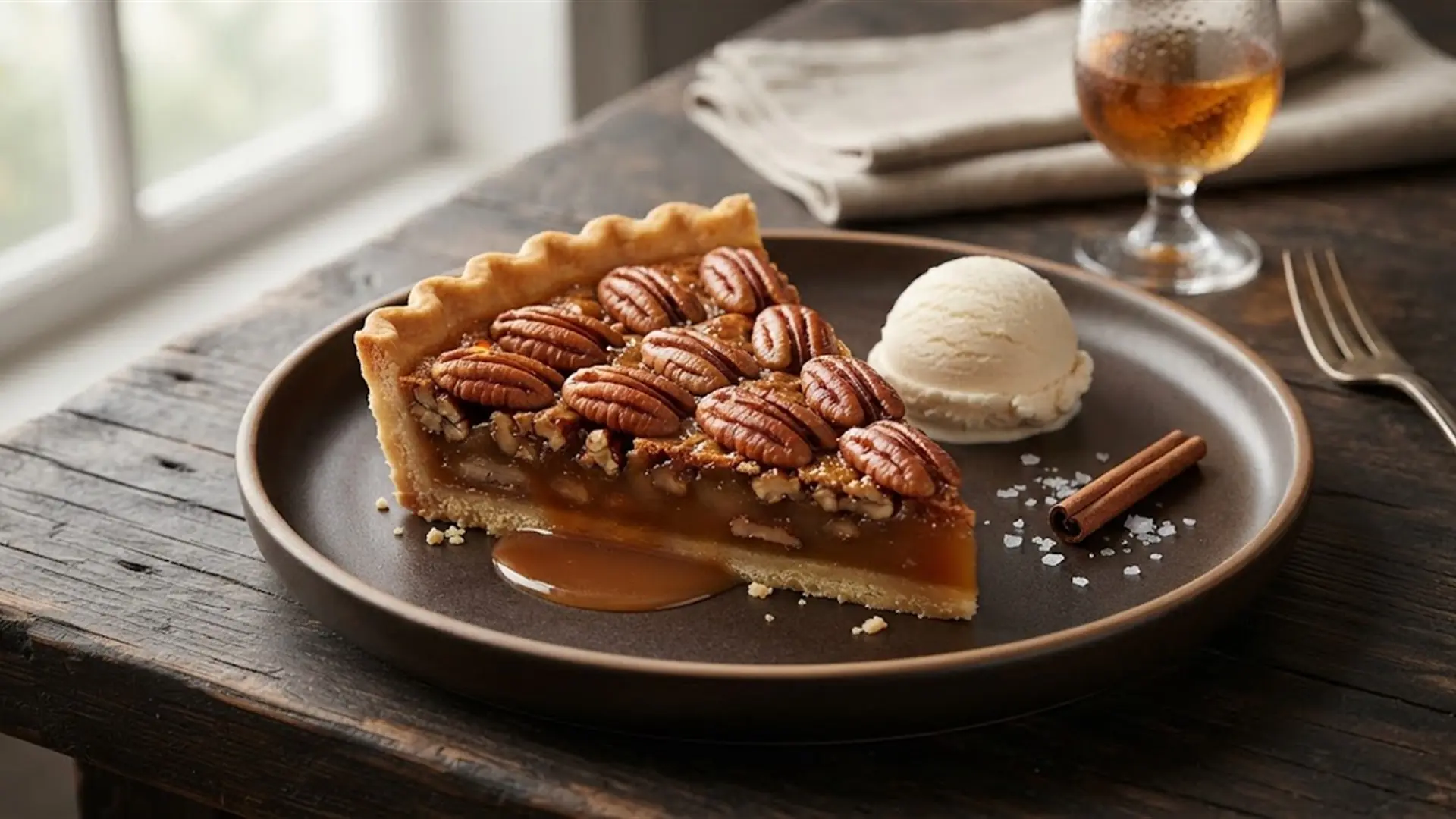
Summary: A pie with a filling of pecan nuts, eggs, butter and dark syrup, baked in a shortcrust pastry. The filling is baked at a lower temperature so it doesn’t curdle and the surface doesn’t crack. Total time 75 minutes plus cooling, serves 6.
Have you cooked this recipe? Share your result with the community.
Category: Desserts, American cuisine
Success rate: not rated yet % of users managed the recipe
Quick overview
- Dish: Pecan Pie – a classic American sweet pie with pecan nuts in a rich sweet filling, traditionally associated especially with the American South
- Category: Desserts, American cuisine
- Cuisine: American
- Main ingredient: Pecan nuts, 200 g
- Guide: 12 most famous American dishes: traditional recipes of American cuisine
- Total time: 75 minutes (25 minutes preparation + 50 minutes cooking), plus 30 minutes chilling the dough and 2 hours cooling the pie
- Difficulty: Medium
- Servings: 6 (Serving weight: 243 g)
- Key technique: Making shortcrust pastry cold, baking the filling at two temperatures
- Preparation types: Baking
- Dietary info & Allergens:tree nuts, gluten, milk, eggs
- Suitable for: Festive menu, holiday table, family celebration, dinner for guests
- Nutritional values (per 1 serving): 1005 kcal, Protein: 12.3 g, Fat: 63.7 g, Carbohydrates: 99.5 g
- Storage: 4 days in the fridge, 2 months in the freezer
- Pairing: A cup of coffee, bourbon, sweet dessert wine
- In short: Cold dough, filling without overwhipping and two baking temperatures – three things that decide whether the filling stays smooth or cracks.
WAGUU says: “Pecan pie is not baked in one go. The first fifteen minutes need a high temperature so the pastry sets, then just a lower temperature so the filling sets but doesn’t crack.”
Key facts
| Preparation time: | 25 minutes + 30 minutes chilling the dough |
| Cooking time: | 50 minutes |
| Temperature: | 190 °C for the first 15 minutes, then 160 °C; internal temperature of the filling 85 °C |
| Number of servings: | 6 (serving weight 243 g) |
In a nutshell
The filling of a pecan pie is a sugar syrup thickened with eggs. Eggs set at 80 to 85 °C, while the sugar dissolves and with the butter creates a thick mass. When the filling goes over 90 °C, the water in it starts to boil vigorously and the surface cracks. That’s why the temperature is lowered after fifteen minutes. The nuts are placed on the bottom and the filling is poured over them – during baking they float to the top and create a characteristic layer on the surface.
Ingredients
Base servings: 6 servings • Serving weight: 243 g
| Ingredient | Amount | Quality |
|---|---|---|
| pecan nuts | 200 g | whole halves, fresh |
| plain flour | 250 g | type 450, sifted |
| butter | 200 g | 82 %, chilled for the dough, melted for the filling |
| icing sugar | 60 g | for the dough, sifted |
| eggs | 4 pcs | size L, room temperature |
| dark corn syrup | 250 g | thick, dark |
| cane sugar | 120 g | unrefined, dark |
| vanilla extract | 8 g | pure, without artificial flavourings |
| fine sea salt | 3 g | balances the sweetness |
| cinnamon | 2 g | ground, fresh |
| lemon juice | 15 ml | freshly squeezed |
| double cream | 150 ml | 33 %, for serving |
Why you’ll love this recipe
- A pie that keeps: In the fridge for four days without any problem and it tastes fuller on the second day than right after baking.
- Shortcrust pastry without proving: The dough is mixed cold and just rests in the cold, so you don’t have to worry about proving.
- Precise ratios for 6 servings: 200 g nuts, 250 g syrup and 4 eggs for one 24 cm diameter pie.
- A moderately advanced cook can manage it: Five phases, one bowl for the dough and one for the filling.
Why it works: The filling of a pecan pie is a mixture of sugar, water and proteins. Eggs set at 80 to 85 °C: their proteins unfold and link into a network that holds the syrup together. When the filling exceeds 90 °C, the water in it starts to boil and steam bubbles tear the surface – that’s why the pie cracks. Lowering the temperature after fifteen minutes keeps the filling below this point, while the pastry is already firm. Sugar plays two roles: corn syrup prevents crystallisation of cane sugar, so the filling stays smooth and doesn’t set into a grainy mass. Butter is added to the filling melted and partially emulsifies with the water from the eggs; during baking some of the fat separates and creates a thin glossy film on the surface. The citric acid from the juice and salt temper the perceived sweetness, so the pie doesn’t taste just of sugar.
Recipe overview
Preparation: 25 min | Cooking: 50 min | Difficulty: Medium | Servings: 6 | Type: Dessert | Origin: American
Detailed method
Total process: 0 % done
Phase 1: Shortcrust pastry – 12 min
Appliances: kitchen scale, bowl, knife
1. Sift the plain flour with the icing sugar and a pinch of salt into a bowl. Add the chilled butter cut into cubes and work it into the flour with a knife or your fingers until the mixture resembles breadcrumbs. Pour in the ice water and bring the dough together into a ball – knead only as long as it takes to hold together.
VKB: The dough is smooth but cold to the touch and springs back only slightly. There is no dry flour left in the bowl, the pieces of butter are visible in the dough as light specks.
Before you move to the next step:
Don’t knead the dough for long and don’t warm it up with your hands. The butter will melt, the gluten will develop and the baked pastry will be hard instead of short.
Phase 2: Chilling and shaping – 8 min + 30 min in the cold
Appliances: fridge, pie dish, rolling pin
2. Wrap the dough in cling film and put it in the fridge for 30 minutes. Then roll it out to a 4 mm thick sheet and line a 24 cm diameter pie dish with it. Shape the edges into a wave and prick the bottom several times with a fork. Return the dish to the cold for another 15 minutes and preheat the oven to 190 °C.
VKB: The dough holds the shape of the dish, the edge is the same thickness all around and doesn’t hang over the edge anywhere. The bottom is pricked but not torn.
Before you move to the next step:
Always chill the pastry before baking. Warm pastry slides down the sides of the tin during baking and the edge collapses.
Phase 3: Filling – 10 min
Equipment: bowl, whisk, small saucepan
3. Whisk the eggs but do not whip them – it is enough for the yolks to combine with the whites. Add the dark corn syrup, muscovado sugar, vanilla extract, cinnamon, the remaining salt and the lemon juice. Melt the remaining butter in the saucepan and let it cool to 50 °C, then pour it into the filling in a thin stream, whisking constantly. Scatter the pecan halves over the base of the chilled pastry and pour the filling over them.
VKB: The filling is smooth and evenly caramel-brown, with no foam and no visible strands of egg white. The nuts are arranged in a single layer across the whole base.
Before you move on to the next step:
Do not whip the eggs to a foam. Air trapped in the filling expands during baking, the filling rises above the edge of the pastry and sinks back once cooled.
Phase 4: Baking – 50 min
Equipment: oven, wire rack, thermometer
4. Place the tin on a baking sheet in the centre of an oven preheated to 190 °C and bake for 15 minutes, until the edge of the pastry begins to turn golden. Then lower the temperature to 160 °C and bake for a further 35 minutes. The pie is ready when the edge is firm and the centre only wobbles slightly; a thermometer inserted in the middle reads 85 °C.
VKB: The surface is glossy, caramel-brown and free of cracks. The nuts have risen to the top and form an even layer. The edge of the pastry is golden brown all the way round.
Before you move on to the next step:
If the surface is browning too quickly, cover the pie with foil with a hole in the middle. Do not cut the baking short – an underbaked filling will stay runny once cooled.
Phase 5: Cooling and serving – 15 min + 2 hours
Equipment: wire rack, knife
5. Leave the pie to cool in the tin for 15 minutes, then transfer it to a wire rack and let it cool completely for two hours – the filling only sets as it cools. Just before serving, whip the cream to soft peaks and serve it separately. Cut the pie with a knife dipped in hot water.
VKB: The filling is completely set and holds its shape when cut. The slice is clean, the nuts stay in the filling and no runny syrup appears on the plate.
Required equipment
| Equipment | Ideal size | Alternative | Risk |
|---|---|---|---|
| pie dish | 24 cm diameter, 4 cm deep, metal | ceramic pie dish | in a dish that is too deep the filling will not cook through in the middle |
| rolling pin | 40 cm long, without handles | a bottle or a glass jar | the pastry rolls out unevenly and the base ends up thin |
| oven thermometer | probe type, up to 250 °C | skewer test | ovens heat unevenly and the filling easily goes past 90 °C |
| dough bowl | 2 l capacity, wide | food processor with a blade | in a processor the dough heats up easily and the butter melts |
| cooling rack | 28 cm diameter | an upturned baking sheet | in the tin, steam condenses under the pie and the base goes soggy |
Shopping list
Nutritional profile
Values per 1 portion (including whipped cream). Calculated from average nutritional values of the ingredients. Portion weight 243 g; this is a large slice, one sixth of a 24 cm pie.
| Nutrient | Per 100 g | Per 1 portion | Per 6 portions |
|---|---|---|---|
| Energy | 413 kcal | 1005 kcal | 6027 kcal |
| Fat | 26.2 g | 63.7 g | 382.2 g |
| of which saturates | 10.9 g | 26.5 g | 159.0 g |
| Carbohydrate | 41.0 g | 99.5 g | 597.1 g |
| of which sugars | 20.2 g | 49.2 g | 294.9 g |
| Protein | 5.1 g | 12.3 g | 74.0 g |
| Salt | 0.28 g | 0.67 g | 4.04 g |
| of which sodium | 0.11 g | 0.27 g | 1.62 g |
Reference intake of an average adult (8400 kJ / 2000 kcal). This dessert covers half the daily energy intake, so serve it in smaller slices than the standard portion.
WAGUU Pro level
- Pro standard: A verified recipe with precise ratios and visual checkpoints.
- Tip 1: Keep the butter for the pastry cubed in the freezer for 15 minutes. The colder the fat, the more defined the layers in the baked pastry.
- Tip 2: Stir the filling with a whisk, not an electric beater. A beater drags air into it and the pie rises in the oven.
- Tip 3: Toast the nuts in a dry pan for five minutes before adding them. This releases their oil and aroma, and the flavour of the pie is then more pronounced.
- Tip 4: Cut the pie once chilled and use a knife dipped in hot water. A warm filling sticks to the blade and the slice tears.
The science behind it
Pecan pie filling is a suspension of nuts in a supersaturated sugar solution held together by eggs. At 80 to 85 °C the egg proteins unfold, link into a three-dimensional network and the solution sets. Once the filling goes above 90 °C, the water in it begins to boil, the steam looks for a way to the surface and the filling cracks; that is exactly why the temperature is lowered to 160 °C after fifteen minutes. Corn syrup contains glucose and maltose, which stop the sucrose from the muscovado sugar from forming crystals – without it the filling would set into a grainy mass. The butter acts as the fat phase in the filling: some of it emulsifies with the water from the eggs, some floats to the surface, where it forms a thin glossy film during baking. Nuts are less dense than the filling, which is why they float to the top as the pie bakes. Citric acid and salt reduce the perceived sweetness by suppressing the perception of sugar on the tongue, so the pie does not taste one-dimensionally sweet.
Fine Dining – Professional techniques
- Plate composition: Stand a slice of pie on the plate with the point upwards, put a quenelle of whipped cream beside it and top it with three caramelised pecan halves.
- Textural contrasts: Add a crisp caramel lattice or toasted nuts on top to contrast with the short pastry and dense filling.
- Temperature contrast: Serve the pie at room temperature and the whipped cream ice-cold. The difference in temperature brings out the caramel flavour.
- Aromatic touches: Add a pinch of sea salt over the caramel surface. The saltiness on the tongue prolongs the lingering note of caramel.
Sensory radar
- Appearance: A glossy caramel-brown surface with a layer of pecan halves, a golden-brown fluted edge of pastry and a dense filling in the cut.
- Aroma: Toasted nuts and caramel, with buttery pastry in the background and a delicate note of cinnamon and vanilla.
- Taste: First caramel sweetness, then the buttery depth of the pastry and finally the bitter note of the pecans and a pinch of salt.
- Texture: The pastry snaps and is short, the filling dense and moist, the nuts firm with a slight bite.
Pairings
- Cup of coffee: The bitterness and roasted notes of coffee balance the sweetness of the filling. Espresso or filter coffee works best.
- Bourbon: The vanilla and caramel notes of the wood pair with the filling. Serve at room temperature.
- Sweet dessert wine: Tokaji or port. The higher viscosity of the wine matches the density of the pie.
- Unsweetened tea: Tannins dry the mouth after the fat and refresh the palate. A non-alcoholic version for children and drivers.
Different ways to make it
- With chocolate: Add 80 g of melted dark chocolate to the filling. It will be less sweet and the flavour darker.
- With bourbon: Replace 15 ml of lemon juice with the same amount of bourbon. Some of the alcohol evaporates and the aroma remains.
- Without corn syrup: Replace the syrup with 200 g of honey and 50 g of maple syrup. The filling will be less sweet and darker, with a denser texture.
Allergens and dietary information
Contains: gluten (plain flour); tree nuts (pecans); milk (butter, double cream); eggs (eggs) • Gluten: yes, in the pastry • Not suitable for: people with coeliac disease, lactose intolerance, egg allergy and nut allergy
Suitable for
A festive menu, a holiday table, a family celebration, a dinner party, an autumn and winter dessert.
Substitution guide
- Pecans: walnuts. The flavour is less sweet and slightly bitter, the texture is the same.
- Corn syrup: honey or maple syrup. The filling will be less sweet, darker and denser.
- Cane sugar: caster sugar with a tablespoon of molasses. The flavour will be less caramel-like.
- Plain flour: spelt flour or a gluten-free blend. The pastry will be more crumbly, so add 10 ml of extra water.
- Double cream: Greek yoghurt or soured cream. The tang will be more pronounced, but it refreshes.
- Cinnamon: nutmeg or ground cloves in the same amount. The flavour will be darker and more spicy.
FAQ
Why did my pie crack?
The filling went above 90 °C and the water in it started to boil. Lower the temperature to 160 °C after fifteen minutes and bake until the internal temperature reaches 85 °C.
How do I know the pie is done?
The edge is firm and the centre only wobbles slightly when you shake the tin. A thermometer inserted in the middle reads 85 °C, and a skewer comes out with crumbs, not with runny filling.
Can I bake the pie the day before?
Yes, it tastes better the next day. Let it cool, cover it and store it at room temperature. In the fridge the filling sets too much and the pastry goes soggy.
Why is the filling grainy?
The cane sugar crystallised. Corn syrup prevents crystallisation, so don’t leave it out and stir the filling only until the ingredients are combined.
Do I need to blind bake the pastry?
You don’t have to. The pastry is chilled and the filling is liquid, so the base won’t go soggy. But if you’re baking a pie with a wetter filling, blind bake the base for five minutes with baking beans.
How can I sweeten the pie if I want less sugar?
Reduce the cane sugar to 80 g, but keep the corn syrup at 250 g. If you cut back on the syrup too, the filling will be thin and won’t set.
WAGUU Petr advises: Cooking for 6 or more people?
6–8 people: Bake two 20 cm pies instead of one large one. A larger pie won’t cook through in the middle before the edge darkens. • 10+ people: Make two batches of pastry and two fillings, but bake one pie at a time. Two tins in the oven at once lower the temperature and the filling stays runny.
Sides and serving
Storage and reheating
Fridge: 4 days • Freezer: 2 months • Reheating: Serve the pie at room temperature or warm it for five minutes in the oven at 150 °C. In the microwave the pastry goes soggy and loses its crispness.
Author: WAGUU Petr & Team • Published: 6 Oct 2026 • Updated: 9 Oct 2026
More recipes from the article
Guide: 12 of the most famous American dishes: traditional recipes from American cuisine
Barbecue Ribs – slow-roasted or smoked pork ribs brushed with barbecue sauce
Pulled Pork – slow-roasted or smoked pork shredded into strands and served with barbecue sauce
Mac and Cheese – pasta with a rich cheese sauce, often cheddar, baked until golden
Gumbo – a thick Louisiana stew-like dish with meat or seafood, vegetables and a heavily spiced base
More recipes you might like
Why WAGUU?
Recipes on WAGUU are checked for accuracy of ingredients, methods and nutritional values. In this recipe the quantities appear in the same form in the ingredient table, in each stage of the method, in the shopping list and in the printable version – 200 g of butter is divided into 100 g for the pastry and 100 g for the filling, and this ratio matches the method text too.
Photo gallery from the method
Photos from the community: Cook it, photograph it and share the result.
You can upload photos in the comments below or send them by email.
Have you filmed a video of our recipe? Post a link to YouTube, YouTube Shorts, TikTok, Instagram Reels, Facebook Reels, Pinterest, Vimeo or X (Twitter) in the comments – we’ll be happy to publish it and help get you and your content noticed.
Most common mistakes
- Over-whisked filling – the air expands during baking and the filling spills over. Whisk the eggs only until they are combined with the syrup.
- One temperature throughout – the filling cracks. Bake for 15 minutes at 190 °C and then for 35 minutes at 160 °C.
- Warm pastry in the tin – the edge slumps during baking. Chill the pastry for 30 minutes and then leave it in the tin for 15 minutes.
- Cutting a warm pie – the filling runs. Let the pie cool for two hours; it only sets as it cools.