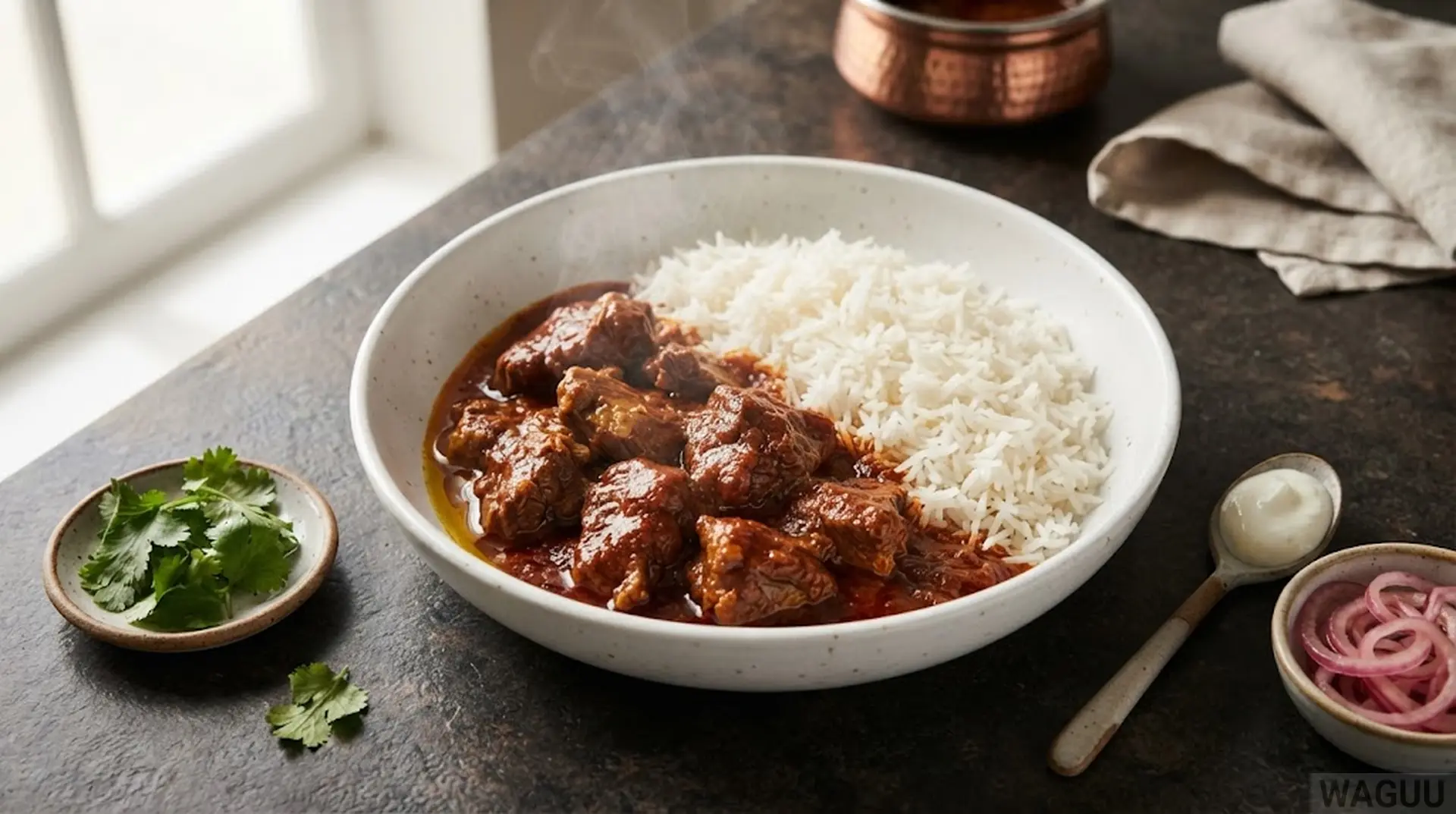
Summary: Lamb shoulder is coated in yogurt with Kashmiri spices, then slowly simmered in a tomato base with cumin, coriander and ground paprika. The colour and aroma come from the meat itself, not from added colouring. Total time 110 minutes, serves 6.
Have you cooked this recipe? Share your result with the community.
Category: Lamb and Game · Indian Cuisine
Success rate: not rated yet % of users managed this recipe
Quick overview
- Dish: Rogan Josh – slow-cooked lamb in an aromatic sauce with Kashmiri spices
- Category: lamb-and-game, indian-cuisine
- Cuisine: Indian
- Main ingredient: Lamb shoulder, 1100 g (boneless, diced) (quality specification)
- Guide: 12 most famous Indian dishes: traditional recipes from Indian cuisine
- Total time: 110 minutes (25 min preparation + 85 min cooking)
- Difficulty: Medium
- Servings: 6 (Portion weight: 402 g)
- Key technique: Coating the meat in spiced yogurt and slow simmering into a dark sauce
- Preparation types: Stewing, slow cooking
- Dietary info & allergens: milk (plain yogurt, ghee)
- Suitable for: Family dinner, dinner with friends, festive multi-course table, and preparing meals for several days ahead.
- Nutritional values (per 1 serving): 529 kcal, Protein: 39.6 g, Fat: 36.8 g, Carbohydrates: 10.0 g
- Storage: 3 days in the fridge, 1 month in the freezer
- Pairing: Indian light lager, Shiraz, salted lassi
- In short: Lamb shoulder is coated in yogurt with Kashmiri spices, then slowly simmered in a tomato base with cumin, coriander and ground paprika. Total time 110 minutes, 6 servings.
WAGUU says: “Rogan josh is not cooked with force. It is cooked with time and gentle heat.”
Key facts
| Preparation time: | 25 |
| Cooking time: | 85 |
| Temperature: | Coating the meat 190–200 °C, simmering 85–92 °C, simmering time 85 minutes |
| Number of servings: | 6 |
At a glance
You can recognise rogan josh by its colour: dark red, glossy, with fat that has separated to the surface. Long simmering over gentle heat is what matters, and the yogurt goes into the pan spoonful by spoonful, not all at once. If you pour the yogurt into a boiling base, you get a grainy sauce and tough meat.
Ingredients
Base servings: 6 servings • Portion weight: 402 g
| Ingredient | Amount | Quality |
|---|---|---|
| boneless lamb shoulder | 1100 g | shoulder or leg, cut into 4 cm cubes |
| plain yogurt | 300 g | full-fat, thick, at room temperature |
| onion | 3 pcs | medium, finely chopped |
| chopped tomatoes | 300 g | peeled, no added salt |
| crushed tomatoes | 200 g | crushed, unsweetened |
| ginger | 25 g | fresh, finely grated |
| garlic | 6 cloves | fresh, finely chopped |
| ghee | 60 g | clarified butter, for high heat |
| garam masala | 2 tsp | freshly ground blend |
| ground red chilli | 2 tsp | sweet paprika with a little heat |
| ground cumin | 2 tsp | ground, toasted |
| ground coriander | 2 tsp | ground, toasted |
| turmeric | 1 tsp | ground |
| ground cinnamon | 1 tsp | ground |
| ground cardamom | 1 tsp | ground |
| fresh coriander | 20 g | fresh, for garnish |
Why you will love this recipe
- Colour without colouring: The dark red colour comes from ground paprika, turmeric and long-fried onions. Nothing is artificially coloured.
- Meat that breaks with a spoon: Slow simmering below boiling point turns collagen into gelatine. The meat stays juicy and the sauce thickens on its own.
- A dish that tastes better the next day: The spices meld in the sauce overnight. It keeps for three days in the fridge and a month in the freezer.
Success guaranteed: Lamb shoulder contains a lot of collagen, which turns into gelatine at around 90 °C. This takes an hour or more, so the meat is simmered slowly and the liquid is kept below boiling point. The yogurt provides acid that tenderises the meat, but it curdles at a rapid boil. The salt comes from the yogurt and tomato purée, so no extra salt is added beforehand.
Recipe overview
Preparation: 25 min | Cooking: 85 min | Difficulty: Medium | Servings: 6 | Type: Main course | Origin: Indian
Detailed method
Overall progress: 0 % done
Phase 1: Preparing the meat and spices – 20 min
Equipment: bowl, chopping board, small bowls
1. Cut the lamb into evenly sized cubes and pat them dry with kitchen paper. Even size means the meat cooks through at the same time.
2. In a small bowl, mix the ground paprika, cumin, coriander, turmeric, cinnamon, cardamom and garam masala. Prepare the spices in advance because there is no time for measuring once you are at the hob.
VKB: The meat cubes are dry and evenly sized. The spices are measured into a bowl and uniform in colour, without lumps.
Before you move to the next step:
Wet meat stews in its own water and won’t brown. Dry each cube separately and don’t overcrowd the pan.
Phase 2: Sealing the meat – 10 min
Equipment: wide pan or cast-iron casserole, tongs
1. Melt half the ghee and heat until almost smoking. Add the meat with space between the pieces and let it brown on each side. Fry in two batches.
2. Remove the meat to a plate and leave the browned bits in the pan. That’s where the flavour is that will later colour the whole sauce.
VKB: The meat is dark brown and dry on the surface, and the pan has brown bits that are not black or bitter.
Before you move to the next step:
Meat crowded in one place steams and releases water. If a puddle appears in the pan, take the meat out, pour off the liquid and reheat the pan.
Phase 3: Onion and spice base – 15 min
Equipment: casserole, wooden spoon
1. In the remaining ghee, fry the onion until dark golden brown. Dark onion is the basis of rogan josh colour; pale onion won’t give the colour.
2. Add the ginger and garlic and fry until fragrant. Add the prepared spices and stir until they release their aroma and start to stick to the bottom.
VKB: The onion is dark golden brown and sweet to taste, the spices are fragrant and a thick paste forms on the bottom. The aroma is warm, not sharp.
Before you move to the next step:
Pale onion leaves the sauce pale and sweet. Let it really darken, but not to black – burnt onion gives a bitterness that can’t be fixed.
Phase 4: Simmering the meat in yogurt – 45 min
Equipment: lidded casserole, whisk
1. Return the meat to the pan and stir with the spiced onion. Then add the yogurt a tablespoon at a time, stirring constantly, and keep the heat low so the sauce doesn’t boil.
2. Add the chopped and crushed tomatoes, cover and simmer over a low heat. Stir the bottom during simmering to prevent the sauce catching.
VKB: The sauce is smooth, without grains of curdled yogurt, and the colour has turned dark red. The meat is starting to soften but still holds its shape.
Before you move to the next step:
Yogurt in a boiling sauce curdles into grains. Lower the heat so only an occasional bubble appears on the surface, and add the yogurt slowly.
Phase 5: Reducing to a dark sauce – 30 min
Equipment: lidded casserole, spoon
1. Remove the lid and let the sauce evaporate until it thickens. The fat will separate during simmering and remain on the surface in a thin layer.
2. Taste the meat: it should break with a spoon but not fall apart. If it’s tough, add a spoonful of water and continue simmering.
VKB: The sauce is dark red, thick and glossy, with fat on the surface. The meat can be cut with a spoon and holds its cube shape.
Before you move to the next step:
The sauce must not stay thin – it wouldn’t coat the rice. Reduce it uncovered, but stir so the bottom doesn’t catch.
Phase 6: Finishing and serving – 5 min
Equipment: serving dish, spoon
1. Taste the sauce and adjust with salt and the remaining garam masala. Add spices only to the finished sauce so the aroma stays fresh.
2. Transfer the rogan josh to a warm dish, top with a spoonful of yogurt and coriander. Serve with naan or a bowl of rice.
VKB: The colour is dark reddish-brown, the sauce coats the spoon and doesn’t run off. The aroma is warm, spicy and slightly sour from the yogurt.
Required equipment
| Utensils | Ideal size | Alternative | Risk |
|---|---|---|---|
| cast-iron casserole with lid | 4 l capacity | heavy-based saucepan | a thin pan will catch the sauce at the bottom before the meat is tender |
| wide pan for sealing | 28 cm diameter | cast-iron frying pan or sauteuse | a small pan won’t let the meat brown and it will release water |
| kitchen thermometer | up to 250 °C | check by bubbles at the edge | without measuring, the sauce will boil and the yogurt will curdle |
| whisk | silicone or metal | wooden spoon | yogurt added without stirring will curdle at the bottom of the pan |
Shopping list
Nutritional profile
Values per 1 serving (without side dish). Calculated from average nutritional values of ingredients.
| Nutrient | Per 100 g | Per 1 serving | Per 6 servings |
|---|---|---|---|
| Energy | 552 kJ / 132 kcal | 2213 kJ / 529 kcal | 13280 kJ / 3174 kcal |
| Fat | 9.2 g | 36.8 g | 220.8 g |
| of which saturates | 4.5 g | 18.3 g | 109.7 g |
| Carbohydrate | 2.5 g | 10.0 g | 60.0 g |
| of which sugars | 2.3 g | 9.2 g | 55.2 g |
| Protein | 9.9 g | 39.6 g | 237.6 g |
| Salt | 0.1 g | 0.4 g | 2.3 g |
Reference intake of an average adult (8400 kJ / 2000 kcal).
WAGUU Professional level
- Pro standard: Verified recipe with precise ratios and visual checkpoints.
- Tip 1: Verified recipe with precise ratios and visual checkpoints.
- Tip 2: The meat cubes are dry and evenly sized. The spices are measured in a bowl and evenly coloured, without lumps. Wet meat stews in its own water and won’t brown. Dry each cube separately and don’t overcrowd the pan.
- Tip 3: The meat is dark brown and dry on the surface, and the pan has brown bits that are not black or bitter. Meat crowded in one place steams and releases water. If a puddle appears in the pan, take the meat out, pour off the liquid and reheat the pan.
- Tip 4: Prepare the ingredients on the table in small bowls beforehand. Indian cooking relies on spices added in a precise order, and there’s no time to portion ingredients during cooking.
Scientific background
The colourings from ground paprika and turmeric are fat-soluble, so the spices are first fried in ghee. During simmering, collagen turns into gelatine and the sauce thickens without flour. The acid from the yogurt lowers the pH and slows down the browning of the meat, so it isn’t added all at once at the beginning.
Fine Dining – Professional techniques
- Plate composition: Spread the sauce across the base of a deep plate and place three pieces of meat in the centre. Leave a ring of clean porcelain around the edge.
- Texture contrasts: Add something crunchy – toasted flaked almonds or a thin piece of naan dried out in the oven. A thick sauce needs contrast.
- Temperature contrast: Spoon a little yogurt over the meat and add a few strands of saffron. The white of the yogurt makes the dark sauce stand out.
- Aromatic extras: Serve pickled onions separately, chilled to 6°C. The acidity and coolness cleanse the palate between mouthfuls.
Sensory radar
- Appearance: The sauce is dark reddish-brown and glossy, with a thin layer of fat on the surface and coriander peeking through between the pieces of meat.
- Aroma: A warm blend of cumin, cinnamon and cardamom, followed by tangy yogurt and finally fresh coriander.
- Taste: Deep meaty flavour with the tang of yogurt, finishing with a warmth of spice that lingers in the mouth.
- Texture: Meat soft and fibrous, sauce thick and velvety, with small pieces of onion.
Pairings
- Indian pale lager: A lager with higher carbonation cleanses the palate from the rich spiced sauce. Serve at 5–7°C.
- Shiraz: A Shiraz with dark fruit and soft tannins keeps pace with both the lamb and the spices.
- Salted lassi: A salted lassi with cumin cools and binds the heat. It goes better with rich meat than water.
Variations
- Beef rogan josh: Beef topside replaces lamb and simmers for thirty minutes longer. The sauce takes on a darker colour and a more beefy flavour.
- Goat rogan josh: Goat shoulder is leaner and needs longer braising. Use a third less yogurt so the meat stays tender.
Allergens and dietary information
Contains: milk (plain yogurt, ghee) • Gluten: no, the recipe is gluten-free (yogurt, tomatoes, spices) • Not suitable for: people with an allergy to milk and dairy products
Suitable for
Family dinners, meals with friends, a festive table with multiple courses, and cooking ahead for several days.
Substitution guide
- boneless lamb shoulder: beef topside (braise for thirty minutes longer)
FAQ
What meat should I use for rogan josh?
Lamb shoulder or leg. Shoulder has more collagen and becomes more tender after braising. Beef topside also works, but needs longer braising.
Why did my yogurt curdle in the sauce?
The sauce was boiling when the yogurt was added. Turn the heat down until only the occasional bubble breaks the surface, and add the yogurt a spoonful at a time.
How can I colour rogan josh if I don’t have Kashmiri chilli?
Use a mix of sweet paprika and turmeric in a two-to-one ratio. Longer-fried onions also add colour, but the flavour will change slightly.
Does rogan josh have to be hot?
No, traditionally it is warming rather than hot. Use sweet paprika and only a pinch of hot chilli, then offer extra chilli at the table.
Can rogan josh be made a day ahead?
Yes, and it’s better. Leave it overnight in the fridge, skim off the solidified fat the next day and reheat gently.
What to serve with rogan josh?
Basmati rice, naan or roti, and pickled onions. A tangy, crunchy side balances the rich sauce.
WAGUU Petr advises: Cooking for 6 or more?
6–8 people: Make the masala (fried spice base) in double quantity and store half in the fridge. When cooking for more people, use two pans rather than one large one – spices don’t fry evenly in too thick a layer. • 10+ people: A tandoor can be replaced by a grill or a cast-iron pan heated to maximum in the oven. Prepare the naan dough and chicken marinade the day before and keep them in the fridge – both flavour and texture will be better.
Sides and serving
Serving: Serve rogan josh in a deep bowl with basmati rice, top with a spoonful of yogurt and a sprig of coriander. Naan and a small bowl of pickled onions are part of the meal.
Storage and reheating
Fridge: 3 days • Freezer: 1 month • Reheating: Fridge: 3 days • Freezer: 1 month • Reheating: gently to 80°C, with a spoonful of water, add yogurt only after heating
Author: WAGUU Petr & Team • Published: 9 Oct 2026 • Updated: 10 Oct 2026
More recipes from the article
Guide: 12 most famous Indian dishes: traditional recipes from Indian cuisine
Butter Chicken – chicken in a mild creamy tomato sauce with butter and aromatic spices
Chicken Tikka Masala – pieces of marinated chicken in a spiced tomato and cream sauce
Tandoori Chicken – chicken marinated in yogurt and spices and cooked at high temperature
Biryani – aromatic layered rice with meat, saffron and a blend of spices
Chana Masala – chickpeas simmered in a spicy sauce of tomatoes, onions and aromatic spices
Chana Masala – chickpeas simmered in a spicy sauce of tomatoes, onions and aromatic spices
Dal Tadka – lentils flavoured with fried spices, garlic, onion and chilli
Masala Dosa – thin crispy fermented rice and lentil pancake with spiced potatoes
Samosa – fried triangular parcels filled with potatoes, peas and spices
Chole Bhature – spiced chickpeas with large fried leavened bhature breads
Naan – traditional Indian flatbread baked at high temperature in a tandoor
More recipes you might like
Why WAGUU?
WAGUU recipes are checked for accuracy of ingredients, methods and nutritional values.
Photo gallery of the method
Community photos: Cook, take a photo and share the result.
You can upload photos in the comments below or send them by email.
Have you filmed a video of our recipe? Paste a link to YouTube, YouTube Shorts, TikTok, Instagram Reels, Facebook Reels, Pinterest, Vimeo or X (Twitter) in the comments – we’ll be happy to publish it and help you and your content get noticed.
Common mistakes
- Preparing the meat and spices – Wet meat steams in its own water and doesn’t brown. Dry each piece separately and don’t overcrowd the pan.
- Browning the meat – Meat piled in one place steams and releases water. If a puddle appears in the pan, take the meat out, pour off the liquid and reheat the pan.
- Onion and spice base – Pale onions leave the sauce pale and sweet. Let them really darken, but not to black – burnt onion gives a bitterness that can’t be fixed.
- Simmering meat in yogurt – Yogurt in a boiling sauce curdles into grains. Turn the heat down so that only the occasional bubble breaks the surface, and add the yogurt slowly.