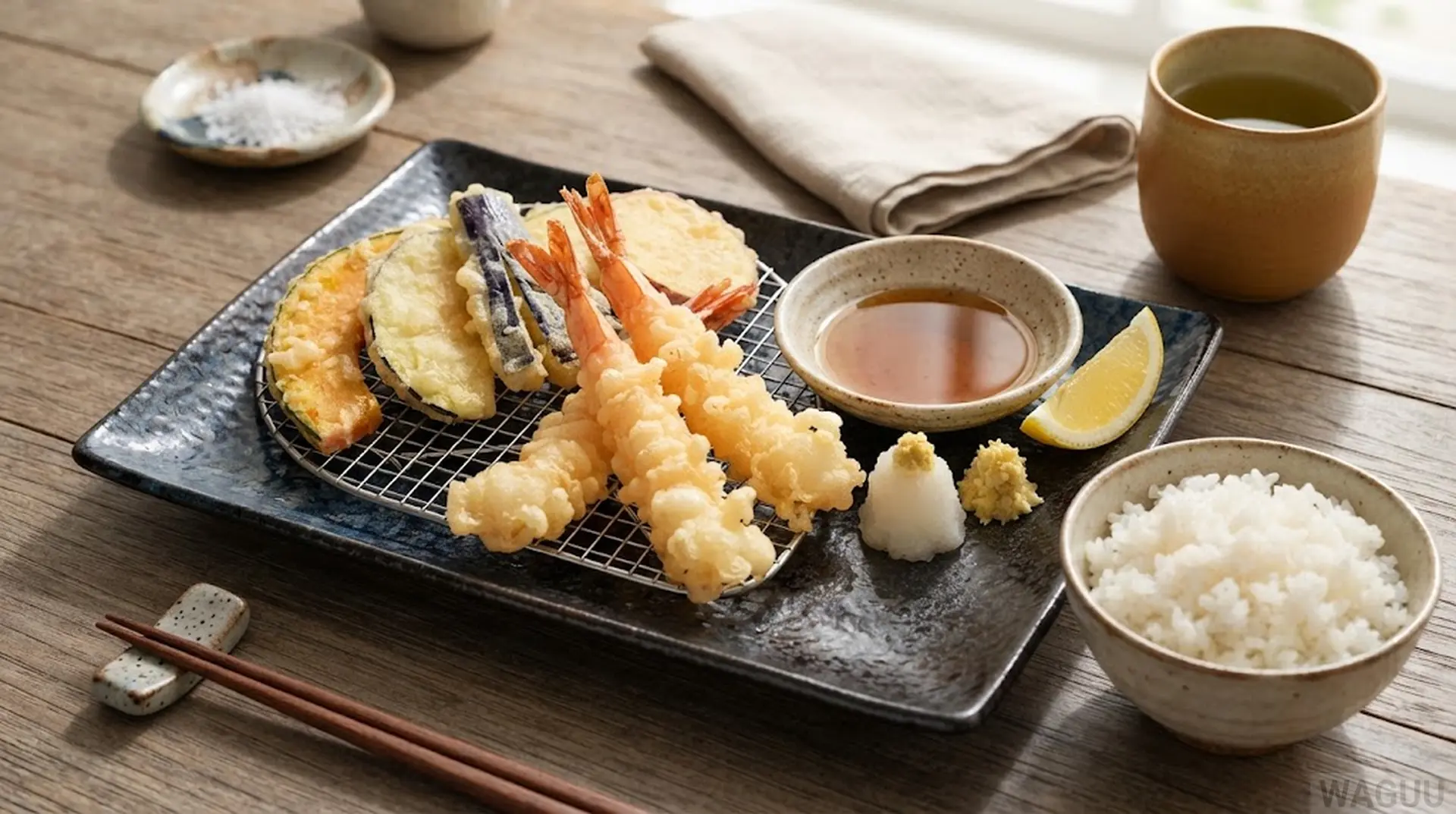
Summary: Shrimp and vegetable tempura in a thin batter made with ice water and all-purpose flour. The batter is mixed with chopsticks only and left lumpy; a smooth batter firms up into a heavy coating. The oil is kept between 340 and 355°F, and the temperature is checked with a drop of batter. Finished pieces are placed on a wire rack and served immediately. Total time 60 minutes, makes 6 servings.
Did you make this recipe? Share your result with the community.
Categories: fish-and-seafood, japanese-cuisine
Success rate: not rated yet% of users mastered this recipe
Quick overview
- Dish: Tempura – lightly battered and fried seafood or vegetables in a thin, crispy coating
- Categories: fish-and-seafood, japanese-cuisine
- Cuisine: Japanese
- Main ingredient: Tiger shrimp, 1.3 lb (raw, peeled, tail-on) (quality specification)
- Guide: 12 most famous Japanese dishes: traditional recipes of Japanese cuisine
- Total time: 60 minutes (35 min prep + 25 min cooking)
- Difficulty: Medium
- Servings: 6 (Serving size: 10.6 oz)
- Key technique: Frying in a thin batter made with ice water, oil temperature held between 340 and 355°F
- Preparation type: Frying
- Dietary info & allergens: shellfish (shrimp), gluten (all-purpose flour, soy sauce), eggs (eggs, batter), soy (soy sauce)
- Suitable for: Quick weeknight dinner, appetizer for guests, weekend cooking for six, dinner party at a Japanese table, homemade version of a restaurant classic.
- Nutrition (per serving): 525, Protein: 32.0 g, Fat: 21.0 g, Carbs: 50.0 g
- Storage: 1 day in the fridge, 1 month in the freezer
- Pairing: Japanese light lager, dry white wine, sencha green tea
- In short: Tempura with shrimp and vegetables in a thin batter made from ice water and all-purpose flour. Total time 60 minutes, 6 servings.
WAGUU says: “Tempura batter is not mixed until smooth. Lumps mean the flour hasn’t been overhydrated – and that’s exactly why the coating stays thin and crispy.”
Key facts
| Prep time: | 35 minutes |
| Cook time: | 25 minutes |
| Temperature: | Oil 340–355°F, batter made with ice water at 39–43°F |
| Servings: | 6 |
At a glance
Tempura is known for its coating, which is thinner than other fried foods. Three things matter: ice water, mixing with chopsticks instead of a whisk, and oil temperature. Cold batter hits hot oil and sets on the surface immediately, so fat doesn’t penetrate. When the batter is mixed until smooth, a gluten network forms that absorbs oil during frying and makes the coating heavy. Shrimp are straightened with slits before coating so they don’t curl during frying.
Ingredients
Base servings: 6 servings • Serving size: 10.6 oz
| Ingredient | Amount | Quality |
|---|---|---|
| tiger shrimp | 21 oz | raw, peeled, tail-on, 12 pieces |
| all-purpose flour | 6.5 oz | wheat, finely milled, sifted |
| eggs | 2 pcs | fresh, chilled, size M |
| ice water | 8.5 fl oz | soft, with ice cubes |
| hokkaido pumpkin | 11 oz | firm, cut into 1/4-inch slices |
| eggplant | 2 pcs | smaller, firm, 10.6 oz |
| bell pepper | 2 pcs | red, meaty, 10.6 oz |
| sweet potato | 14 oz | firm, orange, cut into 1/4-inch slices |
| canola oil | 6.3 cups | for frying, high smoke point |
| fine sea salt | 0.2 oz | for seasoning |
| soy sauce | 1/3 cups | naturally fermented, for dipping sauce |
| mirin | 3 tbsp | sweet rice cooking wine |
| dashi stock | 10 tbsp | from seaweed and dried fish, for dipping sauce |
| daikon radish | 5.5 oz | firm, fresh, finely grated |
| fresh ginger | 0.7 oz | strong juicy rhizome, grated |
Why you’ll love this recipe
- Thin coating, not a heavy crust: Ice water and brief mixing with chopsticks keep the coating thin. The shrimp flavor stays inside, not under a layer of dough.
- Vegetables in the same batch: Shrimp and vegetables are fried in the same batter and at the same oil temperature. A whole dinner fits on one tray.
- Exact ratios for 6 servings: Three and a half ounces of shrimp per serving, two tablespoons of batter per piece, and oil temperature monitored. Everything scales with the number of diners.
Guaranteed success: Tempura coating is made from flour, eggs, and water. When flour is mixed for a long time, its proteins form a gluten network that absorbs oil during frying – the coating darkens, becomes heavy, and loses crispness. That’s why the batter is mixed only briefly and dry spots remain. Oil temperature determines how quickly the coating seals. At 340 to 355°F, the surface dries before fat penetrates deeper. At lower temperatures, the coating absorbs oil; at higher temperatures, it burns outside and stays raw inside. Water in the batter turns to steam at the oil boundary, and the steam lifts the coating – that’s why pieces turn themselves and why we shouldn’t add too many at once. The steam escaping from the coating cools the oil, and with too many pieces the temperature drops below 340°F.
Recipe overview
Prep: 35 min | Cook: 25 min | Difficulty: Medium | Servings: 6 | Type: Main dish | Origin: Japanese
Detailed instructions
Total progress: 0 % done
Phase 1: Prepare ingredients – 20 min
Equipment: refrigerator, sharp knife
1. Peel the shrimp, leaving the tail intact, and make several shallow slits on the inner belly side. Then place the shrimp on a paper towel and pat dry on both sides.
2. Cut the pumpkin, eggplant, bell pepper, and sweet potato into slices of equal thickness and place them on a tray. Refrigerate the vegetables and shrimp until you prepare the batter.
3. In a bowl, mix the dashi stock with soy sauce and mirin, then refrigerate. Grate the daikon radish and ginger finely into two small bowls.
VKB: The shrimp are dry to the touch, the tail stays attached, and after slitting they don’t curl when placed on the cutting board. All vegetable slices are the same thickness and lie in a single layer.
Before you move to the next step:
Do not wash the shrimp under running water. Wipe surface water with a paper towel; a wet shrimp dilutes the batter and it separates during frying.
Phase 2: Dipping Sauce and Batter – 8 min
Equipment: none
1. Pour the water into a bowl and add a few ice cubes. Crack the eggs into a second bowl and whisk them just to combine, then pour in the ice water and stir.
2. Sift the flour into the liquid and stir with chopsticks only until the ingredients come together. Leave dry patches of flour in the batter and set the bowl inside a larger bowl filled with ice and water.
VKB: The batter is thin, drips from the chopsticks in a slender stream, and shows lumps of dry flour. It is cold to the touch and has no bubbles on the surface.
Before you move to the next step:
Do not mix the batter with a whisk and do not let it sit in a warm place. Any longer mixing builds a gluten network that absorbs oil during frying and darkens the coating.
Phase 3: Heating the Oil – 8 min
Equipment: deep fryer or tall pot, kitchen thermometer
1. Pour oil into a deep fryer or tall pot so the level reaches one third of the vessel’s height. Heat over medium heat and monitor the temperature with a thermometer.
2. Test the oil temperature with a drop of batter. The drop should sink to the bottom and immediately rise back to the surface, where it spreads into fine bubbles.
VKB: The thermometer reads 170–180 °F. A drop of batter returns to the surface and does not burn. The oil surface is shiny, not smoking, and shows tiny swirls when viewed against the light.
Before you move to the next step:
Never heat the oil over the highest flame. Overheated fat turns bitter and the coating darkens before the shrimp is heated through.
Phase 4: Frying – 15 min
Equipment: fryer, tongs, rack
1. Hold the shrimp by the tail, dip them into the batter, and let the excess drip off. Add them to the oil a few at a time, keeping space between them so they do not stick together.
2. Coat the vegetables the same way and fry according to the thickness of the slices. Lift out the finished pieces with tongs, let them drain over the oil, and place them on a rack, not on a paper towel.
VKB: The coating is pale golden and glistens after being lifted from the oil, but is not greasy. The bubbles around the pieces are fine and fast. The shrimp is opaque inside when cut, but still moist.
Before you move to the next step:
Do not add more pieces to the oil than it can keep at temperature. When the bubbles around the pieces subside, the oil has cooled and the next pieces would absorb fat.
Phase 5: Resting and Serving – 5 min
Equipment: rack, ladle
1. Place the finished pieces on a rack over a baking sheet so the fat can escape underneath. Leave gaps between the pieces and arrange them in a single layer.
2. Serve the tempura on a warmed plate with a bowl of dipping sauce, grated radish, and ginger. Do not overlap the pieces on the plate.
VKB: Drops of fat collect on the baking sheet under the rack, and the coating stays dry and crisp. When pressed with a finger, the coating breaks rather than bends.
Required Equipment
| Utensil | Ideal Size | Alternative | Risk |
|---|---|---|---|
| deep fryer | 4 qt capacity, with basket and temperature dial | tall pot with thermometer | a shallow pan cannot hold temperature and the coating absorbs oil |
| kitchen thermometer | up to 480 °F, with fast response | check with a drop of batter | without temperature measurement, the coating easily burns outside and stays raw inside |
| kitchen tongs | long narrow jaws | two forks with long handles | short tongs bring your hand close to the surface and risk scalding |
| draining rack | 12 × 8 in, with 0.4 in mesh | oven rack set over a baking sheet | on a paper towel, steam condenses under the pieces and the coating softens |
| mixing chopsticks | wooden, 12 in | fork with blunt tines | a whisk or blender creates a gluten network in the batter |
Shopping List
Nutrition Profile
Values per 1 serving (without sides). Calculated from average nutritional values of ingredients.
| Nutrient | Per 100 g | Per 1 serving | Per 6 servings |
|---|---|---|---|
| Energy | 732 kJ / 175 kcal | 2197 kJ / 525 kcal | 13180 kJ / 3150 kcal |
| Fat | 7.0 g | 21.0 g | 126.0 g |
| of which saturated | 1.2 g | 3.5 g | 21.0 g |
| Carbohydrates | 16.7 g | 50.0 g | 300.0 g |
| of which sugars | 1.0 g | 3.1 g | 18.6 g |
| Protein | 10.7 g | 32.0 g | 192.0 g |
| Salt | 0.7 g | 2.1 g | 12.6 g |
Reference intake of an average adult (8400 kJ / 2000 kcal).
WAGUU Pro Level
- Pro standard: Tested recipe with precise ratios and visual checkpoints.
- Tip 1: Tested recipe with precise ratios and visual checkpoints.
- Tip 2: Stir the batter with chopsticks only until the ingredients come together. Dry patches of flour in the batter are not a mistake, they ensure a thin coating.
- Tip 3: Before coating, straighten the shrimp with a few shallow cuts on the inner belly. During frying they will not curl into a ring and the coating stays even.
- Tip 4: Fry in small batches and let the oil return to temperature between batches. Cold oil soaks into the coating and the crispness is lost.
Scientific Background
The crispness of the coating depends on how much water remains in the batter and how quickly it escapes. When placed in oil, surface water turns to steam, which lifts the coating and creates pores. The less the batter is mixed, the fewer gluten strands form and the thinner the resulting coating. Gluten forms an elastic network that traps water and oil, so a smooth batter darkens and softens after frying. Oil temperature determines how quickly the surface dries. At 170 to 180 °F, the coating dries before fat penetrates deeply. When many pieces are added to the oil at once, the escaping steam cools the oil and the coating absorbs fat. That is why frying is done in small batches. For shrimp, protein also plays a role: muscle fibers contract above 60 °F, so shrimp curl into a ring. Shallow cuts on the inner belly limit this movement and the shrimp stays straight.
Fine Dining – Professional Techniques
- Plate composition: Arrange the tempura on the plate so the pieces do not touch each other. Place a strip of absorbent paper under each piece and a bowl of dipping sauce alongside.
- Texture contrasts: Next to the crispy shrimp, place a piece of steamed pumpkin. The soft pumpkin with its creamy flavor provides contrast against the thin coating.
- Temperature contrast: Serve the tempura immediately after lifting from the oil, when the coating is hottest. Serve the dipping sauce chilled; the temperature difference highlights the crispness.
- Aromatic additions: Grate fresh yuzu or organic lemon zest into the dipping sauce. The aroma is released by the heat of the coating and rises to the nose before the first bite.
Sensory Radar
- Appearance: Light golden to pale yellow coating, thin and irregular, with fine bubbles on the surface. Shrimp show pink through the coating, vegetables keep their color. No traces of oil on the rack under the pieces.
- Aroma: Fresh aroma of fried batter, followed by the sweet aroma of shrimp and vegetables. The dipping sauce adds a fresh note of dashi and soy sauce.
- Taste: Neutral flavor of the coating, sweet taste of shrimp and vegetables. The dipping sauce adds saltiness and a subtle seaweed flavor.
- Texture: Coating crispy, breaks when bitten and does not bend. Shrimp firm and springy, vegetables soft inside. No layer of oil between the coating and the ingredient.
Pairing
- Japanese light lager: Carbonation and mild bitterness cut through the oil from the coating. Serve chilled at 45–45°F.
- Dry white wine: Muscadet or Chablis with higher acidity. The wine’s acidity cleanses the palate after the fried coating.
- Sencha green tea: Warm but not boiling. The tea’s bitterness balances the saltiness of the dipping sauce.
Variations
- Vegetable tempura:: Replace shrimp with slices of pumpkin, eggplant, sweet potato, and bell pepper. Cut vegetables into slices of equal thickness so they fry for the same amount of time.
- Fish tempura:: Use white fish fillet cut into wider strips instead of shrimp. Pat the fish dry with a paper towel before coating; water on the surface will thin the batter.
Allergens and dietary information
Contains: crustaceans (shrimp), gluten (all-purpose flour, soy sauce), eggs (egg, batter), soy (soy sauce) • Gluten: yes, in all-purpose flour and soy sauce • Not suitable for: people with celiac disease, allergies to crustaceans, eggs, and soy
Suitable for
Quick weeknight dinner, appetizer for guests, weekend cooking for six, dinner with friends at a Japanese table, homemade version of a restaurant classic.
Substitution catalog
- Mirin:: dry white wine with a teaspoon of sugar. The flavor is sharper and less sweet, but the balance of salty and sweet remains.
FAQ
Why not mix the batter until smooth?
Mixing for a long time creates a gluten network in the flour, which absorbs oil during frying and darkens the coating. Therefore, mix only with chopsticks and leave dry spots in the batter.
How do I know the oil is at the right temperature?
A thermometer should read 170 to 355°F. Without a thermometer, test with a drop of batter: it sinks to the bottom, immediately returns to the surface, and spreads into fine bubbles.
Why do shrimp curl into a ring?
Muscle fibers contract with heat, and because they are shorter on the inner belly side, the shrimp bends. Shallow cuts on the inner side limit this movement and keep the shrimp straight.
Can I fry tempura ahead of time?
The coating tastes best immediately after coming out of the oil. If you must, hold the finished pieces in an oven at 175°F on a rack and serve within 15 minutes. In a microwave, the coating softens.
What can I substitute for dashi stock?
Stock made from kombu seaweed and dried shiitake mushrooms. The flavor will be slightly different, but the dipping sauce will remain fresh and not salty.
How many pieces to fry at once?
Enough so that the oil surface remains moving and the pieces do not touch. When the bubbles around the pieces subside, the oil has cooled and more pieces would absorb oil. Between batches, let the oil return to temperature.
WAGUU Petr advises: Cooking for 6 or more people?
6–8 people: Fry in two deep fryers or in one pot in two batches and hold the finished pieces in an oven at 175°F on a rack. Always mix fresh batter; after twenty minutes it loses its chill. • 10+ people: Choose the vegetable variation; it can be cut ahead and holds its shape. Fry shrimp last; they need the lowest oil temperature and the shortest time.
Sides and serving
Serving: Serve immediately on a rack with dipping sauce, grated daikon radish, and a bowl of rice. Tempura cannot be set aside; the coating softens within minutes.
Storage and reheating
Refrigerator: 1 day • Freezer: 1 month • Reheating: Refrigerator: 1 day • Freezer: 1 month • Reheating: Reheat tempura in an oven at 355°F for 6 minutes or in an air fryer. In a microwave, the coating softens.
Author: WAGUU Petr & Team • Published: 7 Oct 2026 • Updated: 10 Oct 2026
More recipes from the article
Guide: 12 most famous Japanese dishes: traditional recipes of Japanese cuisine
Ramen – noodle soup with rich broth, meat, egg, vegetables, and other typical toppings
Tonkatsu – breaded fried pork cutlet served with finely shredded cabbage and tonkatsu sauce
Takoyaki – round fried batter balls filled with octopus, typical for Osaka
Katsudon – bowl of rice with breaded pork cutlet tonkatsu, egg, and onion in seasoned broth
Gyudon – bowl of rice topped with thin slices of beef and onion simmered in a sweet-salty sauce
More recipes you might like
Why WAGUU?
Recipes on WAGUU are checked for accuracy of ingredients, procedures, and nutritional values.
Photo gallery of the process
Photos from the community: Cook, take a photo, and share the result.
You can upload photos in the comments below or send them by email.
Did you film a video of the process for our recipe? Paste a link to YouTube, YouTube Shorts, TikTok, Instagram Reels, Facebook Reels, Pinterest, Vimeo, or X (Twitter) in the comments – we will be happy to publish it and help promote you and your content.
Most common mistakes
- Batter mixed until smooth – flour forms a gluten network, the coating absorbs oil and darkens. Mix only with chopsticks and only until ingredients are combined.
- Warm oil and warm batter – warm batter spreads on the oil and the coating does not stick. Keep water and eggs in the refrigerator and mix the batter just before frying.
- Too many pieces in the oil – oil temperature drops below 340°F, the coating absorbs fat and remains soft. Fry in small batches and let the oil return to temperature between batches.
- Finished pieces on a plate – steam condenses under the pieces and the coating softens from the bottom. Place tempura on a rack, not on a plate or paper towel.