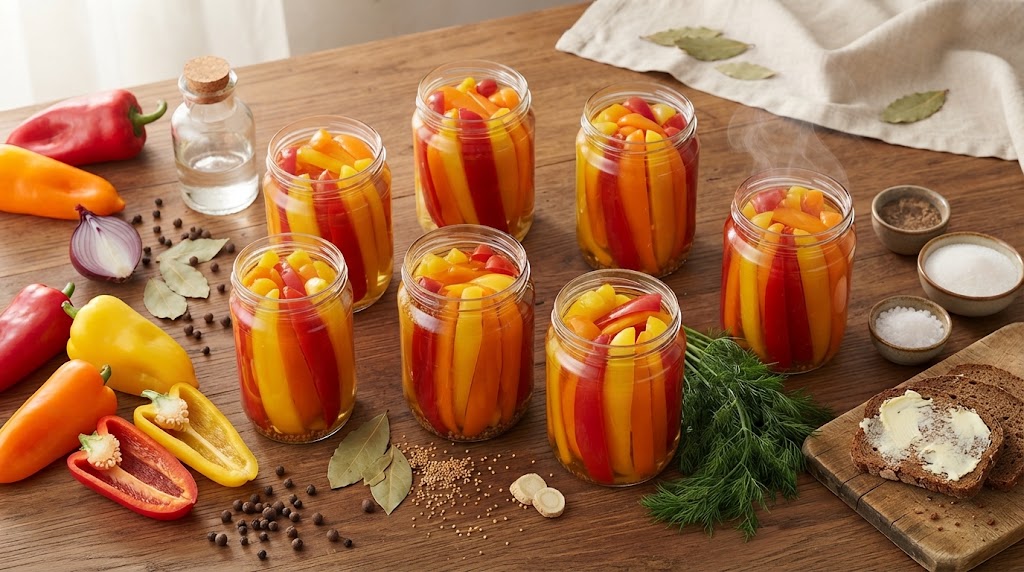
Summary: A complete guide to home-canning sweet peppers in a sweet-and-sour brine. You will learn which peppers to choose, how to slice them lengthwise into six strips, how to build a balanced brine, how to water-bath process the jars and how to get that snap that lasts a full year in the pantry. Written for first-time canners and seasoned ones alike. Reading time roughly 11 minutes.
Category: Articles | Reading time: 11 minutes
Photo gallery from the process
Made any of the variations? Drop a photo in the comments on the recipe and we will gladly add it to the gallery. Filmed a video of the process? Post a link to YouTube, YouTube Shorts, TikTok, Instagram Reels, Facebook Reels, Pinterest, Vimeo or X (Twitter) in the comments and we will feature it.
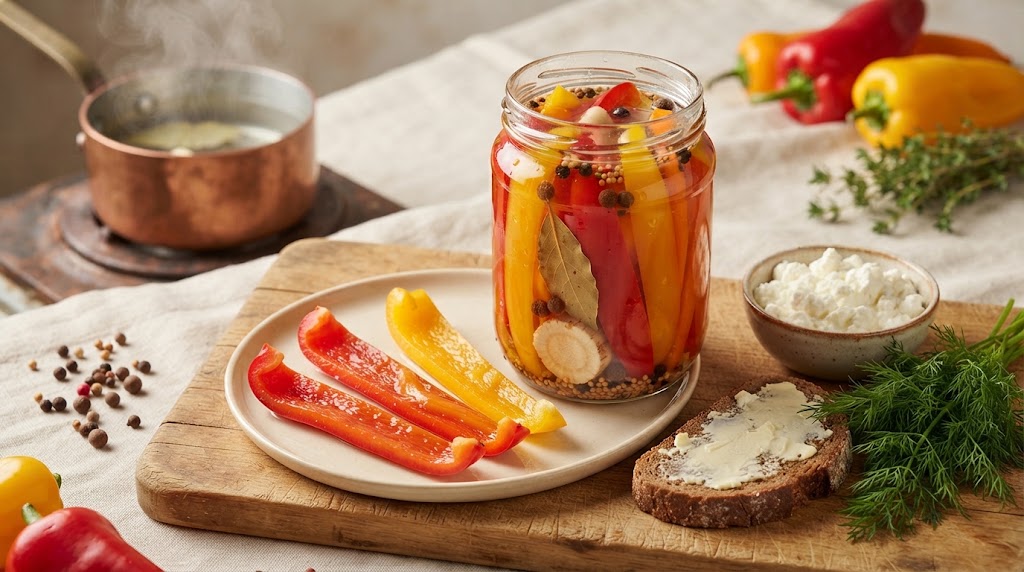
Sweet-and-sour pickled peppers are one of the most rewarding home canning projects you can tackle. Crisp pepper strips in a gently sweet yet vinegary brine are within reach of anyone with a stockpot and a Saturday afternoon. The secret is picking peppers that hold up, slicing them lengthwise into six strips and balancing the sugar and vinegar so the brine tastes bright, not harsh. The jars keep on a cool pantry shelf for a full year and blow anything from the grocery store aisle out of the water.
Quick overview
- Topic / Dish: Sweet-and-sour pickled peppers
- Category: Preserves, American Kitchen
- Cuisine: American home-canning tradition
- Variations included: Sweet-and-sour pickled peppers
- Key techniques: Lengthwise pepper slicing, brine building, water-bath canning, jar packing
- Physico-chemical background: Osmosis, acidic environment, heat processing
- Common mistakes: Brine not acidic enough, short processing time, overpacked jars, cross-slicing the peppers
- In short: Slice the peppers lengthwise into six strips, pack them into jars, cover with hot sweet-and-sour brine and water-bath process.
- Last updated: September 13, 2026
WAGUU says: “Sweet-and-sour brine is a trade-off between flavor and shelf life. The more vinegar, the longer the jars keep, but the sharper the bite. You know it is right when the peppers taste bright and sweet, not astringent.”
Key facts
| Prep time: | 30 minutes |
| Cook time: | 15 minutes (brine) + 15 minutes water-bath |
| Main ingredient: | Sweet bell peppers |
| Yield: | 6 pint jars (about 16 oz each) |
| Difficulty: | Easy |
Method in brief
- Rinse the peppers, remove the cores and slice lengthwise into six strips.
- Build a sweet-and-sour brine from water, vinegar, sugar, salt and pickling spice.
- Pack the peppers snugly into clean, hot jars.
- Ladle the hot brine over the peppers so they are fully submerged.
- Seal the jars and water-bath process at 180 °F for about 15 minutes.
At a glance
- Choosing peppers: Firm, thick-walled bells or sweet Italian frying peppers, ideally red and yellow.
- Slicing: Lengthwise into six strips, never cross-cut into rings.
- Brine: Water-to-vinegar ratio 2:1, sugar-to-salt 7:1.
- Pickling spice: Bay leaves, allspice berries, black peppercorns, yellow mustard seed.
- Water-bath processing: 15 minutes at 180 °F, 20 minutes for larger jars.
- Maturing: At least 3–4 weeks in a cool, dark pantry.
- Result: Crisp peppers with a sweet-and-sour kick that keep for 12 months.
Who this guide is for: Beginner – you will get a precise recipe and learn the basics of water-bath canning and proper slicing. Intermediate – you will find tips on brine variations and pickling spice blends. Professional – you will appreciate the advice on multi-purpose processing of a single case of peppers and working with lengthwise strips.
Why can peppers at home
Home-canned peppers beat store-bought jars on three fronts. First, you know exactly what is inside. No dyes, no stabilizers, no excess preservatives. Second, you can dial the flavor to your family’s taste. Some like it sweeter, some sharper, some with a hit of chile, some with dill. Third, a pint jar costs you a fraction of the grocery store price, even when you buy the peppers at full price.
Sweet-and-sour pickled peppers are one of the most versatile preserves in the pantry. They work alongside burgers and pulled pork, on charcuterie boards, in sandwiches, on pizza, in salads, in deviled eggs and straight out of the jar as a snack. In a lot of households, the first pint is gone by Thanksgiving, even though the recipe keeps far longer.
How to pick the right peppers
For pickling you want firm, thick-walled peppers. Classic red and yellow bell peppers from the farmers’ market are perfect. Cubanelle and sweet Italian frying peppers also shine – they are sweet, meaty and hold their shape. Skip thin-walled varieties, which turn to mush in the brine. For color, mix red, yellow and orange so the finished jar looks like a jewel on the shelf.
Why slice the peppers lengthwise into six strips
The way you slice the peppers matters more than you might think. Cross-cutting into rings is wrong for pickling. The rings fall apart during processing and turn soft in the brine. Slicing lengthwise into six strips keeps the pepper’s structure intact – the fibers stay whole, the strips hold their shape and the peppers stay snappy long after the jar is opened.
The method is simple. Stand each pepper on its stem end, cut off the cap with the seed core and pull out the white membranes. Lay the pepper on its side and, with one clean slice of the knife, cut it lengthwise into six evenly wide strips. Each strip runs the full length of the pepper and is roughly ¾ inch wide.
There is a bonus – more peppers fit into a jar and the strips stack neatly. The finished jar looks fuller and more compact than if you had crammed rings into it.
The anatomy of sweet-and-sour brine
The brine has four building blocks. Water is the base, vinegar preserves, sugar balances the bite and salt lifts the flavor. Pickling spice goes in on top. A 2:1 water-to-vinegar ratio using standard 5% distilled white vinegar gives a brine of roughly 2.5% acidity. That is enough to keep the jars safe and gentle enough that the peppers taste like peppers, not vinegar.
| Brine style | Water : Vinegar |
|---|---|
| Mild, sweeter | 3 : 1 |
| Classic | 2 : 1 |
| Sharper, longer keeping | 1 : 1 |
WAGUU Pro Tip: If you want that serious snap, drop a slice of fresh horseradish or a couple of grape leaves into each jar. The tannins they bring slow down the softening process and keep the peppers crisp for months.
Water-bath canning without the drama
Water-bath canning is the part that scares people off, and it should not. It is straightforward. Jars must be clean, ideally run through the dishwasher or rinsed in hot water and left to dry. Peppers get packed firmly but not forced. Brine goes in hot, not boiling. Jars are sealed and lowered into a pot of water that comes about two-thirds of the way up their sides. The water is held at 180 °F for 15 minutes for pint jars and 20 minutes for quart jars.
After processing, lift the jars out, set them upside down on a folded towel and let them cool undisturbed for 12 to 24 hours. If the lid pulls down as it cools and stays concave, you have a proper seal. If the lid domes back up, that jar goes in the fridge and gets eaten first.
Storage and shelf life
Store the jars in a cool, dark, dry pantry. A basement shelf, a closet away from the stove or the bottom shelf of the fridge all work. Properly sealed and stored, they keep for 12 months, or up to 18 months with a stronger brine. Once a jar is opened, keep it in the fridge and use it within 3–4 weeks.
What to serve pickled peppers with
Sweet-and-sour pickled peppers play nice with everything. They shine next to burgers, pulled pork, roast chicken, ribs, smoked brisket and any backyard cookout spread. They go on charcuterie boards, into subs, on pizza, in grain bowls and chopped into potato salad. The brine itself makes a killer vinaigrette – just whisk it with olive oil, a little Dijon and a pinch of sugar.
Frequently asked questions
How do I know the peppers have gone bad?
A good jar has clear brine, firm peppers and a lid that gives a soft pop when opened. A bad jar has cloudy brine, floating white films, an off smell or a bulging lid. Toss it.
Do I need to peel the peppers?
No. The skins are thin and soften in the brine while keeping the crunch. Peeling is a waste of time. With firm bells, you will never notice the skin.
Which vinegar should I use?
Standard 5% distilled white vinegar is the workhorse of American pickling. Apple cider vinegar gives a rounder, fruitier flavor. White wine vinegar is the fancier choice if you want a gentler finish.
How much sugar do I really need?
Sugar is not just about sweetness. It balances the vinegar so the brine tastes pleasant. A 7:1 sugar-to-salt ratio is classic. Want it sweeter? Double the sugar. Less sugar means a sharper, more acidic bite.
Also known as: Sweet-and-sour peppers, pickled peppers, pickled bell peppers, vinegar peppers, sweet peppers in brine
Conclusion
Canning peppers is simple, quick and deeply satisfying. An hour of work puts six jars on your pantry shelf that will carry you through the year. There is no complicated science here – just get the brine ratio right, slice the peppers lengthwise into six strips, process properly and give the jars time to mellow. The result will beat any jar from the store.
Pick your recipe
Below is the recipe for classic sweet-and-sour pickled peppers. It is the one that even a first-timer can nail, and it has been tested in kitchens across the country.
Sweet-and-Sour Pickled Peppers – A classic recipe for crisp peppers sliced lengthwise into six strips that keep for a full year.
Other variations worth trying
Pickled peppers with carrots
Carrot coins go into the jar alongside the peppers. They add a gentle sweetness and a bright pop of color. Great for anyone who wants more veggies in a single jar and a more interesting look on the shelf.
Pickled peppers with onion
Sweet onion rings get layered between the peppers. They soften in the brine and turn mellow and sweet. Bold flavor – excellent with cold cuts and on subs.
Pickled peppers with jalapeño
Add one or two sliced jalapeños to each jar. The brine picks up a pleasant heat while the bells stay sweet-and-sour. For anyone who likes a gentle kick.
Pickled peppers with mustard seed
Yellow mustard seeds give the brine a subtle sharpness and a stronger aroma. A staple of Pennsylvania Dutch pickling traditions.
Pickled peppers with honey
Swap part of the sugar for honey. The result is rounder and fuller. Add the honey to the brine just before ladling so the aroma stays intact. Great with sharp cheddar and crackers.
Pickled peppers with apple
Tart apple slices go in with the peppers. They bring a fruity freshness and natural sweetness. A variation the kids will actually eat.
Pickled peppers with root vegetables
Carrots, parsnips and celery root join the peppers. The jar is more colorful and the flavor more layered. Ideal for a holiday relish tray.
Pickled peppers with dill
Fresh dill or dill seed goes into the brine. The result is a bright, aromatic pickle that echoes a good dill spear. Fantastic with fish.
Pickled peppers with thyme
A sprig of thyme in each jar gives the brine an herbal backbone. Distinct but not overpowering – beautiful with grilled steak.
Pickled peppers with apple cider vinegar
Swap the distilled white vinegar for apple cider vinegar. The result is rounder and fruitier. For anyone who finds plain white vinegar too sharp.
Pickled peppers with white wine vinegar
White wine vinegar gives the preserve a more elegant finish. Perfect for a cheese board or a hostess gift.
Pickled peppers with balsamic vinegar
Dark balsamic deepens the color and the flavor. Best in fall and winter, when it pairs with roast pork or braised short ribs.
Pickled peppers with horseradish
A slice of horseradish in each jar keeps the peppers crisp and adds a gentle bite. A nod to the Eastern European tradition that inspired this recipe.
Pickled peppers with grape leaves
A grape leaf in each jar does the same job as horseradish – the tannins keep the peppers snappy. Milder flavor than horseradish.
Know another variation? Add your own suggestion below.
Missing a recipe?
Tell us what recipe you would like us to add. We will do our best to publish it soon!
Frequently asked questions about other variations
- Can I combine several variations in one jar? Yes, but keep it tight. Two or three add-ins are plenty. Too many spices and the peppers disappear behind the brine.
- What is the point of the horseradish? Horseradish is full of tannins that slow down softening. That is why the peppers stay crisp for months.
- Do I really need to water-bath process if I use a lot of vinegar? Yes, always. Vinegar alone will not protect you if the jar is not properly sealed.
- Can I use frozen peppers? Not recommended. Once thawed they are soft and fall apart in the brine.
- How long does the brine keep? Unused brine keeps for 2–3 weeks in the fridge. Once it goes into jars it lives with the peppers.
- How many jars does one batch make? The recipe below makes 6 pint jars. Easy to double.
- What is the difference between sweet-and-sour and plain sour brine? Sweet-and-sour has more sugar to balance the vinegar. Plain sour is sharper.
- Can I add a grape leaf to the brine? Yes, grape leaves have tannins and help keep the peppers crisp, just like horseradish.