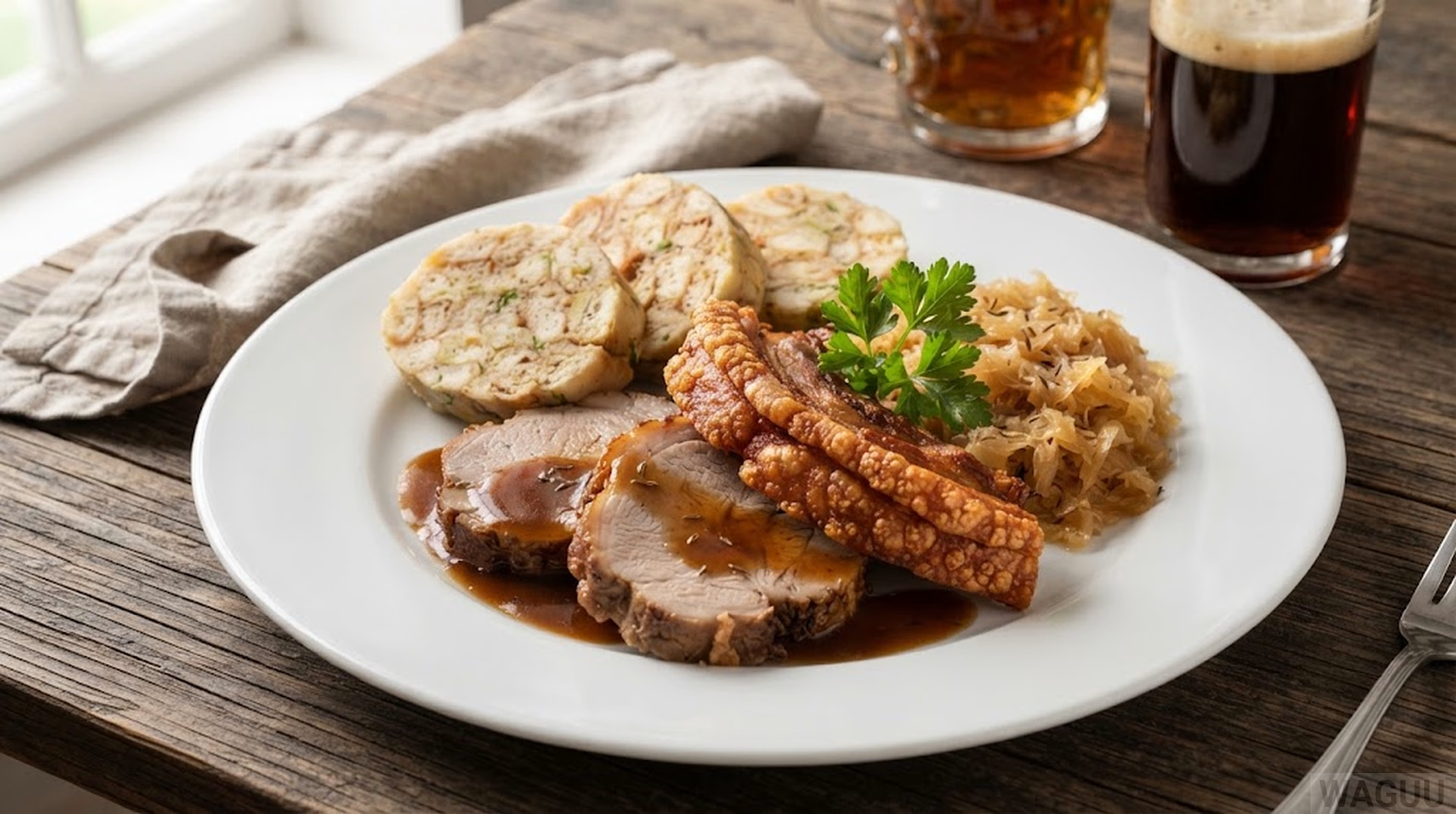
Summary: Pork shoulder rubbed with caraway, garlic and salt, roasted with root vegetables until the skin is crisp and the meat is tender. Ready in 2.5 hours, serves 6.
Cooked this recipe? Share your result with the community.
Categories: Pork, Austrian Cuisine
Success rate: not rated yet % of users cooked this recipe without problems
Quick Overview
- Dish: Schweinsbraten
- Categories: Pork, Austrian Cuisine
- Cuisine: Austrian
- Main ingredient: Pork shoulder, 2 kg (with skin)
- Guide: 12 Most Famous Austrian Dishes
- Total time: 160 minutes (20 minutes preparation + 140 minutes cooking)
- Difficulty: Easy
- Servings: 6 (portion weight: 280 g)
- Key technique: Roasting
- Preparation types: Roasting
- Dietary info & allergens: Gluten (if served with dumplings or bread), milk (if using cream in the gravy)
- Suitable for: Sunday lunch, festive menu, family dinner
- Nutritional values (per portion): 620 kcal, Protein: 45 g, Fat: 42 g, Carbohydrates: 8 g
- Storage: 3 days in the fridge, 3 months in the freezer
- Pairing: Vienna lager, dark beer, Blaufränkisch, Zweigelt
- In short: The Austrian Sunday roast — crackling skin, rich gravy, and a smell that fills the whole house.
- Last update: 28 September 2026
WAGUU says: “The secret to crisp skin is a dry surface and a hot oven at the start. If you salt the skin the day before and leave the joint uncovered in the fridge, the crackling will shatter when you cut it.”
Key Facts
| Prep time: | 20 minutes + overnight in the fridge |
| Cooking time: | 140 minutes |
| Temperature: | 220 °C for 20 minutes, then 160 °C for 120 minutes |
| Servings: | 6 |
At a Glance
Schweinsbraten is the Austrian Sunday roast — pork shoulder with the skin still on, rubbed with caraway and garlic, roasted slowly until the meat is tender and the crackling is crisp enough to shatter. The dripping from the pan becomes a dark, rich gravy.
Ingredients
Base servings: 6 servings • Portion weight: 280 g
| Ingredient | Amount | Quality |
|---|---|---|
| Pork shoulder | 2000 g | With skin, bone in, scored |
| Garlic | 8 cloves | Peeled, cut into slivers |
| Caraway seeds | 10 g | Lightly crushed |
| Fine sea salt | 25 g | For the rub |
| Black pepper | 3 g | Freshly ground |
| Brown onions | 400 g | Roughly chopped |
| Carrots | 200 g | Roughly chopped |
| Celeriac | 150 g | Roughly chopped |
| Pork stock | 500 ml | Hot |
| Dark beer | 200 ml | Vienna lager or bock |
| Bay leaves | 3 pcs | Dried |
| Fresh thyme | 3 sprigs | Fresh |
| Plain flour | 20 g | For thickening the gravy |
| Sour cream | 100 g | Optional, for the gravy |
Why You Will Love This Recipe
- Crisp skin: The scoring and the hot initial blast give the crackling a shattering crunch.
- Hands-off: Once it is in the oven, it cooks itself for two hours.
- Two dishes in one: Roast pork for dinner and a rich gravy from the pan for tomorrow’s dumplings.
Why it works: The salt rubbed into the skin draws out moisture, which dries the surface and lets it crisp. The initial 20 minutes at 220 °C blasts the skin and forces the fat out, while the long slow roast at 160 °C breaks down the collagen in the shoulder and makes the meat tender. The vegetables under the meat catch the dripping and become the base of the gravy.
Recipe Overview
Prep: 20 min | Cook: 140 min | Difficulty: Easy | Servings: 6 | Type: Main | Origin: Austrian
Detailed Method
Total progress: 0 % done
Phase 1: Preparing the Pork (the night before) – 15 min
Equipment: Sharp knife, small bowl, roasting tin
1. Score the skin of the pork shoulder in a diamond pattern — cuts about 5 mm deep, 2 cm apart. Do not cut into the meat. Make small slits in the meat and push in the garlic slivers. Mix the crushed caraway, salt and pepper, then rub the mixture all over the skin and meat. Put the joint on a plate, uncovered, in the fridge overnight.
VKB: The skin is scored evenly and the salt has drawn moisture to the surface. In the morning the skin feels dry and firm, not tacky.
Before you continue:
Leave the joint uncovered in the fridge overnight. This dries the skin and is what makes the crackling crisp. Do not cover it with foil or cling film.
Phase 2: Setting up the Roasting Tin – 5 min
Equipment: Large roasting tin, wire rack
2. Scatter the chopped onion, carrot and celeriac over the bottom of a large roasting tin. Put a wire rack on top of the vegetables and lay the pork on it, skin side up. Pour the beer into the tin — it should not touch the meat. Let the joint come to room temperature for 30 minutes before roasting.
VKB: The pork is on the rack, skin side up, sitting above the vegetables. The beer is in the tin but not touching the meat.
Before you continue:
If the pork sits directly in the liquid, the skin will steam instead of crisp. Always use a rack so the meat is above the vegetables and beer.
Phase 3: Blasting the Skin – 20 min
Equipment: Oven
3. Preheat the oven to 220 °C. Roast the pork on the middle shelf for 20 minutes. The skin should start to bubble and crackle.
VKB: The skin is bubbling, blistered and starting to turn golden. The kitchen smells of caraway and roast pork.
Before you continue:
If the skin is not bubbling after 20 minutes, increase the heat to 240 °C for another 5 minutes. Watch it carefully — the skin can go from crisp to burnt in seconds.
Phase 4: Slow Roasting – 120 min
Equipment: Oven, foil, baster
4. Reduce the oven to 160 °C. Cover the pork loosely with foil, leaving the skin exposed. Roast for 120 minutes, basting the meat with the pan juices every 30 minutes. Add the bay leaves and thyme to the tin after the first hour.
VKB: After 120 minutes, a skewer slides into the thickest part of the shoulder with almost no resistance. The skin is deep golden and crisp. The meat is pulling away from the bone slightly.
Before you continue:
If the skin starts to darken too much, cover just the skin with a small piece of foil. Do not cover the whole joint — the meat needs to roast, not steam.
Phase 5: Making the Gravy – 10 min
Equipment: Small saucepan, whisk, fine sieve
5. Lift the pork onto a warm plate, cover loosely with foil and let it rest for 20 minutes. Strain the pan juices into a small saucepan, pressing the vegetables to extract all the liquid. Skim off the fat. Bring to a simmer, whisk in the flour mixed with a little cold water, and cook for 3 minutes until thickened. Stir in the sour cream if using. Season with salt and pepper.
VKB: The gravy is dark brown, glossy and thick enough to coat the back of a spoon. It tastes rich, savoury and slightly malty from the beer.
Before you continue:
Do not skip the resting time. The juices inside the meat need 20 minutes to redistribute. Cut it straight away and they will run out onto the board instead of staying in the slices.
Phase 6: Carving and Serving – 10 min
Equipment: Carving board, sharp knife, warm plates
6. Remove the crackling from the joint in one piece and cut it into squares. Slice the meat against the grain into 1 cm thick slices. Serve on warm plates with the crackling on top and the gravy poured over. Serve with braised cabbage and bread dumplings.
VKB: The crackling is crisp and shatters when you bite it. The sliced meat is pale pink inside and holds its shape.
Required Equipment
| Item | Ideal size | Alternative | Risk |
|---|---|---|---|
| Large roasting tin | 35 × 25 cm, deep sides | Any deep oven tray | A shallow tin lets the juices evaporate and burn |
| Wire rack | Fits inside the roasting tin | Rolled-up foil snakes | Without a rack the meat sits in the liquid and the skin steams |
| Sharp carving knife | 25 cm blade | Serrated bread knife | A blunt knife tears the meat instead of slicing it |
Shopping List
Nutritional Profile
Values per portion (without side dish). Calculated from average nutritional values of ingredients.
| Nutrient | Per 100 g | Per 1 portion | Per 6 portions |
|---|---|---|---|
| Energy | 221 kcal | 620 kcal | 3720 kcal |
| Fat | 15.0 g | 42 g | 252 g |
| of which saturated | 5.4 g | 15 g | 90 g |
| Carbohydrates | 2.9 g | 8 g | 48 g |
| of which sugars | 1.8 g | 5 g | 30 g |
| Protein | 16.1 g | 45 g | 270 g |
| Salt | 1.1 g | 3.0 g | 18 g |
Reference intake of an average adult (8400 kJ / 2000 kcal).
WAGUU Pro Level
- Pro standard: Verified recipe with exact ratios and visual control points.
- Tip 1: Salt the skin the day before and leave the joint uncovered in the fridge. The salt dries the surface and the result is shatteringly crisp crackling.
- Tip 2: Always use a wire rack. The pork should sit above the vegetables and beer, not in the liquid. This keeps the skin crisp.
- Tip 3: Blast the joint at 220 °C for the first 20 minutes, then reduce to 160 °C for the rest. The high heat starts the crackling, the low heat cooks the meat.
- Tip 4: Rest the pork for 20 minutes before carving. The juices redistribute and the meat stays juicy.
Scientific Background
Pork shoulder is a working muscle, which means it contains a lot of collagen. Collagen does not dissolve at low temperatures, but at 70–80 °C it slowly turns into gelatine, which is what makes the meat tender. The initial blast of heat at 220 °C forces moisture out of the skin and starts the Maillard reaction, which is what makes the crackling crisp and brown. The slow roast at 160 °C continues breaking down the collagen without drying the meat out.
Fine Dining – Professional Techniques
- Plate composition: Place two slices of pork on a warm plate with a square of crackling on top. Spoon the gravy over the meat, not the crackling.
- Texture contrasts: Crisp crackling, tender meat, soft braised cabbage, fluffy dumplings.
- Temperature contrast: Serve hot with a cold beer on the side.
- Aromatic additions: A pinch of fresh caraway seeds over the crackling.
Sensory Radar
- Appearance: Deep golden-brown crackling, pale meat, dark glossy gravy.
- Aroma: Roast pork, caraway, garlic, and a hint of malt from the beer.
- Taste: Rich, savoury, deeply porky, with the sharpness of caraway.
- Texture: Shattering crackling, tender meat, silky gravy.
Pairing
- BEER: Vienna lager, dark bock, or a malty Märzen.
- WINE: Blaufränkisch, Zweigelt, or a light Cabernet Franc.
- SOFT DRINK: Apple juice, or a light apple spritzer.
Preparation Variations
- With beer and vinegar: Add 2 tablespoons of dark beer vinegar to the roasting tin for a sharper gravy.
- With apple: Add 2 sliced apples to the vegetables in the last 30 minutes. They sweeten the gravy.
Allergens and Dietary Information
Contains: Gluten (in the flour for the gravy), milk (sour cream, optional) • Gluten: Yes (in the gravy) • Not suitable for: Vegan, vegetarian, lactose intolerance (without the sour cream)
Suitable For
Sunday lunch, festive menu, family dinner, Oktoberfest-style party
Substitution Catalogue
- Pork shoulder: Pork loin (leaner but drier) or pork belly (fattier but more flavourful)
- Dark beer: Apple juice or cider (sweeter gravy)
- Sour cream: Crème fraîche or Greek yoghurt
FAQ
How do I get crisp crackling?
Salt the skin the day before and leave the joint uncovered in the fridge overnight. The salt dries the surface. Then blast at 220 °C for 20 minutes and finish at 160 °C.
What cut of pork is best?
Pork shoulder with the skin on and the bone in. Shoulder has more collagen than loin, which turns into gelatine and makes the meat tender.
Can I use pork loin instead?
Yes, but loin is leaner and dries out faster. Reduce the roasting time by 30 minutes and check the internal temperature — it should be 63 °C.
What if my crackling does not crisp?
Turn the grill on high and put the joint under it for 3–5 minutes, watching carefully. Or remove the crackling in one piece and finish it in a hot dry pan.
WAGUU Petr advises: Cooking for 6 or more?
6–8 people: A 2 kg joint is enough. If you want leftovers, use 2.5 kg and add 30 minutes to the slow roast. • 10+ people: Roast two smaller joints rather than one large one. They cook faster and are easier to carve.
Side Dishes and Serving
Storage and Reheating
Fridge: 3 days • Freezer: 3 months (meat only — the crackling does not freeze well) • Reheating: Reheat the meat gently in a 160 °C oven for 15 minutes. Crisp the crackling separately under the grill.
Author: WAGUU Petr & Team • Published: 30 Sep 2026
More Recipes from This Article
More Recipes You Might Like
Why WAGUU?
Recipes on WAGUU go through a check of ingredient accuracy, method and nutritional values.
Photo Gallery from the Process
Community photos: Cook it, photograph it, and share the result.
You can upload photos in the comments below or send them by email.
Filmed a video of our recipe? Post a link to YouTube, YouTube Shorts, TikTok, Instagram Reels, Facebook Reels, Pinterest, Vimeo or X (Twitter) in the comments — we will be glad to publish it and help you and your content get noticed.
Most Common Mistakes
- Not drying the skin – If the skin is wet it steams instead of crisping. Salt it the night before and leave it uncovered in the fridge.
- Putting the pork directly in the tin – It sits in the liquid and the skin never crisps. Always use a rack.
- Oven too hot for too long – 220 °C for 20 minutes is enough. Longer at high heat dries out the meat.
- Carving straight away – Rest the pork for 20 minutes or the juices run out and the meat becomes dry.