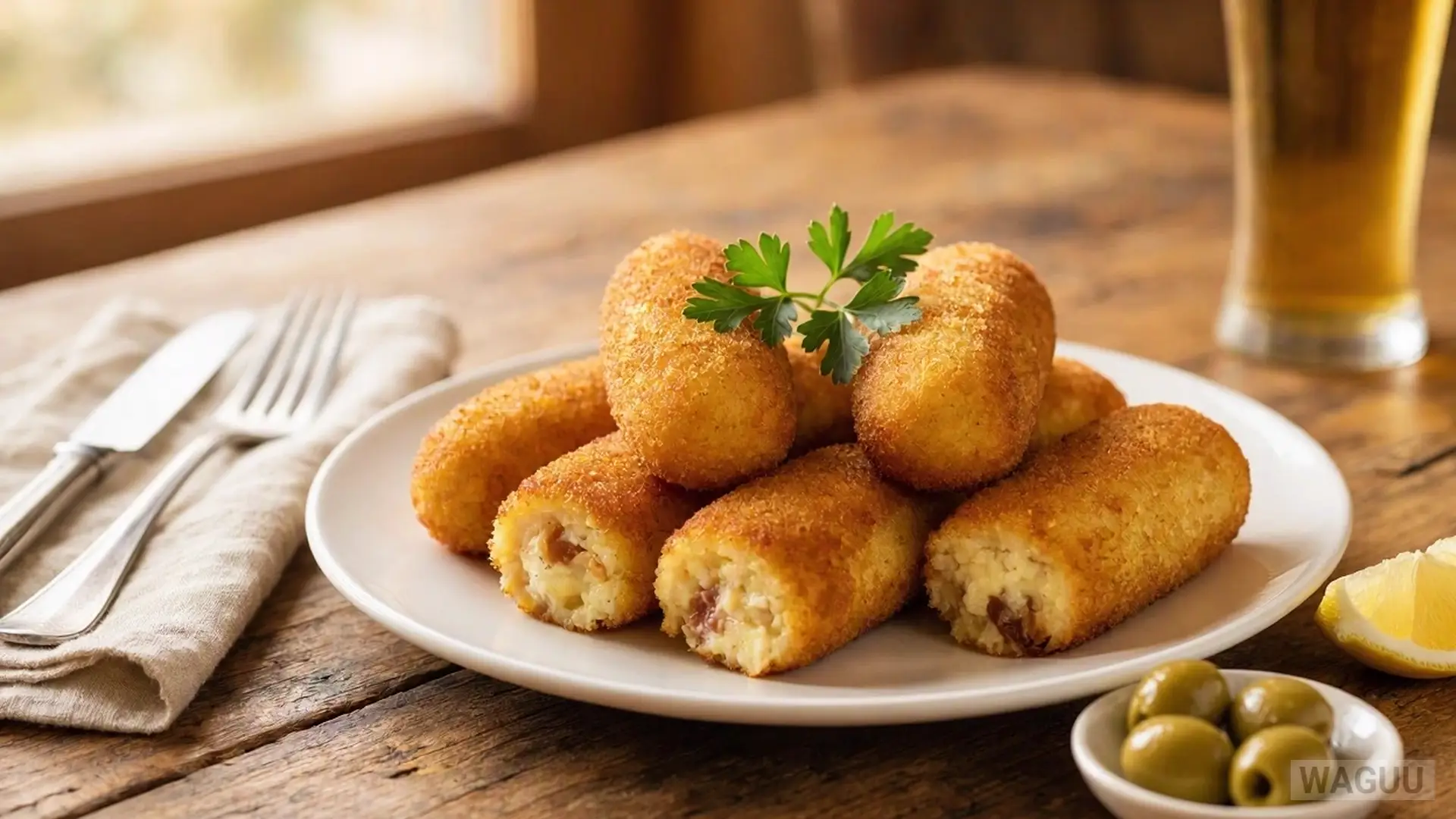
Summary: Croquetas de Jamón are iconic Spanish tapas featuring a silky, ultra-creamy béchamel core infused with rich Spanish cured ham (jamón), encased in a crisp, golden breadcrumb crust. This recipe utilizes a traditional slow-cooked roux and milk reduction technique, requiring meticulous chilling before shaping and frying at 180 °C for precisely 3 minutes to achieve the ultimate textural contrast. Designed for 6 portions, this preparation yields 24 golden croquettes with a total time of 3 hours and 30 minutes, including mandatory resting phases.
Did you cook this recipe? Share the result with the community.
Category: Starters, Spanish Cuisine
Success rate: 96% of users successfully made this recipe
Quick overview
- Dish: Croquetas de Jamón
- Category: Starters, Spanish Cuisine
- Cuisine: Spanish
- Main ingredient: Spanish cured jamón, 150 g (finely diced aged Serrano or Iberian ham)
- Guide: 12 most popular Spanish dishes: favourite recipes of Spanish cuisine
- Total time: 210 minutes (180 min prep + 30 min cooking)
- Difficulty: Advanced
- Portions: 6 portions (Portion weight: 120 g)
- Key technique: Béchamel reduction and double crumb coating
- Preparation types: Roux making, chilling, shaping, deep-frying
- Dietary info & Allergens: Contains milk, wheat gluten, eggs
- Suitable for: Tapas parties, celebratory gatherings, appetizers
- Nutritional values (per 1 portion): 345.5 kcal, Protein: 14.2 g, Fat: 21.8 g, Carbohydrates: 23.4 g
- Storage: 3 days in the fridge, 3 months in the freezer
- Pairing: Spanish lager, crisp dry Sherry (Fino), sparkling mineral water
- In short: Velvety ham-infused béchamel encased in a shatteringly crisp golden crust.
- Last updated: 21 September 2026
WAGUU says: “The soul of a great croquette lies in the moisture balance of the dough—cook your roux thoroughly so the flour loses its raw taste before incorporating the warm milk.”
How to take it further: Infuse the whole milk with a peeled garlic clove and a bay leaf for 15 minutes before mixing; fold in 20 g of finely grated mature Manchego cheese into the hot béchamel.
Key facts
| Prep time: | 180 minutes |
| Cooking time: | 30 minutes |
| Temperature: | 180 °C (frying oil) |
| Number of portions: | 6 portions |
In a nutshell
Experience authentic Spanish bar culture with homemade Croquetas de Jamón. Achieving a molten, custard-like interior that holds its shape when fried is a masterclass in culinary precision. By patiently thickening a rich butter-and-flour roux with warm whole milk and folding in savory bits of cured ham, you create a magnificent dough that chills into an easily shapeable marvel. Coated in fine breadcrumbs and fried to a crisp, they offer an unforgettable textural contrast.
Ingredients
Base portions: 6 portions • Portion weight: 120 g
| Ingredient | Amount | Quality |
|---|---|---|
| Unsalted butter | 80 g | High-fat European style |
| Plain white flour | 100 g | Standard wheat flour |
| Whole milk | 800 ml | Full fat, lukewarm |
| Spanish cured jamón | 150 g | Finely diced Serrano or Iberian ham |
| Yellow onion | 60 g | Finely minced |
| Ground nutmeg | 2 g | Freshly grated |
| Fine sea salt | 5 g | Pure sea salt |
| Free-range eggs | 120 g | 2 medium eggs, beaten |
| Fine dried breadcrumbs | 200 g | Panko or fine white breadcrumbs |
| Rapeseed oil | 500 ml | For deep-frying |
Why you will love this recipe
- Authentic taste: Delivers the genuine flavor profile of traditional Spanish tapas bars right in your home kitchen.
- Melt-in-the-mouth texture: Features an exquisitely creamy béchamel interior that contrasts sharply with the crunchy outer shell.
- Make-ahead friendly: The dough can be prepared a day in advance, making hosting effortless and stress-free.
Why it works: Cooking the flour and butter mixture thoroughly eliminates any raw starch flavor, while the high ratio of milk to flour creates a luscious custard that sets firmly when chilled.
Recipe overview
Prep: 180 min | Cooking: 30 min | Difficulty: Advanced | Portions: 6 portions | Type: Starter | Origin: Spanish
Detailed instructions
Overall progress: 0% complete
Phase 1: Sautéing aromatics and ham – 10 min
Appliances: Hob
1. Place a saucepan over medium heat, melt 20 g of the unsalted butter, and add 60 g of finely minced yellow onion. Sauté gently for 5 minutes until translucent and soft without browning. Add 150 g of finely diced Spanish cured jamón and sauté for another 3 minutes until aromatic and slightly rendered. Remove the mixture from the pan and set aside in a small bowl.
Visual check point (VKB): The onions are translucent and sweet, and the ham has released its aromatic oils into the pan.
Before moving to the next step:
Ensure the pan is wiped clean or use the same pot for the roux, maintaining low heat to prevent burning the residual fats.
Phase 2: Preparing the roux base – 10 min
Appliances: Hob
2. In the same saucepan over medium-low heat, melt the remaining 60 g of unsalted butter. Add 100 g of plain white flour all at once. Whisk continuously for 4 to 5 minutes to cook out the raw flour taste, ensuring the roux turns a pale golden blonde color without forming hard lumps.
VKB: The roux smells pleasantly nutty, bubbles gently, and has a smooth, paste-like consistency.
Before moving to the next step:
Warm 800 ml of whole milk in a separate pan or microwave until lukewarm before incorporating to prevent lump formation.
Phase 3: Cooking the thick béchamel – 25 min
Appliances: Hob
3. Pour the warm whole milk into the roux in a thin, steady stream while whisking vigorously to prevent lumps. Cook the mixture over medium-low heat, stirring constantly with a wooden spoon or heatproof spatula for 20 minutes, until the béchamel thickens heavily into a thick, glossy mass that pulls away from the sides of the pan. Stir in 2 g of freshly grated ground nutmeg and 5 g of fine sea salt.
VKB: The béchamel leaves a clear track when dragged with a spoon and maintains its shape without slumping.
Before moving to the next step:
Fold in the reserved cooked ham and onion mixture thoroughly so the flavors distribute evenly throughout the thick paste.
Phase 4: Chilling the dough – 120 min
Appliances: Refrigerator
4. Transfer the hot croquette dough into a shallow wide glass dish to maximize surface area. Press plastic wrap directly onto the surface of the dough to prevent a skin from forming. Place it in the refrigerator for at least 2 hours until completely chilled, firm, and easy to handle.
VKB: The dough is completely cold throughout, dense, and holds its shape firmly when scooped.
Before moving to the next step:
Set up a standard breading station with beaten eggs in one bowl and fine breadcrumbs in another.
Phase 5: Shaping and breading the croquettes – 35 min
Appliances: None
5. Scoop portions of the chilled dough weighing approximately 30 g each using a spoon or small ice cream scoop. Roll them gently with floured hands into cylinders or oval shapes. Dip each shape into 120 g of beaten free-range eggs, then coat thoroughly in 200 g of fine dried breadcrumbs, patting firmly to adhere. Repeat for a second coating (egg then breadcrumbs) to guarantee zero blowouts during frying. Place on a parchment-lined tray.
VKB: Every croquette is evenly coated in a tight, seamless layer of breadcrumbs with no exposed filling.
Before moving to the next step:
Heat 500 ml of rapeseed oil in a deep fryer or heavy frying pan to exactly 180 °C, verified with a kitchen thermometer.
Phase 6: Frying to golden perfection – 10 min
Appliances: Hob, Deep fryer or deep pan
6. Fry the breaded croquettes in small batches of 4 to 5 pieces at 180 °C for 3 minutes, turning gently until the crust turns an even, deep golden brown. Remove with a slotted spoon and drain thoroughly on paper towels. Serve piping hot.
VKB: The exterior is crisp and golden brown, and the filling inside is piping hot and molten without bursting through the crust.
Required equipment
| Utensil | Ideal size | Alternative | Risk |
|---|---|---|---|
| Heavy-bottomed saucepan | 2 litres | Standard saucepan | Scorching the roux if heat is too high |
| Wire whisk | 25 cm | Wooden spoon | Lumpy béchamel if not whisked well |
| Deep frying pan or fryer | 24 cm diameter | Cast iron pot | Oil temperature drop if overcrowded |
Shopping list
Nutritional profile
Values per 1 portion (excluding side dishes). Calculated from average nutritional values of ingredients.
| Nutrient | Per 100 g | Per 1 portion | Per 6 portions |
|---|---|---|---|
| Energy | 287.9 kcal | 345.5 kcal | 2073.0 kcal |
| Fat | 18.2 g | 21.8 g | 130.8 g |
| of which saturates | 7.5 g | 9.0 g | 54.0 g |
| Carbohydrates | 19.5 g | 23.4 g | 140.4 g |
| of which sugars | 4.2 g | 5.0 g | 30.0 g |
| Protein | 11.8 g | 14.2 g | 85.2 g |
| Salt | 1.1 g | 1.3 g | 7.8 g |
Reference intake of an average adult (8400 kJ / 2000 kcal).
WAGUU Pro Level
- Pro standard: Verified recipe with precise ratios and visual control points.
- Tip 1: Use a kitchen scale to portion the chilled dough into uniform 30 g balls for even frying times.
- Tip 2: Ensure the oil temperature returns to 180 °C between every batch to maintain maximum crispness.
- Tip 3: Chill the shaped croquettes in the freezer for 15 minutes right before frying to create a temperature differential that keeps the center molten.
- Tip 4: Dice the jamón very finely so it integrates smoothly into the velvety béchamel without tearing the crust.
Scientific background
The success of Croquetas de Jamón depends on starch gelatinisation and protein coagulation. When flour is cooked in butter, the starch granules absorb the melted fat, creating a roux that thickens the milk through gelatinisation upon heating. Chilling allows the starches and milk proteins to set into a rigid gel matrix. During deep-frying, the surrounding crust rapidly dehydrates and crisps via the Maillard reaction, while the internal gel melts back into a fluid, creamy emulsion.
Fine Dining – Professional techniques
- Plate composition: Serve three cylindrical croquettes neatly aligned on a minimalist matte black ceramic plate with a delicate smear of roasted garlic alioli.
- Textural contrasts: Shatteringly crisp breadcrumb exterior juxtaposed against a meltingly soft, velvety béchamel core.
- Temperature contrast: Piping hot center served alongside chilled garnishes.
- Aromatic garnishes: Garnish with micro-chervil and a tiny dusting of smoked paprika for visual and olfactory depth.
Sensory radar
- Appearance: Uniform golden-brown cylindrical nuggets with a pristine, unbroken crumb coating.
- Aroma: Rich toasted butter, savory cured jamón, and a subtle hint of warm nutmeg.
- Taste: Deeply savory, milky, and well-balanced with the natural saltiness of the aged ham.
- Texture: Ultra-crisp exterior giving way to an exceptionally smooth, creamy, and fluid interior.
Pairing
- BEER: Crisp Spanish pale lager or refreshing Pilsner.
- WINE: Chilled dry Fino Sherry or a zesty Albariño.
- NON-ALCOHOLIC: Sparkling lemon water with fresh mint.
Various preparation variants
- Chicken and mushroom croquettes: Substitute the jamón with finely minced roasted chicken and sautéed wild mushrooms for a hearty earthy variation.
- Spinach and blue cheese croquettes: Replace the ham with blanched chopped spinach and crumbled blue cheese for a vegetarian-friendly flavor explosion.
Allergens and dietary information
Contains: Milk, wheat gluten, eggs • Gluten: Contains wheat flour and breadcrumbs • Not suitable for: Vegetarians, vegans, lactose intolerant individuals
Suitable for
Tapas parties, celebratory gatherings, appetizers, cocktail receptions
Substitution catalog
- Spanish cured jamón: High-quality smoked bacon or prosciutto
- Whole milk: Semi-skimmed milk combined with 50 ml of double cream
FAQ
Why do my croquettes burst open when frying?
Croquettes usually burst if the oil is not hot enough, if they were frozen improperly, or if the breadcrumb coating has thin spots. Ensure a double coating and maintain oil temperature at 180 °C.
Can I freeze the croquettes before frying?
Yes, you can freeze shaped and breaded croquettes raw for up to 3 months. Fry them straight from frozen, adding an extra minute to the frying time.
Can I make the dough ahead of time?
The béchamel dough can be prepared up to 2 days in advance and kept tightly covered in the refrigerator until ready to shape and bread.
What kind of ham should I use?
Authentic Jamón Serrano or Jamón Ibérico provides the ideal savory depth, but any dry-cured ham with good fat content works well.
WAGUU Petr advises: Cooking for 12 or more people?
12–16 people: Double the recipe ingredients and prepare the béchamel in two separate batches to ensure even cooking and prevent scorching. Shape the croquettes the day before and store them in the refrigerator.
20+ people: Multiply all quantities by 3 or 4. Enlist a helper for the breading station and fry in a large commercial deep fryer in batches of 8 to 10 pieces to maintain constant oil temperature.
Sides and Serving
- Garlic mayonnaise alioli – smooth creamy garlic dip (not included in the recipe)
- Simple mixed leaf salad with lemon dressing – refreshing acidic counterpoint (not included in the recipe)
Serving: Serve piping hot on a warm platter garnished with lemon wedges and fresh parsley.
Storage and reheating
Fridge: 3 days • Freezer: 3 months • Reheating: Reheat in a preheated oven at 190 °C for 8 to 10 minutes to restore crispness; avoid microwaving.
Author: WAGUU Petr & Team • Published: 21 Sep 2026 • Updated: 30 Oct 2026
More Recipes from This Article
Other recipes you might be interested in
Why WAGUU?
Recipes on WAGUU undergo checks for the accuracy of ingredients, procedures, and nutritional values.
Process photo gallery
Community photos: Cook, take a photo, and share the result.
You can upload photos in the comments below or send them via email.
Did you record a video guide for our recipe? Insert a link to YouTube, YouTube Shorts, TikTok, Instagram Reels, Facebook Reels, Pinterest, Vimeo, or X (Twitter) in the comment – we’d be happy to publish it and help promote you and your content.
Common mistakes
- Not cooking the flour long enough – Results in an unpleasant raw flour taste in the béchamel filling.
- Insufficient chilling – Shaping warm dough leads to misshapen croquettes and bursting during frying.
- Overcrowding the fryer – Lowers the oil temperature drastically, causing the coating to become soggy and greasy.
- Skipping the double coating – Leads to cracks in the breadcrumb layer, allowing the molten filling to escape into the hot oil.