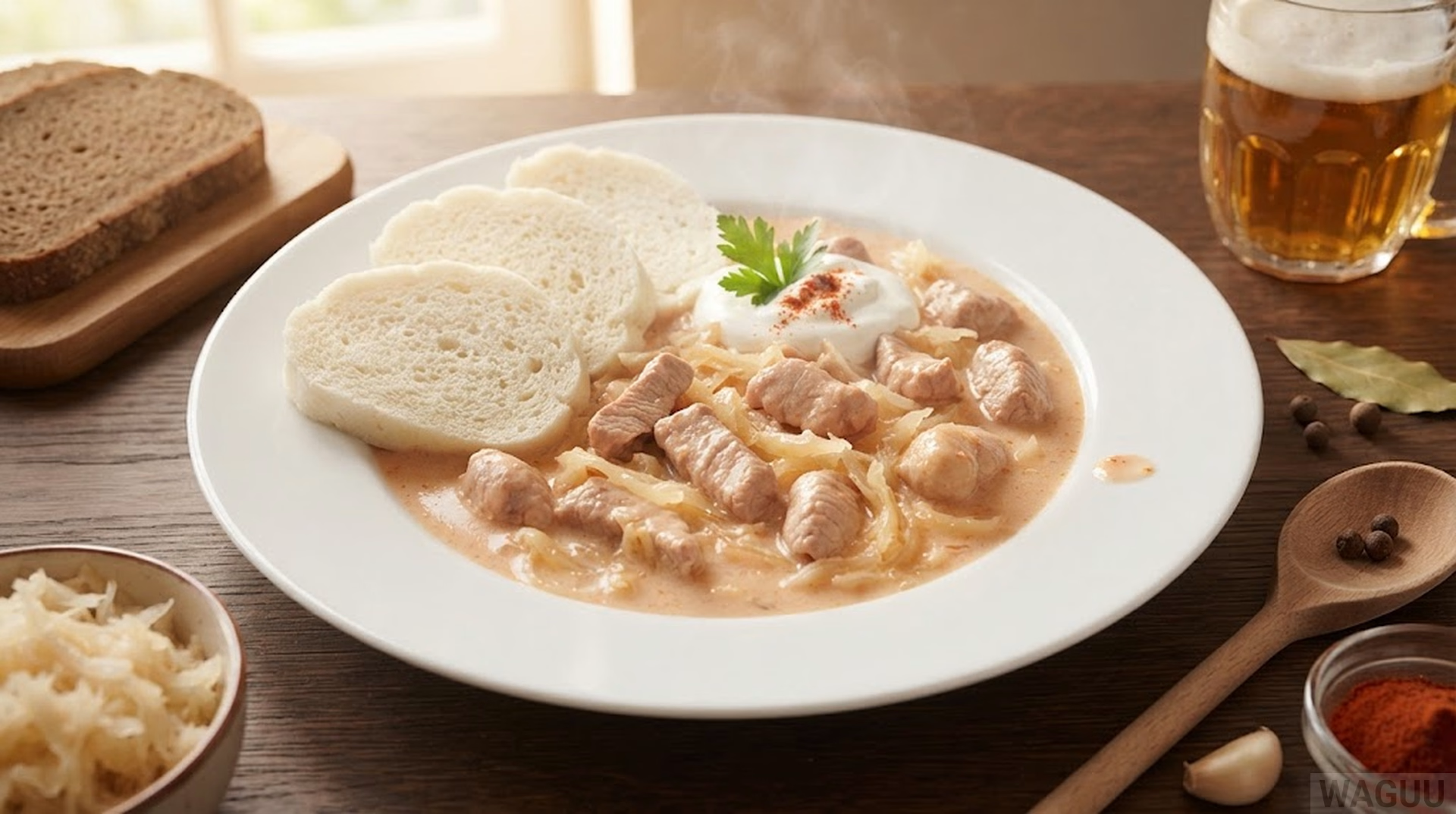
Summary: Pork, sauerkraut, and cream; a deeply rooted dish in Czech cuisine. Ready in 2 hours, serves 6.
Cooked this recipe? Share your result with the community.
Category: Pork, Czech Cuisine
Success rate: not rated yet % of users mastered this recipe
Quick Overview
- Dish: Szeged Goulash
- Category: Pork, Czech Cuisine
- Cuisine: Czech (inspired by Hungarian)
- Main ingredient: Pork shoulder, 1 kg
- Guide: 20 Most Famous Czech Dishes
- Total time: 120 minutes (20 min prep + 100 min cooking)
- Difficulty: Intermediate
- Servings: 6 (Portion weight: 350 g)
- Key technique: Braising
- Preparation types: Braising, simmering
- Dietary info & allergens: Contains gluten, dairy
- Suitable for: Sunday dinner, family gatherings
- Nutrition (per serving): 540 kcal, Protein: 30 g, Fat: 36 g, Carbs: 22 g
- Storage: 3 days in fridge, 2 months in freezer
- Pairing: Pilsner, dry white wine, sparkling water
- In short: A rich, creamy stew of pork and sauerkraut – the Czech answer to Hungarian goulash, and a Sunday classic.
- Last updated: 19. 9. 2026
WAGUU says: “Szeged goulash is what happens when Hungarian paprika meets Czech sauerkraut and cream. The result is tangy, rich, and unforgettable.”
Key Facts
| Prep time: | 20 minutes |
| Cook time: | 100 minutes |
| Temperature: | 160 °C / 320 °F |
| Servings: | 6 |
At a Glance
Tender pork simmered with sauerkraut, onions, and paprika, finished with a swirl of cream. The result is a tangy, rich stew that is deeply comforting and unmistakably Czech.
Ingredients
Base servings: 6 • Portion weight: 350 g
| Ingredient | Amount | Quality |
|---|---|---|
| Pork shoulder | 1000 g | Boneless, cut into 2 cm cubes |
| Sauerkraut | 800 g | Drained, reserve liquid |
| Onions | 3 pieces | Brown, medium, chopped |
| Lard or vegetable oil | 60 g | For frying |
| Sweet paprika | 15 g | Hungarian, fresh |
| All-purpose flour | 30 g | Plain |
| Beef or pork stock | 500 ml | Homemade or low-sodium |
| Heavy cream | 200 ml | Fresh |
| Garlic | 4 cloves | Fresh, minced |
| Caraway seeds | 4 g | Whole |
| Bay leaves | 2 pieces | Dried |
| Sugar | 10 g | Caster |
| Salt | 12 g | Fine sea salt |
| Black pepper | 3 g | Ground |
Why You Will Love This Recipe
- Tangy and rich: The sauerkraut and cream create a unique balance that is both refreshing and satisfying.
- Tender pork: The slow braise makes the pork fork-tender.
- Better the next day: Like all stews, the flavor improves overnight.
Why it works: The slow braise at 160 °C breaks down the pork until it is fork-tender. The sauerkraut provides acidity that cuts through the richness of the cream. The paprika is added off the heat so it does not burn and become bitter.
Recipe Overview
Prep: 20 min | Cook: 100 min | Difficulty: Intermediate | Servings: 6 | Type: Main Dish | Origin: Czech (inspired by Hungarian)
Detailed Method
Total progress: 0 % done
Phase 1: Searing the Pork – 15 min
Equipment: Large Dutch oven or heavy pot
1. Pat the pork dry with paper towels. Season with salt and pepper. Heat the lard in a Dutch oven over high heat. Sear the pork in batches until browned on all sides, about 3–4 minutes per batch. Remove and set aside.
VKB: The pork is deep brown on all sides. The bottom of the pot has a dark, sticky fond.
Before you continue:
Do not overcrowd the pot. If you do, the pork will steam instead of sear. Sear in batches.
Phase 2: Building the Base – 15 min
Equipment: Same pot
2. Reduce heat to medium. Add the chopped onions and cook until soft and golden, about 8–10 minutes. Add the garlic and caraway seeds and cook for 1 minute. Remove the pot from the heat. Stir in the sweet paprika and flour. Return to low heat and cook for 1 minute, stirring constantly.
VKB: The onions are soft and golden. The paprika is fragrant and the mixture is deep red.
Before you continue:
Do not burn the paprika. It turns bitter quickly. Add it off the heat and stir constantly.
Phase 3: Braising – 60 min
Equipment: Oven, Dutch oven with lid
3. Return the pork to the pot. Add the stock, sauerkraut, reserved sauerkraut liquid, bay leaves, sugar, salt, and pepper. Bring to a simmer on the hob, then cover with a lid and transfer to a preheated oven at 160 °C / 320 °F. Braise for 1 hour, stirring occasionally, until the pork is tender.
VKB: The pork is fork-tender. The sauerkraut is soft. The sauce is thick and fragrant.
Before you continue:
Do not boil the goulash. A gentle simmer is key. If the liquid bubbles vigorously, the meat will become tough.
Phase 4: Finishing – 10 min
Equipment: Same pot
4. Remove the bay leaves. Stir in the heavy cream. Simmer gently for 5 minutes. Do not boil. Season with salt and pepper to taste. The sauce should be creamy, tangy, and rich.
VKB: The sauce is creamy and pale pink. It tastes tangy from the sauerkraut and rich from the cream.
Before you continue:
Do not boil the sauce after adding the cream. Boiling will cause the cream to split.
Phase 5: Serving – 2 min
Equipment: Serving bowls
5. Ladle the goulash into bowls. Serve with sliced bread dumplings and a sprinkle of fresh parsley.
VKB: The goulash is thick and creamy. The dumplings are fluffy and white.
Required Equipment
| Equipment | Ideal Size | Alternative | Risk |
|---|---|---|---|
| Dutch oven | 5–6 L | Heavy pot with lid | Thin pot burns the fond |
| Wooden spoon | 30 cm | Silicone spatula | Metal scratches the pot |
| Fine sieve | 20 cm | Colander | Pulp in the sauce |
Shopping List
Nutritional Profile
Values per serving (without side dish). Calculated from average nutritional values of ingredients.
| Nutrient | Per 100 g | Per Serving | Per 6 Servings |
|---|---|---|---|
| Energy | 154 kcal | 540 kcal | 3240 kcal |
| Fat | 10.3 g | 36 g | 216 g |
| of which saturated | 4.6 g | 16 g | 96 g |
| Carbohydrates | 6.3 g | 22 g | 132 g |
| of which sugars | 2.3 g | 8 g | 48 g |
| Protein | 8.6 g | 30 g | 180 g |
| Salt | 1 g | 3.4 g | 20.4 g |
Reference intake of an average adult (8400 kJ / 2000 kcal).
WAGUU Pro Level
- Pro standard: Verified recipe with precise ratios and visual checkpoints.
- Tip 1: Use pork shoulder or pork neck. These cuts have the most collagen and give the best sauce.
- Tip 2: If the sauerkraut is very sour, rinse it briefly before adding.
- Tip 3: Add a tablespoon of sweet paprika directly into the cream for extra color.
- Tip 4: Serve with a dollop of sour cream on top.
Scientific Background
The slow braise at 160 °C breaks down the pork until it is fork-tender. The sauerkraut provides acidity that cuts through the richness of the cream. The paprika is added off the heat so it does not burn and become bitter. The collagen in the pork shoulder converts to gelatine, which gives the sauce its rich, velvety texture.
Fine Dining – Professional Techniques
- Plate composition: Ladle the goulash into a shallow bowl. Place two slices of dumpling on the side.
- Texture contrasts: Top with a dollop of sour cream and a sprinkle of fresh parsley.
- Temperature contrast: Serve the goulash hot and the sour cream cold.
- Aromatic additions: Garnish with a slice of fresh red chili for heat.
Sensory Radar
- Appearance: Pale pink sauce with tender pork cubes and soft sauerkraut, white dumplings.
- Aroma: Sweet paprika, sauerkraut, cream.
- Taste: Tangy, rich, creamy, slightly sweet.
- Texture: Thick sauce, fork-tender pork, soft sauerkraut, fluffy dumplings.
Pairing
- Beer: Czech Pilsner (Pilsner Urquell, Budweiser Budvar)
- Wine: Dry white wine (Riesling, Grüner Veltliner)
- Non-alcoholic: Sparkling water with lemon
Preparation Variations
- Beef version: Use beef chuck instead of pork. Braise for 2 hours instead of 1.
- Smoked pork version: Add 200 g of diced smoked pork for a deeper, smokier flavor.
Allergens and Dietary Information
Contains: Gluten, dairy • Gluten: Yes (flour in roux, dumplings) • Not suitable for: Gluten-free, dairy-free diets
Suitable For
Sunday dinner, family gatherings, freezing
Substitution Catalogue
- Pork shoulder: Pork neck or beef chuck (increase braising time for beef)
- Sauerkraut: Fresh cabbage with vinegar and sugar
- Lard: Vegetable oil or butter
FAQ
Can I make this ahead of time?
Yes. Make it a day ahead and reheat gently on the hob. The flavor improves overnight.
What if the sauce is too thin?
Simmer it uncovered for 10 minutes, or add a little more flour mixed with water.
Can I freeze the leftovers?
Yes. Freeze for up to 2 months. Thaw overnight in the fridge and reheat gently. Add fresh cream after reheating.
What can I use instead of bread dumplings?
Boiled potatoes, pasta, or sliced baguette.
WAGUU Petr Advises: Cooking for 6 or More?
6–8 people: Double the recipe. Use two pots. • 10+ people: Make a double batch and keep it warm in a slow cooker.
Serving Suggestions
Storage and Reheating
Fridge: 3 days • Freezer: 2 months • Reheating: Gently on the hob, stirring occasionally. Do not boil. Add fresh cream after reheating.
Author: WAGUU Petr & Team • Published: 19 Sep 2026
More Recipes from This Article
Guide: 20 Most Famous Czech Dishes
Classic Czech Beef in Cream Sauce
Roast Pork with Dumplings and Sauerkraut
Garlic Roast Pork with Spinach and Dumplings
More Recipes You Might Like
Why WAGUU?
Recipes on WAGUU are checked for accuracy of ingredients, methods, and nutritional values.
Photo Gallery
Community photos: Cook, photograph, and share your result.
You can upload photos in the comments below or send them by email.
Did you film a video of this recipe? Post a link to YouTube, YouTube Shorts, TikTok, Instagram Reels, Facebook Reels, Pinterest, Vimeo, or X (Twitter) in the comments – we will feature it and help promote you and your content.
Most Common Mistakes
- Burning the paprika – It turns bitter quickly. Add it off the heat and stir constantly.
- Boiling after adding cream – Boiling causes the cream to split. Keep it at a gentle simmer.
- Not draining the sauerkraut – Too much liquid makes the sauce thin. Drain it and reserve the liquid.
- Overcooking the pork – The pork should be fork-tender, not falling apart. Check after 1 hour.