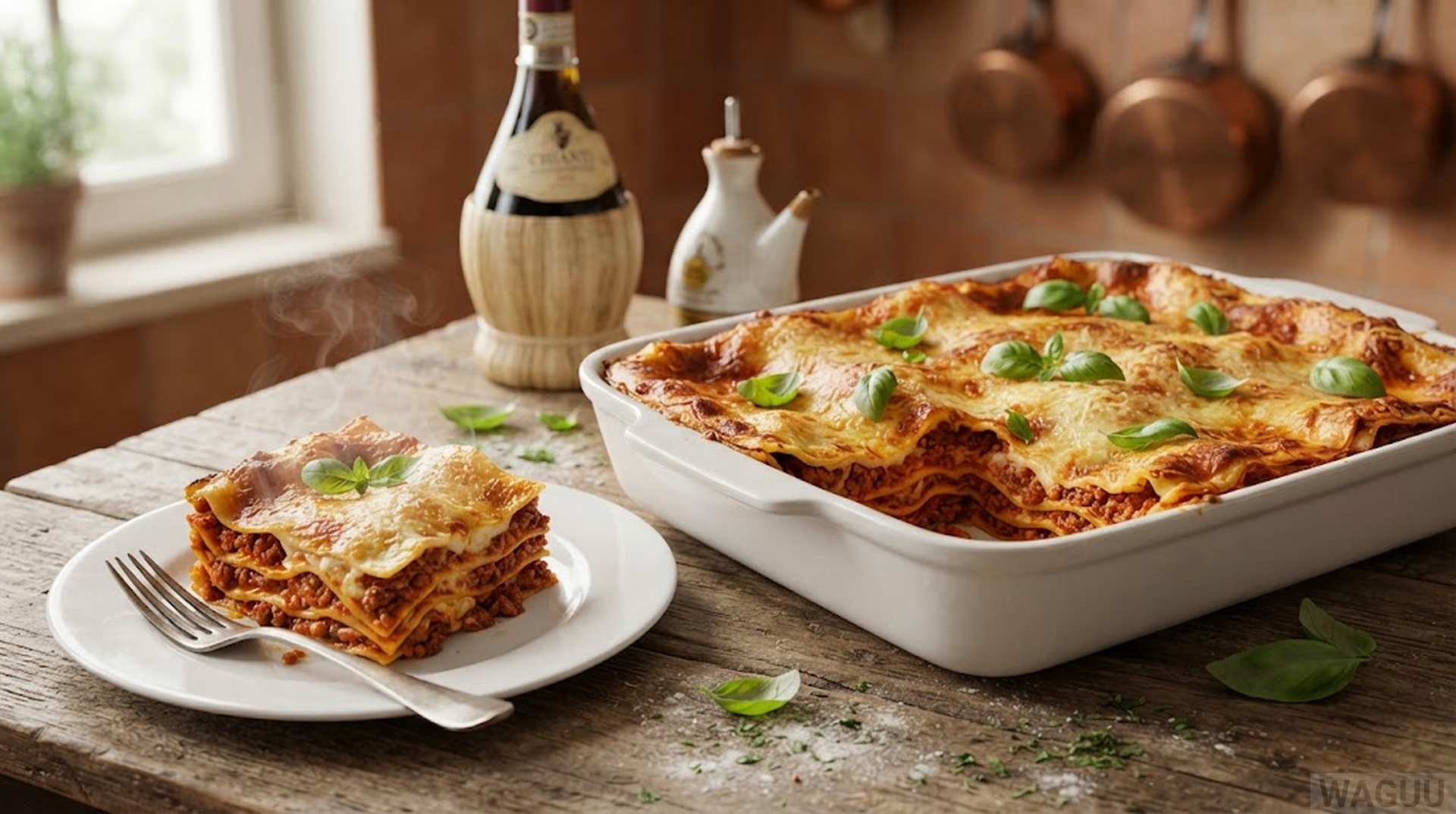
Summary: Layered baked pasta with slow-cooked ragù alla bolognese, béchamel and Parmigiano Reggiano. The ragù alone simmers for at least 3 hours. Makes 6 large portions.
Cooked this recipe? Share the result with the community.
Category: Pasta, Italian Cuisine
Success rate: not rated yet % of users managed this recipe
Quick Overview
- Dish: Lasagne alla Bolognese
- Category: Pasta, Italian Cuisine
- Cuisine: Italian (Bologna)
- Main ingredient: Fresh egg pasta sheets, 14 oz (or dried lasagne)
- Guide: 12 Most Famous Italian Dishes: Traditional Recipes
- Total time: 240 minutes (60 min prep + 180 min cooking)
- Difficulty: Medium
- Servings: 6 (portion weight: 14 oz)
- Key technique: Slow braising, layering, béchamel
- Preparation types: Braising, baking
- Dietary info & allergens: Gluten, milk, egg
- Suitable for: Sunday lunch, family gathering, festive dinner
- Nutrition (per portion): 890 kcal, Protein: 45 g, Fat: 42 g, Carbohydrates: 78 g
- Storage: 3 days in the fridge, 2 months in the freezer
- Pairing: Sangiovese, Chianti Classico, sparkling water
- In brief: Ragù first, then béchamel, then patience. The layering takes five minutes; the sauce takes three hours.
- Last updated: 23. 9. 2026
WAGUU says: “Lasagne is not a quick dish. If you cook the ragù in 40 minutes, you are making something else.”
Key Facts
| Preparation: | 60 minutes |
| Cooking: | 180 minutes (ragù) + 40 minutes (baking) |
| Temperature: | 350 °F (baking) |
| Servings: | 6 |
At a Glance
A dish that rewards patience. The ragù must be slow, the béchamel must be smooth, and the layers must be built with a light hand.
Ingredients
Base servings: 6 servings • Portion weight: 14 oz
| Ingredient | Quantity | Quality |
|---|---|---|
| Beef mince (ground beef) | 17.6 oz | Coarse ground, 15 % fat |
| Pork mince (ground pork) | 10.6 oz | Coarse ground, 20 % fat |
| Pancetta | 3.5 oz | Cut into small cubes |
| Onion | 5.3 oz | Finely chopped |
| Carrot | 3.5 oz | Finely chopped |
| Celery | 2.8 oz | Finely chopped |
| Dry red wine | 8.5 fl oz | Sangiovese or similar dry red |
| Whole peeled tomatoes | 28 oz | Good quality, crushed by hand |
| Whole milk | 6.8 fl oz | Full fat |
| Butter | 2.8 oz | Unsalted |
| All-purpose flour | 2.8 oz | For the béchamel |
| Fresh egg lasagne sheets | 14 oz | Or dried lasagne (about 12 sheets) |
| Parmigiano Reggiano | 7 oz | Aged 24 months, finely grated |
| Nutmeg | 0.035 oz | Freshly grated |
| Fine sea salt | 0.5 oz | For seasoning |
| Black pepper | 0.1 oz | Freshly ground |
Why You Will Love This Recipe
- Slow ragù: Three hours of simmering give depth that quick sauces cannot match.
- Silky béchamel: Smooth, nutmeg-scented sauce – not a heavy flour paste.
- Do-ahead friendly: Assemble the day before and bake straight from the fridge.
Why it works: Slow simmering breaks down the meat collagen into gelatin and reduces the tomato sauce to a concentrated, glossy ragù. Béchamel replaces ricotta in the authentic Bolognese version – it stabilizes the layers and gives the lasagne its silky, not heavy, character. Baking at 350 °F sets the structure without drying the pasta.
Recipe Overview
Preparation: 60 min | Cooking: 180 min | Difficulty: Medium | Servings: 6 | Type: Main dish | Origin: Italian (Bologna)
Detailed Method
Total progress: 0 % done
Phase 1: Soffritto – 15 min
Equipment: Heavy casserole, wooden spoon, knife
1. Heat a heavy casserole over medium-low heat. Add 3.5 oz of diced pancetta and render for 5 minutes until the fat runs. Add 5.3 oz finely chopped onion, 3.5 oz chopped carrot and 2.8 oz chopped celery. Cook gently for 10 minutes, stirring, until the vegetables are soft and sweet, not browned.
Visual check: The vegetables are translucent, glossy, and smell sweet. No browning.
Before you continue:
The soffritto must not brown. Browned vegetables give the ragù a bitter, roasted flavor instead of the sweet base it needs. Keep the heat low.
Phase 2: Meat and wine – 20 min
Equipment: Heavy casserole, wooden spoon
2. Raise the heat to medium. Add 17.6 oz beef mince and 10.6 oz pork mince. Break up the lumps with the spoon and brown the meat for 8–10 minutes until it is no longer pink. Pour in 8.5 fl oz of dry red wine and let it bubble away completely, about 5 minutes.
Visual check: The meat is evenly browned, no pink left. The wine has evaporated – no smell of alcohol, only a slight sweetness.
Phase 3: Ragù simmer – 180 min
Equipment: Casserole with lid, wooden spoon
3. Add 28 oz of hand-crushed tomatoes, 6.8 fl oz of whole milk, 0.5 oz of fine sea salt and 0.1 oz of freshly ground black pepper. Bring to a gentle simmer, reduce the heat to low and cover partially. Cook for at least 3 hours, stirring every 20 minutes, until the fat separates from the sauce and the meat is completely soft.
Visual check: The sauce is thick, glossy, and the fat pools slightly at the edges. The meat is dark and soft.
Before you continue:
Do not rush the ragù. If it is still liquid after 2 hours, the lid was too tight. Remove the lid and let it reduce for the last hour.
Phase 4: Béchamel – 15 min
Equipment: Saucepan, whisk
4. In a separate saucepan, melt 2.8 oz of unsalted butter over medium heat. Add 2.8 oz of all-purpose flour and cook for 2 minutes, whisking, until the mixture is pale and bubbling but not browned. Pour in 6.8 fl oz of whole milk in three additions, whisking constantly. Season with 0.035 oz of freshly grated nutmeg and a pinch of salt. Cook for 5 minutes until thick enough to coat the back of a spoon.
Visual check: The béchamel is smooth, glossy and thick. No lumps. A spoon dipped in it comes out coated evenly.
Phase 5: Assembly – 10 min
Equipment: Large baking dish, spoon, grater
5. Spread a thin layer of ragù on the bottom of a 12 × 9 inch baking dish. Add a layer of pasta sheets. Top with ragù, then béchamel, then grated Parmigiano. Repeat 5–6 times, ending with a layer of béchamel, Parmigiano and a few dots of ragù.
Visual check: The layers are even and the pasta sheets do not overlap. The top is covered but not drowned.
Phase 6: Baking – 40 min
Equipment: Oven, foil
6. Cover the dish with foil and bake at 350 °F for 25 minutes. Remove the foil and bake for a further 15 minutes until the top is golden and bubbling. Rest for 10 minutes before cutting – the layers will hold together better.
Visual check: The top is golden brown, the edges are bubbling. A knife cuts cleanly through the layers.
Required Equipment
| Item | Ideal size | Alternative | Risk |
|---|---|---|---|
| Heavy casserole | 5 quarts, thick base | Cast-iron Dutch oven | Thin pans burn the soffritto |
| Baking dish | 12 × 9 inches, deep | Rectangular roasting pan | Too shallow will overflow |
| Saucepan | 2 quarts, heavy base | Non-stick saucepan | Thin pans burn the roux |
Shopping List
Nutrition Profile
Values per 1 portion (without side). Calculated from average nutritional values of the ingredients.
| Nutrient | Per 100 g | Per 1 portion | Per 6 portions |
|---|---|---|---|
| Energy | 223 kcal | 890 kcal | 5340 kcal |
| Fat | 10.5 g | 42 g | 252 g |
| of which saturated | 5.1 g | 20 g | 120 g |
| Carbohydrates | 19.5 g | 78 g | 468 g |
| of which sugars | 2.8 g | 11 g | 66 g |
| Protein | 11.3 g | 45 g | 270 g |
| Salt | 0.9 g | 3.5 g | 21 g |
Reference intake of an average adult (8400 kJ / 2000 kcal).
WAGUU Pro Level
- Pro standard: Tested recipe with exact ratios and visual control points.
- Tip 1: Make the ragù a day ahead. The flavor improves overnight and the fat is easier to skim off.
- Tip 2: Do not use too much béchamel. It is a binder, not the main event. A thin layer between each pasta sheet is enough.
- Tip 3: Rest the lasagne 10 minutes after baking. Cutting too early will collapse the layers.
- Tip 4: Fresh egg lasagne sheets give a better result than dried, but dried works if you parboil them briefly.
Scientific Background
Three hours of simmering is not traditional romance – it is chemistry. Collagen in the meat breaks down into gelatin at temperatures between 160 and 195 °F, which thickens the sauce and gives it body. At the same time, the tomato sauce loses water through evaporation and concentrates its sugars and acids, which is why a long-cooked ragù tastes sweeter and deeper than a quick one. Béchamel is a roux-based sauce: the flour starch gelatinizes when heated with milk, which thickens the sauce and traps the fat from the butter into a stable emulsion. In the oven, the top layer of béchamel and Parmigiano browns through the Maillard reaction, adding the characteristic crust.
Fine Dining – Professional Techniques
- Plate composition: One clean square of lasagne in the center of a warm plate, with a spoon of ragù on the side.
- Textural contrast: Crisp top crust, soft pasta, silky béchamel, deep ragù.
- Temperature contrast: Serve hot but not boiling – the layers hold better when slightly cooled.
- Aromatic additions: A few leaves of fresh basil on the plate, but not inside the lasagne.
Sensory Radar
- Appearance: Golden-brown top, deep red sauce visible at the edges, clean layers when cut.
- Aroma: Slow-cooked tomato, red wine, nutmeg, aged cheese.
- Taste: Deep and savory, slightly sweet from the milk and carrot, salty from the cheese.
- Texture: Crisp top, tender pasta, silky béchamel, rich ragù.
Pairing
- Beer: A dark Italian birra doppio malto or a Belgian dubbel.
- Wine: Sangiovese, Chianti Classico, or a young Barbera.
- Non-alcoholic: Sparkling water with a slice of orange.
Variations of Preparation
- With ricotta: Replace béchamel with ricotta – denser and more savory. A southern variation.
- Vegetarian ragù: Use lentils or mushrooms instead of meat. The technique is the same.
Allergens and Dietary Information
Contains: Gluten, milk, egg • Gluten: Contains • Not suitable for: Celiac disease, lactose intolerance (unless using lactose-free béchamel)
Suitable For
Sunday lunch, family gathering, festive dinner, do-ahead cooking.
Substitution Catalogue
- Fresh egg lasagne: Dried lasagne (parboil for 2 minutes).
- Parmigiano Reggiano: Grana Padano (milder, less expensive).
- Beef and pork mince: All beef (less depth) or half-and-half with veal.
FAQ
Can I make lasagne ahead of time?
Yes. Assemble and refrigerate for up to 24 hours. Bake straight from the fridge and add 10 minutes to the covered baking time.
Can I freeze it?
Yes, before baking. Wrap well and freeze for up to 2 months. Thaw overnight in the fridge before baking.
Why is my lasagne watery?
The ragù was too thin or the béchamel was too loose. Both must be thick when assembled. If using fresh pasta, do not soak it first.
Do I need to pre-cook the pasta sheets?
Fresh egg pasta, no. Dried pasta, brief parboiling (2 minutes) helps but is not essential if the sauce is wet enough.
WAGUU Petr advises: Cooking for 6 or more?
6–8 people: Use a larger dish (13 × 10 inches). Increase all ingredients by 30 %. • 10+ people: Make two lasagnes in two dishes instead of one large one. They bake more evenly and the layers hold better.
Storage and Reheating
Fridge: 3 days (baked and cooled, covered) • Freezer: 2 months (before baking) • Reheating: Cover with foil and reheat at 325 °F for 20 minutes, then 5 minutes uncovered to refresh the top.
Author: WAGUU Petr & Team • Published: 23 Sep 2026
More Recipes from This Article
More Recipes You Might Like
Why WAGUU?
WAGUU recipes are checked for ingredient accuracy, method consistency and nutritional values.
Photo Gallery from Cooking
Community photos: Cook it, photograph it, share the result.
You can upload photos in the comments below or send them by email.
Filmed a video of this recipe? Paste the link from YouTube, YouTube Shorts, TikTok, Instagram Reels, Facebook Reels, Pinterest, Vimeo or X (Twitter) into a comment – we will publish it and help make you and your content visible.
Most Common Mistakes
- Rushing the ragù – three hours is the minimum. Less time equals less flavor.
- Too much béchamel – it is a binder, not the main ingredient. Thin layers only.
- Cutting too early – wait 10 minutes after baking or the layers will collapse.
- Thin sauce – both ragù and béchamel must be thick enough to coat a spoon.