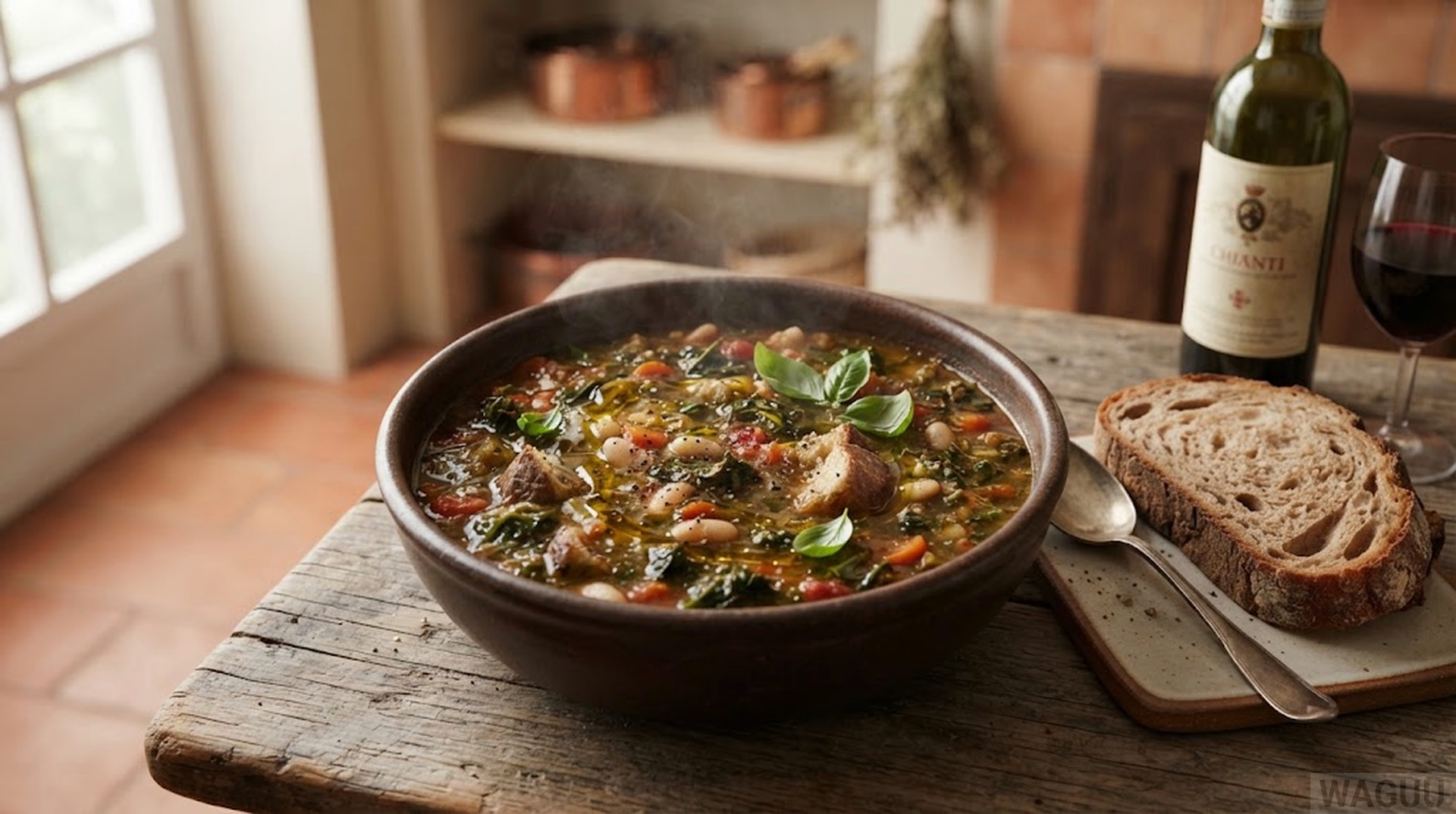
Summary: Tuscan bread soup with cannellini beans, kale, vegetables and stale bread. Thick, rustic and deeply savory. Ready in 90 minutes. Serves 6.
Cooked this recipe? Share the result with the community.
Category: Soups, Italian Cuisine
Success rate: not rated yet % of users managed this recipe
Quick Overview
- Dish: Ribollita
- Category: Soups, Italian Cuisine
- Cuisine: Italian (Tuscany)
- Main ingredient: Dried cannellini beans, 10.6 oz (or 21 oz cooked)
- Guide: 12 Most Famous Italian Dishes: Traditional Recipes
- Total time: 90 minutes (20 min prep + 70 min cooking)
- Difficulty: Easy
- Servings: 6 (portion weight: 14 oz)
- Key technique: Slow simmering, bread thickening
- Preparation types: Simmering
- Dietary info & allergens: Gluten, celery
- Suitable for: Weeknight dinner, budget cooking, winter warming dish
- Nutrition (per portion): 380 kcal, Protein: 18 g, Fat: 12 g, Carbohydrates: 52 g
- Storage: 4 days in the fridge, 2 months in the freezer
- Pairing: Chianti, Tuscan olive oil, sparkling water
- In brief: It means “reboiled”. The soup is better the second day.
- Last updated: 23. 9. 2026
WAGUU says: “Ribollita is not a soup. It is a soup that became bread. The spoon should stand up in it.”
Key Facts
| Preparation: | 20 minutes (plus overnight bean soak) |
| Cooking: | 70 minutes |
| Temperature: | Gentle simmer, 195–205 °F |
| Servings: | 6 |
At a Glance
Thick, dark, deeply savory and almost spoon-standing. A soup that has absorbed the bread and become something more.
Ingredients
Base servings: 6 servings • Portion weight: 14 oz
| Ingredient | Quantity | Quality |
|---|---|---|
| Dried cannellini beans | 10.6 oz | Soaked overnight |
| Kale (cavolo nero) | 10.6 oz | Tuscan kale if possible, stems removed |
| Onion | 5.3 oz | Finely chopped |
| Carrot | 3.5 oz | Finely chopped |
| Celery | 2.8 oz | Finely chopped |
| Potato | 7 oz | Peeled, cubed |
| Canned chopped tomatoes | 14 oz | Good quality |
| Stale Tuscan bread | 10.6 oz | 2–3 days old, crust removed |
| Extra virgin olive oil | 2 fl oz | Tuscan, cold-pressed |
| Garlic | 2 cloves | Crushed |
| Bay leaf | 2 pcs | Dried |
| Fine sea salt | 0.4 oz | For seasoning |
| Black pepper | 0.1 oz | Freshly ground |
Why You Will Love This Recipe
- Budget cooking: Simple ingredients, big flavor.
- Better the next day: Reheating develops the flavor further.
- Warming: A winter soup that fills you up for hours.
Why it works: The bread breaks down during the long simmer and thickens the soup, replacing the cream that would normally be used. The beans add body and protein, the kale adds bitterness and iron, and the soffritto gives a sweet base. The olive oil added at the end – a Tuscan tradition called “all’olio crudo” – brings aroma and freshness to the finished dish.
Recipe Overview
Preparation: 20 min | Cooking: 70 min | Difficulty: Easy | Servings: 6 | Type: Soup | Origin: Italian (Tuscany)
Detailed Method
Total progress: 0 % done
Phase 1: Beans and soffritto – 15 min
Equipment: Large pot, wooden spoon
1. Drain the soaked cannellini beans. In a large pot, heat 1 fl oz of olive oil and cook the chopped onion, carrot and celery for 8 minutes until soft. Add the beans, 2 bay leaves and enough cold water to cover by 1 1/4 inches.
Visual check: The soffritto is soft and glossy. The beans are covered by water.
Phase 2: Bean cooking – 40 min
Equipment: Large pot, lid
2. Bring to a boil, then reduce the heat to a gentle simmer and cook for 40 minutes until the beans are soft. Remove one third of the beans and blend until smooth, then return the purée to the pot.
Visual check: The beans are soft enough to crush between your fingers. The puréed beans are smooth and pale.
Before you continue:
Do not skip the purée step. It gives the soup its thick body and stops the beans and bread from separating in the bowl.
Phase 3: Vegetables and tomato – 15 min
Equipment: Large pot, wooden spoon
3. Add the cubed potato, 14 oz of canned chopped tomatoes, 0.4 oz of salt and 0.1 oz of black pepper. Simmer for 15 minutes until the potato is tender.
Visual check: The potato is soft enough to break with a spoon. The tomatoes have broken down into the liquid.
Phase 4: Kale – 10 min
Equipment: Large pot, wooden spoon
4. Add 10.6 oz of kale, stems removed and leaves roughly chopped. Simmer for 10 minutes until the kale is soft but still holds its shape.
Visual check: The kale is dark green and tender, with no tough stems visible in the soup.
Phase 5: Bread – 10 min
Equipment: Large pot, wooden spoon
5. Tear 10.6 oz of stale Tuscan bread into chunks and stir into the soup. Simmer for 10 minutes, stirring occasionally, until the bread has broken down and thickened the soup.
Visual check: The soup is thick and almost spoon-standing. No visible chunks of bread remain.
Before you continue:
Do not use fresh bread. Fresh bread dissolves too quickly and turns the soup into a paste. Stale bread holds its structure while it thickens.
Phase 6: Finishing – 5 min
Equipment: Ladle, bowls, olive oil
6. Remove the bay leaves. Serve in deep bowls with a generous drizzle of Tuscan extra virgin olive oil on top and a twist of black pepper. Traditionally the soup is reheated the next day and served again, hence the name ribollita – “reboiled”.
Visual check: The soup is thick, dark green-brown, with a glisten of olive oil on top. The spoon stands up in it.
Required Equipment
| Item | Ideal size | Alternative | Risk |
|---|---|---|---|
| Large pot | 5 quarts, thick base | Cast-iron Dutch oven | Thin pans catch at the bottom |
| Blender or stick blender | For one third of the beans | Potato masher | Without purée the soup does not thicken properly |
| Deep bowls | 16 oz | Soup plates | Shallow plates will not hold the thick soup |
Shopping List
Nutrition Profile
Values per 1 portion (without side). Calculated from average nutritional values of the ingredients.
| Nutrient | Per 100 g | Per 1 portion | Per 6 portions |
|---|---|---|---|
| Energy | 95 kcal | 380 kcal | 2280 kcal |
| Fat | 3 g | 12 g | 72 g |
| of which saturated | 0.5 g | 2 g | 12 g |
| Carbohydrates | 13 g | 52 g | 312 g |
| of which sugars | 2.8 g | 11 g | 66 g |
| Protein | 4.5 g | 18 g | 108 g |
| Salt | 0.7 g | 2.8 g | 16.8 g |
Reference intake of an average adult (8400 kJ / 2000 kcal).
WAGUU Pro Level
- Pro standard: Tested recipe with exact ratios and visual control points.
- Tip 1: Make the soup a day ahead. The flavor develops overnight and the texture thickens further.
- Tip 2: Use stale bread – 2 to 3 days old. Fresh bread dissolves into a paste.
- Tip 3: Add the olive oil at the very end, off the heat. Tuscan tradition – “all’olio crudo”.
- Tip 4: If the soup is too thick, loosen with a splash of hot water or stock. It should be spoon-standing but not solid.
Scientific Background
The bread thickens the soup through starch gelatinization. When the bread is heated in the soup, the starch granules inside absorb water and swell, releasing their contents into the liquid. The result is a thick, silky texture that replaces cream or flour. Puréeing one third of the beans adds further body – the bean starch thickens the soup and gives it a velvety mouthfeel. The kale adds bitterness and a mineral note, which balances the sweetness of the carrots and onions. The olive oil is added at the end because its aromatic compounds are volatile and would evaporate during cooking.
Fine Dining – Professional Techniques
- Plate composition: A deep bowl filled two-thirds, with a generous drizzle of olive oil forming a spiral on top.
- Textural contrast: Thick soup with a pool of oil, maybe a few toasted bread cubes on top.
- Temperature contrast: Hot soup, room-temperature olive oil.
- Aromatic additions: A few leaves of fresh basil or a pinch of black pepper on top.
Sensory Radar
- Appearance: Thick, dark green-brown soup with a glisten of olive oil on top.
- Aroma: Earthy kale, sweet onion, tomato, olive oil.
- Taste: Deeply savory, slightly bitter from the kale, sweet from the tomato and carrots.
- Texture: Thick, spoon-standing, silky with the oil on top.
Pairing
- Beer: A light Italian birra chiara or a dry pilsner.
- Wine: Chianti, Rosso di Montalcino, or a young Sangiovese.
- Non-alcoholic: Still water with a slice of lemon.
Variations of Preparation
- Pappa al Pomodoro: Tomato and bread soup without beans or kale – lighter but similar technique.
- Without bread: Skip the bread and serve as a bean and kale soup – thinner but still good.
Allergens and Dietary Information
Contains: Gluten, celery • Gluten: Contains (can be removed by using gluten-free bread) • Not suitable for: Celiac disease (unless gluten-free bread is used)
Suitable For
Weeknight dinner, budget cooking, winter warming dish, do-ahead cooking.
Substitution Catalogue
- Dried cannellini beans: 21 oz canned cannellini beans (add in the last 15 minutes).
- Kale: Savoy cabbage or cavolo nero.
- Stale Tuscan bread: Any stale country bread – ciabatta, sourdough.
FAQ
Can I use canned beans?
Yes. Use 21 oz of canned beans and add them in the last 15 minutes. Dried beans give a better result but canned works.
Why is ribollita so thick?
The bread thickens it – that is the point. It should be thick enough for a spoon to stand up in it. If it is too thick, add hot water.
Can I freeze it?
Yes, for up to 2 months. Reheat gently, adding a splash of water if needed. The bread may break down further.
What is the difference between ribollita and minestrone?
Minestrone is a thinner vegetable soup. Ribollita has bread cooked into it, which thickens the soup. Ribollita is also traditionally made a day ahead and reheated.
WAGUU Petr advises: Cooking for 6 or more?
6–8 people: Increase all ingredients by 30 %. Use a larger pot. • 10+ people: Make the soup a day ahead and reheat – it will taste better and hold its texture.
Storage and Reheating
Fridge: 4 days (cooled, covered) • Freezer: 2 months • Reheating: Reheat gently in a pan with a splash of water. Do not boil – the bread will burn at the bottom.
Author: WAGUU Petr & Team • Published: 23 Sep 2026
More Recipes from This Article
More Recipes You Might Like
Why WAGUU?
WAGUU recipes are checked for ingredient accuracy, method consistency and nutritional values.
Photo Gallery from Cooking
Community photos: Cook it, photograph it, share the result.
You can upload photos in the comments below or send them by email.
Filmed a video of this recipe? Paste the link from YouTube, YouTube Shorts, TikTok, Instagram Reels, Facebook Reels, Pinterest, Vimeo or X (Twitter) into a comment – we will publish it and help make you and your content visible.
Most Common Mistakes
- Using fresh bread – it dissolves too quickly and turns the soup into paste. Use stale bread.
- Skipping the bean purée – the soup will not thicken properly and the layers will separate.
- Not enough olive oil at the end – the drizzle of raw olive oil is not optional.
- Serving too hot – ribollita is best at around 140–150 °F, not boiling.