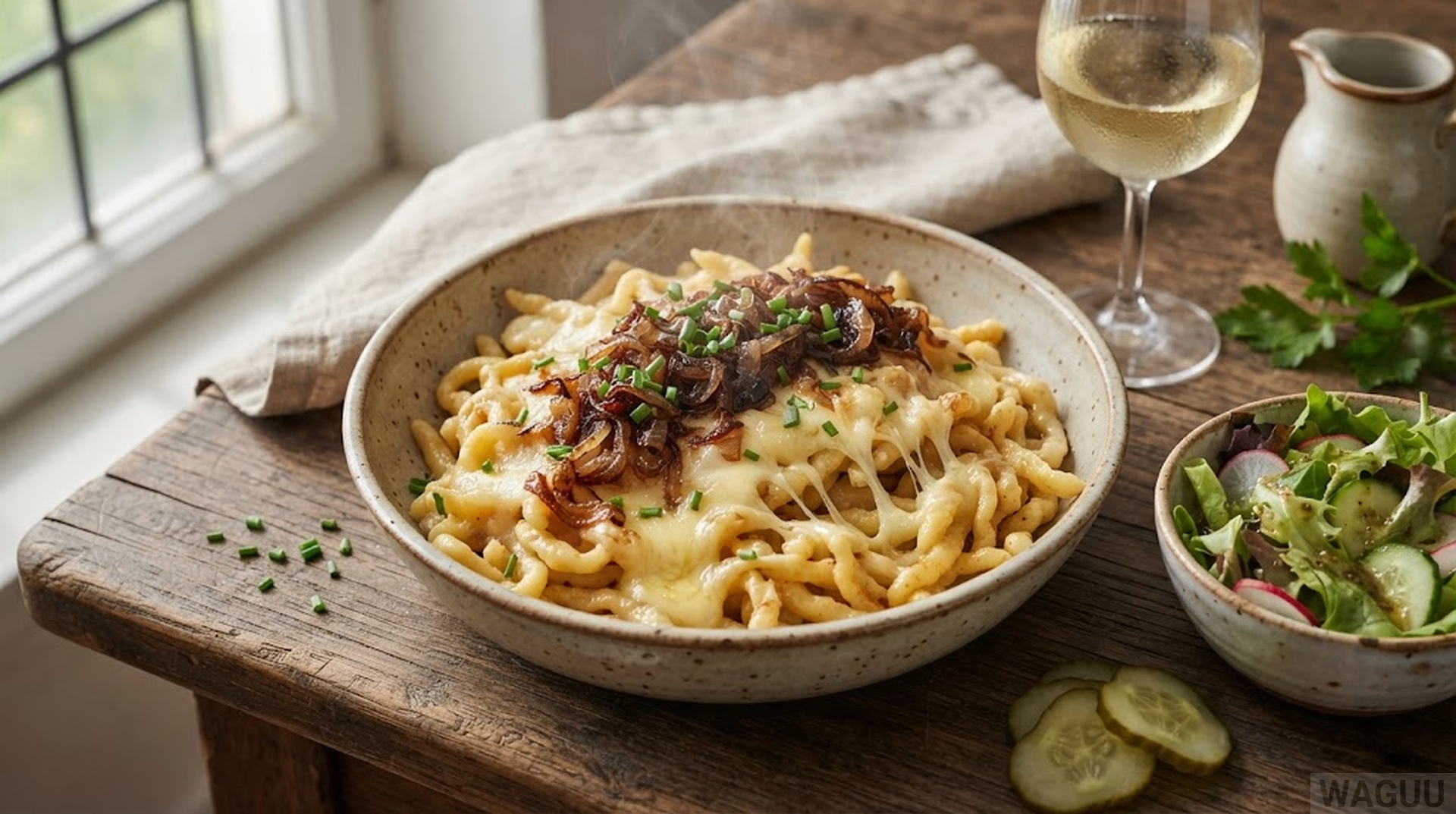
Summary: Soft Swabian egg noodles layered with melted cheese and topped with fried onions. Serves 6, ready in 60 minutes.
Cooked this recipe? Share the result with the community.
Category: American Pasta, American German Cuisine
Success rate: not rated yet % of users managed this recipe
Quick overview
- Dish: Käsespätzle – Swabian Egg Noodles with Cheese
- Category: American Pasta, American German Cuisine
- Cuisine: German (Swabia, Allgäu)
- Main ingredient: All-purpose flour, 4 cups (plus eggs and cheese)
- Guide: 12 Most Famous German Dishes
- Total time: 60 minutes (30 min prep + 30 min cooking)
- Difficulty: Easy
- Servings: 6 (portion weight: 10.5 oz)
- Key technique: Noodle making and baking
- Preparation types: Boiling, baking
- Dietary info & allergens: Contains gluten, eggs, milk
- Suitable for: Family meal, vegetarian dinner, ski holiday dinner
- Nutrition (per portion): 620 kcal, Protein: 26 g, Fat: 32 g, Carbohydrates: 56 g
- Storage: 3 days in the fridge, 2 months in the freezer
- Pairing: Light lager, apple cider, green salad
- In short: Soft egg noodles layered with melted cheese and topped with fried onions – the Swabian answer to macaroni and cheese.
- Last updated: September 26, 2026
WAGUU says: “Käsespätzle is what happens when you give Swabian home cooking a plate and ask it to make you feel warm.”
Key facts
| Prep time: | 30 min |
| Cook time: | 30 min |
| Temperature: | 350 °F oven (optional) |
| Servings: | 6 |
At a glance
A soft dough of flour, eggs, salt and water is scraped or pressed into boiling water to form small, irregular noodles. The cooked Spätzle are layered with grated Emmental or Bergkäse and topped with golden fried onions, then either served directly from the pan or baked briefly in the oven until the cheese melts and the top is crisp. This is the dish of the Allgäu and Swabia, and it is impossible not to love.
Ingredients
Base servings: 6 • Portion weight: 10.5 oz
| Ingredient | Amount | Quality |
|---|---|---|
| All-purpose flour | 4 cups | plus extra for dusting |
| Eggs | 5 pcs | large, free-range |
| Kosher salt | 2 tsp | for the dough |
| Water | ⅓ cup + 1 tbsp | cold, for the dough |
| Ground nutmeg | ¼ tsp | freshly grated |
| Emmental cheese | 12.3 oz | grated |
| Bergkäse cheese | 5.3 oz | grated (or extra Emmental) |
| Unsalted butter | 4 tbsp | for frying the onions |
| Yellow onions | 3 pcs | thinly sliced |
| Fresh chives | ⅓ cup | chopped, to serve |
Why you will love this recipe
- Comfort food at its best: Soft noodles, melted cheese and sweet fried onions – nothing complicated, nothing to hide behind.
- Ready in an hour: The dough is simple and the dish comes together quickly.
- Vegetarian: No meat, just cheese, eggs and flour.
Why it works: The dough is softer and wetter than Italian pasta dough, which gives the Spätzle their characteristic soft, slightly chewy texture. Boiling the Spätzle briefly sets the dough, and the final baking (or serving directly from the pan) melts the cheese and brings everything together. The fried onions add sweetness and crunch to contrast the soft noodles.
Recipe overview
Prep: 30 min | Cook: 30 min | Difficulty: Easy | Servings: 6 | Type: Main course | Origin: German
Detailed method
Overall progress: 0 % done
Phase 1: Making the dough – 15 min
Equipment: Large bowl, wooden spoon, Spätzle press or board and scraper
1. Combine the flour, salt and nutmeg in a large bowl. Add the eggs and water and mix with a wooden spoon until the dough is smooth and elastic. Beat the dough vigorously for 2–3 minutes – this develops the gluten and gives the Spätzle their characteristic bite. The dough should be thick but still slightly sticky.
VKB: The dough is smooth, glossy and holds its shape when lifted on a spoon.
Before you continue:
If the dough is too stiff, add a tablespoon of water. If it is too thin, add a tablespoon of flour. The dough should be soft but hold together.
Phase 2: Cooking the Spätzle – 15 min
Equipment: Large saucepan, Spätzle press or board and scraper, slotted spoon
2. Bring a large saucepan of salted water to a boil. Working in batches, press the dough through a Spätzle press or scrape it off a board into the boiling water. The Spätzle are cooked when they float to the surface (about 2–3 minutes). Remove with a slotted spoon and drain. Continue until all the dough is used.
VKB: The Spätzle float on the surface and are firm but soft when pressed with a finger.
Before you continue:
Do not overcrowd the pan – cook the Spätzle in batches. Overcrowding lowers the water temperature and makes the Spätzle gluey.
Phase 3: Frying the onions – 10 min
Equipment: Large skillet
3. Melt the butter in a large skillet over medium heat. Add the thinly sliced onions and fry gently for 8–10 minutes, stirring occasionally, until soft and golden brown. Do not rush – slow frying gives the onions their sweetness. Set aside.
VKB: The onions are soft, golden and slightly caramelized, with no burnt edges.
Phase 4: Layering and baking – 15 min
Equipment: Oven-safe baking dish, oven at 350 °F
4. Preheat the oven to 350 °F. Layer the cooked Spätzle and grated cheese in a buttered baking dish, starting with Spätzle and ending with cheese. Bake for 10–12 minutes, until the cheese is melted and bubbling. Remove from the oven, top with the fried onions and chopped chives, and serve.
VKB: The cheese is fully melted and golden. The top layer of Spätzle is slightly crisp at the edges.
Phase 5: Serving – 5 min
Equipment: Warm plates
5. Spoon the Käsespätzle onto warm plates and top with the remaining fried onions and a sprinkle of chives. Serve with a green salad or a glass of apple cider.
VKB: The cheese is stringy and melted, and the onions are crisp on top.
Required equipment
| Item | Ideal size | Alternative | Risk |
|---|---|---|---|
| Spätzle press or board and scraper | Standard size | Colander with large holes | Irregular shapes cook unevenly |
| Large saucepan | 5 qt | Wide deep skillet | Small pan = overcrowded Spätzle |
| Oven-safe baking dish | 10 × 8 inch | Large oven-safe skillet | Too shallow = cheese overflows |
Shopping list
Nutritional profile
Values per 1 portion (without side dish). Calculated from average nutritional values of the ingredients.
| Nutrient | Per 100 g | Per portion | Per 6 portions |
|---|---|---|---|
| Energy | 207 kcal | 620 kcal | 3720 kcal |
| Fat | 10.7 g | 32 g | 192 g |
| of which saturates | 6.4 g | 19 g | 114 g |
| Carbohydrates | 18.7 g | 56 g | 336 g |
| of which sugars | 1.7 g | 5 g | 30 g |
| Protein | 8.7 g | 26 g | 156 g |
| Salt | 0.9 g | 2.7 g | 16.2 g |
Reference intake of an average adult (8400 kJ / 2000 kcal).
WAGUU Pro level
- Pro standard: Verified recipe with precise ratios and visual control points.
- Tip 1: Use a mix of Emmental and Bergkäse for depth – the Emmental melts smoothly and the Bergkäse adds a sharp edge.
- Tip 2: Beat the dough vigorously – the more you beat it, the better the texture of the Spätzle.
- Tip 3: If you do not have a Spätzle press, use a colander with large holes or scrape the dough off a wet wooden board with a knife.
- Tip 4: For the classic “geröstet” version, skip the oven and fry the cooked Spätzle in butter with the onions until golden.
Scientific background
Spätzle dough is a soft, wet dough that is cooked directly in boiling water. The eggs and vigorous beating develop the gluten, which gives the noodles their characteristic chew. When the dough hits the boiling water, the starch gelatinizes and the proteins set, forming the soft, irregular shapes. The cheese melts because the heat breaks down the protein bonds in the cheese, allowing the fat and water to flow together. The fried onions add sweetness through the Maillard reaction and caramelization.
Fine dining – professional techniques
- Plate composition: A neat mound of Käsespätzle in the center of a warm plate, topped with a nest of fried onions and a sprinkle of chives.
- Texture contrasts: The soft noodles against the crisp onions.
- Temperature contrast: Serve hot, with a cold glass of apple cider or beer.
- Aromatic additions: A pinch of nutmeg or a few fresh chives on top.
Sensory radar
- Appearance: Golden-brown noodles, melted cheese, dark golden onions.
- Aroma: Melted cheese, fried onion and a hint of nutmeg.
- Taste: Salty, creamy, slightly sweet from the onions.
- Texture: Soft, chewy noodles with a crisp top layer of onions.
Pairing
- Beer: A light lager or a Bavarian wheat beer.
- Wine: A dry Riesling or a light red.
- Non-alcoholic: Cold apple cider or sparkling water.
Preparation variations
- With bacon: Add 3.5 oz of fried bacon to the layers for a richer version.
- Fried (geröstet): Instead of baking, fry the cooked Spätzle in butter with onions until golden.
Allergens and dietary information
Contains: gluten, eggs, milk • Gluten: contains • Not suitable for: celiac disease, lactose-free diet
Suitable for
Family meal, vegetarian dinner, ski holiday dinner, quick weeknight meal
Substitution catalogue
- Emmental: Gruyère, Comté or a mild Cheddar
- Bergkäse: Parmesan or aged Gouda
- Spätzle press: Colander with large holes or a board and scraper
FAQ
What is the difference between Spätzle and Käsespätzle?
Spätzle are the plain egg noodles; Käsespätzle is the dish where those noodles are layered with cheese and onions.
Can I make Spätzle without a press?
Yes. You can scrape the dough off a wet wooden board directly into the boiling water, or push it through a colander with large holes.
Why are my Spätzle chewy?
Either the dough was not beaten enough (beat it more) or the Spätzle were overcooked (cook them just until they float).
Can I make Käsespätzle ahead of time?
Yes. Assemble the dish, cool it and refrigerate for up to 2 days. Reheat in a 350 °F oven for 15–20 minutes.
WAGUU Petr advises: Cooking for 6 or more?
6–8 people: One batch serves 6 as a main course. • 10+ people: Double the recipe and use two baking dishes. Keep the first batch warm while the second bakes.
Sides and serving
- Green salad with vinaigrette – cuts through the cheese (not part of the recipe)
- Glass of apple cider or light beer (not part of the recipe)
- Dill pickle – traditional (not part of the recipe)
Serving: Spoon the Käsespätzle onto warm plates, top with fried onions and chives, and serve with a green salad.
Storage and reheating
Fridge: 3 days • Freezer: 2 months • Reheating: Reheat in a 350 °F oven for 15 minutes, or in a covered pan on the stovetop with a splash of milk.
Author: WAGUU Petr & Team • Published: 28 Sep 2026
More recipes from this article
Guide: 12 Most Famous German Dishes
Other recipes you might enjoy
Why WAGUU?
WAGUU recipes are checked for accuracy of ingredients, methods and nutritional values.
Photo gallery from the process
Community photos: Cook it, photograph it and share the result.
You can upload photos in the comments below or send them by email.
Filmed a video of this recipe? Post a link to YouTube, YouTube Shorts, TikTok, Instagram Reels, Facebook Reels, Pinterest, Vimeo or X (Twitter) in the comments – we will feature it and help your content reach more people.
Common mistakes
- Not beating the dough enough: The Spätzle will be soft and gluey instead of firm and chewy. Beat for 2–3 minutes.
- Overcrowding the pan: The Spätzle will stick together and cook unevenly. Cook in batches.
- Adding too much cheese at once: The cheese will not melt evenly. Layer it thinly between the Spätzle.
- Burning the onions: Burnt onions are bitter. Fry them slowly over medium heat and stir often.