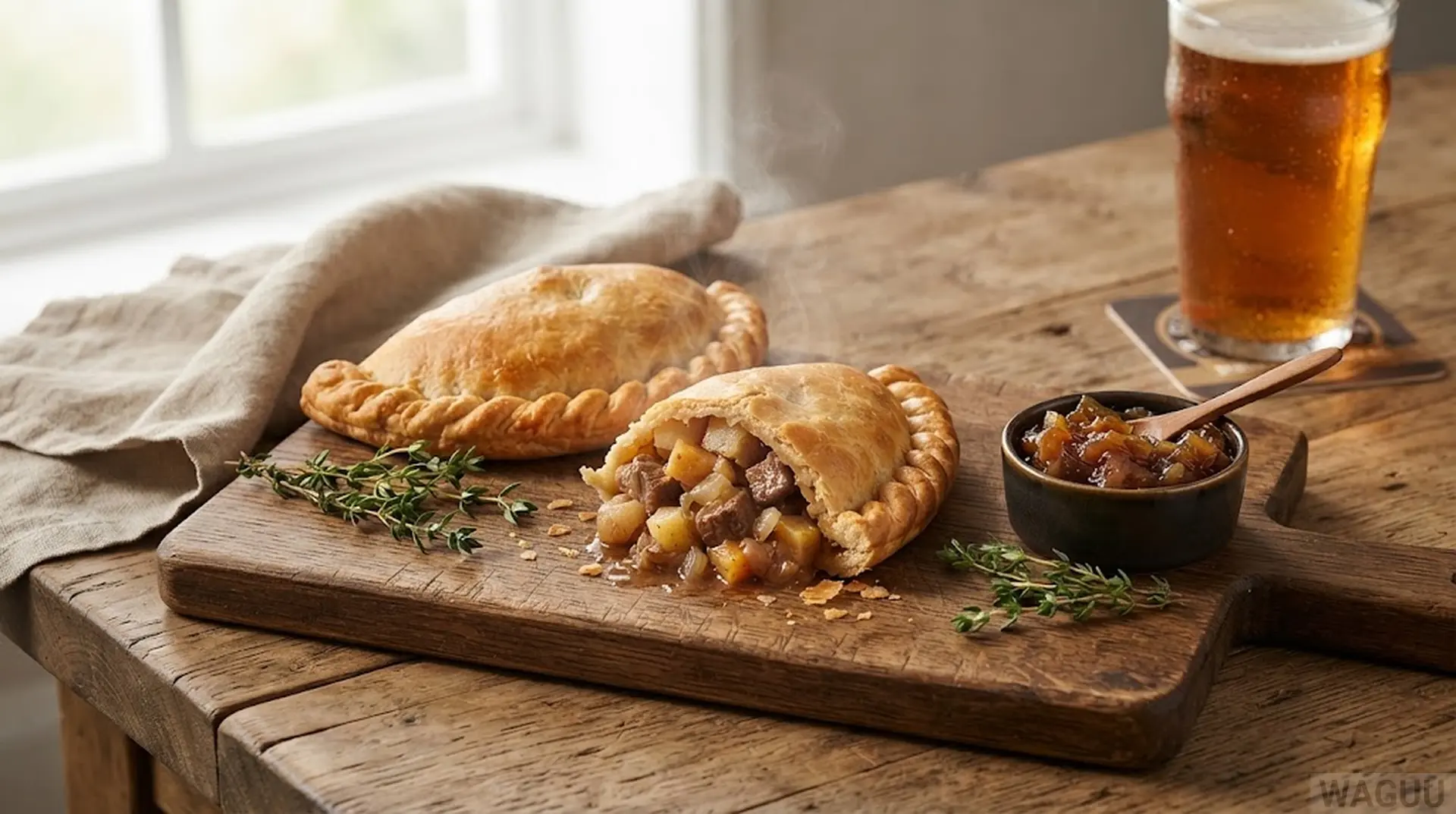
Summary: Hand-held pastry filled with beef, potato, rutabaga and onion, crimped and baked until golden. Ready in 1 hour 30 minutes, serves 6.
Cooked this recipe? Share your result with the community.
Category: Beef, British Cuisine
Success rate: not rated yet % of users succeeded
Quick Overview
- Dish: Cornish Pasty
- Category: Beef, British Cuisine
- Cuisine: British
- Main ingredient: Beef chuck, 1.3 lbs
- Guide: 12 Most Famous British Dishes
- Total time: 90 minutes (45 min prep + 45 min cooking)
- Difficulty: Medium
- Servings: 6 (Portion weight: 12 oz)
- Key technique: Crimping, baking
- Preparation types: Baking
- Dietary info & allergens: Contains gluten, eggs, milk.
- Suitable for: Lunchbox, picnic, packed lunch, snack
- Nutrition (per serving): 620 kcal, Protein: 28 g, Fat: 32 g, Carbs: 58 g
- Storage: 3 days in fridge, 3 months in freezer
- Pairing: Ale, cider, tea
- In short: A hand-held pie from Cornwall – beef, potato, rutabaga and onion in a crimped pastry crust.
- Last updated: 2025-01-27
WAGUU says: “The Cornish Pasty was traditionally a lunch for miners – the crimped edge was used as a handle and discarded. Today, it’s a beloved British snack.”
Key Facts
| Prep time: | 45 minutes |
| Cook time: | 45 minutes |
| Oven temperature: | 400°F |
| Servings: | 6 |
At a Glance
A hand-held pie from Cornwall with a thick pastry crust filled with beef, potato, rutabaga and onion. The edges are crimped to seal in the filling. Traditionally a lunch for miners, today a beloved British snack.
Ingredients
Base servings: 6 • Portion weight: 12 oz
| Ingredient | Amount | Quality |
|---|---|---|
| Beef chuck or braising steak | 1.3 lbs | Cut into 1/2-inch cubes |
| Russet potatoes | 0.9 lbs | Peeled, cut into 1/2-inch cubes |
| Rutabaga (swede) | 0.65 lbs | Peeled, cut into 1/2-inch cubes |
| Brown onions | 2 medium | Chopped |
| All-purpose flour | 4 cups | For pastry |
| Butter | 9 oz | Cold, cubed |
| Eggs | 1 large | For egg wash |
| Ice-cold water | 0.5 cup | For pastry |
| Fine sea salt | 2 tsp | For seasoning |
| Black peppercorns | 1 tsp | Freshly ground |
Why You’ll Love This Recipe
- Traditional Cornish classic: A hand-held pie with a rich, savory filling.
- Perfect for lunchboxes: Portable, filling and delicious cold or warm.
- Make ahead: Assemble ahead and freeze. Bake when needed.
Why it works: The thick pastry crust seals in the filling and its juices, creating a rich, savory interior. The crimped edge acts as a handle and seals the pastry. Baking at high heat creates a golden, crispy crust through the Maillard reaction.
Recipe Overview
Prep: 45 min | Cook: 45 min | Difficulty: Medium | Servings: 6 | Type: Main Dish | Origin: British
Detailed Method
Overall progress: 0 % done
Phase 1: Make the Pastry – 15 min
Equipment: Mixing bowl, pastry blender or fingertips
1. In a large bowl, rub the cold butter into the flour with your fingertips until the mixture resembles breadcrumbs. Add the ice-cold water a little at a time and mix until the dough comes together. Wrap in plastic wrap and refrigerate for 30 minutes.
VKB: Dough is smooth and holds together. It does not stick to your hands.
Before you continue:
Keep the butter cold. Warm butter makes the pastry greasy. Use cold hands and work quickly.
Phase 2: Prepare the Filling – 15 min
Equipment: Cutting board, knife, mixing bowl
2. In a large bowl, mix the beef, potato, rutabaga and onion. Season generously with salt and pepper. The filling should be raw – it cooks inside the pastry.
VKB: Filling is evenly mixed. All ingredients are cut to the same size.
Before you continue:
Cut all ingredients to the same size. This ensures even cooking. Smaller pieces cook faster.
Phase 3: Assemble the Pasties – 15 min
Equipment: Rolling pin, baking sheet, pastry brush
3. Roll out the pastry on a lightly floured surface to a thickness of 1/8 inch. Cut out six circles (about 8 inches diameter). Divide the filling between the circles, placing it on one half. Brush the edges with egg wash. Fold the pastry over the filling and press the edges to seal. Crimp the edges by folding and twisting. Brush the top with egg wash and cut a small slit in the center.
VKB: Pasties are sealed and crimped. The edges are folded and twisted.
Before you continue:
Seal the edges well. Any gaps will allow steam to escape and the filling to leak out during baking.
Phase 4: Bake the Pasties – 45 min
Equipment: Oven, baking sheet
4. Preheat oven to 400°F. Place the pasties on a baking sheet lined with parchment paper. Bake for 40–45 minutes until golden brown and crispy. If the pastry browns too quickly, cover loosely with foil.
VKB: Pastry is golden brown and crispy. The filling is cooked through.
Before you continue:
Place the pasties on a baking sheet to catch any drips. The filling can leak out during baking.
Phase 5: Rest and Serve – 5 min
Equipment: Serving board, napkins
5. Remove from the oven and let rest for 5 minutes before serving. Serve warm or cold with a side of chutney, pickles or a simple salad.
VKB: Pasties hold their shape when served. Filling is moist and savory.
Required Equipment
| Equipment | Ideal size | Alternative | Risk |
|---|---|---|---|
| Mixing bowl | For pastry | Large bowl | Lumpy pastry |
| Rolling pin | For pastry | Wine bottle | Uneven thickness |
| Baking sheet | For pasties | Any baking sheet | Sticking |
Shopping List
Nutritional Profile
Values per 1 serving (without sides). Calculated from average nutritional values of ingredients.
| Nutrient | Per 100 g | Per 1 serving | Per 6 servings |
|---|---|---|---|
| Energy | 177 kcal | 620 kcal | 3720 kcal |
| Fat | 9.1 g | 32 g | 192 g |
| of which saturates | 5.4 g | 19 g | 114 g |
| Carbohydrates | 16.6 g | 58 g | 348 g |
| of which sugars | 1.4 g | 5 g | 30 g |
| Protein | 8 g | 28 g | 168 g |
| Salt | 1 g | 3.5 g | 21 g |
Reference intake of an average adult (8400 kJ / 2000 kcal).
WAGUU Pro Level
- Pro standard: Verified recipe with precise ratios and visual checkpoints.
- Tip 1: Keep the pastry cold. Warm pastry is difficult to work with and becomes greasy.
- Tip 2: Cut all filling ingredients to the same size. This ensures even cooking.
- Tip 3: Crimp the edges well. This seals the pastry and creates a traditional Cornish look.
- Tip 4: Cut a slit in the top of each pasty. This allows steam to escape and prevents the pastry from bursting.
Scientific Background
The pastry crust acts as a sealed container, trapping steam and cooking the filling gently. The Maillard reaction between the proteins and sugars in the pastry creates the golden brown color and crispy texture. The filling cooks in its own juices, creating a rich, savory interior. The crimped edge seals the pastry and prevents leaks.
Fine Dining – Professional Techniques
- Plate composition: Serve a pasty on a wooden board with a small bowl of chutney and a simple salad.
- Texture contrast: Crispy pastry, tender beef, soft vegetables.
- Temperature contrast: Serve warm. The pastry should be crispy, the filling hot.
- Aromatic additions: Fresh thyme in the filling. A sprinkle of sea salt on the pastry before baking.
Sensory Radar
- Appearance: Golden brown pastry, crimped edges, visible slits
- Aroma: Buttery pastry, roasted beef, herbs
- Taste: Savory, rich, slightly peppery
- Texture: Crispy pastry, tender beef, soft vegetables
Pairing
- Beer: British ale, cider, stout
- Wine: Red wine – Rioja, Shiraz
- Non-alcoholic: Tea, sparkling water
Preparation Variations
- With cheese: Add grated Cheddar to the filling for a cheesy twist.
- With carrot: Replace some of the rutabaga with carrot for a sweeter filling.
Allergens and Dietary Information
Contains: Gluten, eggs, milk • Gluten: Yes (from pastry) • Not suitable for: Coeliac disease, egg allergy
Suitable For
Lunchbox, picnic, packed lunch, snack, party food
Substitution Catalogue
- Beef chuck: Lamb, venison, or vegetarian filling
- Rutabaga: Turnip, parsnip
- Butter: Lard, vegetable shortening
FAQ
What makes a Cornish Pasty authentic?
A traditional Cornish Pasty contains beef, potato, rutabaga and onion, and is crimped on the side. It is not made with carrots.
Can I make Cornish Pasties ahead of time?
Yes. Assemble and refrigerate for up to 24 hours. Bake from cold, adding 5 minutes to the cooking time.
Can I freeze Cornish Pasties?
Yes. Assemble, wrap tightly and freeze for up to 3 months. Bake from frozen, adding 15–20 minutes to the cooking time.
Why is my pastry soggy?
The filling was too wet or the pastry was not sealed properly. Use dry ingredients and seal the edges well.
WAGUU Petr Advises: Cooking for 6 or More?
6–8 people: Make larger pasties or double the recipe. 10+ people: Make smaller pasties for party food or double the recipe. Freeze unbaked pasties for later.
Sides and Serving
Storage and Reheating
Fridge: 3 days • Freezer: 3 months (raw, unbaked) • Reheating: Reheat in oven at 350°F for 10–15 minutes. Can be eaten cold.
Author: WAGUU Petr & Team • Published: 1 Oct 2026
More Recipes from This Article
More Recipes You Might Like
Why WAGUU?
WAGUU recipes are checked for ingredient accuracy, method precision and nutritional values.
Photo Gallery
Community photos: Cook it, photograph it, share it.
Upload photos in the comments below or send them by email.
Filmed a video? Post a link to YouTube, YouTube Shorts, TikTok, Instagram Reels, Facebook Reels, Pinterest, Vimeo or X (Twitter) in the comments – we’ll feature it.
Most Common Mistakes
- Soggy pastry – Wet filling or not sealing the edges. Use dry ingredients and seal well.
- Leaking filling – Gaps in the pastry or not crimping properly. Crimp the edges tightly.
- Undercooked filling – Pieces cut too large or oven too cool. Cut ingredients to 1/2 inch and bake at 400°F.
- Tough pastry – Overworking the dough. Handle gently and do not over-knead.